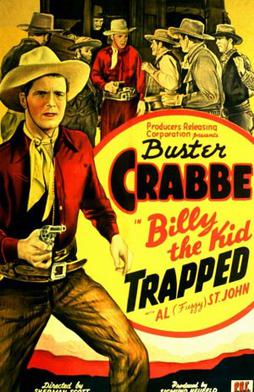
Billy The Kid Trapped (1942, directed by Sam Newfield)


Billy “The Kid” Bonney (Buster Crabbe) and his two buddies Fuzzy (Al St. John) and Jeff (Bud McTaggart) are just trying to mind their own business and make a living in the old west but they keep getting accused of every crime that happens.  This time, they’re sentenced to hang for a crime they didn’t commit.  Luckily, a group of strangers break Billy and his friends out of jail and send them on their way to the next town.  However, the men who broke them out of jail are soon committing crimes while disguised as Billy, Fuzzy, and Jeff!  Billy teams up with Sherriff Masters (Ted Adams) to stop the imposters, who are working for Boss Jim Stanton (Glenn Strange).

One of the joys of Poverty Row westers like this one is that they always featured the same stock company.  Al St. John was everyone’s sidekick.  Ted Adams was often a sheriff.  Glenn Strange was always the criminal mastermind pulling the strings.  Milton Kibbee was always a corrupt judge or ranch owner.  George Cheseboro, Horace B. Carpenter, Jack Curtis, and Budd Buster are amongst the very familiar faces in Billy The Kid Trapped.  It gives each film a homey feel that will be appreciated by fans of the genre.  The hero of the films often changed but the stock company always remained the same.

I like the idea behind Billy The Kid Trapped but the film still feels repetitive, even though it’s less than an hour long.  After Billy captures the men who are imitating him and his friends, a crooked judge sets the men free and the immediately go back to imitating Billy.  Billy has to capture them all over again.  No wonder Billy aged so quickly!  (Buster Crabbe was in his mid-thirties when he was playing The Kid.)  The movie does have all the usual gunfights and horse chases that people watch these movies for.  It’s comforting that, no matter what, the villain is always going to turn out to be Glenn Strange.

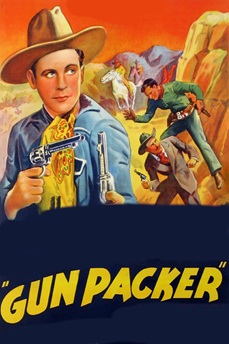
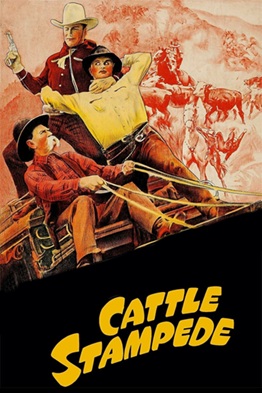
Cattle Stampede (1943, directed by Sam Newfield)


Billy the Kid (Buster Crabbe), that western do-gooder who has been framed for crimes that he didn’t commit, narrowly escapes being captured by a group of bounty hunters.  To thank the man who helped him and his sidekick, Fuzzy Q. Jones (Al  St. John), escape, Billy agrees to help the man’s family make a cattle drive.  It turns out that local ranchers are being targeted by rustlers who cause the cattle to stampede and then buy up what’s left of the herd at a discount.  Even though Mary Dawson (Frances Gladwin) doesn’t trust Billy and initially suspects him of being one of the rustlers, Billy and Fuzzy take over the cattle drive and protect the family from Coulter (Glenn Strange) and Elkins (Frank Ellis).  They even prove their worth by rescuing Mary after she’s kidnapped by the villains.

This is one of the many Poverty Row westerns to feature Billy the Kid not as an outlaw but instead as a hero.  Best-known for playing Tarzan, Flash Gordon, and Buck Rogers, Buster Crabbe was a believable hero even if he was more than a little too old to be nicknamed “the kid.”  Al St. John provides the comedic relief and veteran bad guys Charles King, Glenn Strange and Frank Ellis go through the motions as the villains, much as they did in countless other westerns of the era.  Cattle Stampede is typical of the cheap western programmers that came out of the Poverty Row studios in the 40s.  It was simplistic and predictable but featured enough western action to keep the kids in the audience entertained.  Today, its main selling point is a nostalgic one.

The Billy the Kid films are always strange because they avoid the reason why Billy is being pursued by the law and instead just present him as being another generic western hero.  It seems like a waste of a good legend.

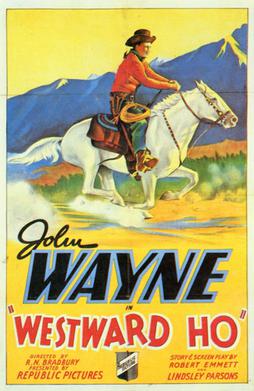
Westward Ho (1935, directed by Robert N. Bradbury)


As a young man, John Wyatt (John Wayne) witnessed an attack on a wagon train by the evil outlaw Wick Ballard (Jack Curtis).  John’s parents were killed and his younger brother Jim was abducted.  Years later, the grown John Wyatt realizes that the law cannot be depended upon in the wild west so he raises his own band of vigilantes and delivers justice to the frontier.  (Wayne’s second-in-command is played by the legendary Glenn Strange.)  Wyatt remains committed to taking down Ballard.  Going undercover as John Allen, Wyatt joins a cattle drive that he thinks will be attacked by Ballard.  Also working undercover as a member of the cattle drive is Jim Wyatt (Frank McGlynn Jr), John’s long-lost brother, who is now working for Ballard!  Both the Wyatt bothers end up falling for Mary Gordon (Sheila Bromley), the daughter of rancher Lafe Gordon (Jim Farley).

This was a good example of the the type of B-movies that John Wayne made in the years before John Ford cast him in Stagecoach.  The story is simple but Wayne gives a commanding performance as Wyatt.  Unlike many of the B-movies that featured Wayne as a callow singing cowboy or a fun-loving rogue, Westward Ho features Wayne playing the type of character that he would often play after he became a star.  Wyatt is determined to get justice for his family and to protect the innocents who are attacked by men like Ballard.  The presence of his brother in the enemy camp adds an extra dimension to Westward Ho.  Wyatt learns that vengeance isn’t everything.

It’s only 61 minutes long but it tells a good story and it has all the gunfights and horse chases that Western fans expect from their movies.  Of Wayne’s poverty row westerns, Westward Ho is one of the better ones.

Horror Film Review: The Mummy’s Tomb (dir by Harold Young)


1942’s The Mummy’s Tomb picks up 30 years after the end of The Mummy’s Hand.

Archeologist Steve Banning (Dick Foran) is now living a peaceful life in the small town of Mapleton, Massachusetts.  As the film opens, he is telling his guests about the time that he and his friend, Babe Hanson (Wallace Ford), went to Egypt and discovered the tomb of an Egyptian princess.  He tells them how Andoheb (George Zucco) tried to use the ancient mummy, Kharis, to protect the tomb.  Steve assures everyone that Andoheb is now dead and Kharis is no longer a threat to anyone.

The film then travels to Egypt where we discover that Steve was not quite correct.  Adoheb survived being shot at the end of The Mummy’s Hand.  He’s now an old man, dying but still obsessed with getting revenge.  He instructs his disciple, Mehemet Bey (Turhan Bey), to travel to America with Kharis (now played, under a bunch of bandages, by Lon Chaney, Jr.) and to get revenge on the remaining members of the Banning expedition.

Bey and Kharis travel to Massachusetts and soon, the entire town of Mapleton is gripped in fear as Kharis starts to murder people.  Steve Banning is the first victim.  Then Steve’s sister, Jane (Mary Gordon). Kharis even kills Babe Hanson, whose role in the previous film was largely comic relief.  Seriously, not even Frankenstein’s Monster killed the comic relief.  Kharis is a ruthless and unstoppable killer and, in a performance that is totally focused on his hulking physicality, Lon Chaney, Jr. makes for a frightening mummy.  Kharis moves slowly, dragging one foot behind him.  But when he does attack, he’s relentless.  This movie reminded me of why the mummy has, to me, always been the scariest of the old Universal monsters.

Despite the fact that Kharis is leaving bandages and ancient mold all over the place, the authorities are not quite convinced that an ancient mummy has come to their small town.  However, the townspeople have no doubt what’s happening and, since this is a Universal film, they are soon running around with torches and pitchforks.  Meanwhile, Steve’s son, John (John Hubbard), tries to figure out how to destroy the mummy and how to protect his fiancée, Isobel (Elyse Knox).  Bey has decided that he’s in love with Isobel and he orders Kharis to bring her to him.  Even under all the bandages, Kharis’s facial expression still suggests that he knows this isn’t a good idea.

The Mummy’s Tomb suffers from the same problem that afflicted The Mummy’s Hand.  It feels like it takes forever to actually get to the good stuff.  This is only a 60-minute film and ten of those minutes is taken up with a flashback to The Mummy’s Hand.  But no matter!  Once Kharis arrives in America, the pace of the film picks up and it becomes an effective little horror film.  Lon Chaney, Jr. is frightening Kharis.  I wouldn’t want him following me down a dark alley!

Previous Universal Horror Reviews:

  1. Dracula (1931)
  2. Dracula (Spanish Language Version) (1931)
  3. Frankenstein (1931)
  4. Island of Lost Souls (1932)
  5. The Mummy (1932)
  6. The Invisible Man (1933)
  7. The Bride of Frankenstein (1935)
  8. Dracula’s Daughter (1936)
  9. Son of Frankenstein (1939)
  10. Black Friday (1940)
  11. The Invisible Man Returns (1940)
  12. The Mummy’s Hand (1940)
  13. The Wolf Man (1941)
  14. Ghost of Frankenstein (1942)
  15. Invisible Agent (1942)
  16. Frankenstein Meets The Wolf Man (1943)
  17. Son of Dracula (1943)
  18. House of Frankenstein (1944)
  19. The Invisible Man’s Revenge (1944)
  20. House of Dracula (1945) 
  21. Creature From The Black Lagoon (1954)

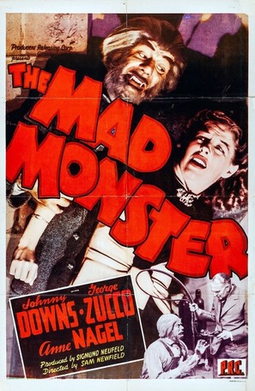
Horror On The Lens: The Mad Monster (dir by Sam Newfield)


In the 1942 film, The Mad Monster, the great George Zucco plays Dr. Cameron.  Dr. Cameron is a mad scientist who has a few issues with his colleagues and who makes the decision to deal with those issues by transforming his simple-minded handyman (Glenn Strange, who played Frankenstein’s Monster in a number of Universal films) into a wolfman.

The Mad Monster is one of the many horror films that were produced by Producers Releasing Corporation, which was one of the most poverty-stricken of the poverty row production companies.  To me, the interesting thing about the film is that Cameron initially wants to use his werewolf formula to help in the war effort.  He wants to help the United States win the war by turning soldiers into wolfmen.  It’s only after his plans are dismissed as being ludicrous that he starts using his wolfman to get revenge.  Unfortunately, the wolfman itself turns more savage and bloodthirsty with each act of revenge so I guess it’s a good thing that it wasn’t deployed on the battlefield because who knows what type of state the soldiers would have been in when they finally came home.

Here is 1942’s The Mad Monster!

Horror Film Review: House of Dracula (dir by Erle C. Kenton)


When last we saw Dracula, the Wolf Man, and Frankenstein’s Monster, they were all coming to an untimely end in House of Frankenstein.

Dracula (John Carradine) was caught out in the sun by a group of angry villagers and ended up turning back into a skeleton while desperately trying to climb into his coffin.  The Wolf Man, also known as Larry Talbot (Lon Chaney, Jr.), was shot, presumably with a silver bullet, and finally, the world was free of having to listen to Larry whine about his unfortunate condition.  The Monster (Glenn Strange) was last seen drowning in quicksand.

Despite all of that, all three of them return in 1945’s House of Dracula.  The Monster is at least found in an underground lair, preserved in a state of suspended animation by the quicksand.  Dracula and Larry Talbot, however, just show up with neither looking the worst for wear.  I supposed that Larry could have survived being shot but Dracula’s return is bizarre because he was literally exposed to sunlight.  In the past, reviving Dracula has always required the stake to be removed from his heart.  Did someone remove the sunlight from Dracula’s skeleton?

All three of the cursed beings show up at the castle of Dr. Franz Edelmann (Onslow Stevens).  Working with two nurses, the beautiful and religious Milizia (Martha O’Driscoll) and a compassionate hunchback named Nina (Janes Adams), Edlemann is researching blood transfusions.  He believes that blood transfusions can cure just about anything.  Edelmann is so convinced that he can cure Dracula of his vampirism that he allows Dracula to move his coffin into the castle’s cellar.  Edelmann is also convinced that he use the spores of a special plant to cure Larry of his lyncanthropy.  As usual, Larry Talbot is skeptical and spends the entire movie boring everyone with the details of how much it sucks to be a werewolf.  As for Frankenstein’s Monster, he’s in the castle because Edelmann happend to come across him in an underground chamber.  Quite a coincidence, that.

Unfortunately, all of the blood transfusions in the world can’t stop Dracula from being Dracula and soon, the Lord of the Vampires is trying to turn Milizia into his queen.  Larry is also in love with Milizia, to the extent that he doesn’t realize that Nina is falling in love with him.  Meanwhile, Edelman ends up infecting himself with some of Dracula’s blood and soon, his reflection is no longer showing up in mirrors and he’s feeling the temptation to revive Frankenstein’s Monster.  A violent murder upsets the villagers, who refuse to listen to Inspect Holz (Lionel Atwill) when he begs them to let the police take care of things as opposed to laying siege on the castle with a bunch of torches.  That’s what happens when you allow your house to become the House of Dracula.

House of Dracula is a clear and marked improvement on House of Frankenstein.  While Larry Talbot is just as whiny as ever (and Lon Chaney, Jr.’s sad sack performance is a bit dull) and Frankenstein’s Monster is a bit underused, John Carradine makes for a perfect Dracula, mixing old world charm with cunning cruelty.  Director Erle C. Kenton directs the film as if it were a film noir, filling the castle with ominous shadows and giving us a cast of morally conflicted characters.  Though I think most modern viewers are a bit too jaded to be truly scared by the old horror films, the scene where Edelmann watches as his reflection disappears from the mirror is effectively creepy.  I can only imagine how audiences in 1945 reacted to it.

When first released, House of Dracula was not a hit and, as a result it was one of the final “serious” films to feature the Universal monsters.  (Chaney and Strange would reprise their signature roles in a few comedies while Carradine would play Dracula in several other non-Universal productions.)  Seen today, it seems like the perfect final chapter for the monsters that, for 20 years, defined Universal.

Previous Universal Horror Reviews:

  1. Dracula (1931)
  2. Dracula (Spanish Language Version) (1931)
  3. Frankenstein (1931)
  4. Island of Lost Souls (1932)
  5. The Mummy (1932)
  6. The Invisible Man (1933)
  7. The Bride of Frankenstein (1935)
  8. Dracula’s Daughter (1936)
  9. Son of Frankenstein (1939)
  10. The Wolf Man (1941)
  11. Ghost of Frankenstein (1942)
  12. Frankenstein Meets The Wolf Man (1943)
  13. Son of Dracula (1943)
  14. House of Frankenstein (1944)
  15. Creature From The Black Lagoon (1954)

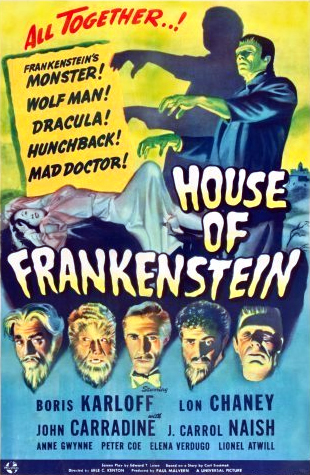
Horror Film Review: House of Frankenstein (dir by Erle C. Kenton)


House of Frankenstein opens in a prison.  Dr. Gustav Neimann (Boris Karloff), the bother of one of Baron Frankenstein’s assistants, has been convicted of robbing graves and attempting to carry on the Baron’s work.  Dr. Neimann’s faithful assistant is the hunchback, Daniel (J. Carroll Naish).  Daniel is loyal to Neimann because Neimann has promised to someday place Daniel’s brain in a stronger body.

When a sudden earthquake allows Neimann and Daniel to escape, they waste no time in getting revenge on Neimann’s enemies.  First, they murder a traveling showman named Prof. Lampini (George Zucco) and steal both his identity and his mobile horror exhibit.  Included in the exhibit is a coffin that Lampini claimed held the skeleton of Dracula.  (There’s even a stake sticking out of the skeleton’s chest.)  When Neimann returns to his original hometown, he removes the stake from the skeleton so that he might use it on the Burgomaster, Hussman (Sig Ruman).  The skeleton transforms into Dracula (John Carradine).  Because he is relieved to have been brought back to life, Dracula does not attack Neimann but instead agrees to help Neimann get revenge on Hussman in return for Neimann looking after his coffin.  Dracula soon learns that he should have thought twice before trusting either Neimann or Daniel.

Neimann moves on, stopping off at Frankenstein’s village and recovering the bodies of both Frankenstein’s Monster (Glenn Strange) and Larry Talbot (Lon Chaney, Jr.) from the frozen chamber in which they were trapped at the end of Frankenstein Meets The Wolf Man.  Revived from suspended animation, Larry immediately starts whining about how much his life sucks.  (I love The Wolf Man but subsequent films turned Larry into the whiniest of the Universal monsters.)  Neimann promises to put Larry’s brain in a new body if he helps to revive the Monster.  Larry agrees.  Meanwhile, Daniel falls in love with a gypsy girl named Ilonka (Elena Verdugo) while Ilonka falls in love with Larry.  Daniel wants Neimann to put his brain in Larry’s body, Larry won’t stop whining about the approaching full moon, and the villagers are getting suspicious!

House of Frankenstein has never been a favorite of critics or horror historians and the film does have its share of flaws.  For instance, though it would have been fun to see Bela Lugosi return to his signature role, John Carradine seems like ideal casting for Dracula.  Unfortunately, Dracula is only in the film for about ten minutes and he comes to an end that really doesn’t feel worthy of a character of his stature.  The film reduces Larry Talbot to just being a dumb lug who won’t stop feeling sorry for himself.  Finally, Glenn Strange has the right physique for the Monster but, much as with John Carradine, he is underused.

That said, I still enjoyed House of Frankenstein.  A lot of that is because of Boris Karloff, who brings a lot of sly humor to his performance as the mad scientist.  (That said, Karloff himself later said that he did the role solely for the money and was bored with the whole thing.)  J. Carroll Naish turns Daniel into a rather sympathetic henchman, one who is so desperate to be “normal” that he’s willfully blinded himself to the fact that Neiman really doesn’t care about anyone other than himself.  (In many ways, he’s the equivalent of the hapless characters that Michael Ripper later played for Hammer Films.)  Finally, Elena Verdugo brings a lot of life to the stock role of the dancing gypsy girl who falls in love with Larry Talbot despite the fact that Larry is kind of a dumb lug.

For a modern viewer, the main appeal of House of Frankenstein is that it is one of the original Universal horror films, even if it came out long after the first Dracula and Frankenstein films.  As such, it has all the things that we associate with and love about those films.  There’s a ruined castle.  There’s angry villagers.  The cast is full of Universal horror mainstays, including Lionel Atwell and Anne Gwynne.  And, yes, the film features a mob descending on the castle with torches.  Flaws and all, House of Frankenstein is an enjoyable time capsule.  It’s a horror film from a far more innocent age and it’s one that remains a fun watch.

Previous Universal Horror Reviews:

  1. Dracula (1931)
  2. Dracula (Spanish Language Version) (1931)
  3. Frankenstein (1931)
  4. Island of Lost Souls (1932)
  5. The Mummy (1932)
  6. The Invisible Man (1933)
  7. The Bride of Frankenstein (1935)
  8. Dracula’s Daughter (1936)
  9. Son of Frankenstein (1939)
  10. The Wolf Man (1941)
  11. Ghost of Frankenstein (1942)
  12. Frankenstein Meets The Wolf Man (1943)
  13. Son of Dracula (1943)
  14. Creature From The Black Lagoon (1954)

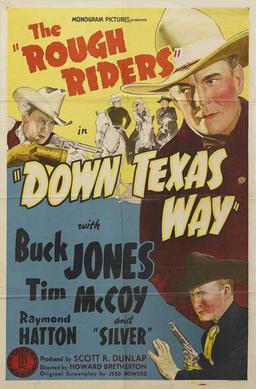
Down Texas Way (1942, directed by Howard Bretherton)


The sixth entry in the Rough Riders series finds Marshal Tim McCall (Tim McCoy) traveling from Wyoming to Texas so that he can help Sandy Hopkins (Raymond Hatton) celebrate his birthday.  When he arrives, he discovers that the birthday celebration is on hold because Sandy has been accused of murdering his best friend, John Dodge (Jack Daley).  Dodge was the richest man in town and the townspeople think that Sandy murdered him as a result of a disagreement over a card game.  What they don’t know is that Sandy and Dodge were only pretending to be mad at each other as a practical joke.

Dodge was really murdered by Bert Logan (Harry Woods), an outlaw who has hired an actress named Stella (Lois Austin) to pretend to be Dodge’s long-lost wife.  When all of Dodge’s property is given to Stella, Stella will then give it all to Dodge.  While Tim tries to keep the sheriff (Glenn Strange) from prosecuting Sandy, Marshal Buck Roberts (Buck Jones) goes undercover and infiltrates Logan’s gang.

After five previous films that just featured the Rough Riders talking about what their lives were like when they weren’t chasing outlaws, Down Texas Way shows us Sandy Hopkins’s life in Texas.  It’s about what you would expect.  Sandy likes to spend his time playing cards and hanging out in the lobby of his hotel.  It seems like an nice life, at least until Bert Logan tries to frame him for murder.  Luckily, the other Rough Riders are always there to have his back.  Down Texas Way is not one of the better Rough Riders films because Bert’s scheme never makes much sense but Hatton is relaxed and engaging and McCoy and Jones are their usual tough selves.  As with the previous film, the appeal of this Rough Riders film is the Rough Riders themselves and the way that they always stick together and have each other’s back.  That’s especially true in Down Texas Way, in which both Tim and Buck show that they’ll travel across several states if it means helping out a friend in a jam.

One final note, the town’s sheriff is named Trump, though I assume he’s no relation.  Glenn Strange, who played Sheriff Trump, would later play Frankenstein’s Monster in the last of the Universal horror movies.

Previous Rough Rider Reviews:

  1. Arizona Bound
  2. The Gunman From Bodie
  3. Forbidden Trails
  4. Below the Border
  5. Ghost Town

Western Cyclone (1943, directed by Sam Newfield)


Feeling that the old west has become a dangerous place, law-abiding gunslinger Billy the Kid (Buster Crabbe) fakes a stagecoach robbery and pretends to kidnap the governor’s daughter, all to show him that the west needs more law enforcers.  The governor is so impressed by Billy’s ruse that he agrees to stand tough on crime.  This upsets Dirk Randall (Glenn Strange, who also played Frankenstein’s monster is some of the later Universal horror films), a businessman who has been funding the criminals in order to make the governor look weak so that Randall could defeat him in the next election.

Randall orders one of his men to pull a gun on Billy while Billy is leaving the local saloon.  Billy pulls and fires his own gun in self-defense but it’s Randall who actually kills the man by shooting him in the back and then running off in the confusion.  Because the man was shot in the back, Billy is accused of murder, arrested, and sentenced to death in record time.  With Billy in jail, it falls to his comic relief sidekick, Fuzzy Jones (Al St. John), to prove that Billy didn’t actually fire the shot that killed the man.

By most accounts, Billy the Kid was a nasty piece of work who would kill anyone who look at him in the wrong way but, in the 30s, the character was the hero of a series of 42 Westerns that all featured him as a hero and a valued member of the community.  (Originally, Bob Steele played Billy.  Buster Crabbe took over the role with the seventh film.)  Western Cyclone was the 17th Billy the Kid film and, as long as you’re not a stickler for historical accuracy, it’s an entertaining B-western.  The plot is formulaic but Crabbe was a good hero, Strange was a diabolical villain, and, for once, Al St. John got to play an important role in resolving the film’s story.  Fuzzy Jones did some impressive detective work.  The real Billy the Kid probably could have used someone like Fuzzy in his corner.

Halloween Havoc!: HOUSE OF DRACULA (Universal 1945)


gary loggins's avatarcracked rear viewer

Since I’ve already reviewed HOUSE OF FRANKENSTEIN back in 2015,  we now turn our attention to HOUSE OF DRACULA, the last “official” entry in the series (though the Universal Monsters would ‘Meet Abbott & Costello’ three years later). The film tries to put a new slant on things, using science to conquer the supernatural, but winds up being just a hodgepodge of familiar horror tropes without much cohesion. HOUSE OF DRACUA does have its fans, but I’m not one of them.

John Carradine  returns as Count Dracula, introducing himself as Baron Latos to Dr. Edlemann (Onslow Stevens ) and seeking a cure for his vampirism. Edlemann discovers a “peculiar parasite” in Dracula’s blood, and believes he can cure him through a series of transfusions. But the Count, that sneaky devil, has his fangs set for Edlemann’s pretty nurse Militza (Martha O’Driscoll),  whom he hypnotizes with those hypnotic eyes of his…

View original post 466 more words