Scenes That I Love: Giovanni Lombardo Radice Dances in The House on The Edge of the Park


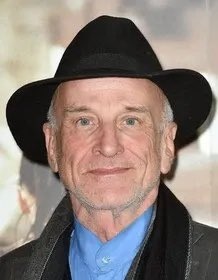
Today, the Shattered Lens celebrates what would have been the 71st birthday of the great Italian actor, Giovanni Lombardo Radice!

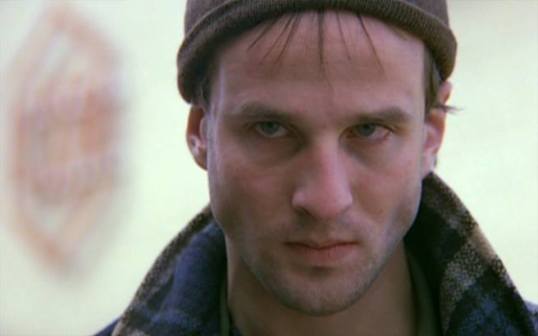
I’ve shared this scene before but I’ll happily share it again.  In Ruggero Deodato’s The House On The Edge of the Park, Giovanni Lombardo Radice shows a bunch of rich jerks how he can dance.  Dancing with Radice is his frequent co-star, Lorraine De Selle.  And, wearing the yellow suit, is David Hess.

Live Tweet Alert: Watch Cannibal Apocaylpse With #ScarySocial!


As some of our regular readers undoubtedly know, I am involved in a few weekly live tweets on twitter.  I host #FridayNightFlix every Friday, I co-host #ScarySocial on Saturday, and I am one of the five hosts of #MondayActionMovie!  Every week, we get together.  We watch a movie.  We tweet our way through it.

Tonight, for #ScarySocial, I will be hosting Cannibal Apocalypse, starring John Saxon and Giovanni Lombardo Radice!

If you want to join us on Saturday night, just hop onto twitter, start the film at 9 pm et, and use the #ScarySocial hashtag!  The film is available on Prime and Tubi!  I’ll be there co-hosting and I imagine some other members of the TSL Crew will be there as well.  It’s a friendly group and welcoming of newcomers so don’t be shy!


October “True” Crime: Bundy Reborn (a.k.a. The Inflicted) (dir by Matthan Harris)


Right now, on Tubi, you can find a film that the service says is titled Bundy Reborn.  It’s a horror film, one that centers on a medical student named David O’Hara (played by the film’s director, Matthan Harris) who turns into a serial killer.  Struggling with the trauma of having witnessed his father (Bill Moseley) murder his younger sister, David kidnaps Melissa Daniels (Lindsay Hightower) and then disappears into the night when Melissa is rescued by Inspector Lorenzo (the one and only Giovanni Lombardo Radice).  Nine months later, David comes out of hiding after Melissa gives birth to their child.  David once again kidnaps Melissa and kills several other people as well.

It’s pretty much a standard serial killer film.  Despite the title, it has little to do with Ted Bundy.  In fact, Bundy isn’t even mentioned in the film.  David, like Bundy, is a handsome serial killer who went to college.  But, whereas Bundy killed because he enjoyed it, David is trying to recreate a family that was destroyed by his equally sociopathic father.  There’s a germ of an interesting idea to be found in this film.  For all of his crimes and his evil actions, David really is just carrying on the family tradition.  Can evil be passed down genetically?  Or would David be perfectly normal if he just hasn’t witnessed his father killing his sister?  Those are legitimate questions that this film raises and then promptly seems to forget about.  The title, however, suggests that David is literally Ted Bundy in a new body and that’s simply not the case here.

Indeed, the film was originally released under a totally different title, The Inflicted.  That title worked well with this film’s portrayal of a son who inherited his murderous compulsions from his father.  David has been inflicted with the same evil that his father carries in his heart.  The Inflicted is an honest title but, at the same time, it’s not a title that’s going to grab the audience.  It’s a title that feels a bit too generic.  Bundy Reborn, on the other hand, is an acknowledgement of the fact that Ted Bundy is a particularly macabre part of the American pop cultural landscape.  As evil and worthy of hate as Ted Bundy may have been, viewers just can’t get enough of him.  Ted Bundy never had much of a chance to pursue his political ambitions but today, more people probably know who Ted Bundy was then know that Connecticut Senator Richard Blumenthal lied about serving in Vietnam.

As for the film, the plot is full of contrivances and moments that just don’t make much sense.  For horror fans, it is a chance to see several icons in one film, though most of them have extremely small roles.  That said, it’s nice to see a usually villainous actor like Sid Haig cast as a kindly psychiatrist.  Bill Moseley is properly menacing as David’s father.  Doug Bradley seems to be enjoying himself as an FBI agent.  As for Giovanni Lombardo Radice, how can you not smile when he’s onscreen?  Radice’s Italian accent may seem out of place in a film that is shot and was made in North Texas.  But Radice had an undeniable screen presence and he looked good wearing a trenchcoat and holding a gun.  He simply was Lorenzo.

On a persona note, this film was shot in my part of the world.  Several scenes were shot in my hometown.  Several other scenes were filmed in the town where I went to college.  When Inspector Lorenzo gets a call about David’s activities, I immediately yelled, “Oh my God, he’s at the Shops at Legacy!”  Later, my heart ached when I saw that the hospital that Melissa was taken to was the same hospital that my father was taken to immediately after his car accident back in May.  I recognized almost every location in the film as some place that I had been personally and that was definitely kind of exciting.

Finally, let’s all just be happy that Bundy has not been reborn but instead was apparently cremated and dumped out over some anonymous swimming pool somewhere.


The TSL Horror Grindhouse: The Reverend (dir by Neil Jones)


At the start of 2011’s The Reverend, the Devil (Rutger Hauer) pulls up in front of a luxurious hotel.  He gets out of his limo, enters the hotel, and finds God (Giovanni Lombardo Radice) sitting at his desk, surrounded by armed priests.

God asks the Devil what he’s been doing.  The Devil says he’s been traveling the world and tempting men to do evil.  The Devil says that he wants permission to ruin the life of one man who is virtuous and God-fearing, saying that the man will reject his faith as things get worse and worse.  God agrees, as long as the man is not killed….

Does this sound familiar?  Yep, this is yet another adaptation of the Book of Job.  Or, I should say, this film pretends to be an adaptation of the Book of Job.  The nameless Reverend (Stuart Brennan) is a God-fearing man whose life goes downhill after he’s bitten by a vampire.  That said, there’s really not much of a comparison to be made between the Reverend and Job.  Job lost everything, including his land and his family and the majority of his friends.  The Reverend doesn’t really have any friends to lose and he actually gets better at his job after he is turned into a vampire and proceeds to take out his village’s criminal element.

In fact, the entire prologue between God and the Devil feels as if it was tacked on at the last minute.  It really doesn’t connect to the rest of the film and we certainly don’t learn whether it was God or the Devil who won the bet.  Hauer and Radice only appear in that one scene and then they are never heard from again.  That’s a shame because, to be honest, the only reason I watched this movie was for the chance to see Hauer and Radice together.  They were both incredible character actors and tragically, both of them are no longer with us.  Hauer passed away in 2019 and Radice died last year.  Neither one of them looks particularly healthy in the prologue, though it is nice to see the two of them sharing the screen together, albeit for just a few minutes.

As for the rest of the film, it did have potential.  There’s a lot of blood spilled and that’s always a plus when it comes to a vampire movie.  Doug Bradley gives a good performance as the Reverend’s enigmatic superior.  Stuart Brannen is himself likable enough as the Reverend and the scene where he’s first bitten has a kinetic energy to it that briefly gave me some hope for the rest of the film.

Unfortunately, with the exception of the aforementioned scenes, The Reverend is a rather slow movie and one that never succeeds in building up any sort of narrative momentum.  (I guess that’s a polite way of saying that it’s kind of boring.)  As a character, The Reverend is likable but he’s never compelling and the film ends on a rather anticlimactic note.  The film had potential but sadly, most of it went unrealized.

Horror Scenes I Love: Giovanni Lombardo Radice in The House At The Edge of the Park


I miss Giovanni Lombardo Radice.

The Italian writer/actor passed away earlier this year, on April 23rd.  He is missed, both for his wit and charm and for his talent.  He was great storyteller and always had the best anecdotes to share about the films in which he appeared, even though he himself often expressed amazement that people were still watching his movies.  Giovanni Lombardo Radice was an artist and a gentleman.

I’ve shared this scene before but I’m going to share it again because it’s Giovanni at his best.  Giovanni, incidentally, is dancing with his frequent co-star and friend, Lorraine de Selle.

From 1981’s The House On The Edge of the Park:

We Have Lost Giovanni Lombardo Radice


I am broken-hearted to learn that the Italian horror icon, Giovanni Lombardo Radice, has passed away.  RIP, Johnny.  He was a good actor, a fascinating intellect, and a witty conversationalist, one who was always willing to take the time to talk to his fans.  I once wrote about a dream that I had after watching one of the films in which he appeared.  (I think it was Cannibal Apocalypse, if just because the DVD included a lengthy interview with him in which he made quite an impression as a well-read and well-spoken actor who just happened to appear in very graphic horror films.)  I was having to look after two hyperactive children who, in the dream, were apparently his kids.  (Before anyone reads too much into the dream, I was not the mother.  I was just the babysitter.)  He replied, “Perhaps actors in monster movies have monster children.”  He also loved animals, followed politics, translated Shakespeare, spoke glowingly of Fulci and Deodato, and never hesitated to talk about how much he hated Cannibal Ferox.  I always hoped that he would one day get the comeback he deserved.  He had a small role in Gangs of New York and a slightly bigger one in The Omen remake.  Tarantino raved about him.  A true gentleman, he will be missed by all.

For once last time, here is Giovanni Lombardo Radice dancing with Lorraine De Selle in The House on The Edge of the Park.

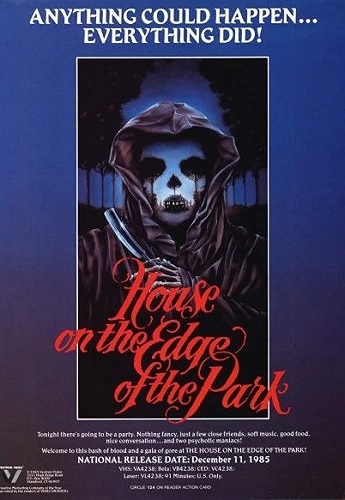
International Horror Film: House On The Edge of the Park (dir by Ruggero Deodato)


Or is it House Of The Park On Edge?

When this Italian thriller was first released in the United States in 1980, the film’s title was mistranslated by whoever put together the film’s American trailer.  In Italy, it was known as La casa sperduta nel parco.  When it was released in the United States, it was meant to be known as The House On The Edge of the Park but the trailer famously referred to it as being….
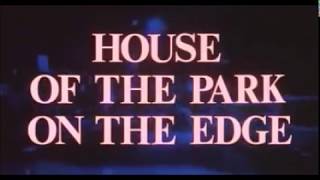
That the trailer was sent out with the title incorrectly translated tells you a lot about the American grindhouse film scene.  If a similar mistake had been made a with a big studio production, someone would have lost their job and a lot of money would be spent to put together a new trailer.  In the world of the grindhouse, it was probably understood that people would come to the film regardless of whether they even knew what the title was.  According to the book Sleazoid Express, House on The Edge of the Park was very popular in the grindhouse theaters of New York’s 42nd Street, where audiences loved the violence, the nudity, and the misogynistic dialogue.
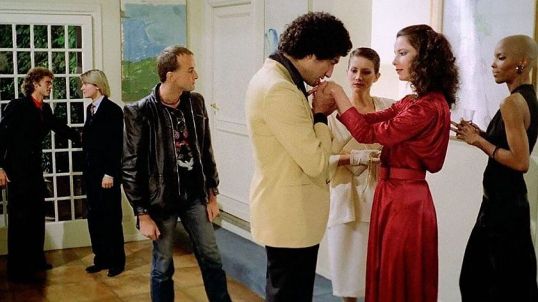
Today, House on the Edge of the Park is remembered for being the film that brought together Ruggero Deodato, David Hess, Giovanni Lombardo Radice, Christian Borromeo, Annie Belle, and Lorraine De Selle.  (The Anchor Bay DVD release featured interviews with Deodato, Hess, and Radice.  Radice and Deodato seemed a bit surprised and, at times, horrified that the film still had fans.  Hess seemed considerably less shocked.)  House on the Edge of the Park was the film that Deodato made after the subversive and satirical Cannibal Holocaust.  Though House on the Edge of the Park retains a subversive edge, it’s a much more straight forward movie than Cannibal Holocaust.  No one has ever mistaken House on the Edge of the Park for a documentary.
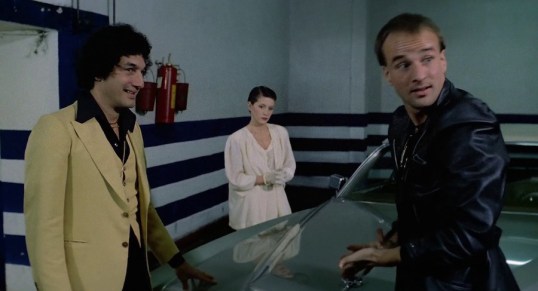
David Hess, who may have written songs for Elvis and Pat Boone but who is destined to always be remembered for his performance as Krug in Last House On The Left, plays Alex.  Alex owns a New York City garage.  Alex owns a canary yellow suit.  Alex likes to dance.  Alex is also a serial killer who, when we first see him, is forcing a woman (played by Hess’s wife, who is credited as Karoline Mardek), off the road so that he can assault and murder her.  As the film begins, Alex and his sidekick, Ricky (Giovanni Lombardo Radice, appearing in one of his first films and stealing the show with his demented energy) are getting ready to go “boogie.”  Two rich kids, Tom (Christian Borromeo, my blonde Italian horror crush) and Lisa (Annie Belle), pull into the garage.  Ricky fixes their car.  Tom and Lisa, whose white dress is to die for, are insistent that Alex accompany them to a party at a house …. a house on the edge of the park!
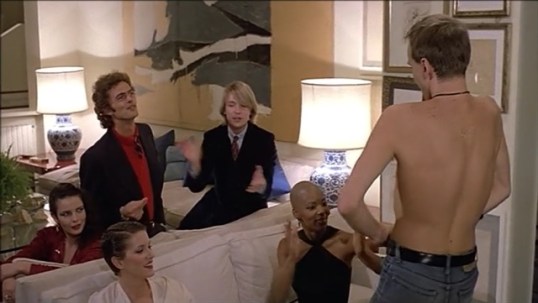
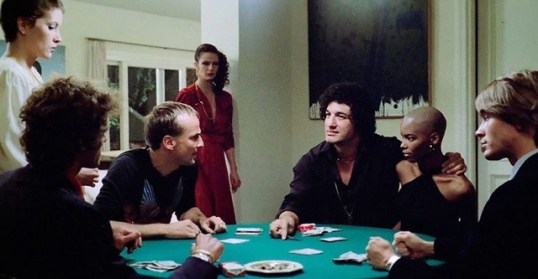
Already at the house are Gloria (Lorraine De Selle), whose red dress is to die for, and Howard (Gabriele Di Giulio), who is apparently Gloria’s boyfriend.  Also waiting at the house is Glenda (Maria Claude Joseph), who appears to just be hanging out because she has nothing better to do.  (There’s a lot of talk about boredom and ennui, amongst the rich young people of House on the Edge of the Park.)  When Tom and Lisa show up with Alex and Ricky, a very familiar class dynamic plays out.  Alex and Ricky are very blue collar.  Alex is earthy and says whatever pops into his head.  Ricky is dependent on Alex to tell him what to do and is also too slow to realize that the rich people are talking down to him.  Ricky is taunted into dancing and then into playing poker.  Ricky loses his money.  Alex discovers that the game is fixed.  Violence follows, with Alex holding the house hostage with the help of the increasingly conflicted Ricky.
Of course, it turns out that there’s a twist and that it wasn’t just coincidence that led to Tom and Lisa pulling into Alex’s garage.  Of course, the twist itself never really makes sense.  The entire film centers around Tom finding time to retrieve something from his office.  It takes him forever to do it because Alex keeps watching him and beating him up.  But there’s actually several moments in the film in which Alex is distracted and he even leaves Tom alone at one point.  You have to wonder just what exactly Tom was doing during all that time.

It’s a deeply misogynistic film, one that features an inexcusable scene in which Gloria and Ricky have consensual sex just a few minutes after Ricky tries to rape her.  (Even if you can see beyond the idea of the sophisticated Gloria falling for a rapist, who stops to have sex while there’s a madman threatening to murder all of your friends?)  Before the party turns violent, Lisa flirts with Alex and, at one point, even showers in front of him.  Her actions make even less sense once it is revealed that Tom and Lisa always knew who Alex was and what he was capable of.  Indeed, the film is sometimes so offensive that it feels almost like a parody of an offensive film.
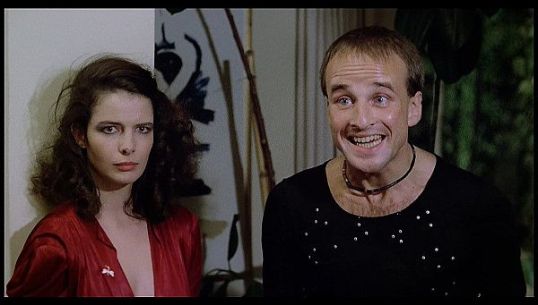
And yet, there are things to appreciate about the film.  Deodato plays up the class warfare aspect of the story, with Tom and his friends initially condescending to Alex and Ricky, just to discover how little power they actually had once Alex got the upper hand.  Giovanni Lombardo Radice, Lorraine De Selle, Annie Belle, and Christian Borromeo all give good performances, even when their characters are required to do things that don’t make any sense.  David Hess is a force of malevolent nature as Alex.  The house is lovely and I especially liked the pool, though I would suggest changing out the water before taking a swim.  The location shots of late 70s New York are interesting to look at, especially if you’re a history nerd like me.  Riz Ortolani’s soundtrack will get stuck in your head.  I defy you to watch this film and not end up singing that “Do It To Me Once More” song.
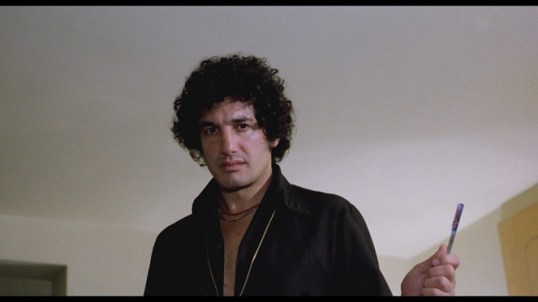
In the end, House on the Edge of the Park is not a film that I can really recommend, unless you’re a fan or a student of Italian horror.  In that case, you have to watch the film, if just because of the familiar faces in the cast and the fact that it was directed by Deodato.  Still, if anyone ever told me that this was their favorite film, I would probably immediately start eyeing the exit.  Towards the end of the movie, Gloria says that there has been enough violence and I agreed with her.  That said, violence against Alex is totally acceptable.
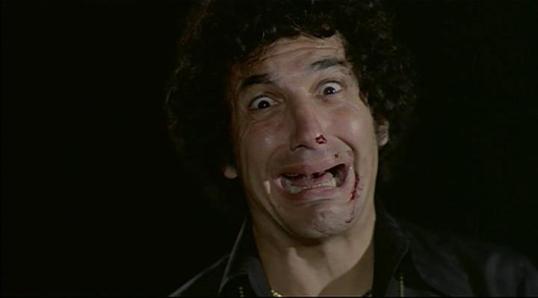
The film itself is destined to live forever as an internet meme, as a GIF of David Hess screaming in slow motion has recently become quite popular on Twitter.  There’s just no escaping the House of the Park on the Edge!
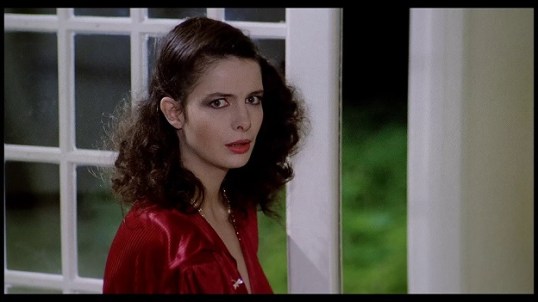
Scenes That I Love: Giovanni Lombardo Radice Dances in The House on The Edge of the Park


Today, the Shattered Lens wishes a happy 68th birthday to the great Italian actor, Giovanni Lombardo Radice!

I’ve shared this scene before but I’ll happily share it again.  In Ruggero Deodato’s The House On The Edge of the Park, Giovanni Lombardo Radice shows a bunch of rich jerks how he can dance.  Dancing with Radice is his frequent co-star, Lorraine De Selle.  And, wearing the yellow suit, is David Hess.

6 Actors Who Will Soon Hopefully Win Their First Oscar


Remember how, an hour ago, I listed 6 actresses who I hope will soon get the role for which they’ll win their first Oscar?

Well, now it’s time to look at 6 actors for whom I have the same hope.  Some of the actors listed below have been nominated in the past.  Some of them have not.  Some of them will probably win an Oscar at some point in their career.  And some of them, sadly, probably will not.

However, what all six of them have in common is that all six of them deserve at least one more opportunity to take home a gold statuette.

Ethan Hawke

I’m still stunned by the fact that Ethan Hawke wasn’t, at the very least, nominated for his performance in First Reformed.  It was certainly one of the best performance of the year and probably one of the best of his career.  Ethan Hawke has been nominated a total of four times (twice for supporting actor and twice for adapted screenplay) but has yet to win.  Hopefully, that will someday change for both him and his frequent director, Richard Linklater.

Jake Gyllenhaal

How the Hell was Jake Gyllenhaal not nominated for Nightcrawler?  Ever since Donnie Darko, Gyllenhaal has been one of the most enjoyably unpredictable actors around.  He’s even managed to become a star even though it’s obvious that the mainstream film industry has no idea what to do with his eccentric persona.  While Gyllenhaal can occasionally be miscast (as evidenced by films like Demolition and Love and Other Drugs), both Nightcrawler and Stronger showed just how special an actor Gyllenhaal can be.

Ryan Renolds

The next time you find yourself enjoying an R-rated comic book movie that features nudity, profanity, and grotesque ultra-violence, you better take a few minutes to thank Ryan Reynolds.  Reynolds will probably never win an Oscar for playing Deadpool but just imagine the acceptance speech he would give if he did.

Hugh Jackman

Amazingly, the multi-talented Hugh Jackman has only one nomination, for his performance in Les Miserables.  He probably deserved a nomination for his performance in Logan, though that film has the misfortune to be released before Black Panther legitimized the idea of a comic book film as a genuine Oscar contender.  Jackman seems like he’s destined to win an Oscar someday.  Hopefully, in the future, he’ll chose better films than The Front Runner.

Kyle Chandler

Despite appearing in several best picture nominees and giving an award-worthy performance in The Spectacular Now, Kyle Chandler has never received an Oscar nomination.  It’s hard not to feel that the right role is somewhere out there, waiting for him.  Someday, someone will write the perfect script about a small-town sheriff solving the biggest case of his career and the next thing you know, Kyle Chandler will be accepting his first Oscar.

Giovanni Lombardo Radice

Someday, someone is going to write a great role for the greatest living Italian horror actor, Giovanni Lombardo Radice.

Book Review: Eaten Alive, edited by Jay Slater


If you were to ask me to recommend one book to someone who is looking for an introduction to the world of Italian horror, Eaten Alive is the book that I would recommend.

That’s largely because this book was my introduction.  Way back in 2006, I came across a copy at Recycled Books in Denton, Texas and I bought it.  I bought it because, at the time, I was already into horror movies.  However, after reading the reviews and the essays in this book, I discovered that I wanted to learn much more about Italian horror.  Outside of Suspiria and a few giallos like Blade in The Dark, the first Italian horror movies that I specifically tracked down and watched were the movies that I read about in this book.  If not for Eaten Alive, I would never have seen the wonderfully macabre and disturbing Beyond the Darkness.  This was book was also my first real exposure to Lucio Fulci.  If not for this book, I never would have seen Zombi 2.  I never would have discovered the Beyond trilogy.

In fact, considering that Arleigh and I first bonded over Italian horror, it’s doubtful that I would be writing for this site if I had not made that decision to buy Eaten Alive.

As for the book itself, it’s a comprehensive overview of Italian cannibal and zombie cinema.  Along with containing information about every Italian cannibal and zombie film released in the 20th Century, it also features interviews with stars like Ian McCullough, Catriona MacColl, and GIovanni Lombardo Radice.  (Radice even reviews one of the films himself.)  The majority of the films are reviewed by Jay Slater but there are also contributions from writers like Ramsey Campbell and Lloyd Kaufman.  (In fact, Kaufman writes a rather stirring defense of one of the more controversial films to be found in Eaten Alive, Cannibal Holocaust.  Campbell, meanwhile, thoroughly destroys Nights of Terror.)

Seriously, if you’re interested in learning more about Italian horror or if you’re already a fan, this book is a must!