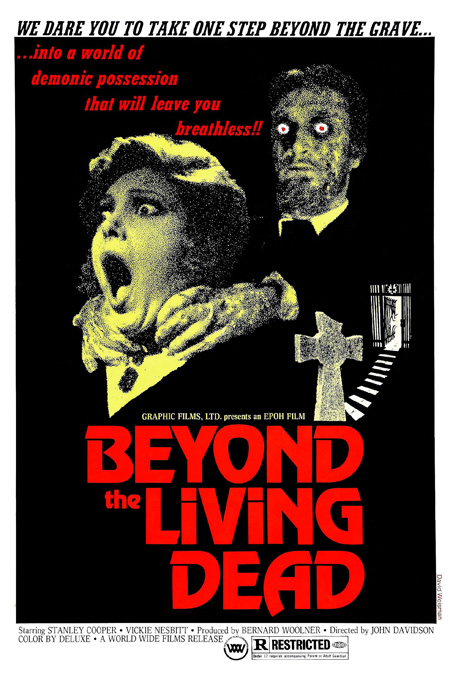
First released in 1973 and also known as The Hanging Woman, Beyond The Living Dead is a Spanish horror film that is just incoherent enough to be intriguing.
Having inherited the estate of his uncle, Serge Chekhov (Stelvio Rosi) arrives in the town of Skopje and is stunned to discover that, even though it’s only 6:00 in the evening, there’s no one in the streets. Everyone has retired to their homes. Even after Serge stumbles across a woman hanging in the cemetery, no one is willing to open their doors when he pounds on them. Serge finally finds his uncle’s place, where he discovers that the hanging woman was the daughter of his uncle’s widow, Countess Nadia Minalji (Maria Pia Conte). While Serge speaks to the police (who seem to view Serge as being the most likely suspect), Nadia retreats to her room, performs a black magic ceremony, and sends out a mental summons to Igor (Spanish horror great Paul Nashcy), a gravedigger who is also a necrophile and who has a huge collection of photographs of naked corpses in his shack.
Once Serge is finally able to convince the police that he’s not a murderer, he helps them when they chase Igor around the village. Later, Serge returns home and is promptly seduced by Nadia. The next morning, Nadia’s servant, Doris (Dyanik Zurakowska), begs Serge not to fire her and her father, Prof. Droila (Gerard Tischy). It turns out that Prof. Droila has a laboratory in the house’s basement where he’s been doing experiment on how to reanimate the dead. Serge has Doris undress for him and then, once she’s crying, he tells her that he already talked to the professor and agreed to allow him and his daughter to remain. WHAT THE HELL, SERGE!?
Got all that? I hope so because the film only gets stranger from there, with multiple murders occurring and Serge falling in love with Doris just as quickly as he fell in love with Nadia. As Igor stumbles around the village and peeps through people’s windows, Nadia holds a séance and eventually, a few decaying zombies show up. The plot is nearly impossible to follow, which is actually something that I tend to find to be true with a lot of Spanish horror films that were released during the Franco era. Making movies full of murder and nudity under a puritanical regime leads to a certain narrative incoherence. That said, the film plays out at such a strange pace and contains so many bizarre red herrings that it does achieve the feel of a particularly vivid dream.
Today, Beyond The Living Dead is best-remembered for Paul Naschy’s memorably weird performance as Igor. Naschy originally turned down the role, thinking that it was too small. The director allowed Naschy to rewrite the script to make Igor more interesting and it was Naschy who came up with the idea of making Igor not just a grave robber but also a necrophile. For English-speaking audiences, it can be hard for us to judge Naschy as an actor because we usually only see him in poorly dubbed films. (The English-language version of Beyond The Living Dead was apparently dubbed by a group of cockney voice actors.) But Naschy definitely had an imposing physical presence and this film makes good use of it.
Full of atmospheric visuals and surprisingly effective gore effects, Beyond The Living Dead does capture the viewer’s imagination, as long as one is content to not worry too much about trying to make much sense of it!
This 1982 Spanish-produced slasher film was advertised, at least in the United States, with the brilliant tag line: “You don’t have to go to Texas for a chainsaw massacre.” And indeed, Pieces takes place in Boston, Massachusetts. And yet, it’s a Boston that has little relation to the Boston of the real world. (Some of that may be because, while a few scenes were filmed in Boston, the majority of the film was shot in Spain.) Indeed, one can argue that Pieces takes place in an alternate reality, one that was created with bits of giallo suspense, slasher gore, and scenes randomly borrowed from every other exploitation film ever made.
In the 1950s, a little boy wears a bowtie and plays with a pornographic jigsaw puzzle. His mother takes the puzzle away from him, which he doesn’t appreciate at all. It leads, as things usually do, to an axe murder.
In the 1980s, a college student tries to roller skate down a sidewalk, just to suddenly lose control. As she helplessly rolls down the street, two workman carrying a sheet of glass just happen to step out in front of her. Pieces of blood-stained glass fly everywhere. As is typical of Pieces, this actually has nothing to do with the larger plot of the film. We never learn the girl’s name. We never hear learn if she survived nor do we hear much else about the accident. Instead, it’s just a random incident, tossed in to illustrate that the world is going mad.
On campus, a chainsaw killer is killing students and teachers. He’s the boy with the bowtie, all grown up. He takes body parts home with him so that he can stitch them together, recreating the jigsaw puzzle that was stolen from him years before. Oddly enough, he never makes much of an effort to hide his chainsaw. He casually gets on an elevator with one of his victims. She notices that he’s carrying a chainsaw but she doesn’t say anything about it until he actually turns it on.
Dean Foley (played by Eurohorror veteran Edmund Purdom) is upset that students keep getting dismembered on campus, as well he should be. Lt. Bracken (Christopher George, barking out his lines with the same annoyed energy that he brought to Graduation Day) is also upset because he’s supposed to arrest criminals and stuff. Unfortunately, all of Bracken’s cops are incredibly incompetent. Bracken is forced to rely on the help of Kendall James (Ian Sera). Despite being kind of scrawny and unappealing, Kendall is the most popular student on campus. Kendall also knows every victim and discovers the majority of them. You would think that Kendall would be the obvious suspect but instead, Kendall somehow ends up directing the entire investigation. Kendall’s not a cop but he’s soon ordering around the veteran detectives and everyone’s okay with that. (One detective even mentions that Kendall might as well be a part of the force.)
Lt. Backen decides that the best way to solve the case is to send in Mary Riggs (Linda Day George), who is not only an undercover cop but also a top-ranked tennis player! There’s a lot of tennis in Pieces, as Mary works on her game in between working with Kendall to solve the murders. Kendall and Mary aren’t very effective though. After discovering that one victim was chopped in half in the showers while Kendall and Mary were trying to find the source of some loud marching band music, Mary lets the killer know exactly what she thinks of him.
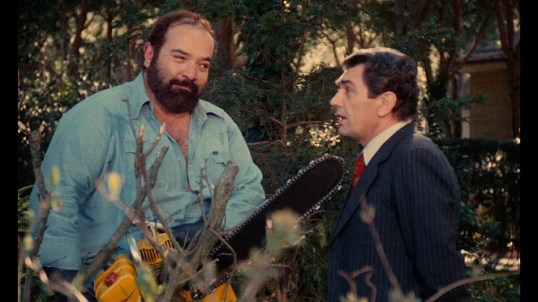
But who is the killer? Because Pieces was as inspired by the giallo genre as the slasher genre, there are several suspects. Kendall seems like the obvious one but, for whatever reason, no one makes that connection. Instead, we’re left to wonder if maybe it could be the Dean. Or how about Prof. Brown (Jack Taylor), the somewhat odd professor who seems to be a bit repressed? Or maybe it’s the handyman, Willard (Paul L. Smith)? Willard is creepy and he works with a chainsaw! There are a lot of suspects and helpfully, after a murder at the pool, every single one of them shows up at the scene of the crime. At one point, they all even gather in the same corner and look straight at the camera. You half expect Kendall to announce, “Well, I can’t possibly solve this one! Can you?”
But that’s not all! When Kendall and Mary aren’t solving murders, they’re having to deal with all of the other weird things that happen on campus. At one point, Mary is randomly attacked by the school’s karate instructor. After Kendall shows up and explains who the man in, they all laugh it off as being the result of “bad chop suey.” Later, Kendall walks Mary back to her place and, after she rejects his attempts at romance, Kendall turns around to be confronted by another student who taunts him by yelling, “Casanova!” Meanwhile, other students are still walking around campus in the middle of the night and making plans to meet up in a room that contain the height of campus luxury, a waterbed!
(Yes, a murder does occur on the waterbed. Yes, water goes everywhere. It’s Chekhov’s waterbed. You can’t introduce it without including a scene where it gets punctured.)
Many things happen, none of which make sense. The entire film is so over-the-top in its combination of gore, overacting, and general absurdity that it becomes strangely fascinating. From today’s perspective, it’s easy to imagine that the film was actually meant to be a parody but director J. Piquer Simon has said that it was meant to be viewed as a serious thriller, regardless of how the film was subsequently advertised in the United States. Even the film’s ending, in which someone who is not the killer is randomly castrated just because, was meant to be taken seriously. Every weird moment was included to give the audience what they wanted. Audiences loved Bruce Lee so, of course, a random karate fight was tossed in. People love chainsaws so, of course …. well, you get the idea.
On the one hand, Pieces is a really heavy-handed and mean-spirited film, one in which the victims are almost exclusively women and where sex and violence are too often connected. Mary may be an absurd character but you’re happy when she shows up because she’s the one woman in the film not presented as being a passive victim. On the other hand, Pieces is just so over-the-top and absurd that it’s hard not to watch the film all the way through. Perhaps the only thing that keeps the film from being incredibly offensive is that, regardless of what the director has claimed, it is so obviously not meant to be taking place in the real world. When that plate glass was shattered, it obviously opened a vortex that sucked the campus into a world where every slasher and giallo trope has been adapted to the point of absurdity. This is one of those films that just gets more and more strange with each passing minute. You watch it and you find yourself continually thinking, “This movie can’t get any weirder” and then it manages to do just that. Watching the movie is like stepping through a portal into some sort of strange alternate reality. Just try to look away.
The 1961 film, King of Kings, was the final biblical film that I watched on Easter. Like The Greatest Story Ever Told, it tells the story of Jesus from the Nativity to the Ascension. Like The Greatest Story Ever Told, it’s an epic film that was directed by a renowned director. (In this case, Nicholas Ray.) Like The Greatest Story Ever Told, King of Kings also has a huge cast and there’s a few familiar faces to be seen, though it doesn’t really take the all-star approach that George Stevens did with his telling of the story.
Probably the biggest star in King of Kings was Jeffrey Hunter, who played Jesus. Hunter was in his 30s at the time but he still looked young enough that the film was nicknamed I Was A Teenage Jesus. (Some of that also probably had to do with the fact that Nicholas Ray was best known for directing Rebel Without A Cause.) But then again, for a man who had so many followers, Jesus was young. He hadn’t even reached his 40th birthday before he was crucified. As well, his followers were also young while his many opponents were representatives of the establishment and the old way of doing things. It makes perfect sense that Jesus should be played by a young man and Hunter gives a good performance. As opposed to so many of the other actors who have played Jesus in the movies, Jeffrey Hunter is credible as someone who could convince fishermen to throw down their nets and follow him. He’s passionate without being fanatical and serious without being grim. He’s a leader even before he performs his first miracle.
King of Kings is one of the better films that I’ve seen about the life of Jesus. While remaining respectful of its subject, it also feels alive in the way that so many other biblical films don’t. Perhaps not surprisingly, Nicholas Ray focuses on the idea of Jesus as a rebel against the establishment. Ray emphasizes the casual cruelty of the Romans and their collaborators. When John the Baptist (Robert Ryan) is arrested by Herod (Frank Thring), it’s not just so the filmmakers can have an excuse to work Salome (Brigid Bazlen) in the film. It’s also to show what will happen to anyone who dares to challenge the establishment. When Jesus visits John the Baptist in his cell, it’s a summit between two rebels who know that they’re both destined to die for the greater good. When Pilate (Hurd Hatfield) makes his appearance, he’s smug and rather complacent in his power. He’s not the quasi-sympathetic figure who appears in so many other biblical films. Instead, he’s the epitome of establishment arrogance.
As a director, Nicholas Ray keeps things simple. This isn’t Ben-Hur or The Ten Commandments. The emphasis is not on grandeur. Instead, the film is about common people trying to improve the world in which they’re living, while also preparing for the next. Jeffrey Hunter gives an excellent performance as Jesus and, all in all, this is one of the better and more relatable biblical films out there.
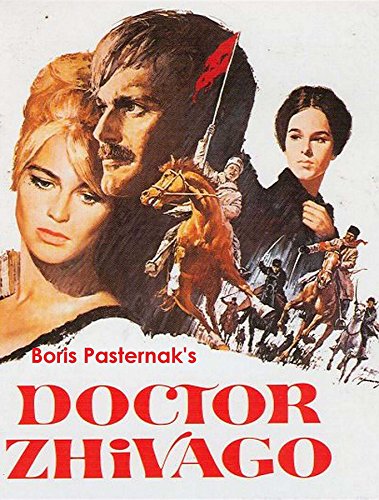
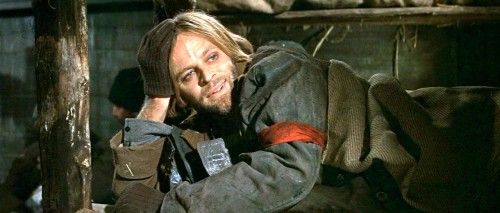
Klaus Kinski is the main reason to watch the 1965 film, Doctor Zhivago.
The legendarily difficult and erratic Mr. Kinski shows up about halfway through this 3-and-a-half hour film. He plays a cynical and unstable prisoner on a train. The train is full of passengers who are escaping from Moscow and heading for what they hope will be a better and more stable life in the Ural Mountains. (The film takes place during the Communist revolution and the subsequent purges.) That Kinski taunts everyone on the train is not a surprise. Both Werner Herzog and David Schmoeller (who directed Kinski in Crawlspace) have made documentaries in which they both talked about how difficult it was to work with Kinski and how several film crews apparently came close to murdering Klaus Kinski several times throughout his career.
Instead, what’s surprising about Kinski’s performance is that he’s even there to begin with. Doctor Zhivago is an extremely long and extremely stately film. It’s one of those films where almost every actor gives a somewhat restrained performance. It’s a film where almost every shot is tastefully composed and where the action often slows down to a crawl so that we can better appreciate the scenery. It’s a film that stops for an intermission and which opens with a lengthy musical overture. In short, this is a film of old school craftsmanship and it’s the last place you would expect to find Klaus Kinski luring about.
When he does show up, you’re happy to see him. Even though he’s only onscreen for about five minute, Kinski gives the film a jolt of much-needed energy. After hours of watching indecisive characters talk and talk and talk, Kinski pops up and basically, “Screw this, I hate everything.” And it’s exciting because it’s one of the few time that Doctor Zhivago feels unpredictable. It’s one of the few times that it feels like a living work of art instead of just a very pretty but slightly stuffy composition.
Just from reading all that, you may think that I don’t like Doctor Zhivago but that’s actually not the case. It’s a heavily flawed film and you have to be willing to make a joke or two if you’re going to try to watch the whole thing in just one sitting but it’s still an interesting throwback to a very specific time in film history. Doctor Zhivago was designed to not only be a spectacle but to also convince audiences that 1) TV was worthless and that 2) Hollywood craftsmanship was still preferable to the art films that were coming out of Europe. At a time when television and independent European cinema was viewed as being a real threat to the future of the film industry, Doctor Zhivago was a film that was meant to say, “You can’t get this on your black-and-white TV! You can only get this from Hollywood where, dammit, people still appreciate a good establishing shot and treat the production code with respect!” Even today, some of the spectacle is still impressive. The beautiful shots of the countryside are still often breath-taking. The scenes of two lovers living in an ice filled house are still incredibly lovely to look at. The musical score is still sweepingly romantic and impressive.
It’s the story where the film gets in trouble. Omar Sharif plays Yuri Zhivago, a doctor and a poet who falls in love with Lara (Julie Christie) while Russia descends into chaos. The Czar is overthown. The communists come to power and prove themselves to be just as hypocritical as the Romanovs. The revolutionary Pasha (Tom Courtenay, bearing a distracting resemblance to Roddy McDowall) is in love with Lara and helps to bring about the revolution but is then declared an enemy of the people during the subsequent purges. The craven Komarovsky (Rod Steiger) also wants to possess Lara and he’s so corrupt that he manages to thrive under both the Czar and the communists. Alec Guinness plays Yuri’s half-brother and is the most British Russian imaginable. Doctor Zhivago is based on a Russian novel so there’s a lot of characters running around and they’re all played by a distinguished cast of international thespians. However, none of them are as interesting as the scenery.
As for the two main actors, Omar Sharif and Julie Christie convince you that they’re in love but not much else. Sharif is never convincing as a poet and he feels miscast as a man who spends most of his time thinking. Reportedly, Lean’s first choice for the role was Peter O’Toole and it’s easy to imagine O’Toole in the part. But O’Toole had already done Lawrence of Arabia with Lean and didn’t feel like subjecting himself to another year of Lean’s notoriously prickly direction. So, the role went to O’Toole co-star, Sharif. Julie Christie turned down Thunderball to do both this film and Darling, for which she would subsequently win an Oscar.
(Speaking of the Oscars, Doctor Zhivago was nominated for Best Picture and, though it won five other Oscars, it lost the big prize to The Sound of Music, of all things. 1965 really wasn’t a great year for the Oscars. The only 1965 Best Picture nominee that still feels like it really deserved to be nominated is Darling. Of the other nominees, Ship of Fools is ponderous and A Thousand Clowns is almost unbearably annoying. And The Sound of Music …. well, I prefer the Carrie Underwood version.)
Doctor Zhivago is a big, long, epic film. It’s lovely to look at and it has a few nice scenes mixed in with a bunch of scenes that seem to go on forever. In the conflict between the state and the individual, it comes down firmly on the side of the individual and that’s a good thing. (The communist government attempts to suppress Yuri’s love poems because they celebrate the individual instead of society. And though the government might be able to destroy Yuri’s life, they can’t destroy his spirit. Again, it’s a message that would have worked better with a more thoughtful lead actor but still, it’s a good message.) It’s a flawed film but watch it for the spectacle. Watch it for Klaus Kinski.

 Through the Shattered Lens