Back to School Part II #18: Not My Kid (dir by Michael Tuchner)


Not_my_kid

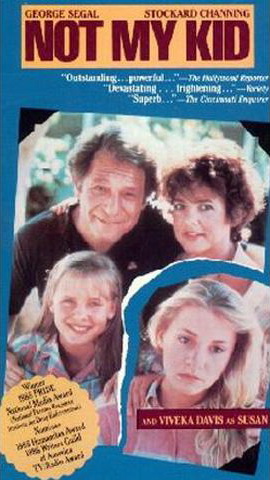
Not My Kid, a made-for-television from 1985, opens with 15 year-old Susan Bower (Viveka Davis) in a car with her friends.  They’re drunk.  They’re stoned.  They’re laughing.  And soon, they’re screaming as the driver loses control and the car ends up getting overturned!  (I’ve had that happen before.  It wasn’t fun but I survived with only a few cuts and bruises.)  Susan isn’t seriously hurt but, at the hospital, it’s discovered that she has alcohol and drugs in her bloodstream.

“NOT MY KID!” her father, surgeon Frank Bower (George Segal), declares.

“NOT MY KID!” her mother, Helen Bower (Stockard Channing, totally wasted in a thinly written role), agrees.

“Totally your kid!” her younger sister, Kelly (Christa Denton), says before then revealing where Susan hides her drugs.  This leads to Kelly getting beaten up by Susan and her drug addict boyfriend, Ricky (Tate Fuckin’ Donavon, decades before playing a hostage in Argo.).

Anyway, neither Frank nor Helen want to admit that Susan has a drug problem so instead, they go to see a smug family counselor who tells them that they are both being too hard on their daughter and that they need to just let Susan be Susan.  That sounds like a good (and easy) plan but then Susan runs away and disappears for two days.  After she’s finally found, stoned and hiding out in the family’s boat, her parents finally decide to send her to rehab.

The rehab is run by Dr. Royce.  Dr. Royce is played by Andrew Robinson and it took me a while to recognize him as being the same actor who played the Scorpio Killer in Dirty Harry.  Perhaps that explains why Dr. Royce came across as being such a creepy character.  As I watched this movie, I kept waiting for the big reveal where Dr. Royce would turn out to be a murderer or something.  That never happened, of course.  In the world of Not My Kid, the harsh and confrontational Dr. Royce is the only thing keeping the entire teenage population for shooting up heroin.

The majority of the film takes place at the rehab and it gets annoying pretty quickly.  This is one of those places where everything is done as a group activity.  Whenever someone says something, everyone in the group replies with, “We love you, so-and-so.”  When Susan doesn’t act properly ashamed of herself, the group gangs up on her.  “You’re a phony!” someone says.  “You’re full of crap!” another person adds.  “We love you, Susan,” the group chants.

AGCK!  Seriously, the rehab scenes totally freaked me out because it came across less like therapy and more like brainwashing.  I spent the entire movie waiting for Susan to escape and when she did, I was happy for her.  She may have been a self-destructive drug addict but at least wasn’t a mindless zombie like everyone else in the movie!  But then she ended up getting caught by her father and taken back to the rehab.

Meanwhile, her parents are going through therapy as well.  Again, it’s all group therapy.  When Frank tries to talk about how Susan’s behavior makes him feel, someone says, “You’re a phony!’  Another person adds, “You’re full of crap!”  And the group chants, “We love you, Frank.”  Okay, to be honest, I’m taking some dramatic license with the dialogue here but hopefully, you get the general idea.

I mean, seriously — I understand that I was supposed to be like, “Yay rehab!” while watching the movie but the rehab came across more like some sort of creepy cult.  It reminded me of both a Canadian film called, Ticket To Heaven and a Texas film called Split Image.  As I watched Not My Kid, I kept waiting for James Woods to show up as a cult deprogrammer.

Anyway, don’t worry.  Everything turns out well in the end.  This was a made-for-TV movie, after all.  Not My Kid is way too heavy-handed for its own good and it lacks a certain self-awareness.  On a more positive note, George Segal does a good job in the role of Frank.

You can watch Not My Kid below!

Embracing the Melodrama #20: Ship of Fools (dir by Stanley Kramer)


ship-of-fools-poster

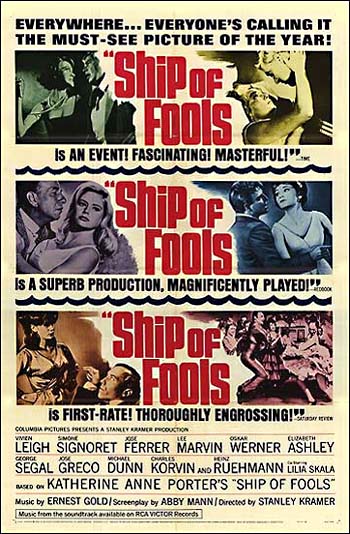
The 1965 best picture nominee Ship of Fools follows a group of passengers as they take a cruise.  The year is 1933 and the luxury liner, which has just left Mexico, is heading for Nazi Germany.  Both the passengers and the crew represent a microcosm of a world that doesn’t realize it’s on the verge of war.

There’s Carl Glocken (played by Michael Dunn), a dwarf who has the ability to break the fourth wall and talk directly to the audience about all of the fools that have found themselves on this ship.  He alone seems to understand what the future holds.

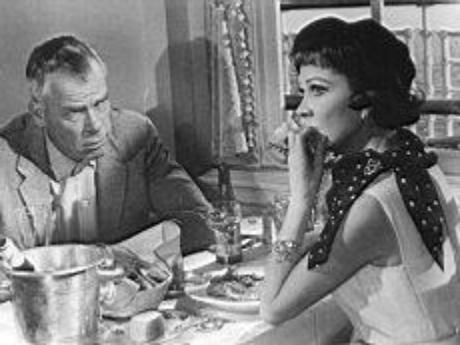
There’s Mary Treadwell (Vivien Leigh), an aging Southern belle who spends almost the entire cruise flirting with the crew and other passengers, desperate to recapture her fading youth.  That also seems to be the main goal of Bill Tenney (Lee Marvin), an unsophisticated former baseball player who spends most of the cruise brooding about his failed career.

There’s the Countess (Simone Signoret), a political prisoner who is being transported to an island prison.  She falls in love with the ship’s doctor (Oskar Werner).  The doctor’s dueling scar suggests that he is a member of the old aristocracy and he is literally the film’s only good German.  Perhaps not surprisingly, he is also in the process of dying from a heart condition.

And then there’s David (George Segal) and his girlfriend Jenny (Elizabeth Ashley).  David is a frustrated and depressed painter while Jenny is far more determined to enjoy life, which should be pretty easy because the boat is also full of performers and dancers.

Finally, there’s the buffoonish Rieber (Jose Ferrer), a German industrialist whose dinner table talk hints at the horrors that are soon to come.

Ship of Fools is a big, long film in which a large cast of stars deal with big issues in the safest way possible.  In short, it’s a Stanley Kramer film.  As one can tell from watching some of the other films that he directed (Judgment at Nuremberg, Guess Who’s Coming To Dinner, and R.P.M.), Stanley Kramer made films that were often easier to admire than to actually enjoy.  As the critic Mark Harris points out in his book Pictures At A Revolution, Kramer started out as a producer and he retained the sensibility of a producer even after he stared directing.  As such, his films would address issues that were certain to generate a lot of free publicity but, at the same time, he would never run the risk of alienating his audience by digging too deeply into those issues.  His films would have the type of all-star casts that would, again, bring in an audience but Kramer rarely seemed to give thought as to whether or not an all-star cast would distract from the film’s message.  Finally, unlike the truly great directors, Kramer never really figured out how to tell a story with images.  As a result, his movies were often full of characters whose sole purpose was to explain the film’s themes.

Does that mean that Stanley Kramer never made a good film?  No, not at all.  Judgment at Nuremberg remains powerful and R.P.M. is a guilty pleasure of mine.  Kramer was usually smart enough to work with talented professionals and, as a result, his films were rarely truly bad.  Some of them even have isolated moments of greatness.  It’s just that his films were rarely memorable and truly innovative and, therefore, they are easy for us to dismiss, especially when compared to some of the other films that were being made at the same time.

With all that in mind and for reasons both good and bad, Ship of Fools is perhaps the most Stanley-Kramerish of all the Stanley Kramer films that I’ve seen.  The film was apparently quite acclaimed and popular when it was originally released in 1965 but watched today, it’s an occasionally watchable relic of a bygone age.  How you react to Ship of Fools today will probably depend on whether or not you’re an admirer of any of the actors in large cast.  For the most part, all of them do a good job though you can tell that, as a director, Kramer struggled with how to make their multiple storylines flow naturally into an overall theme.  Not surprisingly, Vivien Leigh and Lee Marvin give the two most entertaining performances and Jose Ferrer makes for a wonderfully hissable villain.  Oddly enough, I find myself most responding to the characters played by George Segal and Elizabeth Ashley.  I’m not sure why — their storyline is rather predictable.  Maybe it was just because Elizabeth Ashley’s character goes wild and starts dancing at one point.  That’s what I would do if I found myself stuck on a boat with a tortured painted.

(What is especially interesting is that neither Oskar Werner or Simone Signoret are particularly memorable and yet they both received Oscar nominations.  Perhaps 1965 was a weak year for acting.)

In the end, Ship of Fools is a movie that will be best appreciated by those of us who enjoy watching old movies on TCM and take a special delight in spotting all of the wonderful actors that, though they may no longer be with us, have at least had their talent preserved on film.  Ship of Fools may not be a great film but it does feature Vivien Leigh doing an impromptu and joyful solo dance in a hallway and how can you not appreciate that?

ship-of-fools-1-1

A Death-Defying Quickie With Lisa Marie: Rollercoaster (dir by James Goldstone)


Recently, despite my longstanding fear of heights and my refusal to ever ride one in real life, I watched a film called Rollercoaster.  First released in 1977, Rollercoaster recently made its debut on TCM.  I was hesitant about watching it but then Robert Osborne assured me that it was an entertaining film and, seriously, who can say no to Robert Osborne?

An unnamed bomber (Timothy Bottoms) is going from amusement park to amusement park and blowing up roller coasters.  He wants money and, even more importantly, he wants the money to be delivered to him by safety inspector Harry Caulder (George Segal).  Will the FBI back off long enough for Harry to deal with the bomber?  Will the bomber ever smile?  Finally, will Harry be able to save the day while, at the same time, trying to quit smoking and bond with his daughter?

Roller Coaster is about 30 minutes too long and it’s never quite as exciting as it should be.  My mind kept wandering during the climax, which is not a good thing when the film is supposed to be a race against time.  However, at the same time, when taken on its own dated terms, Roller Coaster is a lot of fun.  Even if director James Goldstone (who also directed the far more surreal Brother John) struggles a bit with keeping the action moving at a steady pace, he still directs with a good eye for detail and gets good performances out of the majority of the film’s cast.

Since I best know George Segal for playing cantankerous father figures on about a thousand different sitcoms, it took me a few minutes to get used to the idea that he was the main character here.  While Segal does have several funny lines in Rollercoaster, he is also totally convincing and likable as the film’s hero.  Timothy Bottoms is equally convincing as the unnamed bomber.  The fact that we learn little about the bomber’s motivations or background just serve to make Bottoms’s cold performance all the more chilling.

As for the supporting cast, Henry Fonda is the biggest distraction, snarling his way through his role as Segal’s jerk of a boss.  Oddly enough, Fonda showed up in a lot of disaster films in the 70s, usually playing authority figures and usually only appearing in two or three scenes.  Whenever Henry Fonda shows up in a film like this, overacting and looking somewhat humiliated, it’s best just to close your eyes and think of 12 Angry Men and then realize that even great actors sometimes just needed a paycheck.  Richard Widmark is far more convincing, playing the stuffy FBI agent who doesn’t have much use for George Segal.  Finally, for those of you who enjoy spotting future Oscar nominees in unlikely roles, 13 year-old Helen Hunt makes her film debut here as Segal’s daughter, who just wants to ride the rollercoaster one time.

Ultimately, the best recommendation that I can give to Rollercoaster is to say that it’s a quintessentially 70s films and hence, it’s a piece of history.  Not only is the film full of 70s fashion, 70s hair, and 70s stereotypes (just check out the long-haired teenagers joking about getting high while unknowingly sitting on top of a bomb) but the film also features a performance from a band called Sparks that is so 70s that the cast of Dazed and Confused might as well have been watching them in the audience and going, “Alright, alright, alright…”

(I have to admit that I had never heard of Sparks before I saw this film.  I looked them up on Wikipedia and I discovered that not only is the band still performing but that the lead singer claims that appearing in Rollercoaster was the band’s biggest regret.  Personally, I think he’s being too hard on both the band and the film.  Sure, they seem painfully out-of-place but I dare anyone to get the borderline annoying sound of “Big Boy” out of their head.)

For those of us who were born a few decades too late to experience it firsthand, Rollercoaster is our chance to spend two hours living in the 70s.

Lisa Marie Has Returned With 6 More Trailers


 When last I posted, I was snowed in and I was still dealing with the trauma of seeing the Super Bowl half-time show.  Well, a week has passed.  The snow has melted, the half-time show has faded from memory, and I’m ready to start posting again.  And what better way to prove it than with a new edition of Lisa Marie’s Favorite Grindhouse and Exploitation Trailers?

1) The Streetfighter

Earlier today, when I was talking about which trailers I was thinking of including in this edition, Jeff asked me if I had included any Sonny Chiba trailers.  The way he asked the question seemed to indicate that it was the most important thing he had ever asked so, understandably, I was a little nervous when I answered, “N-no, I don’t think so.”

Well, apparently, that wasn’t the right answer because Jeff’s eyes just about popped out of his head and he’s lucky that he’s s0 cute because I might otherwise have taken his reaction personally.  Instead of taking offense, I’m going to start this edition off with Sonny Chiba in The Streetfighter.

2) House of Whipcord

This one is from one of the great, unacknowledged directors of British cinema, Peter Walker.  I think it’s always strange for Americans to hear grindhouse dialogue being delivered in an English accent.

3) Witchery

This is a trailer for an Italian film that is also known as “House 4,” “Witchcraft,” “Ghost House,” and “Demons 5.”  In Italy, it was promoted as a sequel to Sam Raimi’s Evil Dead 2. For all I know, they may have tried to sell this as an installment in the Zombi series as well.  I saw this film a few years ago when I was first starting to explore the world of Italian horror and oh my God, it gave me nightmares.  Seriously, don’t let the presence of David Hasselhoff fool you.  This is a disturbing movie that was produced (and some day actually directed) by the infamous Joe D’Amato.

Apparently, the trailer is disturbing as well as I tried to show it to my sister Erin earlier and she asked me stop it around the time the gentleman with the weird mouth showed up. 

4) Fighting Mad

“Even a peaceful man…can get fighting mad!”  Peter Fonda looked good playing archer.  This is an early film from Jonathan Demme who directed one of my favorite films ever, Rachel Getting Married.

5) Rollercoaster

I’m scared to death of rollercoasters so I probably won’t be seeing this film anytime soon.  Still this film has a surprisingly good cast — George Segal, Richard Widmark, Henry Fonda — for a movie about a rollercoaster.

6) Big Bad Mama

Not to be confused with Crazy Mama or Bloody Mama, Big Bad Mama features Angie Dickinson, Tom Skerritt, William Shatner, and a lot of tommy guns.  It’s not a great film but it is a lot more fun than Public Enemies.