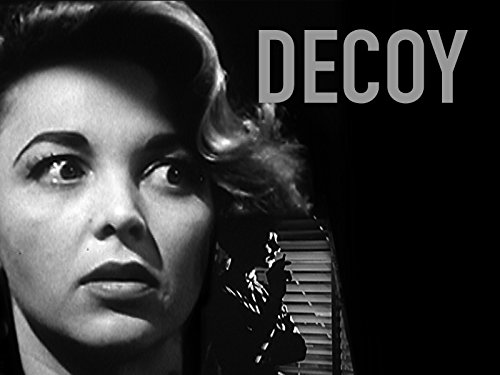
Welcome to Retro Television Reviews, a feature where we review some of our favorite and least favorite shows of the past! On Thursdays, I will be reviewing Decoy, which aired in Syndication in 1957 and 1958. The show can be viewed on Tubi!
This week, Casey investigates a case of insurance fraud.
Episode 1.4 “To Catch A Thief”
(Dir by Teddy Sills, originally aired on November 4th, 1957)
A thief and his girlfriend mug a business owner named Mr. Whitaker (John McGovern). When the police capture the thief, Mr. Whitaker claims that more money was stolen from him than was recovered. Casey is sent undercover to discover whether or not Whitaker is lying or if a cop actually skimmed the cash that they recovered.
Pretending to be the thief’s girlfriend, Casey approaches Mr. Whitaker and tries to blackmail him. When Mr. Whitaker appears to be innocent, his secretary (Mary James) falls under suspicion. Mr. Whitaker, however, is eventually exposed as trying to commit insurance fraud when he has a conversation with his secretary at the police headquarters. Unfortunately, for him, the room was bugged.
This episode bothered me. On the one hand, I didn’t want an innocent police officer to be suspended for stealing money that he didn’t steal. On the other hand, having Casey go undercover as a blackmailer felt almost as if it verging on entrapment. As well, I found it hard to understand why Mr. Whitaker would be fooled into thinking Casey was the one who had robbed him earlier. Didn’t Mr. Whitaker see the people who mugged him?
Though the Academy of Motion Picture Arts and Sciences claim that the Oscars honor the best of the year, we all know that there are always worthy films and performances that end up getting overlooked. Sometimes, it’s because the competition too fierce. Sometimes, it’s because the film itself was too controversial. Often, it’s just a case of a film’s quality not being fully recognized until years after its initial released. This series of reviews takes a look at the films and performances that should have been nominated but were, for whatever reason, overlooked. These are the Unnominated.
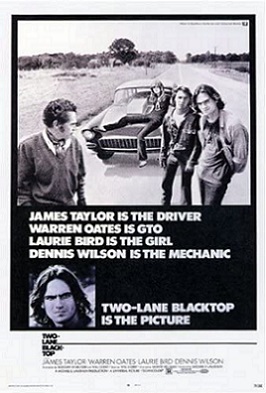
The 1971 road film, Two-Lane Blacktop, is a movie about four people whose real names are never revealed. Indeed, their names are never as important as what they’re driving.
Named after his car, GTO (Warren Oates) is a talkative man who likes to brag on himself and who picks up hitchhikers so he can talk to them. We don’t learn much about GTO’s background. For someone who talks as much as he does, GTO doesn’t reveal much about who he is when he’s not driving. It’s easy to imagine him as a salesman, traveling across the country and desperately trying to make his quota before the sun goes down. With the way that he picks up hitchhikers and his need to convince everyone of his own skill and prowess behind the wheel, it’s easy to imagine that he’s probably recently divorced and still dealing with suddenly being on his own. He seems to have something to prove, not only to everyone around him but especially to himself. One gets the feeling that the life he had suddenly collapsed and he took to the road to escape it all but he still hasn’t reached the point where he can handle truly being alone. For all of his talk, it doesn’t take long to notice that GTO isn’t quite as worldly as he claims he is.
A chance meeting leads to GTO getting into a cross-country race with The Driver (James Taylor) and the Mechanic (Dennis Wilson), two young men who are driving a 1955 Chevy and who make their money by engaging in street races. (They’re also quick to steal a license plate when no one’s looking.) The Driver and the Mechanic don’t talk a lot and, when they do, it’s in terse and somewhat awkward sentences. (Both Taylor and Wilson were musicians who made their acting debut with this film. Their natural stiffness and lack of emotion works well for their characters.) The Driver and the Mechanic seem to communicate solely through driving. They pick up The Girl (Laurie Bird) and both the Driver and the Mechanic seem to have feelings for her but it’s pretty obvious that their true love will always be for their car.
Two-Lane Blacktop is a road movie, a movie that really doesn’t have much of a plot (the cross-country race soon ceases to be a real race) but which does have some beautiful footage of America in 1971 and an outstanding performance from the great character actor, Warren Oates. EasyRider was advertised as being a film about a man who looked for America and couldn’t find it. That’s actually a better description of Two-Lane Blacktop, a film about three uniquely American men who have embraced the car culture that is at the center of life in America but who are still, more or less, lost in their home country. Oates, always talking and refusing to give up or even acknowledge the fact that he doesn’t really know much about how cars work, represents the so-called silent majority. Wilson and Taylor are the next generation, their long-hair branding them as outsiders while their skill with a car and their desire win represents what we’re told is the best of the American competitive spirit. What makes the film unsettling is the feeling that all three of them are using their cars as a way to avoid dealing with the reality of their lives.
Two-Lane Blacktop may sound a bit pretentious and it is. The metaphors get a bit heavy-handed. That said, as directed by Monte Hellman, it’s both a gorgeous travelogue and a valuable time capsule, a document of life in the late 60s and early 70s. Hellman directed the film on the road. When we see the Mechanic stealing a license plate so no one down south will know that he and the Driver are actually from California, it’s a powerful scene because it was actually filmed on location, in the South. This isn’t a film that was shot on a backlot. This is a film that was shot across America and it captures the country at a time when, much like today, no one was really sure what the future held for its politics or its culture. It may be a film about three men who are obsessed with cars but it’s also a portrait of a country in an almost directionless state of turmoil.
Two-Lane Blacktop was promoted as being the next Easy Rider but it turned out to be a notorious box office failure. James Taylor and Dennis Wilson never did another movie. Warren Oates continued as a busy character actor while Laurie Bird died of an intentional drug overdose in 1979. Director Monte Hellman’s directorial career continued but his days of being courted by the major studios were over. However, as the years passed, audiences started to discover Two-Lane Blacktop and now, it’s considered to be a cult classic.
Given its failure at the box office, Two-Lane Blacktop was ignored by the Academy. The Oscar for Best Picture went to another film that featured a memorable car chase, The French Connection. While Two-Lane Blacktop may not have deserved to win Best Picture (not over nominees like The French Connection, The Last Picture Show, Fiddler on the Roof, and A Clockwork Orange), it certainly is far more memorable movie than the fifth film nominated that year, Nicholas and Alexandra. If nothing else, Warren Oates deserved a nomination for his supporting performance. The Academy may not have embraced Two-Lane Blacktop but, fortunately, film lovers eventually would.
A young woman (Suzanne Pleshette) desperately needs a blood transfusion. Fortunately, the police have managed to track down one of the only people to share her blood type, an accountant named Harold Stern (Norman Lloyd). Harold seems like a nice, rather mild-mannered guy and he has a long history of donating blood. However, when the police approach him, Harold refuses to donate.
“What type of crumb are you!?” the police demand.
Harold explains that, whenever he gives someone blood, he develops a psychic connection with that person. He can see their future. And that’s simply a burden that he can no longer shoulder….
This episode of One Step Beyond originally aired on September 15th, 1959. Norman Lloyd, who plays Harold, got his start as a member of Orson Welles’s Mercury Theater and he also played the villain in Alfred Hitchcock’s Saboteur. (Speaking of Hitchcock, Suzanne Pleshette played the doomed school teacher in The Birds.) When Lloyd appeared in this episode of One Step Beyond, he was 44 years old. He would go on to live for another 62 years, making his final film appearance at the age of 101!
Three cowboys — Vern (Cameron Mitchell), Wes (Jack Nicholson), and Otis (Tom Filer) — are riding their horses across the old west when they come upon a cabin that is inhabited by one-eyed Blind Dick (Harry Dean Stanton) and his friends. Though they suspect that Dick may be an outlaw, the cowboys accept his offer to stay the night. The next morning, they wake up to discover that they are surrounded by a posse. Mistaken for members of Dick’s gang, Vern and Wes go on the run. Eventually, they find themselves hiding out at the home of Evan (George Mitchell), Catherine (Katherine Squire), and their daughter, Abigail (Millie Perkins). While Wes and Vern wait for their chance to escape, the posse grows closer and closer.
A minimalistic western with a fatalistic outlook, Ride In The Whirlwind is today best known for being a pre-Easy Rider credit for Jack Nicholson. Nicholson not only co-produced the film but he also wrote the script. With that in mind, it’s not surprising that Nicholson not only gets the best lines but that he also comes close to getting the girl. Of all the roles that Nicholson played before his star-making turn in Easy Rider, Wes probably comes the closest to being what would be considered to be a typical Jack Nicholson role. Wes is sarcastic, quick with a quip, and alienated by mainstream society (represented here by the relentless posse). Nicholson gives a confident performance and it is interesting to see him co-starring with some of the same actors, like Harry Dean Stanton, who would continue to be associated with him once he became a star. Though the film may be dominated by Nicholson, Stanton also makes a strong impression and comes close to stealing the whole movie.
(Also of note is an early appearance by Rupert Crosse. Years later, Crosse was set to co-star with Nicholson in The Last Detail but his early death led to Otis Young being cast in the role.)
With its dark outlook and anti-establishment theme, Ride In The Whirlwind was before its time and it struggled at the American box office. (According to Monte Hellman, it was very popular in France.) It would be another three years before American culture would catch up with Nicholson’s anti-establishment persona and Easy Rider would make him a star.
For tonight’s televised horror, we have another episode of the Boris Karloff-hosted anthology series, Thriller!
In Portrait Without A Face, an arrogant painter is murdered. No one knows who murdered him but don’t worry. Just because he’s dead, that doesn’t mean the artist has to stop painting! In fact, his first post-death painting might just be a picture of the person who killed him…
If A Man Called Peter was the epitome of a stereotypical 1950s film, The Phenix City Story is the exact opposite. Like A Man Called Peter, The Phenix City Story was released in 1955. And like A Man Called Peter, The Phenix City Story is based on a true story. However, beyond that, A Man Called Peter and The Phenix City Story might as well have been taking place on different planets.
And, in many ways, they were. The Phenix City Story not only takes place in Phenix City, Alabama but it was filmed there as well and featured a few actual citizens in the cast. Not only was The Phenix City Story telling a true story but the story was being told by some of the same people who actually lived through it. That makes The Phenix City Story brutally realistic, with brutal being the key word.
And, just in case we have any doubt about the film’s authenticity, it actually opens with a 15 minute documentary in which Clete Roberts (who was an actual news reporter) interviews several citizens of the town. All of them, speaking in thick Alabama accents and nervously eyeing the camera, assure us that what we are about to see is true. Quite a few of them also tells us that they still live in fear of losing their lives as a result of everything that happened.
What’s amazing is that, once the actual film does get started, it manages to live up to all of that build up. The Phenix City Story is a shocking film that remains powerful even 60 years after it was initially released.
As the film opens, we’re informed that Phenix City, Alabama is home to some of the most dangerous and violent criminals in the state. From his club, crime boss Rhett Tanner (Edward Andrews) runs a shadowy organization that not only controls Phenix City but the entire state of Alabama as well. The police ignore his crimes. The majority of the town’s citizens are too scared to stand up to him. When a returning veteran of the Korean War, John Patterson (Richard Kiley), tries to stand up to Tanner, the result is even more violence. A young black girl is kidnapped and murdered, her body tossed on John’s front lawn as a warning. John’s best friend is killed but Tanner uses his influence to have the death ruled accidental.
Finally, John and a group of other reformers convince John’s father — Albert Patterson (John McIntire) — to run for Attorney General. Albert runs on a reform platform and exposes both the corruption of Phenix City and how Tanner’s power extends through the rest of the state as well. When Albert wins the Democratic primary, he’s gunned down in the street and it’s up to John to avenge his death…
To say that The Phenix City Story is intense would be an understatement. As directed by Phil Karlson, there’s not a single frame of The Phenix City Story that’s not full of menace and danger. The stark black-and-white cinematography is full of shadows and the camera moves almost frantically from scene to scene, occasionally catching glimpses of dark figures committing acts of violence and cars speeding away from who knows what outage. It’s a dark film but, ultimately, it’s also a hopeful one. It suggests that evil will triumph when good men do nothing but that sometimes you can depend on good men — like Albert and John Patterson — to actually step up.
The Phenix City Story shows up on TCM occasionally and you should keep an eye out for it. It’s one of the best B-movies ever made.
Tonight’s horror on TV is an episode of The Twilight Zone that is entitled The Hitchhiker. A woman (Inger Stevens) is haunted by a mysterious hitchhiker who continually asks her if she’s “Going my way?”
It’s tempting to call this a companion piece to Carnival of Souls but actually, The Hitchhiker was first broadcast on Jan. 22, 1960, two years before the premiere of Carnival of Souls. So, it would perhaps be more appropriate to call Carnival of Souls a companion piece to the Hitchhiker.
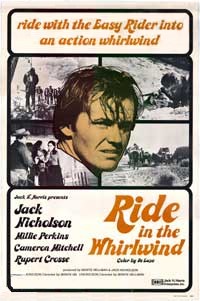 Three cowboys — Vern (Cameron Mitchell), Wes (Jack Nicholson), and Otis (Tom Filer) — are riding their horses across the old west when they come upon a cabin that is inhabited by one-eyed Blind Dick (Harry Dean Stanton) and his friends. Though they suspect that Dick may be an outlaw, the cowboys accept his offer to stay the night. The next morning, they wake up to discover that they are surrounded by a posse. Mistaken for members of Dick’s gang, Vern and Wes go on the run. Eventually, they find themselves hiding out at the home of Evan (George Mitchell), Catherine (Katherine Squire), and their daughter, Abigail (Millie Perkins). While Wes and Vern wait for their chance to escape, the posse grows closer and closer.

 Through the Shattered Lens