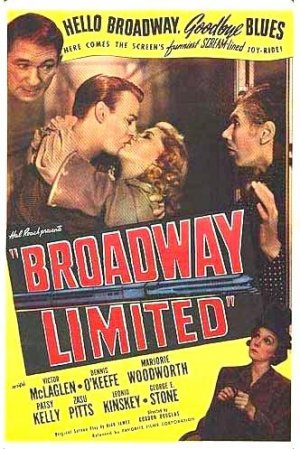
The Fabulous Forties #47: Broadway Limited (dir by Gordon Douglas)


Broadway_Limited_FilmPoster

The 47th film in Mill Creek’s Fabulous Forties box set was a 1941 comedy named Broadway Limited.

Broadway Limited tells the story of several increasingly desperate characters and a baby.  April Tremaine (Marjorie Woodworth) is a film star whose career is in danger of stagnating.  Her frequent director, the eccentric Ivan Ivanski (Leonid Litinsky), comes up with a plan to increase April’s popularity.  He starts a rumor that she has adopted a baby.  The only problem is that April has to be seen with the baby for the rumor to be believable.

Fortunately, April is going to be traveling from Chicago to New York via a train known as the Broadway Limited.  Ivan decides that April needs to be seen with the baby on the train.  April’s assistant, Patsy (Patsy Kelly), is dating the train’s engineer, Mike (Victor McLaglen).  When Patsy tells Mike about the scheme, Mike decides to help out.  He spots a mysterious man with a baby.  Mike asks if he can borrow the baby for a few minutes.  The man agrees and hands over the baby and then Mike gives the baby to April.  Everyone sees April with the baby but the mysterious man has vanished.  What Mike does not initially know but quickly comes to suspect is that the baby might be the Pierson Baby, whose kidnapping has become national news.

(As confusing as it may sound when you read about it, it’s even more confusing when you actually watch it.)

The rest of the film basically follows Patsy, Mike, Ivan, and April as they all try to get the baby to safety without running the risk of being implicated in the kidnapping.  The four of them keep trying to leave the baby in different parts of the train, where she can be discovered by someone, just to inevitably have the baby somehow end up back in their compartment.

But that’s not all!  The high-strung president of the April Tremaine fan club (played by ZaSu Pitts) is also on the train and she keeps getting in everyone’s way.  And then there’s Dr. Harvey North (Dennis O’Keefe).  Harvey was April’s childhood crush and they just happen to be on the same train!  However, Dr. North believes that, since April has a baby, she must also have a lover…

If Broadway Limited sounds like an extremely busy film … well, it is.  The film attempts to do the screwball thing, with increasingly frantic characters running from compartment to compartment and behaving in increasingly ludicrous ways.  How well it works depends on which character is appearing in which scene.  O’Keefe plays his role too seriously, Litinsky is too broad, and Woodward is never believable as a movie star (which, needless to say, is problem when you’re the star of a movie).  However, Patsy Kelly and Victor McLaglen are both hilarious as Patsy and Mike and have a lot of chemistry.  As long as the film concentrates on Patsy and Mike, it’s entertaining.

Plus, the baby’s super cute!

Broadway Limited is hardly a classic but it works well enough.
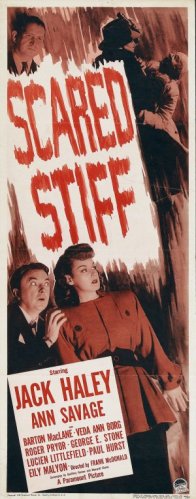
 

The Fabulous Forties #13: Scared Stiff (dir by Frank McDonald)


Poster_of_the_movie_Scared_Stiff

Last night, as a gentle rain fell outside, I watched the 13th film in Mill Creek’s Fabulous Forties box set, 1945’s Scared Stiff.  (The version in the box set appeared under the title Treasure of Fear, which was what the title was changed to when the film was later re-released.  However, the film was originally entitled Scared Stiff and that’s the title that I’m going to use.  Scared Stiff is just a better title and I happen to like the Scared Stiff film poster, featured above.  So, just remember that if you ever find yourself watching an old movie called Treasure of Fear, you’re actually watching Scared Stiff.)

As I attempted to watch Scared Stiff, I was reminded of some of the problems that occasionally come with watching a film that has slipped into the public domain.

On the one hand, the public domain is great because it makes it a lot easier to watch old movies.  And while it’s true that many public domain films aren’t exactly classics, there are a few gems to be found.  For instance, since I started watching the movies in the Fabulous Forties box set, I’ve discovered The Black Book, Trapped, and Jungle Book.

On the other hand, being in the public domain means that virtually anyone can duplicate and sell a copy of the film.  As a result, many of these films are available (and frequently viewed) in versions that are of an extremely poor quality and which have often been haphazardly edited.

That’s one reason why it’s going to be difficult for me to review Scared Stiff.  The version that I saw was, even for a public domain B-movie, rough.  The picture was slightly fuzzy and the sound quality was not the greatest.  I don’t think you can ever truly understand that importance of a clean soundtrack until you listen to a scratchy one.

As for Scared Stiff itself, it’s a comedic murder mystery and thankfully, it’s only 65 minutes long.  Jack Haley plays a reporter who covers chess tournaments for his uncle’s newspaper.  Unfortunately, Haley’s not a very good reporter so his frustrated uncle orders him to go to Grape City so that he can cover a beauty contest, apparently believing that there’s no way that Haley could possibly screw that up.

However, Haley manages to do just that.  He gets off the bus at Grape Center, instead of Grape City.  He finds himself stranded at an inn that’s run by two twins (both played by Lucien Littlefield).  The twins hate each other for reasons that aren’t clear.  However, they do possess a chess set that was once owned by Marco Polo!  One twin owns the white pieces while the other owns the black pieces!  Haley wants to buy all the pieces but things get complicated when it turns out that a gang of thieves are also in town and they want to steal the set for themselves.

But that’s not at all!  One of the passengers on the bus is found murdered and he has a chess piece in his hand.  Of course, everyone suspects Haley.  So, Haley has to get the chess pieces, clear his name, and hopefully get to Grape City before his uncle fires him.

Scared Stiff is way too frantic for its own good and I have a feeling that I would feel the same even if I had seen a version that didn’t sound scratchy or often look fuzzy.  That said, it is interesting to see Jack Haley, who is best known for being The Tin Man in The Wizard of Oz, play a human being.  Also of interest, to film noir fans, was that Haley’s girlfriend was played by Detour‘s Ann Savage.  Both Haley and Savage gave good performances but it was not enough to save this misbegotten little film.

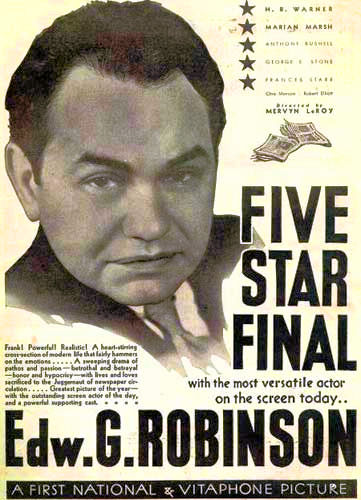
Lisa Reviews An Oscar Nominee: Five Star Final (dir by Mervyn LeRoy)


Five_Star_Final_1931_poster

In 1911, a pregnant secretary named Nancy Voorhees (Frances Starr) shot and killed her boss and lover.  It was quite a scandal at the time but, twenty years later, it has largely been forgotten.  Nancy has married a successful businessman named Michael Townsend (H.B. Warner) and is a respected member of society.  Her daughter, Jenny (Marian Marsh), has no idea about Nancy’s past and believes Michael to be her father.  Jenny is now engaged to marry the handsome and rich Phillip Weeks (Anthony Bushnell).

Everything seems to be perfect but you know what they say about perfection.

Bernard Hincliffe (Oscar Apfel) is the publisher of a struggling tabloid newspaper.  He is frustrated by city editor Joseph Randall (Edward G. Robinson) and Randall’s refusal to do whatever it takes to boost circulation.  “Why, he won’t even print pictures of women in their underwear!” one of Hincliffe’s assistants exclaims.  Finally, Hincliffe orders Randall to publish a series of articles that will take a retrospective look at both the scandal and what has happened to those involved in the years since.  At first, the cynical Randall refuses but eventually, he gives in.

He assigns two reporters to crack the story.  One of them, Kitty Carmody (Ona Munson) is first introduced showing off her legs and bragging about how there’s no way that she won’t be hired to work at the newspaper.  (By the way, if anyone ever remakes Five Star Final and needs someone to play Kitty, I am ready and available.)  The other is the incredibly creepy T. Vernon Isopod (Boris Karloff).  Isopod was a divinity student until he was arrested on a “morals charge.”  Now, he pretends to be a minister as a way to fool people into revealing their deepest secrets to him.  Kitty and Isopod dig into the life of Nancy and Michael.  The stories appear on the front page.  Suicide and melodrama follow and Randall is forced to finally take a stand.

Released in 1931, Five Star Final was nominated for best picture but lost to Grand Hotel.  Seen today, Five Star Final is undeniably stagey (it was based on a play) but it’s still a compulsively watchable melodrama, featuring good performances and a lot of memorably snappy 30s dialogue. Five Star Final is one of several films about journalism to have been nominated for best picture.  Most of these films — like All The Presidents Men, The Front Page, and this year’s front-runner, Spotlight — have featured journalists as heroic seekers of the truth.  Five Star Final, on the other hand, plays more like a pre-Code version of Network set at a newspaper.  It’s a deeply angry film and, when Randall finally tells off Hincliffe, it feels like the 30s equivalent of Peter Finch shouting that he’s mad as hell and not going to take it anymore.

Finally, the best part of the film, for me, was Boris Karloff as the sleazy Isopod.  Karloff made Five Star Final right before he played the creature in Frankenstein and it’s interesting to see him play a totally different type of monster here.  If I had to choose which character is scarier, I’m going with T. Vernon Isopod.

http://www.youtube.com/watch?v=a0qL1fs1c6k

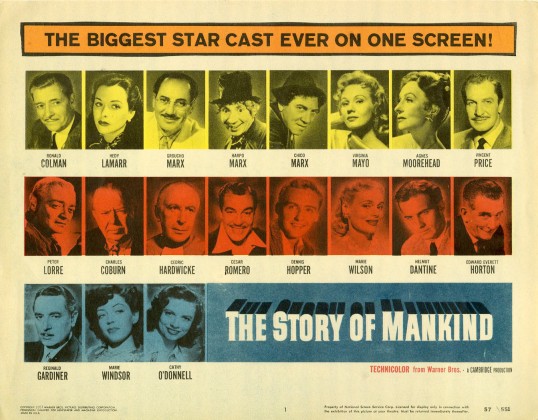
Insomnia File #1: The Story of Mankind (dir by Irwin Allen)


Story of Mankind

What’s an Insomnia File?  You know how some times you just can’t get any sleep and, at about three in the morning, you’ll find yourself watching whatever you can find on cable?  This feature is all about those insomnia-inspired discoveries!

If, last night, you were suffering from insomnia at 3 in the morning, you could have turned on TCM and watched the 1957 faux epic, The Story of Mankind.

I call The Story of Mankind a faux epic because it’s an outwardly big film that turns out to be remarkably small on closer inspection.  First off, it claims to the tell the story of Mankind but it only has a running time of 100 minutes so, as you can imagine, a lot of the story gets left out.  (I was annoyed that neither my favorite social reformer, Victoria C. Woodhull, nor my favorite president, Rutherford B. Hayes, made an appearance.)  It’s a film that follow Vincent Price and Ronald Colman as they stroll through history but it turns out that “history” is largely made up of stock footage taken from other movies.  The film’s cast is full of actors who will be familiar to lovers of classic cinema and yet, few of them really have more than a few minutes of screen time.  In fact, it only takes a little bit of research on the imdb to discover that most of the film’s cast was made up of performers who were on the verge of ending their careers.

The Story of Mankind opens with two angels noticing that mankind has apparently invented the “Super H-Bomb,” ten years ahead of schedule.  It appears that mankind is on the verge of destroying itself and soon, both Heaven and Hell will be full of new arrivals.  One of the angels exclaims that there’s already a housing shortage!

A celestial court, overseen by a stern judge (Cedric Hardwicke) is convened in outer space.  The court must decide whether to intervene and prevent mankind from destroying itself.  Speaking on behalf on humanity is the Spirit of Man.  The Spirit of Man is played by Ronald Colman.  This was Colman’s final film.  In his heyday, he was such a popular star that he was Margaret Mitchell’s first choice to play Rhett Butler in Gone With The Wind.  However, in The Story of Mankind, Colman comes across as being a bit bored with it all and you start to get worried that he might not be the best attorney that mankind could have hired.

Even more worrisome, as  far as the future of mankind is concerned, is that the prosecutor, Mr. Scratch, is being played by Vincent Price.  Making his case with his trademark theatrics and delivering every snaky line with a self-satisfied yet likable smirk on his face, Vincent Price is so much fun to watch that it was impossible not to agree with him.  Destroy mankind, Mr. Scratch?  Sure, why not?  Mankind had a good run, after all…

In order to make their cases, Mr. Scratch and the Spirit of Man take a tour through history.  Mr. Scratch reminds us of villains like the Egyptian pharaoh Khufu (John Carradine) and the Roman Emperor Nero (Peter Lorre, of course).  He shows how Joan of Arc (Hedy Lamarr) was burned at the stake.  The Spirit of Man argues that, despite all of that, man is still capable of doing good things, like inventing the printing press.

And really, the whole point of the film is to see who is playing which historical figure.  The film features a huge cast of classic film actors.  If you watch TCM on a semi-regular basis, you’ll recognize a good deal of the cast.  The fun comes from seeing who tried to give a memorable performance and who just showed up to collect a paycheck.  For instance, a very young Dennis Hopper gives a bizarre method interpretation of Napoleon and it’s one of those things that simply has to be seen.

And then the Marx Brothers show up!

They don’t share any scenes together, unfortunately.  But three of them are present!  (No, Zeppo does not make an appearance but I imagine that’s just because Jim Ameche was already cast in the role of Alexander Graham Bell.)  Chico is a monk who tells Christopher Columbus not to waste his time looking for a quicker way to reach India.  Harpo Marx is Sir Isaac Newton, who plays a harp and discovers gravity when a hundred apples smash down on his head.  And Groucho Marx plays Peter Miniut, tricking a Native American chief into selling Manhattan Island while leering at the chief’s daughter.

And the good thing about the Marx Brothers is that their presence makes a strong argument that humanity deserves another chance.  A world that produced the Marx Brothers can’t be all bad, right?

Anyway, Story of Mankind is one of those films that seems like it would be a good cure for insomnia but then you start watching it and it’s just such a weird movie that you simply have to watch it all the way to the end.  It’s not a good movie but it is flamboyantly bad and, as a result, everyone should see it at least once.


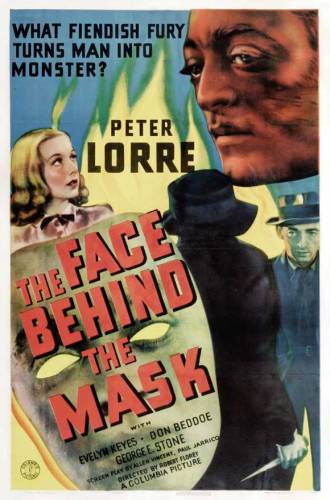
Revisiting an Old Fiend: THE FACE BEHIND THE MASK


the-face-behind-the-mask-1941-dvd-peter-lorre-evelyn-keyes-1189-p

Recently I switched from cable to DirecTV. As part of my package, I’ve officially joined the DVR generation. This is like being in heaven for an old movie buff like myself. Now I can record films of interest no matter what time they’re on and enjoy them at my leisure. Especially those older black & white gems that air mainly in the wee-wee hours. I can catch up with some classics I’ve only read about over the years but never had the opportunity to view, and those I only have vague memories of watching decades ago on snowy looking UHF channels.

THE FACE BEHIND THE MASK falls into the latter category. This 1941 Columbia film was directed by the criminally underrated Frenchman Robert Florey and stars everybody’s favorite madman Peter Lorre. The movie’s a very early example of 40s film noir, as was another Lorre vehicle, 1940’s  STRANGER ON THE THIRD FLOOR.

Lorre plays Janos Szabo, a newly arrived Hungarian immigrant watchmaker, come to America to find work and live the American dream. He’s befriended by police Lt. O’Hara (Don Beddoe), who buys the naïve newcomer a five dollar lunch and directs him to the Excelsior Palace, a low rent hotel. When another border’s negligence causes the joint to go up in flames, Janos is trapped inside, and suffers a horrible disfigurement.

O’Hara feels responsible for the poor guy’s plight and writes a message on one of his calling cards for Janos to contact him when he’s released from the hospital. Now unable to find work due to his terribly scarred visage, Janos goes to the waterfront, contemplating suicide. He meets up with a petty crook named Dinky, who takes a liking to Janos. Dinky has a safe job lined up but falls ill, and asks Janos to take his place. The Hungarian, good with his hands, takes care of business, When Dinky’s former comrades Benson and Watts show up wanting to know why they weren’t in on the score, the four decide to form a crime gang, with Janos (now nicknamed Johnny) as the ringleader. A crime wave ensues, baffling the police, and putting O’Hara under pressure to end the larcenous spree quickly as possible.

Janos wants the illicit dough so he can have plastic surgery and restore his features. A rubber mask is made from his passport photo for him to wear until the doctor returns. When the doc (an uncredited cameo by Frank Reicher, KING KONG’s Captain Englehorn)  finally does see Janos, he informs him that the facial nerves have suffered too much damage, and it would take fifteen years before any progress could be made!

Disheartened, Janos leaves the doctor’s office, where he (literally) bumps into Helen Williams. Helen is blind, but she can sense the goodness still inside the scarred master criminal. Eventually, Janos comes clean to her about his face, but not his illegal activities. Helen is played by the beautiful Evelyn Keyes, best known as Scarlet O’Hara’s Younger Sister (the name of her autobiography) in GONE WITH THE WIND.

Now in love with Helen, and with plenty of money stashed away, Janos decides to leave his life of crime behind and settle down in the country. This doesn’t sit well with his former cronies, especially Jeff, the gang’s new leader. When the cop’s calling card (remember?) is found in Janos’s old desk, they fear their former boss has turned stool pigeon. The gang beats and tortures Dinky, the only one who knows Janos’s whereabouts. Dinky spills the beans, and Jeff and company pay a visit to Janos and his new bride. While Jeff delivers a warning, the gang plants a bomb in his car, connected to the radio. Dinky gets dumped to the side of the road, badly beaten and shot, but manages to get to a phone and warn Janos. But it’s too late. While Helen’s unpacking the car, she wants to hear some music, turns on the radio, and KA-BOOM! She sadly dies in Janos’s arms.

Dinky’s still alive though, and tells Janos the gang has chartered a plane and are going on the lam. They take to the air and head west, unaware that Janos has ambushed the pilot and is flying the plane. He lands them smack in the middle of the Arizona desert and tells them he’s stranding them all there to die a slow, painful death. Soon after, O’Hara gets a hot tip (pun intended!)and flies west to discover a gruesome tableau. The gang members are all dead, including Janos, who’s been tied to the plane’s wing. O’Hara finds an explanation note in his little friend’s pocket, along with the five bucks for the lunch O’Hara bought him long ago.

Lorre is superb as a man trapped in circumstances beyond his control, showing a wider range of emotion beyond his standard pop-eyed psychopath roles. Keyes is also good as the doomed Helen, proving she could’ve been a much bigger star with better roles. FACE BEHIND THE MASK features plenty of familiar faces from the Mighty Columbia Arts Players brigade (Beddoe, George E Stone, Cy Schindell, John Tyrell, George McKay). The film’s a brisk 75 minutes of entertainment for lovers of 40s cinema in general, and Lorre in particular. The name Janos, by the way, was obviously inspired from the Roman god Janus, always depicted with two faces!

I’m glad I got to rewatch this movie and enjoy it without all that UHF snow.. I’ve got plenty more lined up in the DVR, and look forward to sharing my impressions of them with you, dear reader. So get that popcorn ready and let’s go to the show!