Nick Curran (Michael Douglas) is a San Francisco police detective who, along with his jolly partner Gus (George Dzundza), finds himself investigating the ice pick-stabbing of a rock star. The main suspect is glamorous writer Catherine Trammel (Sharon Stone), who is obviously guilty but manages to outsmart all of the men investigating her by not wearing panties during her interrogation. Nick finds himself drawn to Catherine, despite his own relationship with with psychologist Elizabeth Garner (Jeanne Tripplehorn). The more Nick digs into Catherine’s past, the more he becomes obsessed with her but also the more he suspects that she may be a serial killer. This is mostly because Catherine obviously is a serial killer and anyone should have been able to figure that out. Instead, Nick, an experienced homicide detective, just gets turned on.
It’s strange to remember how seriously people took BasicInstinct when it was released in 1992. People debated whether it was a throwback to Hitchcock or just a dirty movie. Feminists debated whether it was empowering or exploitive. For several years afterwards, every show from TheSimpsons to Seinfeld parodied the interrogation scene. (In Seinfeld’s case, it helped that Wayne Knight appeared in the film as the district attorney who kept shifting in his seat to get a better view.) Sharon Stone was described as being the new Grace Kelly and, for a period of years, was the subject of fawning profiles in which she was asked about the future of sex in movies. For a while, she was inescapable.
Sharon Stone, to be fair, did make the role of Catherine her own. It’s impossible to imagine some of the other actresses considered — Michelle Pfeiffer, Geena Davis, Mariel Hemingway, or Meg Ryan — in the role. After a decade of not getting anywhere with her film career, Stone was hungry to be a star and was also willing to do things on camera that other name actresses would have refused. Sharon Stone was not the next Grace Kelly and Catherine Trammel was ultimately more of a sexual fantasy than an actual character but Stone still deserves a lot of credit for her uninhibited performance in the role. Though Stone later said that she didn’t realize what was actually being filmed during the interrogation scene, it’s her confidence and her unapologetic sensuality that makes the scene compelling. Her performance has the energy that the sleepwalking Michael Douglas lacks.
Today, BasicInstinct is best-viewed as a satire. Director Paul Verhoeven sends up both the cop film and the erotic thriller with a movie that turned everything to eleven. The film’s sensibility is established by the fact that Michael Douglas’s “hero” is nicknamed Shooter because he killed two innocent people while high on cocaine. The film’s main joke is an obvious one. Everyone is too busy staring at Sharon Stone to notice that she’s about to stab them in the back with an icepick. Joe Eszterhas’s script was vulgar to the point of parody and, fortunately, director Paul Verhoeven understood that even more than Eszterhas did.
BasicInstinct has been imitated countless times but it’s never been equaled. To that, the credit is owed to Sharon Stone and Paul Verhoeven.
Skokie, a 1981 made-for-television movies, opens in a shabby Chicago office.
A group of men, all wearing brownshirts and swastika armbands, listen to their leader, Frank Collin (George Dzundza). Collin says that they will be holding their next rally in the town of Skokie. Collin explains that Skokie has a large Jewish population, many of whom came to the United States after World War II. Collin wants to march through their town on Hitler’s birthday.
If not for the swastika and the brownshirt, the overweight Collin could easily pass for a middle-aged insurance salesman, someone with a nice house in the suburbs and an office job in the city. However, Frank Collin is the head of the American National Socialist Party. a small but very loud group of Nazis who specialize in marching through towns with large Jewish populations and getting fee media attention as a result of people confronting them. Making Frank Collin all the more disturbing is that he isn’t just a character in a made-for-television movie. Frank Collin is a real person and Skokie is based on a true story.
The Mayor (Ed Flanders) and the police chief (Brian Dennehy) of Skokie are, needless to say, not happy about the idea of modern-day Nazis marching through their city. Though they inform Collin that he will have to pay for insurance before he and his people will be allowed to hold their rally, they know that the courts have been striking down the insurance requirement as being a violation of the First Amendment. While the mayor and the police chief worry about the political fallout of the rally, the Jewish citizens of Skokie debate amongst themselves how to deal with the Nazis. Bert Silverman (Eli Wallach) and Abbot Rosen (Carl Reiner) argue that the best way to deal with Collin and his Nazis is to refuse to acknowledge them, to “quarantine” them. As Rosen explains it, Collin is only marching to get the free publicity that comes with being confronted. If he’s not confronted, he won’t make the evening news and his rally will have been for nothing. However, many citizens of Skokie — including Holocaust survivor Max Feldman (Danny Kaye) — are tired to turning their back on and ignoring the Nazis. They demand that the Nazis be kept out and that, if they do enter the city, they be confronted.
With the support of the ACLU, Collin sues for his right to march through Skokie. The ACLU is represented by Herb Lewishon (John Rubinstein), a Jewish attorney who hates Collin and everything that he stands for but who also feels that the First Amendment must be respected no matter what. When Lewishon is asked how he, as a Jew, can accept a Nazi as a client, Lewishon relies that his client is the U.S. Constitution.
Skokie is a thought-provoking film, all the more so today when there’s so much debate about who should and should not be allowed a platform online. (Indeed, Collin and his Nazis would have loved social media.) Lewishon argues that taking away any group’s First Amendment rights, regardless of how terrible that group may be, will lead to slippery slope and soon everyone’s First Amendment rights will be at risk. Max Feldman, and others argue that the issue isn’t free speech. Instead, the issue is standing up to and defeating evil. The film gives both sides their say while, at the same time, making it clear that Frank Collin and his Nazis are a bunch of fascist losers. It’s a well-acted and intelligently written movie, one that rejects easy answers. Needless to say, at a time when so many people feel free to be openly anti-Semitic, it’s a film that’s still very relevant.
As for the real Frank Collin, he would eventually be charged with and convicted of child molestation. After three years in prison, he changed his name to Frank Joseph and became a writer a New Age literature. He’s looking for Atlantis but I doubt they’d want him either.
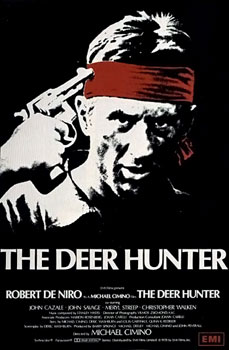
The Deer Hunter, which won the 1978 Oscar for Best Picture Of The Year, opens in a Pennsylvania steel mill.
Mike (Robert De Niro), Steve (John Savage), Nick (Chistopher Walken), Stan (John Cazale), and Axel (Chuck Aspegren, a real-life steel worker who was cast in this film after De Niro met him while doing research for his role) leave work and head straight to the local bar, where they are greeted by the bartender, John (George Dzundza). It’s obvious that these men have been friends for their entire lives. They’re like family. Everyone gives Stan a hard time but deep down, they love him. Axel is the prankster who keeps everyone in a good mood. Nick is the sensitive one who settles disputes. Steve is perhaps the most innocent, henpecked by his mother (Shirley Stoler) and engaged to marry the pregnant Angela (Rutanya Alda), even though Steve knows that he’s not actually the father. And Mike is their leader, a charismatic if sometimes overbearing father figure who lives his life by his own code of honor. The men are held together by their traditions. They hunt nearly every weekend. Mike says that it’s important to only use one shot to kill a deer. Nick, at one point, confesses that he doesn’t really understand why that’s important to Mike.
Steve and Angela get married at a raucous ceremony that is attended by the entire population of their small town. The community is proud that Nick, Steve, and Mike will all soon be shipping out to Vietnam. Nick asks his girlfriend, Linda (Meryl Streep), to marry him when he “gets back.” At the reception, Mike gets into a fight with a recently returned soldier who refuses to speak about his experiences overseas. Mike ends up running naked down a street while Nick chases him.
The Deer Hunter is a three-hour film, with the entirety of the first hour taken up with introducing us to the men and the tight-knit community that produced them. At times, that first hour can seem almost plotless. As much time is spent with those who aren’t going to Vietnam as with those who are. But, as the film progresses, we start to understand why the film’s director, Michael Cimino, spent so much time immersing the viewer in that community of steel workers. To understand who Nick, Mike, and Steve are going to become, it’s important to know where they came from. Only by spending time with that community can we understand what it’s like to lose the security of knowing where you belong.
If the first hour of the film plays out in an almost cinema verité manner, the next two hours feel like an increasingly surreal nightmare. (Indeed, there was a part of me that suspected that everything that happened after the wedding was just Michael’s drunken dream as he lay passed out in the middle of the street.) The film abruptly cuts from the beautiful mountains of Pennsylvania to the violent horror of Vietnam. A Viet Cong soldier blows up a group of hiding women and children. Michael appears out of nowhere to set the man on fire with a flame thrower. An army helicopter lands and, in a coincidence that strains credibility, Nick and Steve just happen to get out. Somehow, the three friends randomly meet each other again in Vietnam. Unfortunately, they are soon captured by the VC.
They are held prisoner in submerged bamboo cages. Occasionally, they are released and forced to play Russian Roulette. Mike once again becomes the leader, telling Steve and Nick to stay strong. Eventually, the three men do manage to escape but Steve loses his leg in the process and a traumatized Nick disappears in Saigon. Only Mike returns home.
The community seems to have changed in Mike’s absence. The once boisterous town is now quiet and cold. The banner reading “Welcome Home, Mike” almost seems to be mocking the fact that Mike no longer feels at home in his old world. Stan, Axel, and John try to pretend like nothing has changed. Mike falls in love with Linda while continuing to feel guilty for having abandoned Nick in Saigon. Steve, meanwhile, struggles to come to terms with being in a wheelchair and Nick is still playing Russian Roulette in seedy nightclubs. Crowds love to watch the blank-faced Nick risk his life.
Eventually, Mike realizes that Nick is still alive. Somehow, Mike ends up back in Saigon, just as the government is falling. Oddly, we don’t learn how Mike was able to return to Saigon. He’s just suddenly there. It’s the type of dream logic that dominates The Deer Hunter but somehow, it works. Mike searches for Nick but will he be able to save his friend?
The Deer Hunter was one of the first major films to take place in Vietnam. Among the pictures that The Deer Hunter defeated for Bet Picture was Coming Home, which was also about Vietnam but which took a far more conventional approach to its story than The Deer Hunter. Indeed, while Coming Home is rather predictable in its anti-war posture, The DeerHunter largely ignores the politics of Vietnam. Mike, Nick, and Steve are all traumatized by what they see in Vietnam. Mike is destroyed emotionally, Steve is destroyed physically, and Nick is destroyed mentally. At the same time, the VC are portrayed as being so cruel and sadistic that it’s hard not to feel that the film is suggesting that, even if we did ultimately lose the war, the Americans were on the correct side and trying to do the right thing. (Many critics of The Deer Hunter have pointed out that there are no records of American POWs being forced to play Russian Roulette. That’s true. There are however records of American POWs being forced to undergo savage torture that was just as potentially life-threatening. Regardless of what one thinks of America’s involvement in Vietnam, there’s no need to idealize the VC.) Released just a few years after the Fall of Saigon, The Deer Hunter was a controversial film and winner. (Of course, in retrospect, the film is actually quite brilliant in the way it appeals to both anti-war and pro-war viewers without actually taking a firm position itself.)
In the end, though, The Deer Hunter isn’t really about the reality of the war or the politics behind it. Instead, it’s a film about discovering that the world is far more complicated that you originally believed it to be. De Niro is a bit too old to be playing such a naive character but still, he does a good job of portraying Mike’s newfound sense of alienation from his former home. In Vietnam, everything he believed in was challenged and he returns home unsure of where he stands. While John, Axel, and Stan can continue to hunt as if nothing happened, Mike finds that he can no longer buy into his own philosophical BS about the importance of only using one shot. Everything that he once believed no longer seems important.
It’s a good film and a worthy winner, even if it does sometimes feel more like a happy accident than an actual cohesive work of art. The plot is often implausible but then again, the film takes place in a world gone mad so even the plot holes feel appropriate to the story being told. Christopher Walken won an Oscar for his haunting performance as Nick and John Savage should have been nominated alongside of him. This was Meryl Streep’s first major role and she gives a surprisingly naturalistic performance. During filming, Streep was living with John Cazale and she largely did the film to be near him. Cazale was dying of lung cancer and he is noticeably frail in this film. (I cringed whenever Mike hit Stan because Cazale was obviously not well in those scenes.) Cazale, one of the great character actors of the 70s, died shortly after filming wrapped. Cazale only appeared in five films and all of them were nominated for Best Picture. Three of them — The first two Godfathers and The Deer Hunter — won.
The Deer Hunter is a long, exhausting, overwhelming, and ultimately very moving film. Whatever flaws it may have, it earns its emotional finale. Though one can argue that some of the best films of 1978 were not even nominated (Days of Heaven comes to mind, as do more populist-minded films like Superman and Animal House), The Deer Hunter deserved its Oscar.
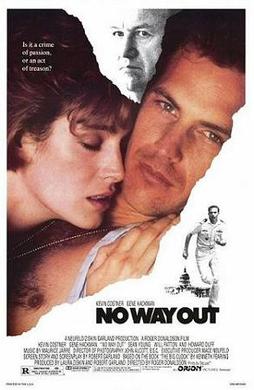
Trust no one in Washington would seem to be the message of this 1987 thriller.
Kevin Costner plays Lt. Commander Tom Farrell, a Naval Intelligence officer who is hailed as a hero after saving a shipmate who falls overboard. In Washington, Tom is recruited by a friend from college, Scott Pritchard (Will Patton), to work for Secretary of Defense Brice (Gene Hackman). Brice doesn’t trust the head of the CIA (played by future senator, Fred Dalton Thompson) and he wants Tom to serve as his mole within the service. What Brice doesn’t know is that Tom is sleeping with Brice’s mistress, Susan Atwell (Sean Young).
Still, Brice does suspect that the woman with whom he is cheating is also cheating on him. When he confronts her about it, their argument leads to him accidentally pushing Susan over an upstairs railing. Pritchard, who is implied to be in love with Brice, takes charge of the cover-up and decides to push the story that Susan was killed by a possibly mythical Russian agent who is known only by the name “Yuri.”
Tom assists with the investigation of her death, both because he wants to know who killed Susan and also because he knows that there’s evidence in Susan’s apartment that could be manipulated to make him look guilty of the crime. For instance, Susan took a picture of Tom shortly before her death. The picture failed to develop but, through the use of what was undoubtedly cutting edge technology in 1987, Naval Intelligence is slowly unscrambling the picture. For Tom, it’s a race against time to find the actual killer before the picture develops and he’s accused of both killing Susan and being Yuri.
Everyone has an agenda in No Way Out, from the ambitious Brice to the fanatical Scott Pritchard to the head of the CIA, who wants Brice to approve funding for a costly submarine. Even the film’s nominal hero has an agenda, which has less to do with finding justice for Susan and everything to do with protecting himself and his future. In fact, as is revealed in the film’s enjoyable if slightly implausible twist ending, some people in Washington have multiple agendas. The film portrays Washington as being a place where, behind the stately facade, everyone is a liar and everyone is ultimately a pawn in someone else’s game. If you have the right connections, you can even get away with murder. Loyalty is rewarded until you’re no longer needed.
It’s an enjoyably twisty thriller, one that makes good use of the contrast between Kevin Costner’s All-American good looks and his somewhat shady screen presence. The film introduces Costner as being a character who, at first glance, seems almost too good to be true and then spend the majority of its running time suggesting that is indeed the case. Gene Hackman is well-cast as the weaselly cabinet secretary, as is Sean Young as the woman who links them all together. In the end, though, the film is stolen by Will Patton, who plays Scott Pritchard as being someone who has unknowingly given his loyalty to a man who is incapable of returning it. As played by Patton, Scott is an outsider who desperately wants to be an insider and who is willing to do just about anything to accomplish that goal. He’s a version of Iago who never turned against Othello but instead devoted all of his devious tricks to trying to cover up the murder of Desdemona.
Even with an over-the-top final twist, No Way Out holds up well as a portrait of how the lust for power both drives and corrupts our political system.
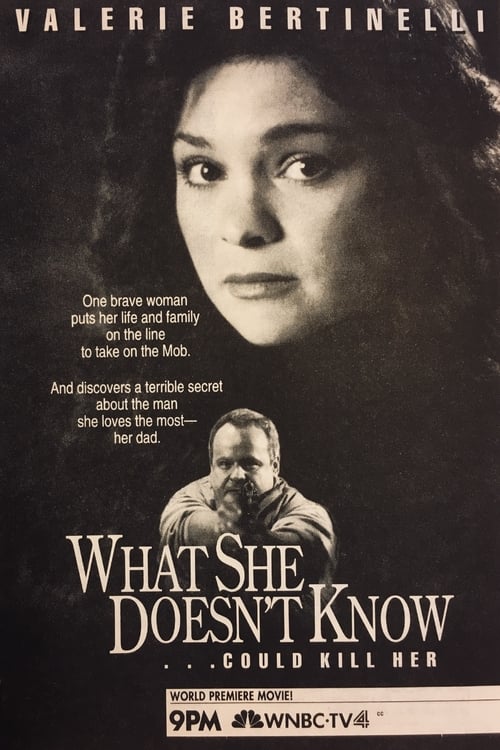
Welcome to Retro Television Reviews, a feature where we review some of our favorite and least favorite shows of the past! On Sundays, I will be reviewing the made-for-television movies that used to be a primetime mainstay. Today’s film is 1992’s What She Doesn’t Know! It can be viewed on YouTube!
Molly Kilcolin (Valerie Bertinelli) has graduated from law school!
In fact, she’s not only graduated from law school but she’s graduated from Harvard Law School, the most prestigious and most expensive law school out there. And she’s graduated at the top of her class. She’s the one who gets to give the speech at graduation, where she says that everything she knows about justice she learned from her father.
It’s really quite an accomplishment when you consider that Molly isn’t even from a rich family. She’s from a family of blue collar, New York City cops. Her father, Jack Kilcoin (George Dzundza), certainly never had a chance to go to Harvard. How did Molly even afford to go to Harvard? Apparently, her tuition was paid out of a trust fund that her aunt set up for her when she was a child. Seriously, that must have been a helluva trust fund because Harvard is not cheap or easy to get into.
Unfortunately, Molly disappoints her father when she tells him that she will not be accepting a job with a high class law firm but instead, she plans to work for the District Attorney’s office. Her fellow prosecutors are skeptical of her as well. Why does she want to go from Harvard to making next to no money in the trenches? Someone asks her if she has political ambitions but no, Molly just wants to do the right thing. She grew up in the neighborhood, don’t you know. She knows the people who are getting caught up in the Mafia’s schemes.
After Molly convinces a young mobster named Joey Mastinelli (Peter Dobson) to testify against his boss, she is shocked to discover that over half of the NYPD is on the Mob’s payroll. She is even more shocked to discover that her father is one of those dirty cops. For years, her father has been taking bribes and hiding the money away in Molly’s trust fund. Molly’s Harvard education was paid for by the Mafia!
As you can probably guess, family dinners are about to get awkward!
I usually enjoy films like What She Doesn’t Know because I’m always interested in the Mafia and there was a time when I briefly thought it might be fun to grow up and go to law school. I don’t know if I would have wanted to become a prosecutor, of course. Unlike Molly, I probably would have taken that ritzy law firm offer. The idea behind What She Doesn’t Know had potential but it was let down by the execution. Valerie Bertinelli tries hard but she’s just not convincing as a tough-as-nails Harvard grad. George Dzundza is a bit more believable as an aging New York cop but he’s still a bit on the dull side. (It would have been nice if this film could have been made a few years later, with Mira and Paul Sorvino in the lead roles.)
The film’s biggest flaw is that it portrays Molly as being so totally clueless about her father’s activities that it makes her seem to be impossibly naïve. I mean, did she never wonder how she could possibly afford to go to Harvard?
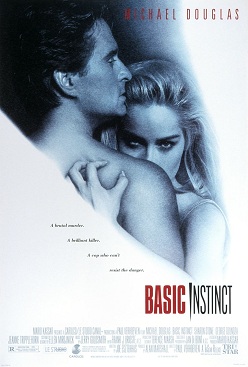 Nick Curran (Michael Douglas) is a San Francisco police detective who, along with his jolly partner Gus (George Dzundza), finds himself investigating the ice pick-stabbing of a rock star. The main suspect is glamorous writer Catherine Trammel (Sharon Stone), who is obviously guilty but manages to outsmart all of the men investigating her by not wearing panties during her interrogation. Nick finds himself drawn to Catherine, despite his own relationship with with psychologist Elizabeth Garner (Jeanne Tripplehorn). The more Nick digs into Catherine’s past, the more he becomes obsessed with her but also the more he suspects that she may be a serial killer. This is mostly because Catherine obviously is a serial killer and anyone should have been able to figure that out. Instead, Nick, an experienced homicide detective, just gets turned on.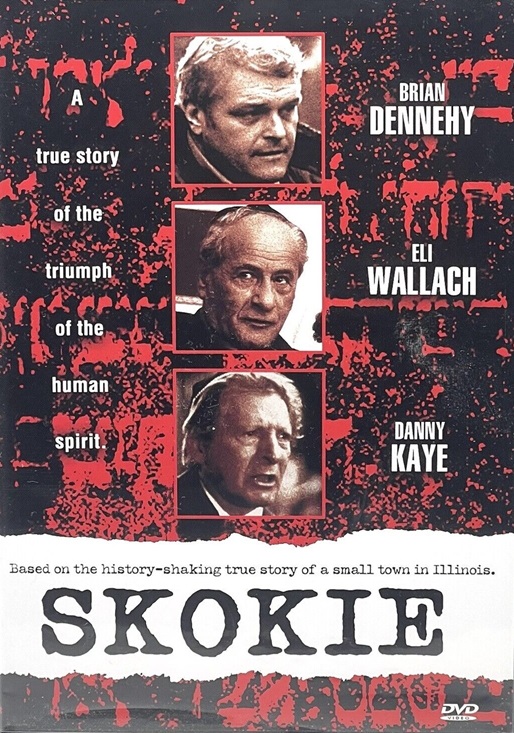
 Through the Shattered Lens