Film Review: Every Which Way But Loose (dir by James Fargo)


In 1978’s Every Which Way But Loose, Clint Eastwood plays Philo Beddoe.

Philo’s an ordinary guy with beautiful hair and a way with throwing punches.  He’s a truck driver.  He enjoys a cold beer.  He enjoys country music.  He makes some extra money by taking part in bare-knuckle brawls.  Everyone says that he could be the next Tank Murdock, a legendary fighter.  Philo is just a simple, blue collar guy who lives in a small house, next door to his best friend Orville (Geoffrey Lewis) and Orville’s profanity-loving mother (Ruth Gordon).  Philo also owns an orangutan named Clyde.  He saved Clyde from being sent to live in a “desert zoo.”

(Actually, now that I think about it, most blue collar guys don’t own monkeys but whatever.  Clyde’s cute and Eastwood’s Eastwood.)

When Philo meets a country singer named Lynn Halsey-Taylor (Sondra Locke), he is immediately smitten.  When Lynn disappears and leaves Philo a cryptic note, Philo decides to go looking for her.  Clyde, Orville, and Philo hit the road.  Along the way, Orville meets and picks up a woman named Echo (Beverly D’Angelo).  This is a road movie so, of course, Clyde, Orville, Philo, and Echo have their adventures on the way to Colorado.  They end running afoul both a corrupt cop and a gang of buffoonish bikers.  Philo enters a fight whenever they need money and one occasionally gets the feeling that Eastwood took this role to show off the fact that, for someone approaching 50, he still looked good without a shirt on.  And good for him!  Because, seriously, Clint does look good in this movie….

I have to admit that, for all of my attempts at sophistication, my roots are in the country and I’ve traveled down enough dirt roads that I find it hard to resist a good redneck story.  And really, there aren’t many films that as proudly and unashamedly redneck than Every Which Way But Loose.  It’s a film that has a laid back, take-it-as-it-comes vibe to it.  Philo may be looking for Lynn but he seems to be okay with taking a few detour along the way.  There’s no real sense of urgency to any part of the movie.  Instead, Every Which Way But Loose was made for people who like a cold beer at the end of the day and who find Ruth Gordon to be hilarious when she curses.  Myself, I don’t drink.  That’s one part of the country lifestyle that passed me over.  But I did enjoy seeing Ruth Gordon cuss out the Nazi biker gang.

Eastwood, Lewis, and D’Angelo have a likable chemistry and the monkey’s cute.  Unfortunately, Sondra Locke isn’t particularly well-cast in the role of Lynn.  (Considering that she was in a relationship with Eastwood, it’s amazing how little chemistry they have in this movie.)  As I watched the film, it occurred to me that it probably would have worked better if Locke and D’Angelo had switched roles.  Locke’s character is supposed to be a femme fatale type but she gives a boring performance and, as a result, the revelation that Philo has misjudged her doesn’t really carry any emotional weight.

That said, this film features some beautiful shots of the wilderness, a charming romance between Lewis and D’Angelo, and a shirtless Clint Eastwood beating folks up.  That’s more than enough to please this secret country girl.
Retro Television Review: Fantasy Island 6.2 “Dancing Lady/The Final Round”


Welcome to Retro Television Reviews, a feature where we review some of our favorite and least favorite shows of the past!  On Tuesdays, I will be reviewing the original Fantasy Island, which ran on ABC from 1977 to 1984.  Unfortunately, the show has been removed from most streaming sites.  Fortunately, I’ve got nearly every episode on my DVR.

This week, Fantasy Island feels familiar.

Episode 6.2 “Dancing Lady/The Final Round”

(Dir by Cliff Bole, originally aired on October 23rd, 1982)

It’s another dancing and boxing episode!

I have lost track of how many Fantasy Island stories have centered around either dancing or boxing but I know that they’ve been the subject of multiple episodes every season.  The fantasies always seem to play out the same as well.  A young boxer has a shot at the championship but taking one wrong blow could end their career or even their life.  And a woman with a boring job — usually, she’s a receptionist — wants to be the world’s greatest dancer but, in the end, discovers that love is the most important thing.  Usually, the familiarity of the stories is a part of Fantasy Island‘s charm but I have to admit that I spent this entire episode wondering if I had seen it before.  The fantasies felt so familiar that, ultimately, everyone just seemed to be going through the motions.

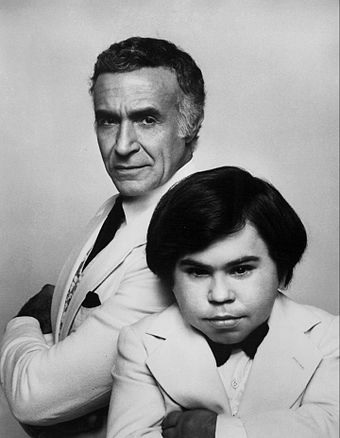
The dancer was Kristy Lee (Lynda Goodfriend), who was given a special powder that would give her the ability to be the world’s greatest dancer.  I know what you’re thinking and no, it was not cocaine.  Instead, it was dust that had been gathered from the world’s greatest theaters and which had magical powers only when used on Fantasy Island.  Using the dust, Kristy auditioned for a spot in a musical showcase starring Ray Tucker (Ken Berry), a down-on-his-luck dancer looking to make a comeback.  Unfortunately, Kristy was so good that Ray feared she would overshadow him.  Ray had to find his confidence and Kristy had to learn that she could dance beautifully even without the magic dust because, according to Roarke, the power of love is all one needs.  (That laughter you hear is coming from every dance teacher I’ve ever had.)  The highlight of this fantasy was Ray Bolger, playing a Broadway producer who happened to be an old friend of Roarke’s.  Bolger and Ricardo Montalban, two old show business pros, seemed to really enjoy working together.  As well, Bolger’s producer had a nice scene where he and Tattoo spoke in French to each other.  It was a fun little moment and, if nothing else, it indicated that both Roarke and Tattoo have lives outside of greeting people on Fantasy Island.

The boxing story featured Al Molinaro as Max, a trainer who wanted to train someone for an exhibition match against the world champion.  Max got his chance to train the enthusiastic Tommy Rudolph (William R. Moses) but, when Max’s ex-girlfriend (Rue McClanahan) warned him that one more concussion could possibly kill Tommy, Max had to make a decision.  Would he push Tommy to keep fighting or would he thrown in the towel after Tommy took a few shots to the head?  Max, of course, did the right thing.

As I said, it was all pretty predictable and familiar.  At least Tattoo got to have some fun.  Along with speaking French, he also got to put on a bookie outfit and then take bets on the outcome of the fight.  When Roarke told Tattoo to cancel all the bets, Tattoo replied that being a bookie was his fantasy!

Hey, it made me laugh,

The TSL’s Grindhouse: No Way Back (dir by Fred Williamson)


Jesse Crowder’s back!

You may remember Jesse Crowder as the super cool and unflappable private detective from Death Journey.  Jesse was a Los Angeles cop but now he works independently.  There’s literally nothing that Jesse can’t do.  Ride a horse?  Ride a motorcycle?  Slow motion kung fu?  Jesse can do it all and he usually do it without bothering to button up his shirt.  Jesse is such a badass that he can kill more people in the time it takes for him to light a cigar than most people will kill in their entire lifetime.

The 1976 film No Way Back is the second Jesse Crowder film.  Once again, Fred Williamson both directs and stars as Jesse.  Williamson is in almost every scene of the film and when he’s not killing bad guys or having sex or just posing with his shirt off, he’s listening to people talk about what a badass he is.  In short, No Way Back is a vanity project but it’s a vanity project with a sense of humor.  Watching the film, you get the feeling that Williamson knows that No Way Back is kind of silly but, at the same time, he’s having fun and he wants everyone watching to have fun too.

No Way Back‘s plot involves a missing man and a lot of money.  Henry Pickens (Charles Woolf) worked at a bank but, one day, he grabbed a briefcase full of money, jumped in a car driven by his girlfriend (Tracy Reed), and disappeared.  Everyone was shocked but you know who was really shocked?  His wife!  Mildred Pickens (Virginia Gregg) and Henry’s brother both want to know to where Henry has vanished.  They hire Jesse, perhaps finding solace in his catch phrase: “You pay the bill, I’ll deliver it.  Legal, illegal, moral or otherwise.”

Not surprisingly, it doesn’t take long for Jesse to figure out that Perkins is in San Francisco.  Jesse lights his cigar and heads for the Bay City.  However, Jesse isn’t the only one looking for Henry Pickens.  There’s also a gangster named Bernie (Stack Pierce) who is determined to get the money for himself.  Much as in Death Journey, it doesn’t matter where Jesse goes or how he gets there.  As soon as he arrives, he people are trying to kill him.  Unfortunately, for them, no one can kill Jesse Crowder.

It all leads to a savage gun battle in the desert.  Fred Williamson jumps up on a horse, unbuttons his shirt, and rides across the screen.  People are betrayed.  People get shot.  Fortunately, no one can touch Jesse Crowder…

Anyway, No Way Back doesn’t really make any sense.  If you happen to watch this film (and I saw it on YouTube), just try to keep track of why Henry stole all of that money in the first place.  However, the plot isn’t really that important.  This film is all about Fred Williamson beating up gangsters and walking around without a shirt on.  It’s a dumb action movie but it never pretends to be anything different and the film’s total lack of pretension is enjoyable.  That’s always a good thing.

http://www.youtube.com/watch?v=RAlWgEPC3RU

Cleaning Out The DVR Yet Again #40: Melinda (dir by Hugh A. Robertson)


(Lisa recently discovered that she only had about 8 hours of space left on her DVR!  It turns out that she’s been recording movies from July and she just hasn’t gotten around to watching and reviewing them yet.  So, once again, Lisa is cleaning out her DVR!  She is going to try to watch and review 52 movies by the end of 2017!  Will she make it?  Keep checking the site to find out!)

melinda

I recorded Melinda off of TCM on November 13th.

First released in 1972, Melinda is technically a murder mystery.  Frankie J. Parker (Calvin Lockhart, giving a brilliant performance) is a popular radio DJ in Los Angeles.  When we first see Frankie, he’s driving his expensive sportscar through a poor neighborhood.  It’s a neighborhood that he knows well but, as opposed to those around him, he’s made it out.  He’s handsome, slick, and more than a little arrogant.  When he arrives at a local gym, he looks at himself in a mirror and says, “I shouldn’t say it … but I am a pretty motherfucker.”  Frankie’s a student in a taekwondo class taught by Charles Atkins (Jim Kelly).  Charles gives Frankie a hard time about not giving back to the community.  Frankie blows off his concerns.  To be honest, we really should dislike Frankie but he’s so damn charming.  As played by Calvin Lockhart, Frankie has one of those irresistible smirks, the type of the lights up the screen.

One night, Frankie meets the mysterious Melinda (Vonetta McGee) and spends the night with her.  He thinks that it’s just going to be another one night stand but Melinda tells Frankie that he has the potential to be more than he realizes.  Touched, Frankie goes to work and resolves to be a better person.  Then he returns home and discovers that Melinda has been murdered!

The rest of the film deals with Frankie’s attempts to discover who murdered Melinda.  It turns out that Melinda had underworld connections and mob boss Mitch (Paul Stevens) is desperate to recover something that Melinda had in her possession when she died.  But honestly, the whole murder subplot is a MacGuffin (if you want to get all Hitchcockian about it).  Ultimately, Melinda is a character study of Frankie Parker and how, over the course of solving Melinda’s murder, he learns that there’s more to life than just looking out for himself.

Though Melinda was obviously made to capitalize on the blaxploitation craze of the early 70s, it’s actually far more low-key than most of the better known films in the genre.  (Or, at least it is until the karate-filled finale.)  Perhaps because it was directed by a black man and written by noted black playwright Lonne Elder III, Melinda is far more interested in exploring what makes its characters who they are, as opposed to just putting a gun in their hand and having them shoot up the screen.  Frankie Parker emerges as a fascinating character.

Mention should also be made of the performance of Rosalind Cash, who plays Terry, Frankie’s ex.  Cash gets an absolutely amazing scene where, while attempting to convince a bank employee that she’s Melinda so that she can get into Melinda’s safe deposit box, she tells off a rude teller.  It’s such a good scene and Cash delivers her lines with such fury that you find yourself forgetting that the teller was actually correct in her suspicion that Terry wasn’t actually who she said she was.

Melinda is probably one of the best films that hardly anyone has ever heard of.  Keep an eye out for it.

Embracing the Melodrama Part II #46: Walking Tall (dir by Phil Karlson)


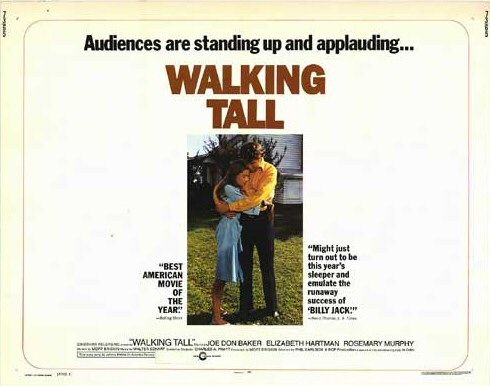
Walking_Tall_(1973_film)About 50 minutes into the 1973 film Walking Tall (not to be confused with the 2005 version that starred Dwayne Johnson), there’s a scene in which newly elected sheriff Buford Pusser (Joe Don Baker) gives a speech to his deputies.  As the deputies stand at attention and as Pusser announces that he’s not going to tolerate any of his men taking bribes from the Dixie Mafia, the observant viewer will notice something out-of-place about the scene.

Hovering directly above Baker’s head is a big, black, almost phallic boom mic.  It stays up there throughout the entire scene, a sudden and unexpected reminder that — though the film opens with a message that we’re about to see the true story of “an American hero” and though it was filmed on location in rural Tennessee — Walking Tall is ultimately a movie.

And yet, somehow, that phallic boom mic feels oddly appropriate.  First off, Walking Tall is an almost deliberately messy film.  That boom mic tells us that Walking Tall was not a slick studio production.  Instead, much like Phil Karlson’s previous The Phenix City Story, it was a low-budget and violent film that was filmed on location in the south, miles away from the corrupting influence of mainstream, yankee-dominated Hollywood.  Secondly, the phallic implications of the boom mic erases any doubt that Walking Tall is a film about men doing manly things, like shooting each other and beating people up.  Buford does have a wife (Elizabeth Hartman) who begs him to avoid violence and set a good example of his children.  However, she eventually gets shot in the back of the head, which frees Buford up to kill.

As I said earlier, Walking Tall opens with a message telling us that we’re about to watch a true story.  Buford Pusser is a former football player and professional wrestler who, after retiring, returns to his hometown in Tennessee.  He quickly discovers that his town is controlled by criminals and moonshiners.  When he goes to a local bar called The Lucky Spot, he is unlucky enough to discover that the bar’s patrons cheat at cards.  Buford is nearly beaten to death and dumped on the side of the road.  As Buford begs for help, several motorists slow down to stare at him before then driving on.

Obviously, if anyone’s going to change this town, it’s going to have to be Buford Pusser.

Once he recovers from his beating, Buford makes himself a wooden club and then goes back to the Lucky Spot.  After beating everyone up with his club, Buford takes back the money that he lost while playing cards and $50.00 to cover his medical bills.  When Buford is put on trial for armed robbery, he takes the stand, rips off his shirt, and shows the jury his scars.  Buford is acquitted.

Over his wife’s objections, Buford decides to run for sheriff.  The old sheriff, not appreciating the competition, attempts to assassinate Buford but, instead, ends up dying himself.  Buford is charged with murder.  Buford is acquitted.  Buford is elected sheriff.  Buford sets out to clean up his little section of Tennessee.  Violence follows…

On the one hand, it’s easy to be snarky about a film like Walking Tall.  This is one of those films that operates on a strictly black-and-white world view.  Anyone who supports Buford is good.  Anyone who opposes Buford is totally evil.  Buford is a redneck saint.  It’s a film fueled by testosterone and it’s not at all subtle…

But dangit, I liked Walking Tall.  It’s a bit like a right-wing version of Billy Jack, in that it’s so sincere that you can forgive the film’s technical faults and frequent lapses in logic.  Walking Tall was filmed on location in Tennessee and director Phil Karlson makes good use of the rural locations.  And, most importantly, Joe Don Baker was the perfect actor to play Buford Pusser.  As played by Baker, Pusser is something of renaissance redneck.  He’s a smart family man who knows how to kick ass and how to make his own weapons.  What more could you ask for out of a small town sheriff?

In real life, Buford Pusser died in a mysterious car accident shortly after the release of Walking Tall.  Cinematically, the character of Buford Pusser went on to star in two more films.