Film Review: The Don Is Dead (dir by Richard Fleischer)


“The Don is Dead!” shouts the title of this 1973 film and it’s not lying.

After the powerful and respect leader of the Regalbuto crime family dies, the Mafia’s governing body meets in Las Vegas to debate who should be allowed to take over the family’s operations.  Frank Regalbuto (a smoldering Robert Forster) wants to take over the family but it’s agreed that he’s still too young and hot-headed.  Instead, control of the family is given Don Angelo DiMorra (Anthony Quinn), an old school Mafia chieftain who everyone agrees is a man of respect.  Don DiMorra will serve as a mentor to Frank while Frank’s main enforcers, The Fargo Brothers, will be allowed to operate independently with the understanding that they will still respond if the mob needs them to do a job.  Tony Fargo (Forrest) wants to get out of the rackets all together while his older brother, Vince (Al Lettieri), remains loyal to the old ways of doing things.

Frank is not happy with the arrangement but he has other things to worry about.  He knows that there’s a traitor in his family.  While he and the Fargo brothers work to uncover the man’s identity so that they can take their revenge, Don Angelo falls in love with a Vegas showgirl named Ruby Dunne (Angel Tompkins).  However, Ruby is engaged to marry Frank and, when Frank returns from taking care of the traitor, he is tipped off as to what has been happening in his absence.  Frank goes crazy, nearly beating Ruby to death.  Don Angelo declares war on Frank and the Fargo brothers are forced to decide which side they’ll serve.

In the 1970s, almost every crime film was either a rip-off of The French Connection or The Godfather.  The Don Is Dead is unique in that it attempts to rip off both of them at the same time.  The film opens French Connection-style with a couple of hoods trying to double-cross Frank during a drug deal, leading to shoot-out.  (Keep an eye out for Sid Haig as one of Frank’s men.)   The film is full of scenes that are meant to duplicate the gritty feel of The French Connection though, needless to say, none of them are directed with the cinema verité intensity that William Friedkin brought to that classic film.  Meanwhile, Anthony Quinn plays a character who is very much reminiscent of Don Vito Corleone, even pausing at one point to tell Frank that “drugs are a dirty business.”  The Godfather‘s Abe Vigoda and Al Lettieri show up in supporting roles and Robert Forster gives a performance that owes more than a little to James Caan’s Oscar-nominated turn as Sonny Corleone.  (Interestingly enough, both Quinn and Forster were among the many actors considered for roles in The Godfather.)

Unfortunately, the film itself is slowly-paced and never really draws us into the plot.  Director Richard Fleischer, who directed a lot of films without ever developing a signature style, brings none of the intensity that William Friedkin brough to The French Connection nor can he duplicate Francis Ford Coppola’s operatic grandeur.  The Don is Dead plays out like a particularly violent made-for-TV movie.  There’s a lot of talented people in the cast but they’re defeated by thinly drawn characters.  Robert Evans often said that Coppola was hired to direct The Godfather because, as an Italian-American, he would bring an authenticity to the material that a non-Italian director would not be able to do.  The Don Is Dead would seem to indicate that Evans knew what he was talking about.
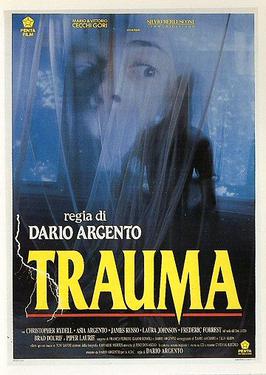
The Films of Dario Argento: Trauma


In 1993’s Trauma, Dario Argento tells a story of giallo horror, complete with a killer who wears black gloves, a camera that stalks through the streets of a rainy city, and plenty of eccentric red herrings.  The story is set and was filmed in Minneapolis, Minnesota, making this one of the two Argento films to be completely shot in America.

Trauma was also the first of Argento’s films to star his daughter Asia Argento.  Asia, who was 16 at the time of filming, plays Aura Petrescu, the daughter of Adriana (Piper Laurie) and Stefan (Dominique Serrand).  Aura is a bulimic drug addict, with track marks up and down her arms.  Having recently escaped from a mental hospital run by the eccentric Dr. Judd (Frederic Forrest), Aura is preparing to jump off a bridge and end her life when she’s grabbed by David (Christopher Rydell).  David works as a headline writer and an artist for a local TV news station.  David is also a recovering addict who takes sympathy on Aura and buys her breakfast.  Aura thanks David by stealing his wallet and running out of the restaurant.

After being  caught by the police, Aura is then returned to her home, a baroque mansion where Adriana works as a fake psychic.  When Aura arrives, Adriana is preparing for a séance.  She’s been hired to contact the spirit of a victim of The Head Hunter, a serial killer who has been chopping off people’s heads in Minneapolis.  As a storm rages outside, Aura again flees from the house.  Stefan and Adriana chase after her.  Soon, while a terrified Aura screams in the rain (in a scene that will remind some of Asia’s mother, Daria Nicolodi, freaking out at the end of Tenebrae), the Head Hunter is holding up what appeas to be the heads of her parents.

Terrified for her life, Aura goes through David’s wallet, finds his number, and calls him.  After setting Aura up at his house, David investigates who is chasing her and how those people are connected to The Head Hunter.  David also falls in love with Aura and Aura falls for him.  Unfortunately, as so often happens in the films of Dario Argento, the world is full of people who don’t care how in love two people are.  The people who are after Aura are determined to get her and if that pushes David back into the world of drug abuse, so be it.

Trauma is middle-of-the-road Argento, featuring some scenes that are touched with genius and other scenes that just feel a bit bland.  The cast is an interesting mix of veteran performers like Piper Laurie, Frederic Forrest, and Brad Dourif and younger actors like Christopher Rydell and Asia Argento.  Dario Argento is known for being a director who prefers for his actors to come in, hit their marks, and deliver their lines with a minimum amount of fuss and he’s complained about American method actors (like Tenebrae’s Anthony Franciosa, with whom Argento had a notoriously difficult relationship) who want to discuss every little detail of their character and their performance.  One can only imagine how he handled working with actors as outspoken and creative as Laurie, Forrest, and Dourif.  It must be said that those three actors all give memorable performances but none of them seem to be acting in the same film as Rydell and Asia Argento.  Rydell and Asia give rather earnest and straight-forward performances while Laurie, Forrest, and Dourif are all a bit more eccentric in the way they interpret their characters.  Piper Laurie, in particular, rejects subtlety and delivers her lines with all of the melodramatic force she can summon.  (It should be said that this is absolutely the right approach for the character that she’s playing.)  That said, it’s Fredric Forrest who truly seems to be on a different planet from everyone else, giving a performance that can only be described as weird.  Again, much as with Laurie’s self-aware melodrama, Forrest’s approach works well enough for his odd character, who I assume was named for the Dr. Judd who appears in Cat People.

The most controversial aspect of the film was the casting of Asia Argento as Aura, with some complaining of nepotism and others accusing Dario of exploiting his own daughter.  Personally, I think Asia does a perfectly acceptable job in the lead role, even if it’s obvious that she still had room to develop as an actress.  At the time the film was made, Asia was herself bulimic and the film’s most powerful scenes are the ones dealing with Aura’s own fragile sense of self-worth.  Along with being hunted by a serial killer and having lost her entire entire family, Aura is also an outsider in America.  The film paints a portrait of a society that doesn’t care about those living on the fringes.  The only person that Aura has to look out for her is David, himself a former resident of the fringe.  Christopher Rydell gives a good performance of David, playing him as someone who is trying to do the right thing and protect the victimized, even at the risk of his own sobriety.

(That said, there is one scene in which David receives a panicked phone call from Aura and Rydell’s underreaction suggests that the actor was not informed of just how desperate Asia Argento would sound when she later dubbed in her part of the conversation.)

Argento’s camera glides down dark hallways and through the streets of the city.  He films Minneapolis in the same way that many directors would film New Orleans and, as such, the film becomes a vision of Middle America through European eyes.  Because there’s a few issues with pacing and some clunky dialogue that was probably due to the Italian script being translated into English, Trauma is not Argento’s best.  It’s middle-of-the-road Argento but it remains intriguing, nonetheless.

The (Reviewed) Films of Dario Argento:

  1. The Bird With The Crystal Plumage
  2. Cat O’Nine Tales
  3. Four Flies on Grey Velvet
  4. Deep Red
  5. Suspiria
  6. Inferno
  7. Tenebrae
  8. Phenomena
  9. Opera
  10. Two Evil Eyes

A Quickie With Lisa Marie: The Conversation (dir. by Francis Ford Coppola)


As a result of my continuing effort to see every single film ever nominated for best picture, I’ve been lucky enough to both discover and rediscover a handful of excellent films that, for whatever reason, have ended up forgotten and neglected in the years since they scored their nominations.  One of the more recent of these films was Francis Ford Coppola’s masterpiece of a paranoia, the 1974 Best Picture nominee The Conversation.*

The Conversation tells the story of Harry Caul (played by Gene Hackman), a surveillance expert who, along with his colleague Stan (played by the great John Cazale), is hired by a businessman (Robert Duvall) to bug a conversation between Duvall’s much younger wife (played by Cindy Williams) and a man who might be her lover (played by Fredric Forrest).  Harry, we quickly discover, is a man who values his privacy and who manages to find a balance between his unsavory job and his devout religious faith by maintaining an impenetrable shield of detachment from the rest of humanity.  He is a man who hides from the world inside of his apartment, only allowing himself to show the slightest hint of emotion when playing his saxophone.  In one of the film’s best scenes, Harry finds himself awkwardly socializing with a far more sleazy acquaintance (played by Alan Garfield, one of the great character actors of the 70s) and it becomes apparent that Harry may be the best in the business but he’s still the ultimate outsider.

However, Harry is forced to confront the contradictions of his own lifestyle when he listens to the conversation between Forrest and Williams and believes that he might have found evidence that both Forrest and Williams are in fear for their lives.  With Duvall’s operatives demanding the surveillance tapes, Harry Caul soon finds himself becoming more and more paranoid and unstable as he finds it more and more difficult to justify his detachment.  Harry finds himself obsessively listening to the conversation over and over again, going over every possible nuance and emphasis to try to figure out what’s actually being said.  Of course, by the end of the film, it’s obvious to both Harry and the audience that nothing is as simple as it sounds. 

Compared to the Godfather films and Apocalypse Now, the Conversation is a surprisingly low-key and rather muted film.  A lot of this is because, as opposed to the Corleones and Martin Sheen’s Captain Willard, Gene Hackman’s Harry Caul is a complete and total introvert, a man who makes his living by observing a world that he refuses to be a part of.  Though the film works quite well as a thriller, it works best when viewed as a sympathetic character study of a paranoid and anti-social human being.  Hackman full inhabits the role, bringing Harry — with all of his frustrating contradictions and conflicted actions — to oddly vibrant life.  The film ultimately serves as a sad-eyed look at how a good person can justify doing bad things and how the inevitable consequences of those bad things can only be delayed for so long.

On a final note, an impossibly young Harrison Ford shows up here as Duvall’s sinister assistant.  He plays the role with just the right amount of prissy arrogance and he has a great scene where he asks Harry is he wants to try a homemade cookie.  “They’re good,” Ford assures him.

So is The Conversation.

—–

* Of course, another Coppola film — The Godfather, Part II — beat the Conversation for best picture.  However, The Conversation did win the Palme D’Or at Cannes that year.  It was a good year to be Francis Ford Coppola.