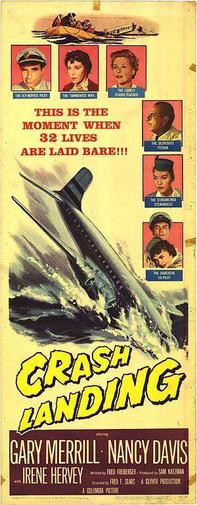
Crash Landing (1958, directed by Fred F. Sears)


Flying from Lisbon to New York City, a commercial airline is flying over the ocean when two of its engines fail.  When the propellers fail to restart, Captain Steve Williams (Gary Merrill) realizes that he will have to land the plane in the ocean.  The Navy is standing by to rescue the passengers.  It’s just a question of whether or not Steve and his crew can land the plane without injuring the passengers or causing the plan to break in half.

This is a disaster film that doesn’t really have a disaster.  The members of the crew all work professionally and efficiently to make sure that the landing is a success, even though none of them have ever had to ditch a plane before.  The Navy shows up on time and ready to help.  With one exception, the passengers react calmly and do what they’re told.  An Orthodox priest prays for the plane.  The flight attendants neatly pack all of the kitchen utensils.  The only drama comes from a boy who is traveling with his dog Wilbur and is upset to hear that Wilbur will have to stay in the back of the plane, where he will probably drown.  The boy’s father says, “I’ll buy you a new dog,” and the boy asks that his baseball cap be placed by Wilbur’s cage so that Wilbur knows his owner was thinking of him.  Don’t worry kid!  Steve Williams isn’t going to let your dog die.

It’s strange to see a disaster film without any real drama.  The crew thinks that Williams can be overbearing but it turns out he knows what he’s doing.  At home, his wife (Nancy Davis, in her final film role) thinks that Steve is too hard on their son.  Their son is going to grow up knowing how to land airplanes in water.  This is almost the Sully origin story.  Otherwise, the film emphasizes the way that everyone works together and doesn’t panic.  The scene where the plane lands in the water features some good special effects but otherwise, the movie is pretty dull.  It could have used Leslie Nielsen and Peter Graves.

Actress Nancy Davis retired from movies after this one but she remained in the public eye as the wife of future President Ronald Reagan.
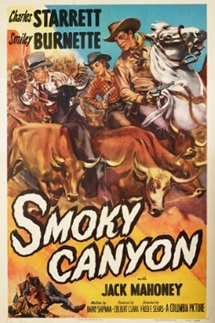
Smoky Canyon (1952, directed by Fred Sears)


There’s a $2500 dollar reward out for the masked bandit known as the Durango Kid but little do the residents of Timber Rock know that the Kid is actually Steve Brent (Charles Starrett), a Treasury agent who puts on a mask whenever he needs to go undercover and discover what the bad guys are doing.

A range war has broken out between the sheep farmers led by Jack Mahoney (Jock Mahoney) and the cattlemen led by Carl Buckley (Tristram Coffin).  To broker a peace and discover which side is the most to blame, Brent works for the cattlemen while the Durango Kid sides with the sheepmen.  It turns out that Buckley’s to blame here.  He’s using the war to thin out his cattle so that an Eastern beef syndicate can keep prices high.  When Mahoney gets too close to the truth, he is framed for the murder of Mr. Woodstock and it’s up to the Durango Kid to prove that Mahoney is innocent.  Meanwhile, Carl wants to blow up an entire mountain so that it will really thin out his cattle herd.

This is a typical Durango Kid movie, entertaining if you like B-westerns and probably boring if they’re not your thing.  It has all the usual gunfights, horse chases, and dynamite explosions that are promised by every Durango Kid film.  Starrett was always one of the most convincing cowboys on screen, even if his use of the Durango Kid alter ego didn’t always make sense.  All the usual members of the Durango stock company show up, all playing different characters than they did in the previous Durango Kid film.  Mahoney gets to play one of the good guys for once and his spirited girlfriend is played by the lovely Dani Sue Nolan.  Smiley Burnett shows up to provide comic relief.  This time, he’s a singing tour guide.  He sings a song called It’s Got To Get Better.  Let’s hope so.

Bonanza Town (1951, directed by Fred F. Sears)


The frontier community of Bonanza Town has been taken over by the corrupt businessman, Krag Boseman (Myron Healey).  No one can stand up to Krag because the local judge (Luther Crockett) is under Boseman’s control.  The judge’s son (Ted Jordan) writes to the Durango Kid and asks him to come to Bonanza Town and lead a group of vigilantes to overthrow Boseman.

The Durango Kid, whose real name is Steve Ramsay (Charles Starrett) somehow receives the letter and heads into town.  As Steve, he gets a job working for Boseman and looks for evidence that Boseman is actually being bankrolled by a notorious outlaw named Henry Hardison (played by the film’s director, Fred Sears).  As the masked Durango Kid, he defuses the vigilante’s violent plan and, with the help of Smiley Burnette, he investigates what Boseman has on the judge.

Charles Starrett played the Durango Kid in 131 films.  In fact, he appeared in so many movies that the majority of Bonanza Town is made up of flashbacks from 1947’s West of Dodge City.  Despite all of the flashbacks, Bonanza Town is one of Starrett’s better films, featuring an interesting story and good performances from both Fred Sears and Luther Crockett.  Sears shows some imagination with his staging of the many gunfights and, as always, Starrett is convincing riding a horse and carrying a gun.

Bonanza Town is a fairly serious film and Smiley Burnette’s trademark comedic relief feels out of place but the kids in 1951 probably enjoyed it.  While everyone else is shooting guns and committing murder, Smiley is running his barber shop and turning a potato into a musical instrument.  While the Durango Kid dispenses frontier justice, Smiley sings a song and leaves his customers bald.  They were a good team.

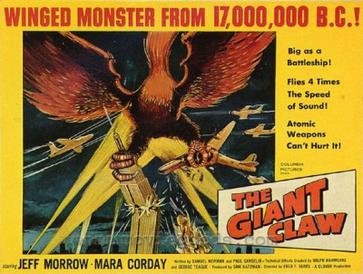
Horror Film Review: The Giant Claw (dir by Fred Sears)


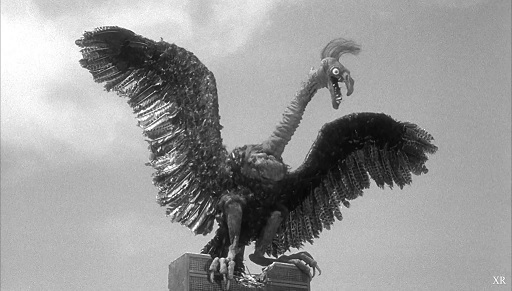
You know, a lot of people are a bit of dismissive of 1957’s The Giant Claw because they say that the monster — a big flying turkey from an anti-matter universe that has somehow slipped into our universe — is not convincing.

They make fun of the fact that, instead of hiring Ray Harryhausen like they were originally planning to do, the producers decided to save money by going for his non-union, Mexican equivalent.

They make fun of the scene in which a French-Canadian trapper announces that the Turkey Monster is actually a mythological beast that has the body of a woman, the head of a wolf, and the wings of a bat because the Turkey Monster certainly looks nothing like that.

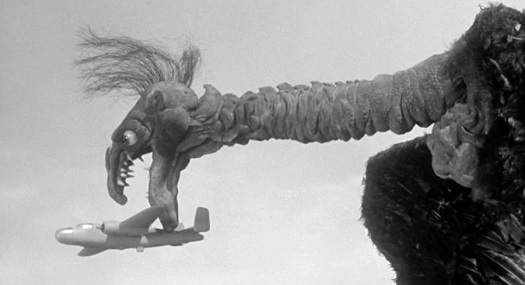
They laugh at the scene where the Turkey Monster chases an airplane, even though I think that would be pretty terrifying if I was actually on the airplane.  I mean, the last time we were flying home from the UK, we hit a bit of turbulence and it traumatized me for days.  I can only imagine how I would feel if I looked out the window and I saw a giant flying turkey chasing after the plane.

Critics will even make fun of how the turkey sounds, mocking it for its weird “caw caw” noises.

Well, alright.  Let’s just admit it.  The turkey isn’t the most menacing monster in the world and yes, it does sometimes sound a bit hoarse and it could definitely stand to put on a little weight but seriously, how can you not love this thing?

As for the film itself, it not only features one of the greatest monster of all time but it’s also a love story!  Mitch MacAfee (Jeff Morrow) is a pilot who sees a UFO and who faces an attempt, by the government, to cover up what he’s seen.  As happened to so many of the people who saw UFOs in the 50s, he’s accused of being either mistaken or an outright hoaxer.  Meanwhile, Sally Caldwell (Mora Corday) is a mathematician who is originally skeptical of Mitch and his claims but who realizes that he was right when they’re attacked by the Turkey Monster.  Their plane crashes in Canada, where they are rescued by a French-Canadian trapper named Pierre Brousssard (Lou Merrill).  While the Turkey Monster is terrifying the world, Sally and Mitch are falling in love and since Jeff Morrow and Mara Corday are the most attractive people in the film, it only seems right.  They’re a cute couple, who cares if the script makes any sense?

Anyway, back to the Turkey Monster.  The Turkey Monster is protected by an anti-matter shield, which makes it impossible for it to be attacked by missiles and planes.  A high-ranking general is left repeating, “Missiles and bombs,” after realizing that they’re all useless against the turkey.

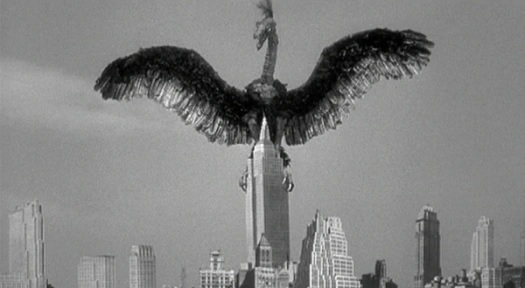
Eventually, the Turkey Monster makes its way to New York City and announces that it’s not going anywhere!

Well, you know what, Giant Turkey?  If you can make it there, you can make it anywhere!

Sadly, the Turkey’s New York visit doesn’t end well and that’s a shame.  Benjamin Franklin famously suggested that America’s official bird should have been the turkey as opposed to the eagle.  Looking at the Giant Turkey sitting on the Empire State Building, how can you disagree?

Seriously, don’t listen to the critics.  The Turkey Monster is one of the most entertaining monsters of all time and The Giant Claw is tons of fun!

Horror Film Review: Earth vs. The Flying Saucers (dir by Fred Sears)


In 1956’s Earth vs. The Flying Saucers, the aliens have finally decided that it’s time to land their ships and meet with the Earthlings. Believe it or not, the aliens are coming in peace. They even send a coded message down to Dr. Russell Marvin (Hugh Marlowe) as he’s driving through the desert with his wife, Carol (Joan Taylor).

Unfortunately, that turns out to be a mistake because Russell totally fails to decipher the message. The flying saucers land at a local military base and, instead of being greeted in peace, they’re fired upon by a bunch of soldiers. After the aliens vaporize most of the soldiers, they kidnap Russell’s father-in-law (Morris Ankrum) and they send out another message. The citizens of Earth have 56 days to negotiate a surrender or the planet will be destroyed!

It’s now falls to Russell to not only figure out a way to defeat a superior invading force but to also build the weapon that will save Earth. And really, seeing as how this is all his fault, that’s the least that Russell could do.

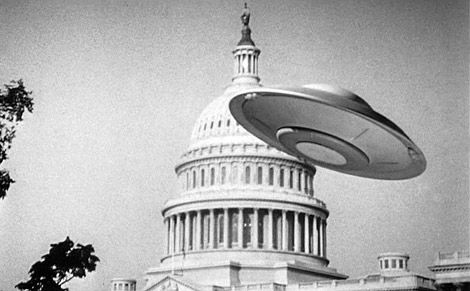
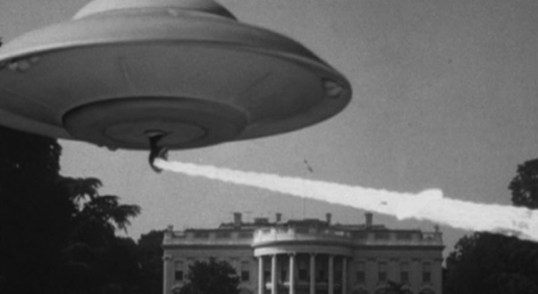
Despite the campy name and the low-budget, Earth vs. The Flying Saucers actually takes itself fairly seriously. This movie was made at the start of the big UFO boom, when newspapers were still full of stories about people claiming that they had spotted something strange in the air. The legendary Ray Harryhausen based his UFO designs on actual reports of what people claimed that they had seen in the sky. As a result, this is the film that, for many, first solidified the idea of what a flying saucer should look like.

One of the most interesting things about this film is that the aliens, themselves, are rather reasonable. Oh sure, they end up killing a lot of people and trying to destroy the planet but really, it’s all just a big misunderstanding. The aliens came in peace and, even after they get mad, they still give humanity time to negotiate a surrender. Of course, that being said, we still have to blow them out of the sky because they are trying to conquer the world and, as always seemed to happen in 50s sci-fi films, it’s pretty much up to America to do all the work.

Though director Fred Sears keeps the action moving quickly and both Marlowe and Ankrum give good performances in their stock roles as, respectively, the scientist and the military leader, Ray Harryhausen is the real star of this movie. The stop-motion animation special effects are still a lot of fun to watch today. Plus, if you don’t applaud when that flying saucer crashes into the Capitol dome, there may be no hope for you.

Earth vs. The Flying Saucers is one of the better alien invasion films of the 50s. If nothing else, it’s a film that will inspire you to keep watching the skies!