Welcome to Retro Television Reviews, a feature where we review some of our favorite and least favorite shows of the past! On Mondays, I will be reviewing Miami Vice, which ran on NBC from 1984 to 1989. The entire show can be purchased on Prime!
After taking a two-month hiatus, I think it’s time to finally get back to the reviews. Thank you for your patience, everyone. Now, let’s head to down to Miami for some Vice!
Episode 2.20 “Payback”
(Dir by Aaron Lipstadt, originally aired on March 14th, 1986)
A low-level drug dealer named Jesus Moroto (Roberto Duran) wants a meeting with the detective who arrested him and sent him to jail. When Sonny Crockett arrives to see what Moroto wants, Sonny is shocked when Moroto commits suicide in the visitation room.
Sudden and violent deaths are a recurring thing in Miami but the death of Moroto haunts Sonny. As Sonny explains to Tubbs, it doesn’t make any sense for Moroto, who was only looking at a few years in jail, to have killed himself. Sonny wonders why Moroto died in front of him. Tubbs suggests that Sonny instead focus on their current assignment, trying to get close to the elusive drug lord, Mario Fuente (played by famed art rocker, Frank Zappa). As a lot of drug lords do on this show, Fuente lives on a yacht and it’s next to impossible to see him. Using their undercover identities as Burnett and Cooper, Crockett and Tubbs have so far only been able to meet with Fuente’s second-in-command, Reuben Reydolfo (Dan Hedaya).
Crockett and Tubbs find themselves assigned to work with two DEA agents, one whom — Kevin Cates (Graham Beckel) — claims that he can get Crockett and Tubbs onto Fuente’s boat. Crockett and Tubbs are reluctant to work with anyone but it soon turns out that Cates is apparently better at his job than Crockett and Tubbs gave him credit for.
Except, of course, everyone’s got a secret. Before he went to jail, Moroto stole several million dollars from Fuente. It turns out that Internal Affairs is convinced that Crockett helped Moroto steal the money and Fuente, who knows that Burnett and Cooper are actually Crockett and Tubbs, believes the same thing. The only person who can truly prove that Crockett is innocent is Kevin Cates and that’s because he’s the one who stole the money!
It doesn’t matter that the twisty plot of this particular episode is not always easy to follow. It also doesn’t matter that this episode leaves you wondering just how exactly Crockett and Tubbs have managed to maintain their Burnett/Cooper personas for so long without everyone in Miami’s underworld figuring out the truth. (Personally, I wonder that after every episode.) This episode works due to the atmospheric direction of Aaron Lipstadt and the performances of Don Johnson, Edward James Olmos, Frank Zappa, and especially Graham Beckel. Beckel gives a performance that will keep you guessing at just who exactly Kevin Cates is working for and whether or not he can be trusted. That he makes Kevin into a somewhat likable character makes it all the more disturbing when he turns out to not be quite the honest law enforcer that he made himself out to be. If the main theme of Miami Vice often seemed to be that Crockett and Tubbs were fighting a war that there was no way to win, this episode shows why their work often felt so futile. In this episode, Crockett not only has to battle a drug lord but he also has to battle Internal Affairs. No one trusts anyone.
The episode ends on an ambiguous note, with Crockett technically cleared but still unable to truly prove his innocence. (Kevin Cates, the only man who can truly prove Crockett’s innocence, is naturally gunned down during the show’s final few minutes.) Crockett is warned that Fuente is still going to be coming after him. (Unfortunately, Zappa was in poor health when he filmed this episode and Fuente would never return.) This episode is Miami Vice at its most cynical and its most effective.
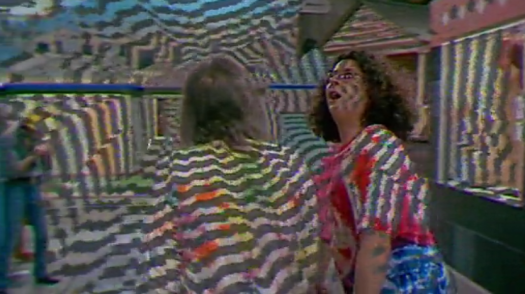
Frank Zappa is definitely an acquired taste, one I acquired as a young kid listening to albums like “Absolutely Free”, “Weasels Ripped My Flesh”, and “Apostrophe”, which goes a long way in helping to explain my warped world view. Zappa’s avant garde rock’n’roll, a mélange of jazz, classical, doo-wop, psychedelica, and anything else he could think of, combined with his nonsensical, sexual, and scatological lyrics, skewered convention, the plastic world of suburban America, and hippie culture as well (Zappa was an equal opportunity offender). 200 MOTELS was his first attempt at making a movie, co-directing and co-writing with British documentarian Tony Palmer, and to call it bizarre would be a gross understatement.
Visually, the film is as close to Zappa’s avant garde compositions as you can get. 200 MOTELS was shot on videotape and transferred to 35mm film, using techniques like double and triple exposure, color filters, flash-cut editing, and…
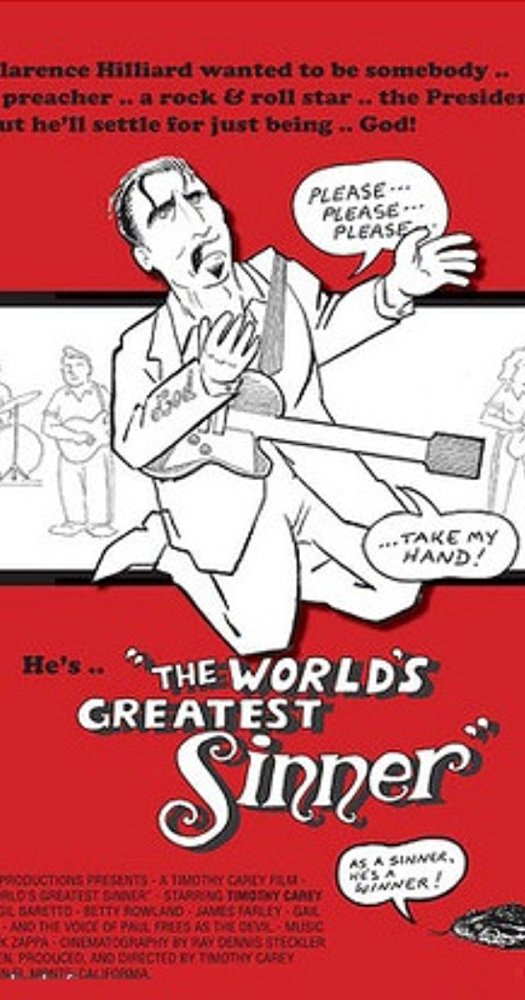
Timothy Agoglia Carey (1929-1994) was an eccentric, oddball actor who played in everything from early Stanley Kubrick films (THE KILLING, PATHS OF GLORY) to AIP Beach Party romps (BIKINI BEACH, BEACH BLANKET BINGO ). He had the look of an overfed vampire, and was noted for his off-the-wall characterizations. Carey didn’t play the Hollywood game, considering himself an artist, and you’ve got to admire that. In 1962, he made a film called THE WORLD’S GREATEST SINNER, which he produced, directed, wrote, starred in, and released himself. Top THAT, Orson Welles!.
This ultra-low-budget film is totally bizarre right off the rip. Insurance man Clarence Hilliard (Carey) gets himself fired from his job after telling people they don’t need insurance. He wants more out of life, believing man is a superbeing, and begins to set himself up as a God. After watching a rock’n’roll teen idol, Clarence becomes a charismatic, guitar-toting, fiery…
In 1978, just based on what I’ve read, everyone in America was regularly doing huge amounts of cocaine. Whether you were in a disco or at a PTA meeting, you knew that eventually someone would produce a small mirror covered with white powder. President Carter even snorted it during that year’s State of the Union speech. Sure, some people used gold spoons and others had to make do with a one dollar bill but, in the end, cocaine brought all Americans together as a nation and helped the country heal after the trauma of Watergate.
It also contributed to some the year’s best films. Days of Heaven, Superman, The Deer Hunter, Coming Home, Grease, Animal House, Interiors, Halloween, Midnight Express, Convoy, Go Tell The Spartans, and An Unmarried Woman; these were all films fueled by the Peruvian Headache Powder.
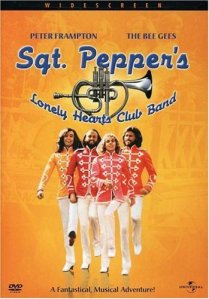
However, no discussion of 1978 cocaine-fueled films would be complete with mentioning Sgt. Pepper’s Lonely Hearts Club Band. Featuring songs originally performed by the Beatles and starring the Bee Gees, Peter Frampton, and a whole bunch of other people that my mom liked, Sgt. Pepper’s is a film that, quite honestly, should just be retitled 1978.
Plotwise — oh God, do I really have to try to describe the plot? Seriously, this could take forever. I mean, the film isn’t quite two hours long but a lot of stuff happens and really the only connection between any of it is that these odd cover tunes of classic Beatles songs keep popping up in the weirdest places. Okay, let me try to get this all into one paragraph —
There’s a small town called Heartland that is very small and simple but it’s also the home of the legendary Sgt. Pepper who, throughout history, has maintained world peace by playing his magic instruments. But then Sgt. Pepper dies and apparently turns into a gold weather vane. His magic instruments are given to the mayor of Heartland, Mr. Kite (George Burns, who also narrates the entire movie). The world is in mourning. But then one day, the Henderson Brothers (the Bee Gees) decide to form a new Sgt. Pepper’s Lonely Hearts Club Band and they invite Sgt. Pepper’s grandson, Billy Shears (played by Peter Frampton) to be their lead singer. Heartland rejoices and George Burns has a surprisingly sweet scene where he sings Fixing A Hole.
Anyway, the new band is such a hit that the owner of a record company invites them to come to Los Angeles and record an album. Billy says goodbye to his girlfriend, Strawberry Fields (Sandy Farina) and then joins the Hendersons in a hot air balloon which promptly leaves for California. En route, the balloon collides with an airplane but nobody is seriously injured.
In Los Angeles, they meet the record company owner and it turns out that he’s played by Donald Pleasence. (It’s interesting to think that Pleasence filmed this and Halloween around the same time.) Pleasence proceeds to sing the creepiest version of I Want You ever heard. I’d include a clip of the performance but Pleasence manages to go on for a good ten minutes, repeating “I want you,” in an odd little voice while staring at Peter Frampton.
The boys sign a contract with Pleasence. Billy Shears is led astray by Lucy and her band, the Diamonds. (Guess which song they get to sing.) Somehow, this allows Mean Mr. Mustard to steal Sgt. Pepper’s magic instruments. Mr. Mustard drives around in a yellow van and he’s assisted by two female robots who, at one point, sing She’s Leaving Home in their electronic, robot voices.
The band is informed that the instruments have been stolen. Outraged, they jump back in their hot air balloon and quickly start a recovery operation. It turns out that Mean Mr. Mustard has given the instruments to three separate villains.
The first villain is Dr. Maxwell Edison who uses his silver hammer to turn old people into boy scouts. This may sound ludicrous and silly but fortunately, Maxwell is played by Steve Martin. His cameo is one of the highlights of the film, if just because he seems to be one of the few people who actually enjoyed himself on set.
The second villain is the Reverend Sun. He brainwashes people or something. I’ve seen this movie a few times and I still can’t quite figure out what Reverend Sun’s deal is. When I first saw this movie, I got excited because I thought that Tom Savini was playing Rev. Sun. Then I forced my sister Erin to watch the movie and she told me I was stupid because Rev. Sun was obviously being played by Frank Zappa. Well, I did some reasearch and discovered that we’re both stupid. That’s neither Savini nor Zappa. It’s Alice Cooper.
The final villains are played by a very young (and very, very hot!) Aerosmith. Here, they are called the Future Villain Band and oh my God, Joe Perry…this film needed a lot more Joe Perry. I mean, it’s understandable that Steve Tyler gets most of the screen time and young Steve actually looks pretty good in a Mick Jagger sort of way but Joe Perry…Oh. My. God. Anyway, Aerosmith does a cover of Come Together and Joe Perry circa 1978 was just so freaking gorgeous, oh my God. Eventually, Frampton and the Bee Gees come along and ruin things by getting into a fight with Steve Tyler which leads to the camera constantly cutting away from Joe Perry who is really, really, really hot and all kinds of sexy in this movie. They should have just called this movie Joe Perry. Oh. My. God.
Uhmm, where was I? Oh yeah — so, anyway, eventually the weather vane comes to life and suddenly, Sgt. Pepper’s a black man who sings Get Back and ends up magically resetting the past and turning Mean Mr. Mustard into an altar boy or something like that. Oh, and the Bee Gee who looks like a New Age healer ends up singing my favorite Beatles song, A Day in the Life.
Finally, it appears that every single person on the planet shows up in the film’s final scene where a huge group of “stars” show up and sing the film’s title tune one last time. In the end credits, these people are listed as being “Our Guests At Heartland.” Doing some research (i.e., looking the thing up in Wikipedia), I’ve discovered that these folks were apparently all pop cultural icons in the 70s. I didn’t recognize a single one of them but I’m sure they probably all snorted a lot of cocaine.
(And, by the way, Joe Perry does not get to return for the finale so bleh on you, movie.)
For some reason, this movie kept showing up on Starz last November and that’s where I first discovered it. The first time I saw it, I came in right at the start of Steve Martin’s cameo and the film itself was so just plain weird that I had to jump on twitter and let the world know what I was watching. (Actually, it doesn’t take much to make me jump on twitter and tell the world what I’m doing.) As a result, I soon discovered that, apparently, I was the only person on the planet who didn’t know about this film.
Sgt. Pepper’s Lonely Hearts Club Band is really a pretty bad movie. The plot tries way too hard, the pacing is terrible with some scenes lasting forever and others ending before they really start, and Frampton and the Bee Gees are all distinguished by an utter lack of charisma. The youngest Bee Gee appears to be cheerfully stoned throughout the entire movie while the other two (and Frampton) are trying way too hard to act.
And yet, the film fascinates me. After I saw it the first time, I forced my sister to watch it with me a second time. I then watched it again on my own. Finally, I went down to the local Fry’s and nearly did a happy little dance when I found it on DVD. I’ve watched it since several times. Whenever I’m depressed, it always cheers me up.
What’s the appeal? Some of it is definitely the whole “so-bad-its-good” thing. Actually, that’s probably most of it. Another thing fascinating thing is how literally the filmmakers choose to interpret the Beatles lyrics. Considering the fact that the Beatles themselves were rather open about the fact that a lot of their lyrics were simply nonsense and word games, it’s interesting to try to understand logic behind trying to force them into a coherent storyline. (This is also the appeal of 2007’s Across The Universe, which is technically a better movie than Sgt. Pepper’s but isn’t half as fun to watch.) For instance, Billy Shears isn’t in the film because he’s an interesting character. Instead, he’s just here because — 10 years earlier — either John Lennon or Paul McCartney choose to toss the name into a song. We’re never quite sure what Mean Mr. Mustard’s dastardly motivation is beyond the fact that the filmmakers had the rights to his song. If nothing else, the film is an interesting example of what happens when people try to create a novel out of somebody else’s short story.
However, I think the main appeal of Sgt. Pepper’s is the appeal of 1978. Watching the movie, you feel almost as if you’re literally sitting beside the cast at Studio 54, watching as everyone snorts a line. I think that, for future historians, this film may very well turn out to be a cinematic Rosetta Stone.
Then again, maybe it really is just so bad that it’s good.



 Through the Shattered Lens