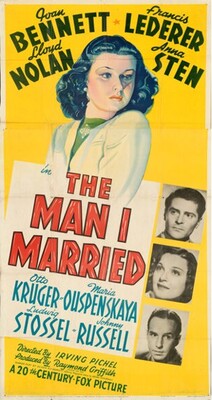
In 1940’s The Man I Married, Joan Bennett stars as Carol Cabbott Hoffman.
Carol is a New York-based art critic. She is young, sophisticated, wealthy, and politically naive. Because she has been married to a German for seven years, she has been keeping up with what has been happening in Germany but it’s clear that she doesn’t really understand the full story of what she’s hearing. As she says, at one point, she has heard bad things about the Nazis but she also tries to keep an open mind and not get drawn in by “propaganda.”
Her husband, Eric Hoffman (Francis Lederer), has not been back to Germany in ten years and he says that he has little interest in ever returning. But, when he receives a letter from his father (Otto Kruger), Eric announces that he has to return home for a visit. Before Carol, Eric, and their son, Ricky (Johnny Russell), leave for Germany, they are approached by their friend, Dr. Hugo Gerhardt (Ludwig Stossel). He explains that his brother has been imprisoned in a concentration camp and he asks Carol and Eric to deliver money to him and to appeal to the American embassy for help. Carol agrees to do so. Eric is noticeably reticent.
As soon as they arrive in Germany and Eric learns that his father wants him to take over the family’s factory, Eric starts to change. He and a former schoolmate named Freida (Anna Sten) are a bit too happy to see each other again. Eric insists on listening to the nightly radio broadcasts from Dr. Goebbels. When Freida mentions that it is illegal to joke about Hitler, Eric surprises Carol by defending the law. With Eric spending all of his time with Freida and dismissing Carol’s understandable suspicions by saying that she’s just being jealous, Carol meets an American correspondent named Keith (Lloyd Nolan) who reveals to her the truth of life in Nazi Germany. Carol discovers that, rather than being the economically-strong paradise that Eric and Freida claim it to be, Germany is a place where many citizens live in fear of being heard saying the wrong thing and, as a result, they’ve chosen to close their eyes to what is going on around them.
The Man I Married is an interesting film. It’s an anti-Nazi film that was released at a time when America was still technically a neutral nation. Indeed, the film almost feels like it was made to prepare Americans for the inevitability of war with Germany. When Keith mocks Carol for trying to be neutral about the Nazis, it’s clear that he’s meant to be speaking to the audience watching the film. Eric begins the film as an erudite and seemingly charming man but, as soon as he arrives in Germany and is reunited with Freida, he reveals himself to be a fervent Nazi. The film warns the audience not to trust those who were trying to excuse or dismiss Germany’s actions.
This is also one of the few films made before World War II that really acknowledged just how central anti-Semitism was to the Nazi ideology, acknowledging the concentration camps at a time when many in the West were refusing to admit they existed, either because they were in denial or because they just didn’t care. Towards the end of the film, a major character is discovered to have had a Jewish mother and the reaction to the news reveals the hate that was at the heart of the Third Reich.
The Man I Married, with its portrayal of a populace that has convinced itself that their government is never to be questioned and that all dissent must be punished, is a film that feels just as relevant today as it did in 1940. It’s a film that warns viewers of the risk of disbelieving their own eyes.

 Through the Shattered Lens