Late Night Retro Television Reviews: Friday the 13th: The Series 1.7 “Doctor Jack”


Welcome to Late Night Retro Television Reviews, a new feature where we review some of our favorite and least favorite shows of the past! On Fridays, I will be reviewing Friday the 13th, a show which ran in syndication from 1987 to 1990. The show can be found on YouTube!

This week’s episode of Friday the 13th: The Series is actually really good!

Episode 1.7 “Doctor Jack”

(Dir by Richard Friedman, originally aired on November 9th, 1987)

Dr. Vincent Howlett (Cliff Gorman) has a reputation for being a miracle worker.  He’s the surgeon who is called in to do the difficult operations that no other surgeon would have the courage to try.  Somehow, despite all of the complex surgeries that he has been involved in, he has never lost a patient.  The local Toronto hospital is very happy to have Dr. Howlett on staff.

However, Dr. Howlett’s success rate is not just a case of medical skill.  He owns a special, lucky scalpel.  He purchased it from a knife dealer who earlier purchased it from — you guessed it! — the cursed antique shop.  The scalpel is from the Victorian era and it once belonged to none other than Jack the Ripper!  The scalpel can make any surgery a success but it demands blood as payment.  So, before every surgery, Dr. Howlett has to go out and find someone to murder.

Searching the scalpel as a part of their mission to track down all of the cursed antiques, it doesn’t take long for Ryan, Micki, and Jack to track the scalpel down to Dr. Howlett.  However, when Ryan tries to steal the scalpel, a chase through the hospital ensues.  When Jack distracts Howlett long enough for Ryan and Micki get away, Jack ends up getting thrown down an elevator shaft.

Jack survives his fall but he’s suffered some terrible internal injuries.  In fact, he’s going to need surgery!  Fortunately, the best surgeon in Canada is on staff at the hospital.  As much as Ryan and Micki want to steal that scalpel, they know that Howlett is going to need it if he’s going to save Jack’s life.

Meanwhile, Jean Flappen (Eva Mai Hoover) is stalking the hallways of the hospital, carrying a gun and hoping to get revenge on Dr. Howlett for the murder of her daughter….

Yikes!  Hospital’s are creepy in general but they’re even more creepy when the head surgeon is carrying around a scalpel that once belonged to Jack the Ripper.  (Of course, in reality, it’s doubtful that Jack the Ripper was actually a doctor.  In all probability, he was a butcher in all definitions of the word.)  This episode makes great use of the hospital setting, creating an atmosphere of perpetual unease.  It was a genuinely scary location and, for once, the fact that Friday the 13th didn’t have a huge budget worked to show’s advantage.  The shots of the empty and shadowy hospital hallways, without even an extra or two populating them, were truly ominous.

Cliff Gorman also gave a wonderful performance as Dr. Howlett, playing him as the type of arrogant jerk who knows that he can get away with being unlikable because he’s the best at his profession.  The scene where Howlett can’t find his scalpel and has a sudden meltdown really drives home the idea that the owners of the cursed antiques have become addicted to using them.  As soon as Howlett can’t hold his scalpel in his hands, his smooth façade crumbles and he starts going through what can only be called withdrawal.

With its creepy atmosphere and Gorman’s sinister performance, Dr. Jack is the best episode of Friday the 13th that I’ve reviewed so far.

Film Review: Ladybug Ladybug (dir by Frank Perry)


Long before he played the long-suffering Mr. Feeney on Boy Meets World, William Daniels made his film debut as another school principal in the 1963 film, Ladybug Ladybug.

In Ladybug Ladybug, Daniels plays Mr. Calkins and he’s got a lot more to worry about than just some unstable student with an unhealthy fixation on a girl that he’s gaslighted into loving him.  No, Mr. Calkins has to deal with the very real possibility that a nuclear war might break out at any second.  One day, when an imminent nuclear attack warning signal goes off, no one can be sure whether or not it’s real or if it was an accident.  However, Mr. Calkins takes no chances.  He dismisses school for the day and tells all of the students to go home.

However, there’s a problem.  The school is in a rural area and most of the students live several miles away.  Because it’s early in the day, there aren’t any school buses running.  The children will have to walk home.  To make sure that the kids get to safety, they’re divided into groups.  A teacher is assigned to each group, tasked with keeping the children calm and making sure they reach their houses.

It’s a long walk and the countryside is deathly quiet.  Some of the children talk about what’s going to happen if there really is a war.  Others, being too young to understand the seriousness of the situation, treat it all like a game.  As each child reaches their house, they have to deal with parents who are more concerned about why their child has come home early than the fact that there might be a war about to break out.

Back at the school, Mr. Calkins and a few remains teachers wait.  One teacher tries to clean up her classroom, all the while realizing that there’s a chance that the classroom will never be used again.

And we, the viewers, keep waiting for a bomb to drop or, at the very least, some sort of clarification about what’s really happening.  We wait in vain.  The film’s ending is harrowing but, at the same time, ambiguous.  Is the world ending or are the children going to wake up in the morning and head back to school?  It all depends on how you interpret the film’s final few moments.

Of course, by the time we reach that ending, a group of children has already taken cover in a bomb shelter.  Unfortunately, their self-appointed leader has decided that there’s not room for all the children, which means that one girl ends up getting kicked out.  Wandering around outside, she finds an old refrigerator to hide in.  Your heart sinks as you watch her climb in and close the door behind her….

Ladbybug Ladybug is a grim film.  At times, it runs the risk of being a bit too grim.  The film definitely gets across its point but it’s so relentlessly depressing that it’s a bit difficult to sit through.  Of course, Ladybug Ladybug was filmed around the same time as the Cuban Missile Crisis so, for many viewers in 1963, the film was less an allegory and more just a record of the feelings and fears that they had to deal with every single day.  Towards the end of the film, when one of the children desperately starts to yell, “Stop!  Stop!  STOP!,” he was undoubtedly speaking for an entire generation that grew up under the shadow of mutually assured destruction.

Ladybug Ladybug was one of the many nuclear war-themed films to be released in the early 60s.  One could easily imagine it as being a companion piece to Fail Safe.  While President Henry Fonda is debating whether or not to sacrifice New York, the children are simply trying to get home.

Lisa Cleans Out Her DVR: Monsignor (dir by Frank Perry)


(Lisa is currently in the process of cleaning out her DVR!  It’s taking her longer than it took Saint Malachy to transcribe The Prophecy of the Popes!  She recorded the 1982 film, Monsignor, off of Retroplex on March 8th!)

Maybe it’s because I’m a fourth Italian and I was raised Catholic but Monsignor amused the Hell out of me.

See, Monsignor is a big, sprawling epic about the Church and the Mafia.  I don’t know much about the production of this film but, having watched it, I’m going to guess that it was made by people who were neither Catholic nor Italian.  This is one of those films that is so full of clichés and inaccuracies and yet so self-important that it becomes oddly fascinating to watch.

It tells the story of Father John Flaherty (Christopher Reeve, an Episcopalian who gives a performance so wooden that one worries about getting splinters just from watching it).  When we first meet Father Flaherty, he’s just taken his orders.  He’s a good Irish kid from Brooklyn.  The neighborhood’s proud of him, because he has volunteered to serve as a chaplain in the army.  (The film opens during World War II.)  The neighborhood is even prouder when he performs a Mafia wedding.  Don Appolini (Jason Miller), who may be a mobster but who still loves the Church, is especially impressed.  He expects big things from Father Flaherty.

(The father of the bride, incidentally, is played by Joe Spinell, who played Willy Chicci in Godfathers One and Two and who achieved a certain infamy when he starred in Maniac.)

Father Flaherty goes to war and discovers that it’s not easy to be a man of God in a war zone.  Everywhere around him, soldiers are either dying or losing their faith.  (Perhaps it would help if Father Flaherty knew how to properly conduct a Requiem Mass but the movie screws that up, with Flaherty saying, “”Requiescat in pace” when he clearly should have said, “Requiescant in pace.”)   After trying, in vain, to comfort a mortally wounded man, Flaherty snaps, picks up a machine gun, and starts blowing away Germans.

Having broken the Thou Shalt Not Kill Commandment and indulged in one of the seven deadly sins, Father Flaherty apparently decides to commit every other sin as well.  Or, at least, it seems like that’s his plan.  The thing is, Christopher Reeve’s performance is bland that it’s difficult to guess what could possibly be going on inside of Flaherty’s head.  Is he disillusioned with the church or does he still have faith?  When he says that he feels guilty over his transgressions, is he being sincere or is he lying?  It’s impossible to tell because, when it comes to Father Flaherty, there’s no there there.  He’s literally an empty vessel.

That, of course, doesn’t stop him from becoming a powerful man in the Church.  Through his Mafia connections, he makes a fortune on the black market and launders money for the church.  He also has sex with a cynical, nymphomaniac postulant nun, who is something of a stock figure in films like this.  In this case, the role is played by Genevieve Bujold.  Despite the stereotypical nature of her character, Bujold comes the closest of anyone in the cast to giving a nuanced performance but her character abruptly vanishes from the film.  One can literally hear the producers in the background saying, “Okay, we’ve indulged in the sexy nun thing.  Send her home now.”

Towards the end of the film, there’s a flash forward that is so abrupt that I didn’t even realize it had happened until I noticed that Christopher Reeve and Jason Miller now had a little gray in their hair.  The flash forward doesn’t really accomplish much.  Father Flaherty has lost a lot of the Mafia’s family and the Mafia’s not happy about it.  It’s kinda like the Vatican subplot in The Godfather Part III, just with less interesting actors.

Anyway, Monsignor obviously thinks that it has something to say about both the Church and the Mafia but it’s actually remarkably empty-headed.  Strangely enough, for an epic film that cost 10 million dollars to make (that’s in 1982 money), the whole film looks remarkably cheap.  If a community theater decided to put on a production of Otto Preminger’s The Cardinal, the end result would probably end up looking a lot like Monsignor.

And yet, I really can’t hate Monsignor.  It’s so bad that, as I said earlier, it’s also oddly fascinating.  You watch and you ask yourself, How many details can one film about Catholicism get wrong?  How many Italian stereotypes can be forced into a movie with a Mafia subplot?  Now, I should point out that, at no point, does Don Appolini say, “Mama mia!” but, if he had, I wouldn’t have been surprised.  It’s just that type of film.

Anyway, Monsignor is so sordid and stupid that it becomes entertaining for all the wrong reasons.  If you’re into that, you’ll enjoy Monsignor.

A Movie A Day #130: Doc (1971, directed by Frank Perry)


No, this latest movie a day is not about Lisa and Erin’s cat.
Instead, Doc is yet another retelling of the famous gunfight at the O.K. Corral.  Most cinematic depictions of that event present Wyatt Earp as being an upright hero, Doc Holliday as being his roguish friend, and the Clantons as being black hat-wearing villains.  Doc takes the opposite approach.  In this one, Wyatt (Harris Yulin) and his brother are sociopaths whose feud with the Clantons comes down to Ike Clanton’s (Mike Whitney) refusal to bow to their authority.  Wyatt is a coward and a physical weakling, who gets beaten up by Ike and is only saved when his friend, Doc Holliday (Stacy Keach), steps forward to protect him.

In this film, Doc is clearly dying from the minute he first appears.  Not only is Doc so thin that his bride actually carries him over the threshold, he is also constantly coughing.  His misery is only relieved by opium, herbs, and the love of Katie Elder (Faye Dunaway), the prostitute that he wins in a poker game at the start of the film.  Doc would rather just spend his remaining days with Katie but, because of his friendship with Wyatt, he is dragged into the Earp/Clanton fight.

Like most revisionist westerns of the early 1970s, Doc is a heavy-handed metaphor for the Vietnam War, with Wyatt Earp serving as an LBJ/Nixon stand-in and Doc Holliday standing in for all the leaders who enabled them.  It sounds interesting and Stacy Keach gives a good performance but Doc is glacially paced and Harris Yulin is thoroughly miscast as Wyatt.  It takes forever to get to the gunfight and the Doc is so determined to be revisionist that it forgets to be interesting.  Doc is an unfortunate misfire.

Embracing the Melodrama #24: Last Summer (dir by Frank Perry)


last-summer-movie-poster-1969-1020204164

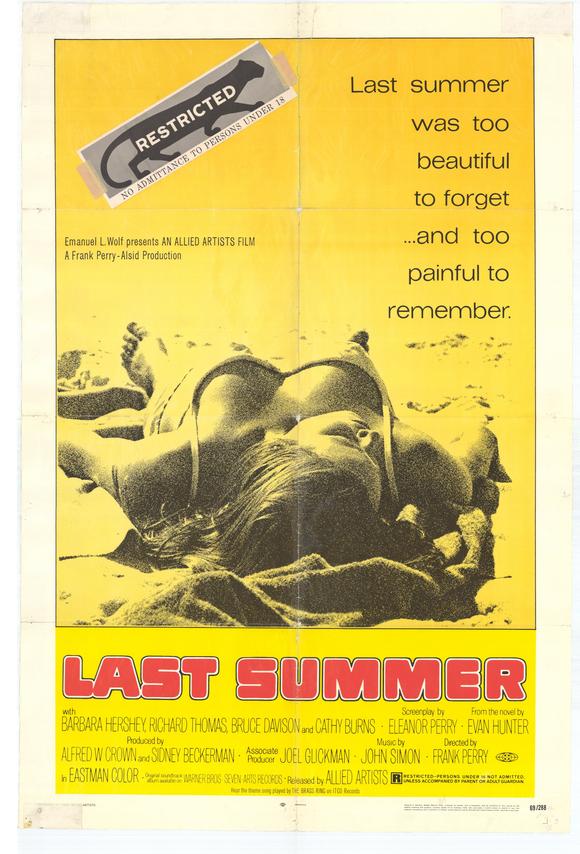
Let’s close out today’s series of melodrama reviews by taking a look at an unfairly obscure film from 1969, Last Summer.  Directed by Frank Perry (who also directed at least part of The Swimmer before getting into an argument with Burt Lancaster), Last Summer is a film about four teenagers who make the mistake of hanging out with each other during one fateful summer.

Peter (Richard Thomas) and his best friend Dan (Bruce Davison) meet Sandy (Barbara Hershey) on the beach.  Sandy recruits them into helping her take care of a seagull with a broken wing and soon, the three of them are inseparable.  The sexually inexperienced Peter and Dan are both attracted to Sandy while Sandy shown proves herself to have a casually destructive streak.  The two boys are so infatuated with Sandy that they even forgive her after she gets bored with the seagull and kills it.

Eventually, Rhoda (Catherine Burns, who was Oscar-nominated for her performance) starts to hang out with the three of them.  Overweight and shy, Rhoda is, at first, an awkward addition to the group but soon, she and Peter start to grow close.  Sandy, who was previously more interested in Dan until she realized that Peter was losing interest in her, reacts by looking for more and more ways to humiliate the insecure Rhoda.  Eventually, they set Rhoda up on a blind date with a shy Puerto Rican man, a cruel prank which quickly goes wrong.

When Rhoda eventually stands up to her three new “friends,” it leads to a disturbing finale that it is all the more effective specifically because it is so inevitable.

I have to admit that I have a weakness for out-of-control youth films, largely because — while I never went as crazy as Sandy or made as many mistakes as Rhoda — I still had my moments back when I was in high school.  In ways both good and bad, I could relate to the two female leads of Last Summer.  There have been times in my life when I’ve felt like the intellectual and naive Rhoda and then there’s been other times when I’ve felt like the beautiful and self-assured Sandy.  For the most part, I’m usually prouder of myself when I feel like Rhoda but I have a lot more fun when I feel like Sandy.  While the two boys largely remain ciphers, Last Summer is worth seeing for the outstanding performances of Barbara Hershey and Catherine Burns.  Combined with Frank Perry’s atmospheric direction (you can literally see the layers of ennui and humidity clinging to some of the scenes), the end result is an effectively creepy coming-of-age film.

For some unknown reason, Last Summer appears to one of those rare Oscar-nominated films that has never been released on DVD or Blu-ray.  However, it does occasionally show up on TCM and I would suggest keeping an eye out for it.

Last Summer 1969 Thomas Hershey Davidson

(Incidentally, California Scheming — was was released earlier this year — is pretty much an unacknowledged remake of Last Summer, right down to the bit with the seagull.  California Scheming is actually not a bad film.  It’s certainly deserves better than some of the online reviews that it’s received.)


Embracing the Melodrama #23: The Swimmer (dir by Frank Perry)


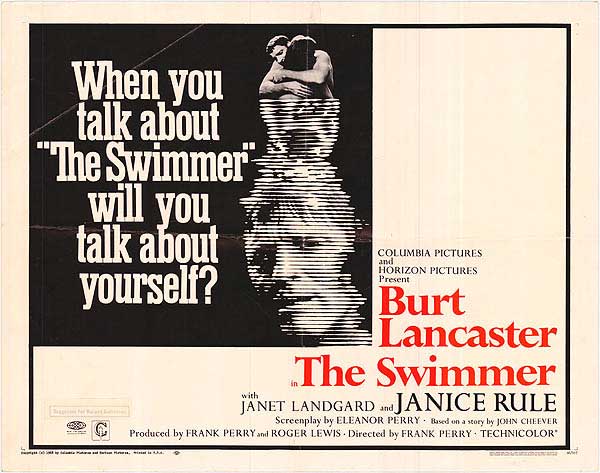
The Swimmer

The 1968 film The Swimmer opens with Ned Merrill (Burt Lancaster) emerging from the woods that surround an affluent Connecticut suburb.  He’s a tanned, middle-aged man and, because he spends the entire film wearing only a bathing suit, we can tell that he’s still in good shape for a man in his 50s.  When Ned speaks, it’s with the nonstop optimism of a man who has found and claimed his part of the American Dream.  In short, Ned appears to be ideal American male, living in the ideal American community.

However, it gradually starts to become apparent that all is not well with Ned.  When he mysteriously shows up at a pool party being held by a group of his friends, they all seem to be shocked to see him, commenting that it’s been a while since Ned has been around.  Ned, however, acts as if there’s nothing wrong and instead talks about how beautiful the day is and says that he’s heading back to his home.  He’s figured out that all of his neighbor’s swimming pools form a “river” to his house and Ned’s plan is to swim home.

And that’s exactly what Ned proceeds to do, going from neighbor to neighbor and swimming through their pools.  As he does so, he meets and talk to his neighbors and it becomes more and more obvious that there are secrets hidden behind his constant smile and friendly manner.  As Ned gets closer and closer to his actual home, the neighbors are far less happy to see him.

At one house, he runs into Julie (Janet Landgard) who used to babysit for his daughter.  Julie agrees to swim with Ned and eventually confesses that she once had a crush on him.  When Ned reacts by promising to always protect  and love her, Julie gets scared and runs away.

At another house, Ned comes across another pool party.  A woman named Joan (played by a youngish Joan Rivers) talks to him before a friend of her warns her to stay away from Ned.

When Ned reaches the house of actress Shirley (Janice Rule), it becomes obvious that Shirley was once Ned’s mistress.  They discuss their relationship and it quickly becomes apparent that Ned’s memories are totally different from Shirley’s.

And, through it all, Ned keeps swimming.  Even when he’s offered a ride to his house, Ned replies that he has to swim home.

The Swimmer is a film that I had wanted to see ever since I first saw the trailer on the DVD for I Drink Your Blood.  (That’s an interesting combination, no?  I Drink Your Blood and The Swimmer.)  I finally saw the film when it showed up on TCM one night and, when I first watched it, I have to admit that I was a little disappointed.  Stylistically, the film itself is such a product of the 1960s that, even though suburban ennui and financial instability are still very relevant topics, The Swimmer felt rather dated.  I mean, I love a good zoom shot as much as anyone but, often times during the 60s, they seemed to be used more for the sake of technique than the sake of story telling.

However, the second time I sat through The Swimmer, I appreciated the film a bit more.  I was able to look past the stylistic flourishes of the direction and I could focus more on Burt Lancaster’s excellent lead performance.  Lancaster plays Ned as the epitome of the American ideal and, as a result, his eventual collapse also mirror the collapse of that same ideal.  The Swimmer is based on a short story by John Cheever and, quite honestly, the film’s story is a bit too much of a literary conceit to really work on film.  That said, The Swimmer — much like the character of Ned Merrill — is an interesting failure, which is certainly more than can be said of most failures.