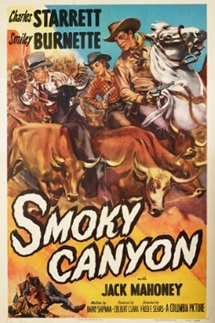
There’s a $2500 dollar reward out for the masked bandit known as the Durango Kid but little do the residents of Timber Rock know that the Kid is actually Steve Brent (Charles Starrett), a Treasury agent who puts on a mask whenever he needs to go undercover and discover what the bad guys are doing.
A range war has broken out between the sheep farmers led by Jack Mahoney (Jock Mahoney) and the cattlemen led by Carl Buckley (Tristram Coffin). To broker a peace and discover which side is the most to blame, Brent works for the cattlemen while the Durango Kid sides with the sheepmen. It turns out that Buckley’s to blame here. He’s using the war to thin out his cattle so that an Eastern beef syndicate can keep prices high. When Mahoney gets too close to the truth, he is framed for the murder of Mr. Woodstock and it’s up to the Durango Kid to prove that Mahoney is innocent. Meanwhile, Carl wants to blow up an entire mountain so that it will really thin out his cattle herd.
This is a typical Durango Kid movie, entertaining if you like B-westerns and probably boring if they’re not your thing. It has all the usual gunfights, horse chases, and dynamite explosions that are promised by every Durango Kid film. Starrett was always one of the most convincing cowboys on screen, even if his use of the Durango Kid alter ego didn’t always make sense. All the usual members of the Durango stock company show up, all playing different characters than they did in the previous Durango Kid film. Mahoney gets to play one of the good guys for once and his spirited girlfriend is played by the lovely Dani Sue Nolan. Smiley Burnett shows up to provide comic relief. This time, he’s a singing tour guide. He sings a song called It’s Got To Get Better. Let’s hope so.
On the frontier, someone is raiding the homes of ranchers like Jim (Henry Hall) and Judy Barton (Paula Raymond). The Homeowners Association summons Steve Roper (Charles Starrett) to bring a stop to the raids. Everyone suspects that Cal Matson (Steve Darrell) and his son, Rob (Billy Halop), are behind the raids but Steve, as the Durango Kid, discovers that a third party is trying to set everyone at war with each other for his own benefit.
The entry in the Durango Kid series was Charles Starrett’s 103rd western. It’s not a particularly distinguished entry, relying heavily on stock footage. I did find the idea of the film’s bad guy trying to manipulate the Bartons and the Matsons into destroying each other to be interesting but the movie doesn’t do much with it and the identity of main villain will be obvious to anyone who watches the film. There is one good scene where Steve disarms three bad guys and then makes them walk all the way back to town without their boots on. Steve doesn’t mess around.
Smiley Burnette provides the comic relief and a few songs. This time, Smiley’s a dime store writer researching his next book. Musically, he is accompanied by The Sunshine Boys. 103 movies in and Smiley still hasn’t figure out that Steve and Durango are one of a kind.
Sherriff Jeff Conner (Jack Rockwell) is having trouble ridding his town of outlaws so his son, Larry, (Mickey Kuhn) writes a letter to his hero to ask for help. He addresses the letter to “Durango Kid, Texas.” That’s all it takes for Steve Randall (Charles Starrett) and his sidekick, Smiley Burnette, to show up in town.
Steve and Smiley apply to be deputies but Sheriff Conner explains that someone is circulating a petition to get him fired. Steve dresses up as the Durango Kid and pressures the citizens to give the Sheriff another chance. Realizing that the Durango Kid is making them look bad, the outlaws decide to dress up one of their own as Durango and make the Kid look bad. With the town turning on Durango, will Durango and Smiley be able to save Sheriff Conner from an assassination attempt?
This Durango Kid film is different from the rest of the series in that, for once, Steve is hired to be a deputy instead of a sheriff. This really is Sheriff Conner’s story, as he tries to win the respect of the town and keep its citizens safe, even while his own brother (Ed Cassidy) is working with the outlaws. There are all the usual horse chase and shootouts but this time, Durango and Smiley are mostly around to provide support to a man who is trying to do the right thing. B-western fans will enjoy it.
Smiley sings a few songs, as always. This time, musical accompaniment is provided by Merle Travis and his Bronco Busters.
Brock Masters (Mark Roberts) has been awarded a contract to supply the army with horses. Corrupt businessman Grat Hanlon (Clayton Moore) wants that contract for himself so he sends his henchmen to kill Brock. Because Brock has no known relatives, Grat believes that both the horses and the contract will soon be his.
However, Brock does have an heir! He adopted an Indian child named Johnny (Louis Lettieri). Johnny inherits the contract and both the Durango Kid (Charles Starrett) and Smiley Burnett are going to make sure that Johnny is able to deliver the horses. Smiley is also going to find some time to sing some songs that have even less to do with the story than usual.
Cyclone Fury was one of the later entries in the Durango Kid series. By the time it was made, Colombia was no longer willing to spend much money on the series so that majority of the film’s action scenes are lifted from other Durango Kid movies. If you’ve never seen another Durango Kid movie, the action scenes are exciting and feature some impressive stunts. If you have seen another Durango Kid movie, this one is going to seem really familiar.
For western fans, the main appeal here will be seeing Clayton Moore playing a bad guy. Moore had already played The Lone Ranger when he appeared in this movie. At the time Cyclone Fury was made, Moore had been unceremoniously fired from his most famous role and The Lone Ranger was being played by John Hart. Hart would only last a season and Moore would subsequently be invited back to play the role that defined his career. As for Cyclone Fury, Moore is convincing as Grat, though the character himself is just a typical Durango Kid bad guy. The Durango Kid was always going up against seemingly respectable businessmen who were actually outlaws.
One final note: Moore’s Lone Ranger co-star, Jay Silverheels, appears in this film but only in archival footage from an early adventure of The Durango Kid.
The 1947 film, Shoot to Kill (also known as Police Reporter), opens with both a bang and a crash.
The police are chasing a car down one dark and lonely road. When that car crashes, the police are shocked to discover who was inside of it. Two men and one woman, all well-dressed. The men are both dead but the woman is merely unconscious. The police identify one of the men as being the notorious gangster, Dixie Logan (Robert Kent). It makes sense that Logan would be fleeing the police but what about his two passengers, newly elected District Attorney Lawrence Dale (Edmund MacDonald) and Dale’s wife, Marian (Luana Walters)?
The police may not be able to get any answers but fortunately, there’s a reporter around! Mitch Mitchell (Russell Wade) is a crime reporter and, seeing as how he knew both Lawrence and Marian, he seems like the perfect person to get some answers. (In fact, it was Mitch who first suggested that Lawrence should hire Marian as his administrative assistant, therefore setting in motion the whirlwind romance that would end with them married.) Mitch goes to see Marian in her hospital room and he asks her what happened.
It’s flashback time! Yes, this is one of those films where almost the entire film is a flashback. That, in itself, is not surprising. Some of the best film noirs of all time were just extended flashbacks. (D.O.A, Double Indemnity, and Sunset Boulevard, to name just a few examples.) What sets Shoot to Kill apart is the fact that, occasionally, we even get characters having a second flashback while already in someone else’s flashback. We’re through the the film noir looking glass here, people.
Lawrence Dale, we’re told, was elected district attorney because he managed to secure the conviction of notorious gangster Dixie Logan, despite Logan’s insistence that he was no longer involved in the rackets. However, what we soon discover is that not only was Logan actually innocent but Dale specifically prosecuted him as a favor to some of Dale’s rival gangsters. That’s right, Lawrence Dale was on the take! It also turns out that Marian has some secrets of her own. When she first showed up at Dale’s office, she was doing more than just looking for a job. As for her marriage to Dale …. well, I really can’t tell you what the twist is here because it would spoil the entire film.
Shoot To Kill may clock in at just 64 minutes but it manages to pack a lot of twists and turns into just an hour. In fact, I’d argue that it probably tries to do a little bit too much. At times, the film is a bit difficult to follow and a few inconsistent performances don’t help matters. For instance, Russell Wade is likable as the crime reporter but he still doesn’t exactly have a dynamic screen presence. Much better cast are Luana Walters and Edmund MacDonald, who both do a good job as, respectively, a femme fatale and a sap. At the very least, history nerds like me will be amused by the fact that Edmund MacDonald was obviously made up to resemble Thomas E. Dewey, the former Manhattan District Attorney who twice lost the U.S. presidency.
The best thing about Shoot To Kill is the look of the movie. Filmed in grainy black-and-white and full of dark shadows, crooked camera angles, and men in fedoras lighting cigarettes in alleys, Shoot to Kill looks the way that a film noir is supposed to look.
Regardless of whether it was the filmmaker’s original intention, Shoot To Kill plays out like a low-budget, black-and-white fever dream. It’s definitely a flawed film but, for lovers of film noir, still worth a look.
 There’s a $2500 dollar reward out for the masked bandit known as the Durango Kid but little do the residents of Timber Rock know that the Kid is actually Steve Brent (Charles Starrett), a Treasury agent who puts on a mask whenever he needs to go undercover and discover what the bad guys are doing.


 Through the Shattered Lens