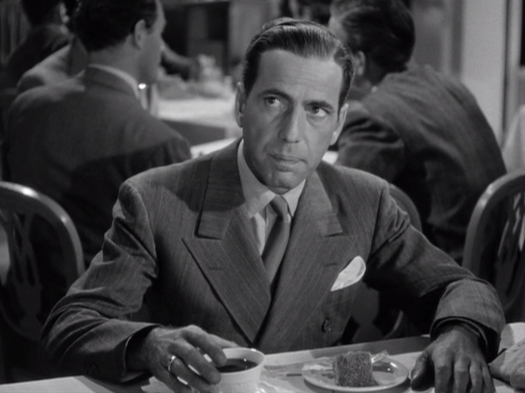
A Loyalty Day Film Review: My Son John (dir by Leo McCarey)


Oh my God, did you know that it’s Loyalty Day!?

Well, actually, it’s not Loyalty Day for everyone.  In fact, a lot of the world’s citizens are celebrating Communist May Day today.  However, here in the United States, it’s Loyalty Day.  Even if you are an American, it’s possible that you’ve never heard of Loyalty Day.  It was first celebrated in 1921 and it was intended to provide a non-Communist alternative to International Workers Day.  It wasn’t until 1955 that Loyalty Day was officially recognized by Congress.

From Wikipedia:

Loyalty Day is defined as follows in 36 U.S.C. § 115:

  • (a) Designation.— May 1 is Loyalty Day.
  • (b) Purpose.— Loyalty Day is a special day for the reaffirmation of loyalty to the United States and for the recognition of the heritage of American freedom.
  • (c) Proclamation.— The President is requested to issue a proclamation—
    • (1) calling on United States Government officials to display the flag of the United States on all Government buildings on Loyalty Day; and
    • (2) inviting the people of the United States to observe Loyalty Day with appropriate ceremonies in schools and other suitable places.

Though released before it officially became a holiday, the 1952 film, My Son John, is perfect for Loyalty Day.
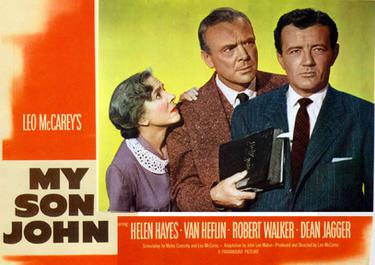
The John of the title is John Jefferson (Robert Walker, in his final role), an employee of the State Department.  While his younger brothers (played by Richard Jaeckel and James Young) are two high school football stars who are looking forward to serving their country in Korea, John is an intellectual who considers concepts like patriotism to be simplistic and naive.  While his father (Dean Jagger) sings patriotic songs at the American Legion hall, John rolls his eyes at such middle class activities.  (“If you don’t like your Uncle Sammy,” move to another country, John’s father sings.)  The only person to whom John is especially close is his nervous mother, Lucille (Helen Hayes).

However, John is keeping a secret from even Lucille.  He’s a double agent, working for the communists!  With FBI agent Stedman (Van Heflin) hot on his trail, will John ever be able to see the light about the communists?  And, how will the communists respond to John having doubts about the cause?

My Son John was a dream project for Hollywood director Leo McCarey.  (It’s not a coincidence that the devoutly Catholic McCarey made a film about a devoutly Catholic family who discovers that one of their own has become a communist.)  McCarey carefully supervised every detail of the film and he was even able to talk stage legend Helen Hayes into starring in the film, her first in 14 years.  My Son John is full of scenes of shadowy communists, smug intellectuals, and all-American FBI agents marveling at the strength of Lucille Jefferson’s faith.  Everything that is today often cited as a negative aspect to living in the suburbs is presented as being a positive in My Son John.  The film’s communists come into a world of happy families, big houses, and well-manicured lawns and they set out to make everyone else as miserable as they are.  There’s nothing subtle about either McCarey’s approach or Helen Hayes’s performance but, as is often the case with propaganda, the film is crudely effective.

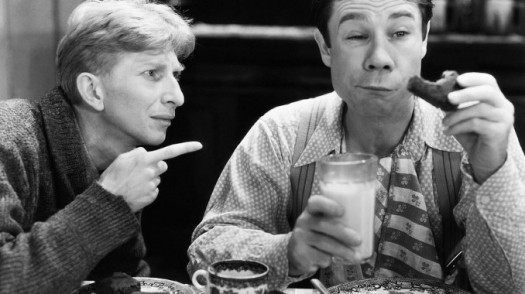
My Son John was Robert Walker’s final film.  In fact, he died before completing work on the film, leading the ending being rewritten.  (No longer would John personally deliver a commencement address.  Instead, his words come out of a tape player that has been rolled out on stage.  A holy light shines down on the player while The Battle Hymn of the Republic plays in the background.  It’s bizarre but it’s also probably the most memorable part of the movie.)  Scenes from Strangers On A Train were rather awkwardly spliced into final moments of My Son John, never mind the fact that Robert Walker’s gleefully evil performance as Bruno Antony had little in common with his self-tortured performance as John Jefferson.

Surprisingly, considering that My Son John was released at the height of the anti-Communist era, the film was not a success at the box office.  (Audiences seemed to better appreciate low-budget and pulpier anti-communist films, like I Was A Communist For The FBI.)  Still, thanks to the Internet, My Son John is still available to be viewed on this Loyalty Day.

So, remember — if you don’t like your Uncle Sammy …. well, actually, the cool thing about this country is that you don’t have to like your Uncle Sammy.  You have the right to decide for yourself how you feel about old Uncle Sammy.  That’s an idea that is worth being loyal to.
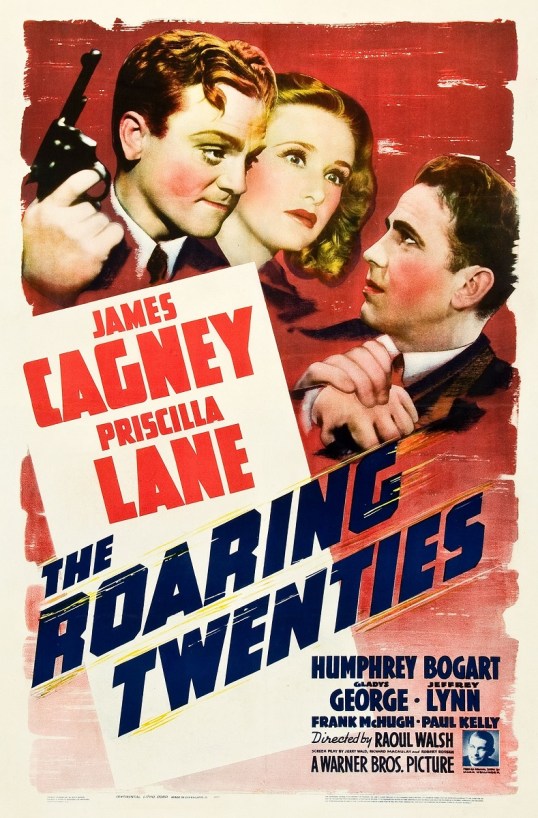
An Offer You Can’t Refuse #7: The Roaring Twenties (dir by Raoul Walsh)


The 1939 gangster epic, The Roaring Twenties opens with newsreel footage of men like Franklin D. Roosevelt, Winston Churchill, and Adolf Hitler.  We watch as they give speeches and as armed soldiers march across Europe.  For those of us watching in the present, these are figures from the past.  For audiences in 1939, though, these were the men who were shaping both their present and their future.

A narrator informs us that the world has changed much over the past few years and that it’s on the verge of changing again.  The world is preparing for war and who knows what society is going to look like afterwards.  (Interestingly enough, at the time that The Roaring Twenties was released, the U.S. was officially neutral when it came to the war in Europe, with many politicians arguing that the U.S. should pursue an isolationist foreign policy.  Though the film seems to be speaking to a nation that was already committed to war but that was actually not the case.)  The narrator goes on to say that it’s easy to forget what America was like just 20 years ago.  World War I was ending.  Soldiers were returning home.  Prohibition has just become the law of the land and, as a result, there was now a whole new way to make illicit cash.  It was a different era, the narrator tells us, one that is running the risk of being forgotten.

With that narration, it’s made obvious that The Roaring Twenties is designed to be more than just a gangster film.  It’s also a history lesson.  With Americans aware that another war might be coming, perhaps they needed to be reminded of what happened during and after the previous one.  By that same token, with people across the world already dying in the fight for freedom, perhaps Americans needed to be reminded of what happened the last time they allowed the government to take those freedoms away.

The Roaring Twenties tells the story of three men who first met in 1918, while they were all hiding out in a foxhole while a bloody and violent war rages all around them.  (The narrator somewhat archly notes that the three men — like all the men who fought and died in World War I — had been told that they were making “the world safe for democracy.”)  The three of them become friend while under fire and they remain friends when they return home to a war-weary nation that refuses to take care of its veterans.  Unfortunately, that friendship doesn’t survive the roaring 20s.

George Holly (Humphrey Bogart) is a former saloon keeper who becomes a major bootlegger after the passage of prohibition.  George is the type who takes pleasure in gunning down a 15 year-old during World War I.  (“He’ll never make 16,” George says after pulling the trigger.)  He doesn’t improve once he returns home but he does find a lot of success as a bootlegger.  Soon, he’s got a mansion.  He’s got bodyguards.  He goes to the best clubs and owns the best clothes.  Prohibition may have been meant to put George Holly out-of-business but instead it’s made him a rich and influential man.

Lloyd Hart (Jeffrey Lynn) is a college-educated idealist, one who becomes a lawyer once he returns home.  Even the most successful of bootleggers needs a good lawyer but Lloyd refuses to compromise his belief in the law, even when it comes to helping out his friends.  Lloyd will eventually end up working out of the district attorney’s office, where he builds cases against men like George Holly.

And finally, there’s Eddie Bartlett (James Cagney).  Eddie is the film’s main character.  He’s a criminal but, unlike George, he’s not totally corrupt.  In many ways, he’s an idealist but he’s never as self-righteous as Lloyd.  While his friends worry about their place and their role in society, Eddie is just trying to survive.  Before he went off to war, Eddie was a mechanic but, once he returns, he discovers that his job has been filled.  With no other work available, Eddie is finally hired to drive a cab.  What is those cabs could be used to smuggle alcohol?  Eddie finds himself working with Panama Smith (Gladys George) while, at the same time, going to war with Nick Brown (Paul Kelly).  In between making and losing a fortune (due to both the end of prohibition and the 1929 stock market crash), Eddie falls in love with singer Jean Sherman (Priscilla Lane).  Because Eddie can’t leave the rackets, Jean ends up married to Lloyd instead.

The film follows these characters, from 1918 to 1933.  Along the way, it also provides a critique of prohibition.  Prohibition is presented as being a bad law, one that led to men like George Holly getting rich and which destroyed the lives of countless people.  By making liquor illegal, the film argues, it also made it appealing to people who would have otherwise never had a drink.  There’s a definite appeal to the forbidden.  Interestingly enough, Eddie never takes a drink while he’s getting rich smuggling the stuff.  It’s only after prohibition is repealed and Eddie finds himself once again reduced to driving a cab for a living that he becomes a drunk.  Rich George and educated Lloyd might survive the end of prohibition by Eddie — who was as much a foot soldier during prohibition as he was during World War I — against finds himself cast out by a society that wants to forget about the national trauma that it’s just gone through.  Eddie, however, isn’t going to go down without a fight.  He’s played by James Cagney, after all.

The Roaring Twenties is a true classic.  It works as a gangster movie, a historical epic, and a portrait of the side effects of out-of-control regulation.  It tells the story about what happens when society becomes more interested in governing people than in helping them.  Indeed, the film asks, what were men like Eddie Bartlett supposed to do when, after risking their lives for their country, they returned home to discover that their jobs were gone, rent had gone up, and the government wouldn’t even allow them to commiserate their sorrows over a cold beer?  Who can blame America for rebelling?  Who can blame the Eddie Barletts of the world for doing what they had to do to survive?

Finally, not only does The Roaring Twenties feature brilliant performances from genre veterans like Bogart and Cagney (in fact, this is a probably Cagney’s best gangster performance) but it also recreates the 20s with such skill that you can’t help but wish that you could have been a part of it.  It all ends with a brilliant final scene on the steps of a church.  “He used to be a big shot!”  Yes, he was.

This is definitely an offer not to refuse.

Previous Offers You Can’t (or Can) Refuse:

  1. The Public Enemy
  2. Scarface
  3. The Purple Gang
  4. The Gang That Could’t Shoot Straight
  5. The Happening
  6. King of the Roaring Twenties: The Story of Arnold Rothstein 

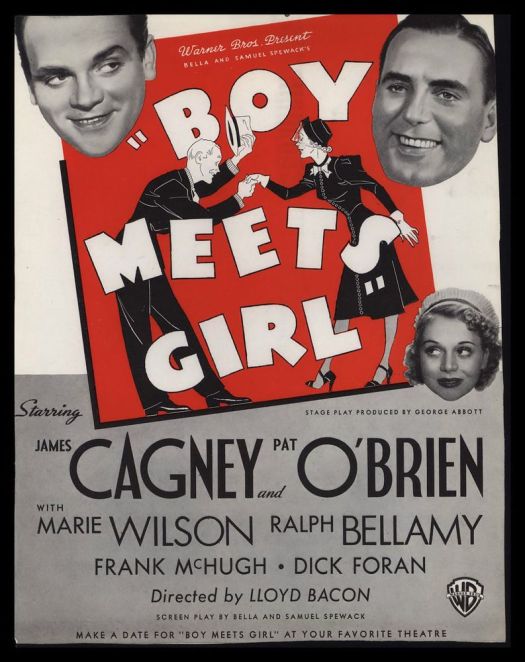
A Wee Bit O’Blarney with Cagney & O’Brien: BOY MEETS GIRL (Warner Brothers 1938)


gary loggins's avatarcracked rear viewer

Tomorrow’s the day when everybody’s Irish, and America celebrates St. Patrick’s Day! The green beer will flow and copious amounts of Jameson will be consumed,  the corned beef and cabbage will be piled high, and “Danny Boy” will be sung by drunks in every pub across the land. Come Monday, offices everywhere will be unproductive, as all you amateur Irishmen will be nursing hangovers of Emerald Isle proportions. They say laughter is the best medicine, so my suggestion is to start your workday watching an underrated screwball comedy called BOY MEETS GIRL, starring James Cagney and Pat O’Brien, both members in good standing of “Hollywood’s Irish Mafia”!

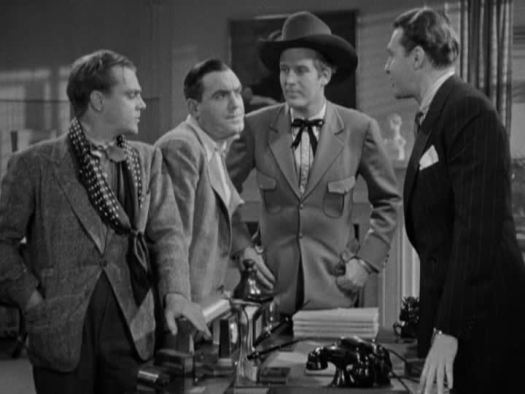
Jimmy and Pat play a pair of wacky screenwriters working for Royal Studios on a vehicle for fading cowboy star Dick Foran. Pretentious producer Ralph Bellamy has enough problems without these two jokers, as rumor has it Royal is about to be sold…

View original post 493 more words

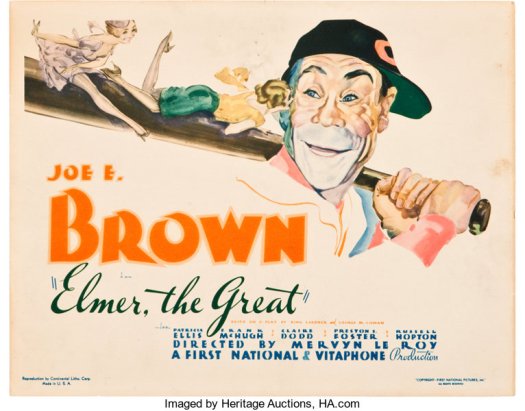
Spring Fever: Joe E. Brown in ELMER THE GREAT (Warner Brothers 1933)


gary loggins's avatarcracked rear viewer

It may be cold and snowy here in New England, but down in sunny Florida, Spring Training has already begun – which means baseball season is on it’s way! The Red Sox are looking good, although they got pounded by the Orioles in the game I watched this afternoon (I’m writing this on a Saturday), but just hearing the crack of the bats has whetted my appetite for the return of America’s National Pastime. So while we wait for Opening Day to arrive, let’s take a look at the 1933 baseball comedy ELMER THE GREAT.

Comedian Joe E. Brown plays yet another amiable country bumpkin, this time Elmer Kane of small town Gentryville, Indiana. Elmer’s  laid back to the point of inertia, except when he’s eating… or on a baseball field! He’s better than Babe Ruth and he knows it, and so do the Chicago Cubs, who’ve bought his contract…

View original post 400 more words

A Hidden ‘Poil’: THREE MEN ON A HORSE (Warner Brothers 1936)


gary loggins's avatarcracked rear viewer

Frank McHugh got a rare starring role in the comedy THREE MEN ON A HORSE, based on the hit Broadway play by George Abbott and John Cecil Holmes. McHugh was usually cast as the funny friend of fellow members of “Hollywood’s Irish Mafia “ James Cagney and Pat O’Brien, but here he takes center stage as a meek, hen-pecked type who has an uncanny knack for picking winning horses – as long as he doesn’t bet on them!

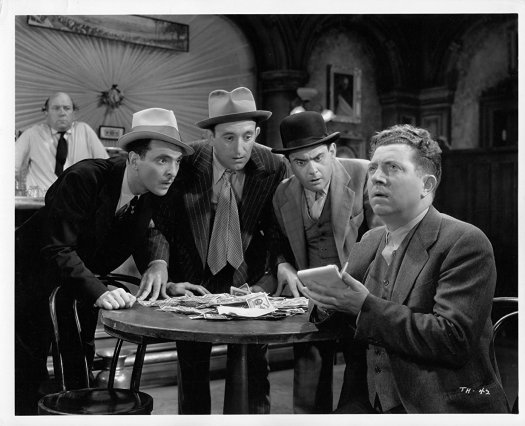
Greeting card writer Erwin Trowbridge is beset by a whiney wife, obnoxious brother-in-law, and bullying boss. After a row with wifey brought on by meddling bro-in-law, Erwin leaves his humble Ozone Park, Queens abode and decides to skip work and get sloshed. Stumbling into a seedy hotel bar frequented by Runyonesque gamblers, Erwin gives them a winning pony – then passes out. The three mugs, Patsy, Charlie, and Frankie, bring him up…

View original post 380 more words

Happy St. Patrick’s Day: THE IRISH IN US (Warner Brothers 1935)


gary loggins's avatarcracked rear viewer

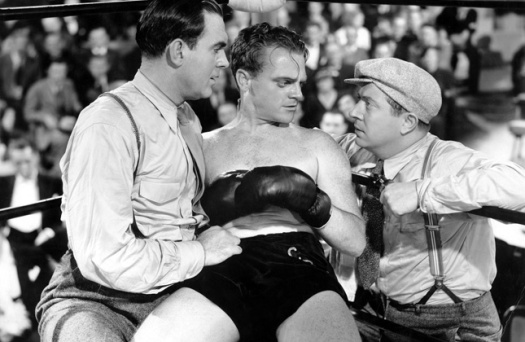
Faith and begorrah! You can’t get much more Irish than a film featuring Jimmy Cagney , Pat O’Brien , and Frank McHugh all together. THE IRISH IN US is sentimental as an Irish lullaby, formulaic as a limerick, and full of blarney, but saints preserve us it sure is a whole lot of fun! The story concerns three Irish-American brothers, the O’Hara’s, living with their Irish mum in a cramped NYC apartment. There’s sensible, levelheaded cop Pat (O’Brien), dimwitted fireman Michael (McHugh), and ‘black sheep’ Danny (Cagney), who’s a fight promoter.

O’Brien, Cagney, and McHugh

Pat announces his intention to marry pretty Lucille Jackson (19-year-old Olivia de Havilland in an early role), while Danny’s got a new fighter named Carbarn Hammerschlog ( Allen Jenkins , who’s a riot), a punchy pug who “every time he hears a bell ring, he starts sluggin”! Danny and Lucille ‘meet cute’ while he’s out…

View original post 465 more words

Hoods vs Huns: ALL THROUGH THE NIGHT (Warner Brothers 1942)


gary loggins's avatarcracked rear viewer

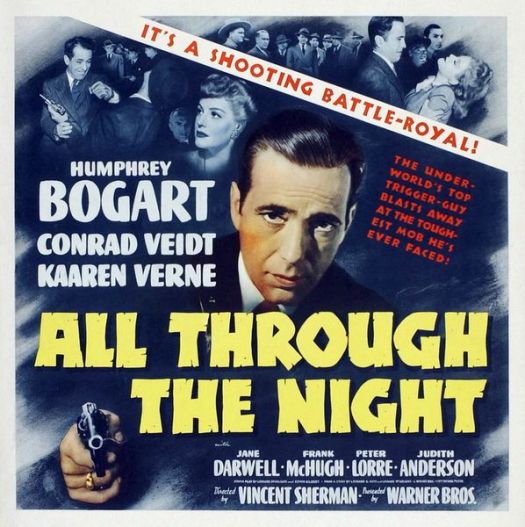
A gang of Runyonesque gamblers led by Humphrey Bogart take on Nazi spies in ALL THROUGH THE NIGHT, Bogie’s follow-up to his breakthrough role as Sam Spade in THE MALTESE FALCON. Here he plays ‘Gloves’ Donovan, surrounded by a top-notch cast of character actors in a grand mixture of suspense and laughs, with both the action and the wisecracks coming fast and furious in that old familiar Warner Brother style. Studio workhorse Vincent Sherman, whose directorial debut THE RETURN OF DOCTOR X also featured Bogart, keeps things moving briskly along and even adds some innovative flourishes that lift the film above its meager budget.

Bogie’s gangster image from all those 1930’s flicks come to a humorous head in the part of ‘Gloves’. He’s a tough guy for sure, but here the toughness is humanized by giving him a warm, loving mother (Jane Darwell ) and a fondness for cheesecake…

View original post 562 more words

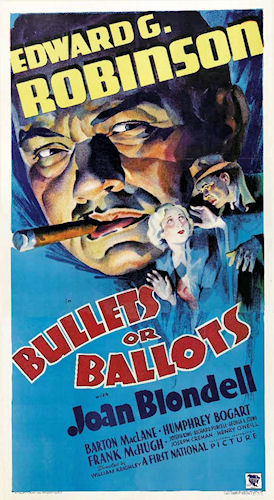
A Movie A Day #180: Bullets or Ballots (1936, directed by William Keighley)


Johnny Blake (Edward G. Robinson) was one of the toughest cops in New York City, until he punched out his new captain (Joe King) and was kicked off the force.  That punch was witnessed by racketeer Al Kruger (Barton McLane).  Kruger has long wanted to get Blake to join his organization and, with Blake now out of work, Kruger makes an offer.  Blake goes to work for Kruger, much to the consternation of Kruger’s second-in-command, Bugs Fenner (Humphrey Bogart).  Bugs says that anyone who was once a cop will always be a cop.  Bugs is right.  Blake is working undercover, trying to expose and take down the mob from the inside.

Bullets or Ballots is an entertaining if predictable gangster film from the 1930s.  After making his career playing bad guys, Robinson makes the transition to the side of law and order without losing any of his trademark attitude.  Bogart plays one of the many remorseless killers that he played before Casablanca reinvented him as a hero.  Bullets or Ballots may be predictable but it’s impossible not to enjoy watching Robinson and Bogart snarl hard-boiled insults at each other.

Second-billed Joan Blondell does not have much screen time but her role is still an interesting one, as a tough businesswoman who runs a numbers racket with her former maid (played by Louise Beavers).  I would have enjoyed seeing a full movie just about Blondell’s character but she mostly takes a back seat to Robinson and Bogart.

Unfortunately, unlike Little Caesar, The Public Enemy, and Scarface, Bullets or Ballots was made after Hollywood started to enforce the infamous Production Code and, as a result, Bullets or Ballots never reaches the gritty, violent heights of those earlier films.  Still, fans of Robinson, Bogart, and Blondell will find much to enjoy here.

End of an Era: THE ROARING TWENTIES (Warner Brothers 1939)


gary loggins's avatarcracked rear viewer

Warner Brothers helped usher in the gangster movie era in the early 1930’s with Pre-Code hits like LITTLE CAESAR and THE PUBLIC ENEMY, and at the decade’s end they put the capper on the genre with THE ROARING TWENTIES, a rat-a-tat-tat rousing piece of filmmaking starring two of the studio’s top hoods, James Cagney and Humphrey Bogart , directed with the top down by eye-patch wearing macho man Raoul Walsh for maximum entertainment.

The film’s story was written by Mark Hellinger, a popular and colorful New York columnist in the Damon Runyon mold who based it on his encounters with some of the underworld figures he knew during that tumultuous era. Hellinger was later responsible for producing some of the toughest noirs of the late 40’s: THE KILLERS BRUTE FORCE , THE TWO MRS. CARROLLS, and THE NAKED CITY. Jerry Wald, Richard Macauley, and Robert Rossen adapted Hellinger’s story for the screen, and the film…

View original post 572 more words

A Movie A Day #57: Here Comes The Navy (1934, directed by Lloyd Bacon)


here_comes_the_navy_posterLisa asked me to review an old best picture nominee for today’s movie a day so I picked Here Comes The Navy, because hardly anyone has ever heard of it and I usually like old service comedies.

Chesty O’Connor (James Cagney) is a construction worker who thinks that he is tougher than anyone in the Navy.  When Chesty gets into a fight with Chief Petty Officer Biff Martin (Pat O’Brien), Chesty enlists in the Navy just to get on his nerves.  Chesty brings his friend Droopy (Frank McHugh) with him.  With Biff determined to force him out of the service, Chesty bristles against the rules of the Navy.  But then Chesty meets and falls in love with Dorothy (Gloria Stuart), Biff’s sister.  Chesty loses his bad attitude, proves that his shipmates can depend on him, saves Biff’s life when an airship landing goes wrong, and even gets to marry Biff’s sister.

Here Comes The Navy is a typical 1930s service comedy, distinguished mostly by the wiseguy presence of James Cagney.  It is the type of movie where men have names like Chesty, Biff, and Droopy.  Warner Bros. made a hundred versions of this story and Here Comes The Navy was certainly one of them.

Here Comes The Navy was produced with the full cooperation of the U.S. Navy, so it’s not surprising that it feels like a recruiting film.  The sailors are all happy to do their bit to protect the American way of life and the commanding officers are all tough but fair.  The majority of the movie was filmed on the USS Arizona, which would be sunk seven years later during the Japanese attack on Pearl Harbor.  Here Comes The Navy also features some scenes shot on the USS Macon, an airship that would crash a year later.

It’s hard to guess how Here Comes The Navy came to be nominated for best picture.  It’s okay but, for the most part, it’s for James Cagney completists only.