Lisa Reviews An Oscar Nominee: Lost Horizon (dir by Frank Capra)


Long before there was Lost, there was Lost Horizon!

Much like the famous television show, the 1937 film Lost Horizon begins with a group of strangers on an airplane.  They’re people from all walks of life, all with their separate hopes and dreams.  When the plane crashes, they find themselves stranded in an uncharted land and, much like the Lost castaways, they are shocked to discover that they are not alone.  Instead, they’ve found a semi-legendary place that is ruled over by a man who has lived for centuries.  Much as in Lost, some want to return to civilization while others want to remain in their new home.  Both Lost and Lost Horizon even feature a terminally ill woman who starts to recover her health after becoming stranded.

Of course, in Lost, everyone was just flying from Australia to America.  In Lost Horizon, everyone is trying to escape the Chinese revolution.  Among the passengers on the plane: diplomat Robert Conway (Ronald Colman), his irresponsible brother, George (John Howard), a con artist named Henry (Thomas Mitchell), a paleontologist (Edward Everett Horton), and the very ill Gloria (Isabel Jewell).

While Lost featured a plane crash on a tropical island, Lost Horizon features a plane crash in the Himalayas.  In Lost, the sinister Others sent spies to infiltrate the survivors.  In Lost Horizon, the mysterious Chang (H.B. Warner) appears and leads the survivors to a place called Shangri-La.

Shangi-La is a lush and idyllic valley that has somehow flourished in one of the most inhospitable places on Earth.  The happy inhabitants inform the survivors that they never get sick and they never fight.  They’re led by the High Lama (Sam Jaffe), a philosopher who explains that he is several hundred years old.  The valley is full of magic and the Lama tells the survivors that Shangri-La is their new home.

Now, I’ve seen enough horror movies that I spent most of Lost Horizon waiting for the Lama to suddenly reveal that he was a vampire or an alien or something.  Whenever anyone in a movie seems to be too good to be true, that usually means that he’s going to end up killing someone about an hour into the story.  But that didn’t happen in Lost Horizon.  Instead, the Lama is just as wise and benevolent as he claims to be and Shangri-La is as much of a paradise as everyone assumes.  I guess we’re just naturally more cynical in 2018 than people were in 1937.

Of course, the Lama isn’t immortal.  Not even the magic of Shangri-La can prevent the inevitably of death.  The Lama is looking for a successor.  Could one of the survivors be that successor?  Perhaps.  For instance, Robert absolutely loves Shangri-La.  Of course, his brother George is determined to return to the real world.  He has fallen in love with one of the inhabitants of Shagri-La and plans to take her with him, despite the Lama’s warning about trying to leave…

Frank Capra was a huge fan of James Hilton’s book, Lost Horizon, and he spent three years trying to bring it to the big screen.  Based on Capra’s previous box office successes, Colombia’s Harry Cohn gave Capra a budget of $1.25 million to bring his vision of Shangri-La to life.  That may not sound like much today but, at the time, that made Lost Horizon the most expensive movie ever made.  The production was a notoriously difficult one.  (The original actor cast as the elderly Lama was so excited to learn he had been selected that he dropped dead of a heart attack.)  As a result of both its ornate sets and Capra’s perfectionism, the film soon went overbudget.  When Capra finally delivered a first cut, it was over 6 hours long.  Capra eventually managed to edit it down to 210 minutes, just to then have Harry Cohn order another hour taken out of the film.  When Lost Horizon was finally released, it had a running time of 132 minutes.

Seen today, Lost Horizon is definitely an uneven work.  With all the cutting and editing that went on, it’s hard to guess what Capra’s original vision may have been but, in the final version, much more time is devoted to the characters discussing the philosophy of Shangri-La than to the characters themselves.  (It’s always good to see Thomas Mitchell but he really doesn’t get much to do.)  Since you never really feel like you know what any of these characters were like outside of Shangi-La, it’s hard to see how being in Shagri-La has changed them.  You just have to take their word for it.  That said, it’s a visually stunning film.  Capra may have gone over budget creating the look of Shangri-La but it was money well-spent.  If I ever find myself in a magic village, I hope it looks half as nice as the one in Lost Horizon.

Despite all of the drama that went on behind the scenes and a rather anemic box office reception, Lost Horizon was nominated for best picture.  However, it lost to The Life of Emile Zola.
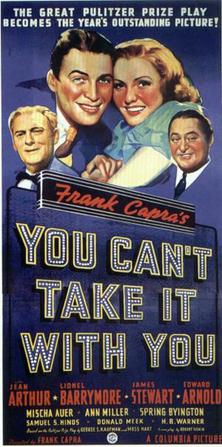
Lisa Reviews An Oscar Winner: You Can’t Take It With You (dir by Frank Capra)


(With the Oscars scheduled to be awarded on March 4th, I have decided to review at least one Oscar-nominated film a day.  These films could be nominees or they could be winners.  They could be from this year’s Oscars or they could be a previous year’s nominee!  We’ll see how things play out.  Today, I take a look at the 1938 best picture winner, You Can’t Take It With You!)

“You can’t take it with you.”

If there’s any one belief that defines the worldview of Martin Vanderhof (Lionel Barrymore), it’s this.  It doesn’t matter how much money you make in your life.  It doesn’t matter how successful you are at business or anything else.  The fact of the matter is that, when your time is up, you won’t be able to take any of that stuff with you.  Instead, Grandpa Vanderhof (as he’s called by his large family) believes that the most important thing to do during your lifetime is to make friends and pursue what you’re truly interested in.

Vanderhof has another belief, one that particularly appealed to be me.  He has never paid income tax.  He doesn’t see the point of giving money to the government when he doesn’t feel that they’ll make good use of it.  When an outraged IRS agent (Charles Lane) stops by Vanderhof’s sprawling house and demands that Vanderhof pay his taxes, Vanderhof refuses.  When the IRS man argues that the income tax is necessary to pay for the Presidency, the Congress, and the Supreme Court, Vanderhof offers to give him five dollars.  “Hell yeah!” I shouted at the TV.  With an attitude like that, Vanderhof should have moved down here to Texas.  We would have elected him governor.

Grandpa Vanderhof is the head of a large and cheerfully eccentric family, all of whom live together under the same roof.  Penny (Spring Byington) writes novels because, years ago, a typewriter was accidentally delivered to the house.  Her husband, Paul (Samuel S. Hinds), has a basement full of fireworks.  Essie (Ann Miller) loves to dance and spends almost the entire movie twirling from room to room.  Her husband, Ed (Dub Taylor), is a xylophone player.

Of course, it’s not just family living in the Vanderhof House.  There’s also Potap Kolenkhov (Mischa Auer), a Russian who is “teaching” Essie how to dance.  There’s Rheba the maid (Lillian Yarbo) and Donald (Eddie Anderson) the handyman.  Actually, the house appears to be open to just about anyone who wants to stay.

And then there’s Penny’s daughter, Alice (Jean Arthur).  Alice is the most “normal” member of the family.  She has just become engaged to Tony Kirby (James Stewart) and she is still trying to figure out how to introduce Tony’s stuffy parents (Edward Arnold and Mary Forbes) to her eccentric family.  What she and Tony don’t know is that Mr. Kirby is currently trying to buy up all the houses that are near a competitor’s factory.  Only one homeowner has refused to sell.  The name of that homeowner?  Martin “Grandpa” Vanderhof.

It all leads, of course, to one chaotic dinner party, one lively night in jail, and a huge fireworks display.  It also leads to true love, which is nice.  Jimmy Stewart and Jean Arthur are even more adorable here than they were in Mr. Smith Goes To Washington.

Based on a Pulitzer-winning play by George S. Kaufman, You Can’t Take It With You was the second comedy to win the Oscar for Best Picture.  The first comedy to win was 1934’s It Happened One Night.  It’s probably not coincidence that both of these films were directed by Frank Capra.

Seen today, You Can’t Take It With You seems a bit slight for an Oscar winner.  Grandpa Vanerhof is a lovable eccentric.  Tony’s father is a stuffy businessman.  Hmmm … I wonder whose philosophy is going to be victorious at the end of the movie?  Still, predictability aside, it’s a delightfully enjoyable film.  While it never quite escape its stage origins, it features wonderful performances from all the usual members of the Capra stock company.  James Stewart and Jean Arthur are a charming couple while Lionel Barrymore gives a performance that is so warmly likable that it’s hard to imagine that, just 9 years later, he would be so perfectly cast as the heartless Mr. Potter in It’s A Wonderful Life.  Of course, my favorite member of the member was Essie, mostly because I also like to dance from room to room.  While it’s hard to justify awarding it Best Picture over The Adventures of Robin Hood and Grand Illusion, You Can’t Take It With You is still a wonderfully fun movie.

It’ll make you smile and laugh.  Who can’t appreciate that?


Classic Film Lovers Rejoice! Here’s The Trailer for Five Came Back!


If you love classic movies, you’re going to love this trailer for the new Netflix documentary, Five Came Back!

Based on Mark Harris’s brilliant non-fiction book, Five Came Back takes a look at the work that five great directors — Frank Capra, William Wyler, John Huston, George Stevens, and John Ford — did during World War II.  It’s a fascinating story and it was a fascinating book.  I just hope this documentary does it justice.

We’ll find out on March 31st!

(Incidentally, Five Came Back is narrated by Meryl Streep so expect to see her nominated for Best Actress next year…)

Scenes I Love: George Meets Mary Again in It’s A Wonderful Life


It may seem strange, on Valentine’s Day, to share a scene that I love from a Christmas movie.  Well, we’re all about being strange here at the Shattered Lens!

Add to that, George and Mary share one of the greatest romances ever put on the big screen.  It may be a Christmas movie but it’s also a love story.

So, for your viewing pleasure, here’s how it all started…

Holiday Scenes That I Love: The Ending of It’s A Wonderful Life


At this very moment, NBC is broadcasting the classic 1946 film, It’s A Wonderful Life!  They show it every Christmas Eve and every year, I watch.

Why?

Because I love this movie so much that I could watch it a million times and then a million times more!  There is no movie that makes me happier than It’s A Wonderful Life.  There is no movie that brings tears to my mismatched eyes as quickly as It’s A Wonderful Life.  I love this film so much that I even watch it outside of December.  If I’m depressed, this is the movie that I’m going to watch.

And who can blame me?  The scene below is one that I love but, to be honest, there’s not a single scene in It’s A Wonderful Life that I don’t love.  I even love those scenes with old Sam Wainwright going, “Hee haw!”  Sam may have been a jackass but he was a good guy underneath it all.

(Plus, he made a fortune in plastics!  Money can excuse all sorts of obnoxious behavior!)

As for the scene below, it’s the final ten minutes of It’s A Wonderful Life.  To me, nothing exemplifies the joy of the holidays better than Jimmy Stewart running down the snow-filled streets of Bedford Falls and shouting “Merry Christmas” to everyone, even mean old Mr. Potter.  (“And a happy new year to you — IN JAIL!”)  This is a great scene and wonderfully acted by James Stewart, Donna Reed, Lionel Barrymore, Ward Bond, and everyone else in the film!

And here it is!

(For an alternative take on whether or not Bedford Falls would have been better off if George Bailey had never been born, check out this interview with Mr. Potter himself!)


4 Shots From 4 Holiday Films: Holiday Inn, It’s A Wonderful Life, Miracle on 34th Street, White Christmas


4 Shots From 4 Films is just what it says it is, 4 shots from 4 of our favorite films. As opposed to the reviews and recaps that we usually post, 4 Shots From 4 Films is all about letting the visuals do the talking.

4 Shots From 4 Holiday Films

Holiday Inn (1942, dir by Mark Sandrich)

Holiday Inn (1942, dir by Mark Sandrich)

It's A Wonderful Life (1946, dir by Frank Capra)

It’s A Wonderful Life (1946, dir by Frank Capra)

Miracle on 34th Street (1947, dir by George Seaton)

Miracle on 34th Street (1947, dir by George Seaton)

White Christmas (1954, dir by Michael Curtiz)

White Christmas (1954, dir by Michael Curtiz)

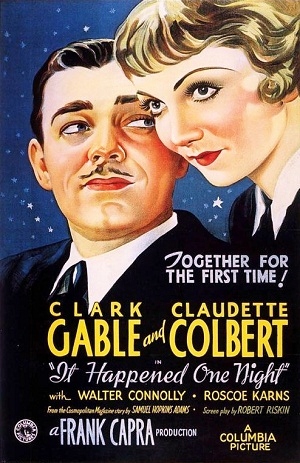
Cleaning Out The DVR #38: It Happened One Night (dir by Frank Capra)


For those following at home, Lisa is attempting to clean out her DVR by watching and reviewing 38 films by the end of today!!!!!  Will she make it?  Well, it depends on whether or not she can finish the review below!)

Gable_ithapponepm_poster

Before I talk too much about the 1934 film It Happened One Night, I want to tell a story about legs.

I’ve always been insecure about having a slightly large nose and once, when I was 17 years old, I was giving my mom a hard time about the fact that I had basically inherited it from her.  I was going on and on and being fairly obnoxious about it.  (Yes, believe it or not, I can occasionally be obnoxious…)

Finally, my mom held up her hand and said, “Yes, you got your nose from me but you also got my legs so stop crying!”

And you know what?  I glanced down at my legs and I realized that she was right and that made me feel a lot better.  Ever since then, I’ve taken a lot of pride in having a good pair of legs.

Now, you may be asking yourself what that has to do with It Happened One Night.  Well, It Happened One Night is one of the ultimate “good legs” movies.  That’s because It Happened One Night features the famous scene in which Claudette Colbert teaches Clark Gable the proper way to hitchhike.  (If I ever take up hitchhiking, I’m planning on using the same technique.)

That’s the scene that It Happened One Night is justifiably famous for.  However, It Happened One Night is more than just a film about hitchhiking.

It’s also a romance, one that features Claudette Colbert at her wackiest and Clark Gable at his sexiest.  Reportedly, the sell of undershirts plummeted after Clark Gable took off his shirt and revealed that he wasn’t wearing one.

It was one of the first road movies and it was such a success that it remains influential to this very day.  Any time you watch a movie that features two seemingly different characters getting to know each other on a road trip, you’re watching a movie that exists because of It Happened One Night.  (And yes, that includes Tom Hardy and Charlize Theron in Mad Max: Fury Road.)  

Frank Capra won his first Oscar for directing this film and It Happened One Night remains one of his most likable and least preachy films.  Just compare the unpretentious, down-to-Earth style of It Happened One Night to Meet John Doe.

Perhaps most importantly, It Happened One Night was the first comedy to win the Oscar for best picture.  It Happened One Night is a film that announces that a film doesn’t have to be a self-serious, pretentious epic to be great. Before the victory of It Happened One Night, the top prize was exclusively reserved for films like Cimarron and Calvalcade.  (Seriously, just try watching some of those early winners today.)  It Happened One Night‘s Oscar victory was a victory for the future of entertainment.

(By the way, as I sit here typing up this review, I keep accidentally typing It’s A Wonderful Life instead of It Happened One Night.  That’s the power of Frank Capra.)

It Happened One Night tells the story of  Pete Warne (Clark Gable).  Pete is an out-of-work reporter.  Though he may be down on his luck, he’s still confident and lovably cocky in that way that only Clark Gable could be.  While riding on a bus from Florida to New York, Pete recognizes one of his fellow passengers as Ellie Andrews (Claudette Colbert), an heiress who has recently eloped with a buffoonish big game hunter named King Westley (Jameson Thomas).  Ellie’s father wants to get the marriage annulled and has people all over the country searching for his daughter.  Pete agrees not to call Ellie’s father if Ellie will agree to give him an exclusive story when she meets up with Westley in New York.

For the rest of the film, we follow Pete and Ellie as they cross the United States, spending awkward nights in motel rooms, getting kicked off of buses, and hitchhiking.  Ellie gives lessons on how to get a car to stop.  Pete delivers a long monologue on the proper way to undress before going to bed.  Along the way, Pete and Ellie fall in love.  It also becomes obvious that Ellie’s father is right about Westley only marrying her for her money.

They also meet a large cast of increasingly eccentric characters.  Whether they’re dealing with the passengers on the bus or the cranky people staying at a rest stop or a motorist who won’t stop singing, Pete and Ellie do noy meet anyone who doesn’t have at least one odd quirk.  Like many classic screwball comedies, It Happened One Night takes place in a world where everyone — from a bus driver to a desk clerk to a group of women waiting to use a shower at a rest stop — has something to say about everything.  Some of the film’s funniest moments come from watching the normally smooth Pete have to deal with the increasingly crazy world in which he’s found himself.

(For her part, Ellie is at her happiest when things are at their strangest.  Ellie’s the best.)

The other great moments come from simply watching Gable and Colbert interact.  They have an amazing chemistry and it comes through in their performances.  It’d odd to read that apparently neither Gable nor Colbert were happy to be cast in It Happened One Night because their performances are so much fun to watch.  A love story only works if you love the characters and the love story in It Happened One Night definitely works.

As I stated above, It Happened One Night was the first comedy to win Best Picture.  Beyond that, it was also the first movie to win all of the top 5 Oscars: Picture, Director, Actor, Actress, and Adapted Screenplay.  (Those were also the only 5 nominations that It Happened One Night received.)  For once, the Academy got it right.  It Happened One Night remains a delightful film.

(Oh my God, y’all, I did it!  That’s 38 films reviewed in 10 days and my DVR now has space to record all sorts of things!  And making it all the better is that I finished this project by reviewing a truly wonderful comedy like It Happened One Night!)

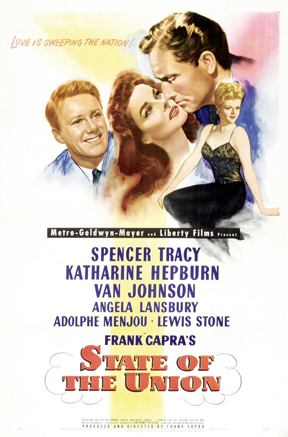
Shattered Politics #9: State of the Union (dir by Frank Capra)


Sotu1948

“Politicians have remained professionals only because the voters have remained amateurs!” — State of the Union (1948)

Does anyone remember the Americans Elect fiasco of 2012?

Americans Elect was an organization set up by a bunch of businesspeople, attorneys, and out-of-office politicians.  Their stated goal was to challenge the political establishment, shake up the two-party system, and elect a president.  The idea was that the party would hold a nationwide primary.  Any registered U.S. voter could go online and cast their vote on what they thought should be in the party’s platform and who they thought should be the Americans Elect presidential candidate.  Whoever won this nationwide primary would be required to 1) run on the platform and 2) pick a vice presidential candidate from the opposite party.

And all would be right with the world, right?

Right.

Anyway, I did register as an American Elect delegate, just because I was curious to see who was getting votes in the nationwide primary and who wasn’t.  (And yes, I did cast a vote.  I voted for Dallas County Commissioner Elba Garcia.)  Looking over the site, I saw that all of the usual suspects were getting votes — Ron Paul, Hillary Clinton, Michael Bloomberg, Donald Trump, and even Barack Obama.  None of the big vote getters were exactly nonpartisan or independent figures.  With the possible exception of Ron Paul, all of them were members of the very establishment that Americans Elect was claiming to challenge.

Anyway, Americans Elect ended up nominating no one for President and, as we all know, the 2012 election came down to choosing between two candidates who both received money from the same millionaires and, in the end, the status quo was upheld.

To be honest, everyone should have realized that Americans Elect was a sham as soon as the New York Times printed a column praising the effort.  Any truly independent political organization would never be praised by the New York Times.  Instead, like most so-called independent political organizations, Americans Elect was just a case of certain members of the establishment slumming.

So, the lesson of American Elect would seem to be that any attempt to run outside of the mainstream will, in the end, simply lead you back to the mainstream.  That was an expensive lesson for all of the volunteers who devoted their time to getting Americans Elect on the ballot in 28 states.  It was a lesson that they could have learned much more easily by watching the 1948 film, State of the Union.

In State of the Union, newspaper publisher Kay Thorndyke (Angela Lansbury) wants to make her lover, Grant Matthews (Spencer Tracy), President of the United States.  Grant is a no-nonsense, plain-spoken businessman who is quick to explain that he loves and cares about his country but that he hates partisan politics.  (In many ways, it’s impossible not to compare Grant to … well, to just about every single wealthy businessman who has ever run for public office while claiming to essentially be nonpolitical.  The big difference is that Grant actually means it.)  However, by subtly appealing to both his ego and his patriotism, Kay convinces Grant to run.  With the help of sleazy Jim Conover (Adolphe Menjou) and the sardonic Spike McManus (Van Johnson), Kay uses her money and her newspapers to turn Grant into a viable candidate.

The only problem is that Grant is separated from his wife Mary (Katharine Hepburn) and, since this movie was made in the 1940s, everyone knows that Grant has to be seen as being a family man if he’s going to be elected.  For the election, Mary and Grant pretend to be happily married.

As the primary season continues, Grant finds himself being more and more manipulated by Kay and Jim.  Eventually, Grant is forced to make a decision between his campaign and his integrity…

Following Mr. Smith Goes To Washington and Meet John Doe, State of the Union was the third part of director Frank Capra’s political trilogy.  Based on a play (which, itself, was supposedly inspired by the 1940 Republican presidential candidate, Wendell Willkie), State of the Union never quite escapes its stage-bound origins.  Add to that, the film was probably a bit more shocking when it was first released in 1948.  In 2015, we’re used to idea of politicians being controlled by money.  But, in 1948, audiences were perhaps a little bit more innocent.

But, that said, State of the Union is still an entertaining film.  Needless to say, Spencer Tracy and Katharine Hepburn have a wonderful chemistry together and Hepburn gets a great drunk scene.  (Hepburn had such an aristocratic presence that it’s always fun to watch her do comedy.)  Angela Lansbury also does well, playing a character who could very well grow up to be the role she played in The Manchurian Candidate.

67 years after it was first released, State of the Union remains an entertaining film that makes some good and still relevant points.  In 2016, when you’re tempted to get involved with the latest version of Americans Elect, watch State of the Union instead.

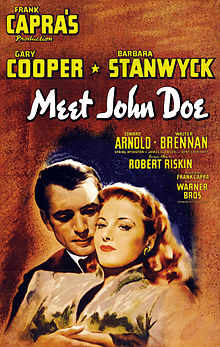
Shattered Politics #7: Meet John Doe (dir by Frank Capra)


Meet John Doe

I cannot stand the phrase “pay it forward.”

The idea is that somebody does something nice for you and then they say, “Pay it forward” and suddenly, you are magically required to go out and do something nice for someone else.  For one thing, I hate the obligation of it all.  I have this fear that as soon as I finally get finished paying it forward, some stranger is going to hand me a Coke and say, “Pay it forward,” and suddenly I’ll have to do it all over again!  And really, honestly, I shouldn’t have to pay it forward just because someone  gives me a Coke.  If you’re going to tell me to pay it forward, at least give me a car or a Victoria’s Secret gift card or something.

Ultimately, “pay it forward” is something that people say to make themselves feel good but it’s actually a pretty shallow concept.

The same thing can be said about John Doeism, the philosophy that rests at the center of the 1941 film Meet John Doe, our latest entry in Shattered Politics.  John Doeism is a grassroots political movement that is based around the slogan, “Be a Better Neighbor.”  Much like “Pay it forward,” “Be a better neighbor” sounds good and it’s easy to say but its main appeal is that it doesn’t require that much thought.  If anything, it sounds like the first step on the road to serfdom…

That said, I still like the film.

Meet John Doe opens with lay-offs at a major metropolitan newspaper.  (These lay-offs are signified by a handsome young man who points at people and then runs his finger across his throat.)  Among those laid off is columnist Ann Mitchell (Barbara Stanwyck).  However, before Ann is officially let go, she is told to write one final column.  Understandably angry over her treatment, Ann responds by making something up.  She writes and prints a fake letter from a man calling himself “John Doe.”  John Doe explains that he’s unemployed and that he will be committing suicide on Christmas Eve.

Well, quicker than you can say twitter death hoax, everyone in the entire country reads John Doe’s letter and demands to know who he is.  The newspaper’s editor, Henry Connell (James Gleason), rehires Ann and puts her in charge of finding the real John Doe.

When numerous unemployed and homeless men start to show up at the newspaper, claiming to be the real John Doe, little do they realize that they are, in fact, auditioning.  Ann finally decides that Joe Willoughby (Gary Cooper) has what it takes to be the public face of John Doe.  Not only does he have a compelling personal story (he’s a former baseball player whose career was ended by an arm injury) but he looks and sounds like Gary Cooper.

(And, as I typed that last sentence, it suddenly occurred to me that Meet John Doe managed to predict American Idol…)

Joe is soon a celebrity, reading speeches that have been written for him by Ann and encouraging people across the nation to be a better neighbor.  And Ann is falling in love with Joe.  However, Joe is not comfortable with his new role.  For one thing, he doesn’t like being a hero for telling a lie.  Secondly, he knows that rival newsmen are eager to expose him as being a fraud.  And finally, there’s a sinister publisher named D.B. Norton (played by Edward Arnold, who previously played corrupt Boss Taylor in Mr. Smith Goes To Washington) who is eager to be President of the United States.  He wants to turn John Doeism into a fascist political movement and, unless Joe endorses him, he’ll reveal that Joe’s a fraud…

Meet John Doe was Frank Capra’s follow-up to Mr. Smith Goes To Washington.  It features many of the same themes as Mr. Smith, with the main difference being that Meet John Doe is a lot more preachy.  Whereas Mr. Smith saved its big speech for the end, Meet John Doe has several big speeches spread throughout its running time.  (There’s also a scene where a guy named Bert tells the story of how he was inspired by John Doe and, I swear, it literally goes on forever.)

So, no, Meet John Doe is definitely no Mr. Smith Goes Go To Washington but I still liked it, mostly because of the chemistry between Gary Cooper and Barbara Stanwyck.  I wanted to be Barbara Stanwyck’s character.  Seriously, watching a film like Meet John Doe, leaves me convinced that I was born several decades too late.  If I had been born in 1918, I could have been a quick-witted, cynical, and secretly romantic intrepid girl reporter at a major metropolitan newspaper.

Girl Reporter

Even better, I would never have to worry about ever being told to “pay it forward.”

Shattered Politics #4: Mr. Smith Goes To Washington (dir by Frank Capra)


mr-smith-goes-to-washington

So, when you read that I was going to be reviewing 94 political films here at the Shattered Lens, you probably knew that one of them would have to be the 1939 best picture nominee, Mr. Smith Goes To Washington.

So, we all know that story right?  The senator from an unnamed state dies.  The weak-willed Governor (Guy Kibbee) has to appoint a new senator.  Political boss Jim Taylor (Edward Arnold) demands that the governor appoint one of his cronies.  The state’s reformers demand that the Governor appoint a never-seen crusader named Henry Hill (who, whenever I hear his name, makes me think of Ray Liotta snorting cocaine in Goodfellas).  The Governor’s children demand that he appoint Jefferson Smith (James Stewart, of course!), who is the head of something called the Boy Rangers.  The Governor flips a coin.  The coin lands on its edge but it also lands next to a newspaper story about Jeff Smith.

So, of course, Mr. Smith goes to Washington.

Now, as the movie quickly makes clear, Jeff Smith is immediately out-of-place in Washington.  For one thing, he’s actually excited to be there.  He’s convinced that he’s there to make America a better place.  When a bunch of drunken reporters (led by the great Thomas Mitchell) make Smith look foolish, Smith responds by running around Washington and punching them out.  (That whole sequence probably serves as wish fulfilment for a lot of politicians.)  When his cynical legislative aide Saunders (Jean Arthur) tells him that he’s too naive to survive in Washington, he wins her over with the purity of his idealism.  When his mentor, Senator Paine (Claude Rains), is revealed to be a part of Washington’s corrupt culture, Smith is stunned.  When Taylor tries to destroy his political career, Smith responds by giving the filibuster to end all filibusters.  He’s one man standing up against a culture of corruption and…

And there’s a reason why, 76 years later, aspiring political candidates still attempt to portray themselves as being a real-life, modern Jefferson Smith.

This is one of those films that everyone seems to agree is great and, of course, there’s many reasons to love Mr. Smith Goes To Washington.  There’s the lead performance of Jimmy Stewart, of course.  While this may not be his best performance (I prefer the more layered characterization that he brought to It’s A Wonderful Life and Anatomy of a Murder), it is Stewart at his most likable and, most importantly, he makes you feel Jeff Smith’s pain as he discovers that Washington is not the great place that he originally assumed it to be.  Claude Rains was always great when it came to playing good men gone wrong and he’s perfect as Sen. Paine.  Thomas Mitchell and Jean Arthur are perfectly cast and I always enjoy seeing the bemused smile on the face of Vice President Harry Carey as Smith conducts his filibuster.

But I think the best thing about Mr. Smith Goes To Washington is that it actually makes you believe that there are Jeff Smiths out there who actually could make a difference.  And, until Judd Apatow gets around to remaking the film with Adam Sandler, audiences will continue to believe.