The TSL’S Daily Horror Grindhouse: Devil Monster (dir by S. Edwin Graham)


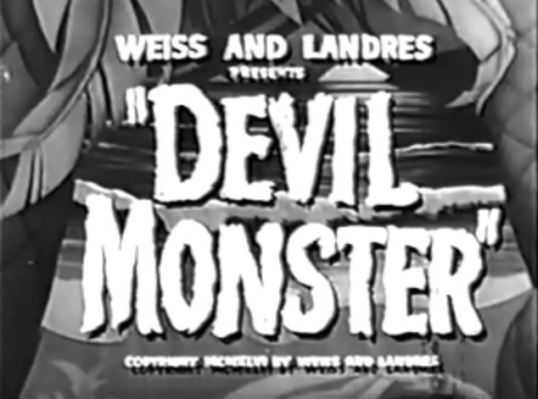
Devil_Monster_(1946)_-_Title

Oh my God, where to begin with this?

Okay, how about with a few confessions.

Number one, I came across the 1946 film Devil Monster in my 100 Horror Classic Movie Pack from Mill Creek.  The main reason that I decided to watch and review it was because it only had a running time of 64 minutes.  (On a good night, I have a 10-minute attention span.)

Number two, I guess it’s debatable whether or not Devil Monster really qualifies as horror movie.  I mean, it is called Devil Monster.  And there’s a big stingray that shows up during the final 10 minutes of the film and it rips off someone’s arm.  I assume the stingray is meant to be the devil monster of the title.  It’s not really scary but it’s supposed to be.  What matters is that, from the title and some of the dialogue, it’s obvious that an attempt was made to sell this movie as being at least partially a horror film.

Finally, you may have noticed that I mentioned that Devil Monster was a 1946 film.  Well, that’s actually debatable.  Devil Monster was apparently released in 1946 but, according to Wikipedia and the imdb, it’s actually a re-edited version of a 1936 film called The Sea Fiend.  Footage from The Sea Fiend was apparently mixed with stock footage and scenes lifted from other random films.  (One scene, featuring a bunch of island natives dancing, was clearly lifted from a silent film.)  The film was then dubbed over and a heavy-handed, nonstop narration was added in an attempt to link all of these random scenes together.  So, even though Devil Monster was released in 1946, it was actually filmed, in pieces, much earlier.

And really, that’s the main thing that I liked about Devil Monster.  It’s not that the film is in any way good or memorable.  (Well, it is memorable but mostly in a WTF sort of way.)  Instead, it’s a testament to the “never give up” attitude of the best B-filmmakers.  The producers of Devil Monster took a bunch of random footage, crammed it all together, and created something that resembles a movie.  Good for them.

As for the movie itself, it’s about a bunch of tuna fishermen who take the boat out and decide, in between searching for tuna, to stop by an island and pick up Jose (Jack Del Rio), who has been hiding out on the island ever since he was shipwrecked.  The problem is that Jose doesn’t want to go home and, after he’s forcefully dragged onto the boat, he decided to sail the boat into a part of the ocean that is home to the Devil Monster.  But then once the Devil Monster shows up, Jose changes his mind about killing everyone.  He jumps overboard and gets into a fight with the Devil Monster and … well, you simply have to watch it to truly understand how ludicrous this fight truly is.  Basically, footage of Jose throwing punches was superimposed over footage of a stingray in the ocean.  As a result, the scene features Jose punching the stingray and the stingray not reacting at all.  On top of all that, Jose is somewhat transparent.  You can literally see the ocean through him.  And, in the scenes where Jose is supposed to be swimming, you can see the hands of the crew holding him up in the air.

(Meanwhile, as we watch all this, we hear — but do not see — the tuna fishermen cheering Jose on.  “Get that devil fish, Jose!” someone yells.)

Of course, before that exciting scene, we get to see a battle between an octopus and a moray eel.  They are supposed to be at the bottom of the ocean but it’s obvious that they are actually in an aquarium.  How obvious?  Obvious enough that the studio lights are reflected in the glass and that the octopus tentacles gets stuck on the side of the aquarium in a few scenes.

And, before we watch the octopus/eel battle, the fisherman stop off at an island, where they meet a bunch of topless native girls.  We don’t actually see the fisherman interact with the natives.  Instead, we just hear the narrator tell us how much they enjoyed hanging out with the girls.  The natives, of course, change ethnicity from scene-to-scene, depending on from which source the footage has been lifted.

One of my favorite parts of this film comes at the end.  That’s where the boat captain’s son spots Jose and says, “There he is now.”  We then see Jose walking, before cutting back to the exact same footage of the son saying, “There he is now,” followed by the exact same footage of Jose walking.

My other favorite part of the film comes about 40 minutes in.  That’s when the screen goes black and we’re presented with a title card that reads, “One Moment Please, While We Change Reels.”

Of course, there’s also the scene where one of the fishermen suddenly yells, “TUNA!  TUNA!  TUNA!”  He’s just sounds so excited.

Devil Monster is in the public domain and can be found on YouTube.  Watch it at least once, just so you can say that you’ve seen it.

The TSL’s Daily Horror Grindhouse: The Nun (dir by Luis De La Madrid)


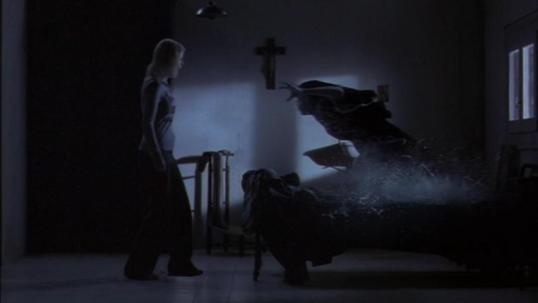
The Nun (2005, directed by Luis De La Madrid)

When talking about the 2005 Spanish horror film The Nun, it’s best to admit one thing from the start.  This film has got an absolutely terrible ending.

It seems to be the unwritten rule of modern horror that every movie has to have a “shocking” twist that’s revealed during the film’s final 10 minutes.  Occasionally, the twist is so well-done and memorable that it will actually redeem an otherwise forgettable film.  Far too often, the twist turns out to be so predictable that most filmgoers will have guessed what it is within the first few minutes of the film.  And then you’ve got a film like the Nun, where the twist will be so bad and so illogical that it’ll actually cause you to hate the entire film regardless of how effective it may have been before the twist was revealed.

I’ve debated with myself whether or not to just say “Spoilers be damned!” and reveal film’s twist in this review.  Seriously, it literally comes from out of nowhere and it’s so ludicrous that I almost feel like I have a responsibility to warn you about what the film has up its sleeve.  However, after a lot of thought, I’ve decided not to give the specifics of the twist.  Instead, I’m just going to tell you that it’s there and it’s really, really stupid.  It’ll probably make you hate the entire film.  If you ever find yourself watching The Nun, maybe you should stop watching around the 90 minute mark, just so you don’t have to deal with “twist.”

Because, seriously, until that twist shows up, The Nun is actually a pretty well-done ghost story.

The movie tells the story of Sister Ursula, an insane nun who terrorizes six of her students until eventually, they end up fighting back and accidentally drowning her.  They hide her body in a nearby pond and go on with their lives.  However, 18 years later, the pond is drained and the former classmates start to die one by one.

Whenever it rains or a bathtub overflows or water drips from a leaky faucet, a murderous apparition of the Sister Ursula is formed from the drops of water.  It may be because I was raised Catholic and I’ve actually experienced Catholic school firsthand but I thought that the apparition of Sister Ursula was one of the most effective cinematic ghosts that I’ve seen in a long time.  Forming from clouds of mist and with a permanently enraged expression on her twisted face, Sister Ursula is a nightmare personified and, as long as she’s lurking about in the shadows, it doesn’t matter that the film itself doesn’t make much sense.  Sister Ursula is scary and the scenes where she takes revenge on her former students are truly frightening.

But the film couldn’t be happy just being the type of simple (but effective) ghost story that would keep you awake at a slumber party.  Instead, the film has to introduce that terrible “twist” during the final ten minutes and, as a result, the entire film collapses.

Sometimes, it’s better just to keep things simple.

The TSL’s Daily Horror Grindhouse: Deathdream (dir by Bob Clark)


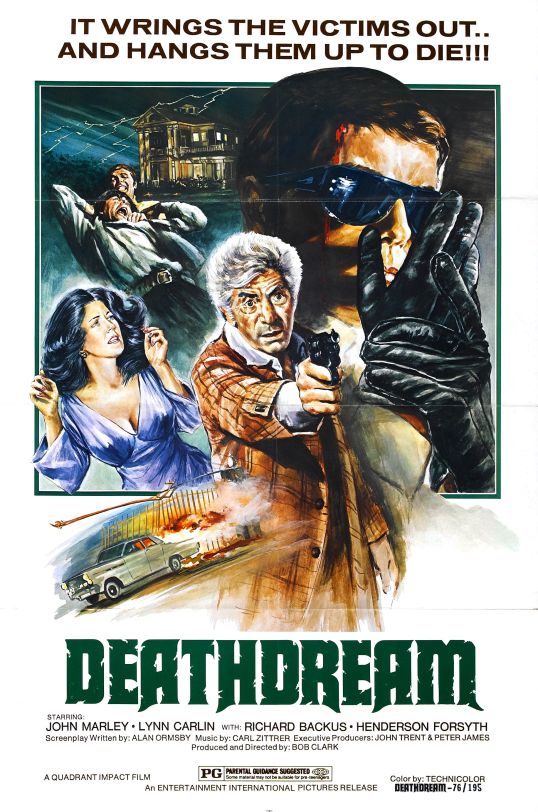
deathdream_poster_01

The 1974 film Deathdream opens with American soldier Andy Brooks (played by Richard Backus) on patrol in Vietnam. When he’s suddenly shot by an unseen sniper, he hears his mother’s voice calling out to him, telling him that he promised to come home. With the voice filling his head, Andy closes his eyes.

Sometime later, back in America, Andy’s family has been informed that Andy was killed in action. His father (John Marley, who you might recognize as the man who played Jack Woltz in The Godfather) and his younger sister (Anya Ormsby) have managed to accept the fact that Andy is dead but his mother (Lynn Carlin) remains in denial. Oddly enough, his mother is apparently proven to be correct in her doubts when Andy suddenly shows up at the front door.

The family (and, eventually, the entire community) welcomes Andy home but it quickly becomes apparent that Andy has returned as a far different person than when he left. Now pasty and emotionless, Andy spends most of his day sitting around listlessly. It’s only at night that Andy seems to have any energy and he spends those hours wandering around town and hanging out in the local cemetery.

It quickly becomes apparent to his father that Andy is no longer quite human. However, his devoted mother continues to insist that nothing is wrong with Andy and, once it becomes apparent just what exactly Andy is doing in order to survive, she becomes just as fanatical about protecting him as his father is about destroying him.

Not surprisingly, Deathdream is more than just a zombie film.  When Andy suddenly shows up on his family’s doorstep, he’s more than just a decaying monster.  He’s also a metaphor for the unease that viewers in the 70s would have felt about the state of American society.  (Of course, in many ways, contemporary viewers share that same unease.)  Andy goes off to war and it literally robs him of his humanity.  I would also argue that, in its way, Deathdream serves as a satire of the type of complacent society that sends young people off to fight for their lives and then expects them to come back exactly the same as they were before they left.  No matter how strange Andy’s behavior becomes, the people around him are willing to either ignore it or make excuses for it.  Andy’s mother emerges as a stand-in for everyone who willfully refuses to acknowledge the human consequences of war.

Deathdream is one of those wonderful horror films that deserves to be better known than it is. Deathdream was an early credit for the legendary effects artist Tom Savini and, while the film itself is not especially gory, Savini’s work can definitely be seen in the scenes where Backus’s body slowly decays. Screenwriter Alan Ormsby and director Bob Clark (who later went on to direct the far different A Christmas Story) perfectly creates and maintains a deceptively low-key atmosphere of perpetual unease while the cast elevates the entire film. Backus makes for an all-too plausible ghoul and Marley is great as a man struggling to understand what his son has become. The film is totally stolen, however, by Lynn Carlin who is both poignant and frightening as Andy’s devoted mother.

If you haven’t discovered Deathdream yet, this Halloween is the perfect season to do so.

The Daily Horror Grindhouse: Patrick Still Lives (dir by Mario Landi)


Patrick_Still_Lives

From the mid-60s to the early 80s, filmgoers could be sure of one thing.  If a film was in any way successful in America or Europe, an Italian filmmaker would end up directing an unofficial sequel.  These films usually had next to nothing to do with the original film, beyond having a similar title and occasionally duplicating a few plot points.  (Since these films were always dubbed before being released in non-Italian markets, dialogue, character names, and even plot points were often arbitrarily changed to take advantage of whatever film was currently popular at the box office.)  Occasionally, you’d have a film that managed to overcome its “unofficial sequel” status.  For instance, Lucio Fulci’s Zombi 2 may have started out as a fake sequel to Dawn of the Dead but, thanks to Fulci’s skill as a director, the film transcended its origins and managed to establish its own identity.

Far more typical, however, was the case of Patrick Still Lives, a 1980 film that was sold as being a sequel to the Australian horror classic, Patrick.  Though the film’s title suggests that it was meant to be a sequel, nobody involved in the production of Patrick had anything to do with Patrick Still Lives.

Patrick Still Lives follows the same basic plot as Patrick.  A young man named Patrick (Gianni Dei) may be in a coma but he has psychic powers that he uses to kill various people.  Again, Patrick falls in love with a woman, in this case a secretary named Lydia (Andrea Belfiore).

There are, of course, a few differences.  Whereas Patrick opened with the title character murdering his mother and her lover, Patrick Still Lives opens with a hilariously awkward sequence in which Patrick gets struck in the head by something thrown from a passing car.  Or, at least, that’s what I think happened.  The way the scene is shot, it’s really hard to tell what exactly happens.  At one point, Patrick is standing on the side of the road.  Suddenly, he’s clutching his head and collapsing to the ground and we hear a car speeding away on the soundtrack.  Patrick’s head is covered in ketchup, which I assume is meant to be blood.

Next thing we know, Patrick is in a coma and, with his eyes always open, he’s even duplicating the infamous stare that made the first film so memorable.  Fortunately, Patrick’s father is a doctor who runs a spa.  He keeps Patrick hidden in a locked room, where he’s wired to three other comatose people.

Eventually, five people show up at the spa.  They’re looking to spend a relaxing weekend away from it all but Patrick is planning on killing them all…

There’s a few things that you notice immediately about Patrick Still Lives.  First off, everyone’s naked, but, on the plus side, everyone has, at the least, an okay body and the men get naked too.  The nudity is so gratuitous and so excessive that it actually becomes amusing. By the time the film’s male lead (who, it should be noted, had quite an impressive pornstache) was standing naked at a dresser and casually lighting a cigarette while ominous music played on the soundtrack, I simply could not stop laughing.

Secondly, you notice just how amazingly violent and bloody this film is.  Whenever Patrick’s glowing eyes are superimposed over a scene, it means that someone is about to die in the most violent way possible.  Dogs attack.  A hook is driven into a face.  An automatic car window is used as a tool for decapitation.  The film’s most infamous scene features Mariangela Giordano being skewered, in close-up, by a fireplace poker.

That’s right — Patrick Still Lives is yet another Italian horror film that features Mariangela Giordano dying in the most unpleasant way possible.  As such, along with Giallo in Venice and Burial Ground: The Nights of Terror, it forms an unofficial trilogy of films in which Mariangela Giordano is brutally murdered.  Oddly enough, all three of these films were produced by Giordano’s then-boyfriend, Gabriele Crisanti.  If my boyfriend ever produces a horror film, I better be one of the survivors and that’s all I’ll say about that.

The third thing that you notice about Patrick Still Lives is the dialogue.  Now, I’m not sure if Patrick Still Lives ever got a “true” (and dubbed) release here in the States.  I do know that my DVD features everyone speaking in Italian, with English subtitles.  I have to admit that I’ve always resented that, in the U.S., so many Italian horror films are only available in a dubbed version.  Often the dubbing is so terrible that it detracts from the film’s overall effectiveness and makes it impossible to fairly judge the performances.  Well, with Patrick Still Lives, I got to see an Italian horror film in the original Italian and … well, the performances were just as bad in Italian as they probably would have been in badly dubbed English.

That said, I did enjoy reading the subtitles, largely because they were hilariously bad.  It was almost as if someone had typed the film’s Italian dialogue into Google translator and transcribed the results.  My favorite line?  “The cause of death was fatality.”

Anyway, Patrick Still Lives is a pretty crappy film and I don’t recommend it unless you’re a diehard fan of Italian exploitation films.  I do, however, recommend that you watch Zombi 2.  That’s a really good film.

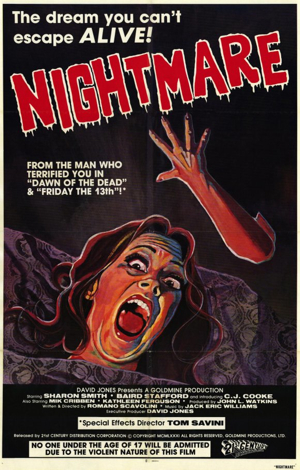
The Daily Horror Grindhouse: Nightmares in a Damaged Brain (directed by Romano Scavolini)


Nightmare_FilmPoster

I once read about a low-budget horror film that was released in the mid-70s.  The film was advertised as being “a film that could only have been made in South America … where life is cheap!”  That little bit of advertising hyperbole has always stuck with me and sometimes, when I see a particularly nasty exploitation or horror film, I find myself saying, “They must have made this movie somewhere where life is cheap!”

This, of course, brings us to Nightmares in a Damaged Brain, an Italian film that was originally released in 1981, at the height of the slasher movie boom.  Nightmares is infamous as one of those gore-filled horror films that has achieved a certain amount of immortality by being banned in several different countries.  It’s only been within the past few years that Nightmares has been released on DVD in the U.S.  That DVD is supposedly the “uncut” version of the film but there are rumors of scenes so bloody and disturbing that they have still not seen the light of day.  Usually, it’s something of a let down to finally see a film as infamous as Nightmares in a Damaged Brain.  It’s rare that a film’s reality ever lives up to the rumors surrounding it.  However, having seen Nightmares in a Damaged Brain, I can truly say that, if nothing else, this film had to have been made in a place where life is cheap.

Nightmares in a Damaged Brain concerns itself with George (Baird Stafford), a violent inmate at a New York insane asylum who is given an experimental drug that seems to control his violent impulses.  He’s released from the hospital and, after spending some time wandering around some of the seediest sections of New York ever captured on film, he ends up at a sex club, writhing on the floor and foaming at the mouth.  Apparently, that drug’s not working as well as everyone thought…

Soon, George has stolen a car and he is relentlessly driving across the country.  George, it seems, is obsessed with a young boy who lives in Florida along with his loud, white trash family.  Along the way to Florida, George has several gore-filled nightmares (the majority of which feature him as a bowtie-wearing child, murdering two people with an axe) and kills a few random people as well.

While the film was released to take advantage of the early 80s slasher boom, director Romano Scavolini rejected many of the conventions of slasher genre.  Instead of emphasizing pretty teenagers and slick production values, Scavolini instead emphasized the sordid “reality” of the film’s rather trashy cast of characters.  There’s not a likable character to be found anywhere within this film nor is there a single scene that doesn’t feel as if it’s been drenched in sleaze.  An ominous atmosphere of impending, relentless doom hangs over every second of the film.  This doesn’t necessarily make for an enjoyable viewing experience but it is a film that, once you start watching, is difficult to look away from.

The film’s opening credits (and the poster pictured above) claim that the gore effects were done by the famous Tom Savini.  Savini has always denied having anything to do with the film and, at one point, threatened to sue the filmmakers to get his name removed from the credits.  Regardless of whether Savini did them or not, the film’s gore effects are memorable and rather disturbing.

I had to take a shower after sitting through Nightmares In A Damaged Brain and I doubt I’ll ever watch it a second time.  Still, I’m glad that I did watch it because this brutally effective film is truly a part of horror film history.  If nothing else, I can now honestly say that I’ve seen a film that truly must have been made somewhere where life is cheap.

TSL’s The Daily Horror Grindhouse: They Found Hell (dir by Nick Lyon)


They Found HEll 2

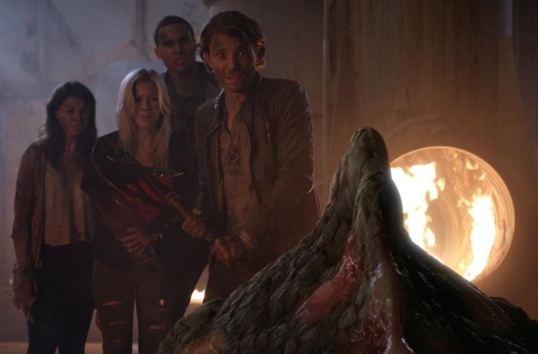
They Found Hell, which premiered last night on the SyFy channel, deserves a lot of credit.  In the tradition of the best grindhouse films (and, make no mistake, this was definitely a grindhouse film even if it was made for TV), They Found Hell delivers exactly what it promises.  The title tells us that “they” will find Hell and that’s exactly what happens.

“They” refers to a group of college students who, through some questionable use of science, manage to not only open up a portal into Hell but get sucked into it as well.  One student does manage to avoid getting sucked into the portal but he turns out to be pretty ineffective.  When he goes to the local crazy professor (James Sobol Kelly), he tells him what has happened, and then suggests maybe calling the police.  (I assume so that the police could read Hell its rights?)  The professor responds by tying the student up.  The professor has a plan of his own.

As for the students actually went down the portal … well, they’re in Hell.  One student insists that there’s no such thing as Hell and therefore, this must all be a dream.  Of course, he’s the first to die.  This, of course, leads to an interesting theological question: if an atheist dies in Hell, does he just come back to life?  I mean, he’s already in Hell.  What else can be done to him?

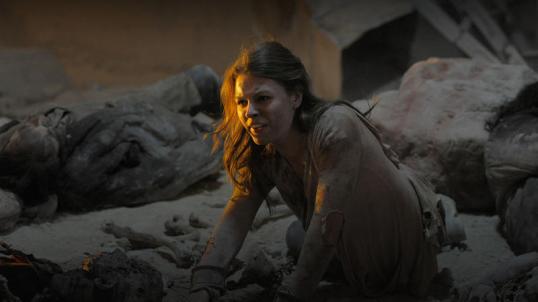
Anyway, the remaining students soon find themselves split up and each exploring a different section of Hell.  And this is really where the movie triumphed because this was a very convincing and very memorable Hell.  One student found himself in a desolate forest and ended up getting attacked by a bunch of vines.  Another found herself wandering through the hallways of what appeared to be the ruins of a Tuscan castle.  Another student found himself in a burning city while two others found themselves chained to a wall while a pendulum swung back and forth.  (I assume they were in the Edgar Allan Poe Wing of Hell.)  It was all surprisingly well-done and quite creepy.

At first, it seemed that Hell was nearly deserted and I guess we should be happy about that.  (I mean, humanity must be doing something right if there’s hardly anyone on the streets of Hell.)  But, as we quickly learn, the students are not alone.  There are lizard creatures that jump through windows.  There are snarling dogs that eat men who have been tied to the trees in a dark forest.  And, of course, there’s the succubus…

And then there’s Charon, the boatman.  In Greek mythology, Charon is the ferryman who takes souls across the River Styx.  Of course, he’ll only take you if you can pay the toll.  Charon’s always been one of my favorite mythological characters so I was definitely excited when he made an appearance here, looking all spooky and ghastly.

When They Found Hell started, I noticed that a lot of Hell seemed to look like other horror movies.  There were some scenes that had a Saw feel to them.  And then there were others that felt like they could have been lifted from a zombie movie.  At first, I assumed the film was just ripping off other horror films and I was totally okay with that.  But, as we discover, there’s actually a very clever reason why the various sections of Hell resemble other horror movies.  I’m not going to spoil it but it really is pretty clever.

And really, that’s a great description of They Found Hell.  It’s a surprisingly clever little horror film, one that is full of spooky atmosphere and scary moments.  It’s also surprisingly well-acted, with the entire cast bringing a lot of conviction to their roles.  This is a fun movie, one that you should definitely watch with a group of your best, snarkiest, and smartest friends.

So, keep an eye out and, the next time that They Found Hell is on SyFy, be sure to watch!

They Found Hell

6 More Great Trailers For A Hopping October!


Hi there!  It’s time for yet another October edition of Lisa Marie’s Favorite Grindhouse and Exploitation Film Trailers!  I gave the trailer kitties the weekend off and I recruited a whole new group of mythical animals to go find this week’s trailers.  Let’s see what they came back with!

1) Corruption (1968)

2) Frightmare (1974)

3) Curtains (1983)

4) Hungry Wives (1973)

5) Incubus (1981)

6) The Unseen (1980)

What do you think, Contemplative Jackalope?

Jackalope

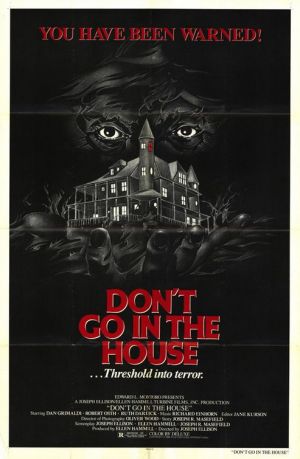
TSL’s Daily Horror Grindhouse: Don’t Go In The House (dir by Joseph Ellison)


Don't_Go_in_the_House_FilmPoster

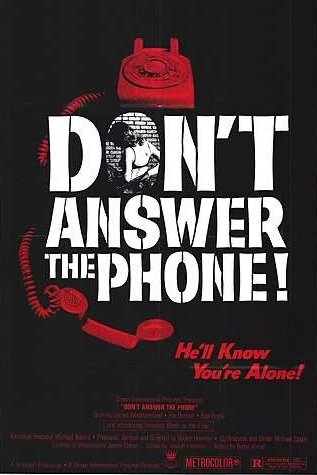
1980’s Don’t Go In The House is one of the many “Don’t” films to come out in the 70s and 80s.  These films all had titles that warned viewers not to do something.  Don’t Answer The Phone!  Don’t Stand Near The Window!  Don’t Go To Sleep!  Don’t Go Into The Woods…Alone!  Don’t Go In The House!

And I have to admit that whenever I come across one of these titles, my initial response is to get a little offended because I don’t like being told what to do.  A grindhouse movie about me would be called Don’t Give Lisa Orders.  Seriously, you’re going to tell me not to go into the house?  I’m going not only going to go into the house but I’m also going to stay for however long I feel like staying.  If you don’t like it, buy a new house.

But, that being said, these Don’t titles do make it very easy for a lazy reviewer.  A title like Don’t Go In The House practically invites a critic to be snarky.  “Don’t go in the house?  How about don’t watch the fucking movie?”

Seriously, it’s fun!

But, at the same time, that’s a bit unfair to Don’t Go In The House.  As far as crazed serial killer films go, Don’t Go In The House is one of the most disturbingly effective entries in the genre.  Dan Grimaldi (who later played Patsy Parisi on The Sopranos) stars as Donny Kohler.  Shy and awkward, Donny lives in a dilapidated mansion with his mother.  When Donny was a child, his mother’s favorite punishment was to burn him and, as a result, Donny has grown up both fearing and loving fire.

Though Donny is obviously disturbed from the first minute we see him, it’s not until his mother dies that the true extent of Donny’s madness becomes apparent.  Now living alone in that huge house, Donny starts to hear whispering voices.  The voices tell him to “master the flame.”  Soon, Donny is luring victims into his house, where he chains them up in a specially made room and uses a flame thrower to set them on fire…

AGCK!

Seriously, this movie is soooooooo disturbing!  Not only is the film full of ominous atmosphere but Dan Grimaldi gives an all-too realistic performance in the role of Donny.  Much like Nicholas Worth in Don’t Answer The Phone, Grimaldi turns Donny into an all too familiar monster.  The fact of the matter is that we’ve all known a potential Donny.  Don’t get paranoid?  Well, that’s next to impossible after you watch a movie like Don’t Go In The House.

I also have to say that I have never actually seen anyone burned alive, though, when I was nine, I did see my Dad accidentally set himself on fire.  (Before anyone freaks out, he did that whole drop and roll thing or whatever it is and he was absolutely fine.)  That said, the immolation scenes in Don’t Go In The House felt totally and completely authentic.  They were pure nightmare fuel, truly some of the most disturbing scenes that I have ever seen.

Am I recommending Don’t Go In The House?  I don’t know.  It’s thoroughly unpleasant but, at the same time, it’s a very well-made film and surprisingly well-acted film.  And, despite being about a serial killer and featuring very graphic violence, the film itself is always on the side of the victims.  No attempt is made to make Donny into some sort of Hannibal Lecterish antihero (from the minute we first meet him until the film’s final scene, Donny is presented as being a total loser) and, as a result, Don’t Go In The House emerges as a grindhouse film that has a stronger moral center than most mainstream features.

But my God, is it ever disturbing!  I saw the film once and that was more than enough for me.  If you’re a fan of grindhouse and exploitation films, Don’t Go In The House is a film that you’re going to have to see eventually.  If you’re like me, you’ll probably end up watching it through your fingers.

Seriously, don’t underestimate the disturbing experience of watching Don’t Go In The House.

The TSL’s Daily Horror Grindhouse: Don’t Answer The Phone (dir by Robert Hammer)


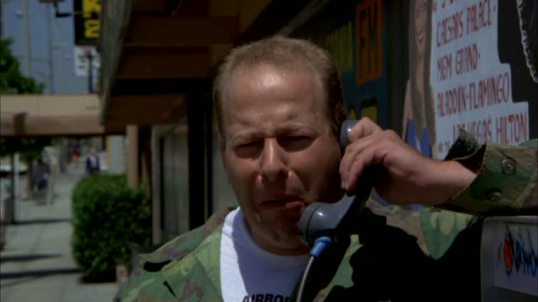
Nicholas Worth in Don't Answer The Phone

Nicholas Worth in Don’t Answer The Phone

AGCK!

As a self-described lover of grindhouse and exploitation films, I have seen my share of truly icky films.  But Don’t Answer The Phone, a 1980 mix of police procedural and serial killer horror, is in a class all by itself.  It is not only exceptionally icky but it’s distressingly effective as well.

After I watched Don’t Answer The Phone, I actually checked to make sure all the doors were locked.  Before I got into bed, I searched all the closets to make sure there wasn’t anyone hiding in there.  And, as I fell asleep, I found myself thinking that maybe I should follow the advise of both Arleigh and my sister.  Maybe it was time for me to finally get a gun of my own and learn how to use it.

Seriously, Bowman, I thought as I waited for sleep to come, you live in Texas.  It’s totally legal to carry a gun down here so you need to take advantage of the law and make you’re ready to blow any pervert losers away!  Even if you shot the wrong person, you’re cute.  The jury would never convict…

That’s the type of effect that Don’t Answer The Phone had on me.  It’s not necessarily a good film.  With one notable (and important) exception, most of the acting is terrible.  The film’s few attempts at intentional humor largely fall flat.  Even with a running time of only 94 minutes, Don’t Answer The Phone feels overlong and full of unneeded padding.  And yet, this is a very effective film.  It did freak me out, largely because it was so crude and heartless.  It strikes at the most primal fears of the viewer, that feeling that — even within the security of our own home — we may not truly be safe.

As Don’t Answer The Phone opens, Los Angeles is a city being stalked by a madman.  That, in itself, is not surprising.  Just taking a quick look at Wikipedia will reveal that Los Angeles has been home to a large number of serial killers.  In fact, if there is anything shocking about Don’t Answer The Phone, it’s the suggestion that Kirk Smith (played by Nicholas Worth) is the only serial killer in town.

Who is Kirk Smith?  He’s an overweight, bald photographer who always wears an army jacket and is obsessed with candles, body building, and strangulation.  He also enjoys calling up a local talk show host, Dr. Linsday Gale (Flo Gerrish).  (One wonders if Dr. Gale’s name was specifically meant to make the viewer think of The Wizard of Oz.)  “Hello,” he says in an outrageously fake accent, “this Ramon!”  He tells Dr. Gale that he has frequent headaches and bad urges.  When he’s not pretending to be Ramon, Kirk can usually be found staring at himself in a mirror and yelling, “Do I measure up, Dad!?”

Kirk is killing women across Los Angeles and it looks like he might never be caught because Don’t Answer The Phone features some of the most incompetent cops ever!  These are the type of cops who smirk at the victims and shoot anyone who doesn’t get on the ground fast enough.  These are the type of cops who open fire and then say, “Adios, creep.”  Civil liberties!?  BLEH, THESE COPS DON’T HAVE TIME FOR YOUR RIGHTS!  Of course, they do end up shooting and killing the only witness who can identify Kirk Smith as the murderer.  Whoops!

If there’s anything that sets Don’t Answer The Phone apart from all the other serial killer films, it’s the performance of Nicholas Worth.  Far more than the slick and erudite serial killers who dominate contemporary thrillers, Nicholas Worth is a frighteningly believable lunatic.  He’s scary because we’ve all seen his type wandering the streets.  We’ve all felt his stare linger for a few seconds too long and we’ve all had the same feeling of dread when we saw him approaching us.  Reportedly, Worth did a lot of research on actual serial killers before taking on the role of Kirk Smith and his performance is terrifying because it is so real.

It’s icky to watch but, at the same time, it do serve to remind us that there are real life Kirk Smiths out there.

Agck!  Seriously, it makes me shake just thinking about it.

I’m getting a gun…

DAtP

The Daily Horror Grindhouse: Zero in and Scream (dir by Lee Frost)


zas

I have to admit that there’s one very simple reason why I decided to watch and review the 1970 thriller/horror/softcore/sniper mayhem film, Zero In And Scream.  And that reason was that the movie is only 63 minutes long.  Seriously, when you’re writing for 7 different sites while working during the day and living during the night, there are times when you simply have to say, “That 4-hour epic from the Ukraine looks like it’s a great movie but I’ve only got time for an hour-long, low-budget excursion into cinematic obscurity.”

Zero In and Scream (and that’s great title, by the way) is about Mike (Michael Stearns).  Mike has really impressive hair and a deep tan.  (Perhaps the scariest part of this film comes when Mike undresses and we are confronted with his pasty white tan lines.)  I was going to comment on the fact that Mike also spends a good deal of the film wearing a really ugly and really wide tie but then again, this movie was made in 1970, so I guess that’s to be expected.

Mike has some issues that go beyond questionable fashion choices. He simply cannot get a girlfriend.  Maybe it’s because he’s an extremely moralistic jerk who says things like, “When a man climbs on top of a woman, she becomes ugly!”  Or maybe it’s because he spends almost all of his spare time holding and stroking a very phallic rifle.  Whenever Mike spots a couple making love, he shoots the man and allows the woman to remain pure.

Mike spends his spare time at the local strip club where, for reasons that aren’t quite clear, one of the dancers (Dawna Rae) decides that she likes this weirdo and she invites him to come to a party at her place.  The party is tres decadent in a 1970 softcore sort of way so, as you can imagine, Mike freaks out.

Will Mike be able to control his homicidal urges?  Will he listen to the radio reporter who, at one point, begs the killer to turn himself in because, “It’s obvious that you’re not in control of yourself!”  Or will he just continue to just wander around with his rifle while having flashbacks?

For the most part, Mike’s issues are just an excuse to get as many naked bodies on screen as possible, with a good deal of the film’s 63 minutes being taken up by a surprisingly well-shot underwater orgy scene.  Zero In and Scream doesn’t really work as horror film or as a thriller but I’m still recommend it for all of my fellow history fanatics.  Like many a worthy grindhouse film, Zero In and Scream is a time capsule of the era in which it was made.  Until we get our hands on a time machine, films like this are as close as we will ever come to personally experiencing the 70s.

Add to that, Zero In and Scream is worth watching for its abrupt but clever final shot.  It may not be a particularly good film but it has a great ending!

(In case you hadn’t already guessed, Zero In And Scream is available from Something Weird Video.)