The Blind Dead are back and this time, they’re on a boat!
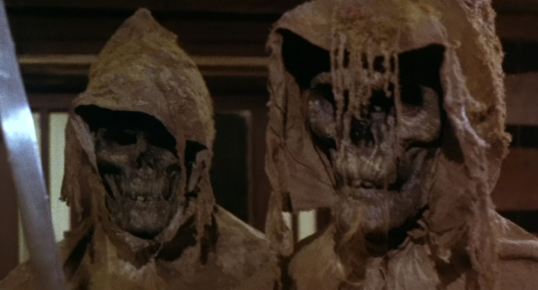
Yes, you read that correctly. 1974’s The Ghost Galleon is the third film in Spanish director Amando de Ossorio’s Blind Dead series. The decaying and blind Knight Templar are back and they’re just as evil and blood thirsty as they were in both Tombs of the Blind Deadand Return of the Evil Dead. However, this time, they’re on a boat. What are they doing on a boat? Apparently, they’re guarding some sort of Satanic treasure chest and they’re killing and eating anyone who makes the mistake of boarding their boat.
That means that this is the first Blind Dead film to not feature any scenes of the Blind Dead riding their horses in slow motion. That may not sounds like much but the absence of those horses is definitely felt. The Blind Dead on horses are a metaphor for everything from political tyranny to religious oppression. The Blind Dead on a boat are still scary but now they’re also vaguely silly.
And yet, the Blind Dead on a boat is not the silliest part of the film! The Ghost Galleon starts out with two models lost at sea. Apparently, they were hired by a businessman and aspiring politician named (in the version released in America, anyway) Howard Tucker (Jack Taylor). Howard is a boat manufacturer and he felt it would be great publicity if the models took one of his boats out into the ocean and pretended to get stranded. Apparently, Howard felt that this would convince the public that they could live for weeks in one of his speedboats if they needed to…
No, I’m not making that up. That’s the plot of the damn film.
ANYWAY — the models get stranded for real but suddenly, here comes a big, dark, old timey galleon. It’s just floating out in the middle of the ocean and it appears to be surrounded by a very thick fog. Naturally, the models decide to leave their boat for the galleon because why stay somewhere vaguely safe when you can get on a big, scary, evil looking galleon?
Now the models are missing and Howard needs to get his boat back. So, he and his evil henchman get yet another model to sail out to the middle of the ocean with them. Also accompanying them is a historian/scientist guy, who is mostly there because the film will later need him to fill in the backstory of the Blind Dead…
Now, I know that it probably sounds like I’m being supercritical of the third Blind Dead film but actually, it kind of works. The key is not to worry about logic, consistency, or anything you learned about at that screenwriting workshop. Instead, simply accept The Ghost Galleon as being the equivalent of a filmed nightmare. For everything that the film lacks in logic, it makes up for in atmosphere. (Let’s just say that the fog machine gets quite a workout.) And while it may not make much sense for them to be on a boat, the Blind Dead are just as scary, evil, and merciless as ever.
Add to that, the film has a great ending. I won’t spoil it here but I will say that the film’s final shot makes up for a lot of what you have to sit through in order to reach it.
The Ghost Galleon should not be the first Blind Dead film that you see. (Unfortunately, it can be found in several ultra cheap box sets, complete with a bad transfer and spotty soundtrack.) But if you’ve seen Tombs of the Blind Dead and Return of the Evil Dead, you should also see The Ghost Galleon. If nothing else, it proves the de Ossorio could get results with even the most ludicrous of premises.
If you really want to see something scary this Halloween season, I suggest tracking down Tombs of the Blind Dead, a Spanish film from 1971.
Who are the Blind Dead? Well, the obvious answer is that they’re a group of dedicated horsemen who have not allowed being both dead and blind to keep them from accomplishing their goals. Of course, since all of their goals are evil, that’s not necessarily a good thing. When they were alive, the Blind Dead were 14th century knights. (The usual assumption is that they were Knights Templar, even though this is never specifically stated.) Accused of witchcraft and heresy, the knights were executed and, as their corpses hung from the gallows, bird pecked out their eyes. The bodies were eventually buried in an isolated Spanish monastery.
The future members of the Blind Dead
Jump forward six centuries. The year is 1970 and Spain is still under the repressive grip of the feared dictator, General Francisco Franco. (This is important because some critics have suggested that the Blind Dead were meant serve as a metaphor for Franco’s regime.) The monastery sits deserted, an otherwise menacing ruin on the beautiful Spanish countryside. There’s a train that regularly runs by the monastery but the train’s conductor is always quick to tell his son to never stop the train. The monastery, he explains, is a cursed place and no one should go near it.
Unfortunately, someone does go near it. A passenger on the train, Virginia (María Elena Arpón) is annoyed that her boyfriend, Roger (Cesar Burner) has been flirting with Virginia’s former schoolmate and lover, Betty (Lone Fleming). So, naturally, Virginia hops off the train and decides to take a cheerful stroll across the Spanish countryside. With night falling, she decides to camp out in the ruins of the old monastery.
Now, if you guessed that this leads to a bunch of decaying blind knights coming out of nowhere and chasing her down, you’re absolutely right. That’s exactly what happens. And, when Betty and Roger come to the monastery to investigate what happened to their friend, the Blind Dead are waiting for them.
The Blind Dead are also waiting for that train, which leads the film to its bloody conclusion…
Now, you may have noticed that I was very careful not to describe the Blind Dead as being zombies. That’s because the film’s director, Amando de Ossorio, frequently stated that the Blind Dead were not meant to be zombies. He stated that, if anything, the Blind Dead were mummies with vampiric tendencies. He also pointed out that, unlike zombies, the Blind Dead are not mindless. Instead, they are calculating, deliberately cruel, and, unlike the living, they work together. Because of this, they’re even more dangerous and frightening than your typical zombie.
So, what distinguishes The Tomb of the Blind Dead from every other mummy/vampire/zombie/living dead film? It’s certainly not the film’s plot. This is one of those films were characters frequently do the stupidest thing they can at the worst possible time. Instead, it’s the fact that the Blind Dead themselves are pure nightmare fuel. Some of it is the brilliant makeup. The Blind Dead truly do look like they’ve spent the last 600 years decaying. Some of it is the fact that the Blind Dead are shockingly cruel and merciless, even by the standards of a European horror film. When they finally do get on that train, no one — not even the cute little girl who sobs as her mother is killed in front of her — is shown a hint of mercy.
But you know what makes the Blind Dead truly frightening? It’s an amazingly simple thing. de Ossorio films them in slow motion. I know that doesn’t sounds like much but, along with the film’s brilliant soundtrack, it really does create a relentless atmosphere of impending doom. When you watch the Blind Dead as they ride their similarly decaying horses across the Spanish countryside, you truly do feel that they’ve come from a different time and place. The Blind Dead are so relentless and determined that, even though they may move slowly, there’s still no way you could ever escape them.
(And, of course, it doesn’t help that the Blind Dead are basically indestructible. You can shoot the walking dead in the head and go on about your day but that’s not going to help out when it comes to the Blind Dead.)
Amazingly, when Tombs of the Blind Dead was first released in the United States, the film’s American distributor added a nonsensical prologue that described the Blind Dead as actually being super intelligent apes and changed the film’s title to Revenge From Planet Ape, all in an attempt to cash in all the popularity of Planet of the Apes.
That PG-rating should clue you in on just how much material was cut out of Tombs of the Blind Dead in order to make Revenge From Planet Ape!
Well, Tombs of the Blind Dead may not actually involve any super intelligent apes but it’s still a shocking and effective horror film and I highly recommend it for your Halloween viewing. Just make sure you see the uncut Spanish version!
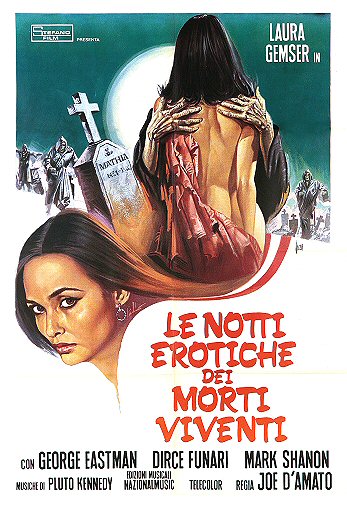
Yes, I know that The Erotic Nights of the Living Dead sounds like something that someone made up but the movie totally exists and you probably won’t be surprised to know that it really doesn’t live up to the brilliance of the name. There is a lot sex but most of it involves a really unattractive guy with a mustache and a perm that makes him look like he should be a part of Anchorman‘s Channel 5 Action News Team so it’s debatable how erotic it is. The living dead do show up and, let’s give credit where credit is due, the zombie effects are undeniably well done. They really do look like the dead come back to life. However, none of the zombies are particularly sexual. There is a ghost who, in close-up, castrates a man while giving him a blow job but, since she’s a ghost, it’s debatable whether or not she can truly be considered one of the living dead. Finally, the title promises us “nights of the living dead” but it’s really more of an evening of the living dead.
Details matter.
Released in 1980, The Erotic Nights of the Living Dead was directed by Aristide Massaccesi, a filmmaker who was better known by the name Joe D’Amato. D’Amato had a deserved reputation for directing some of the sleaziest Italian exploitation flicks of all time, though he also directed one of my personal favorites, Beyond the Darkness. (For the record, Joe D’Amato was not the only alias used by Massaccesi. Over the course of his long career, he was credited under at least 43 different names. Also, for the record, I’ve read several interviews from people who worked with Massaccesi and, without fail, all of them have reported that he was one of the nicest and most generous people that one could hope to work with during the Italian horror boom of the 1980s.)
The Erotic Nights of the Living Dead is really two bad films in one. The first film features a land developer named John Wilson (Mark Shannon). Wilson has purchased an island and wants to build a luxury hotel on the island. However, he’s having some trouble convincing anyone with a boat to give him a ride out to his property. It seems that the location has a bad reputation. John finally convinces local boat captain and adventurer, Larry O’Hara (George Eastman), to take him to the island. Accompanying them is Fiona (Dirce Funari) who is either John’s girlfriend or just didn’t have anything better to do. (To be honest, it was kind of hard to follow.) Before heading out for the island, John takes a long shower with two prostitutes and Larry languidly watches as a stripper does a dance that involves popping a champagne cork without using her hands.
The second movie involves the trip to the island. It turns out that the island isn’t as deserted as Mark assumed. There’s an old man with a massive bump on his head. There’s also the man’s mysterious daughter, played by Laura Gemser who also starred in D’Amato’s Black Emanuelle films. The old man and his daughter warn everyone that they should leave the island but, of course, people are stupid.
Anyway, there are two good things about The Erotic Nights of the Living Dead. First off, the great George Eastman gets a lengthy scene in which he giggles like a madman and it’s fun to watch because Eastman truly throw himself into the performance. Secondly, the arrival of the zombies is heralded by a mysterious black cat. The cat has the most Hellish meow that you’ll ever hear but he’s a black cat so he’s cute.
In the end, though, the best thing about The Erotic Nights of the Living Dead is the title.
Since I earlier reviewed The Wolf Man, it only made sense to me that tonight’s entry in daily horror grindhouse should be the 1976 Italian horror film, Werewolf Woman. I’d had Werewolf Woman on DVD for a while now but I had yet to get around to watching it. I actually knew next to nothing about it. The only reason why I bought the DVD was because of the title.
So, last night, I watched the movie and I quickly discovered that, in the best tradition of grindhouse cinema, Werewolf Woman‘s title actually had very little do with the actual film. The title character may go around ripping out throats with her teeth but it’s not because Daniella Neseri (Annik Borel) is a werewolf. Instead, it’s just because she’s gone insane.
When Daniella was thirteen years old, she was raped by a family friend. She has now grown up to be a young woman who fears sex and rarely leaves her family’s decaying estate. Her aging father, Count Neseri (Tino Carraro), is extremely protective of Daniella but, at the same time, he also tells her stories about how one of her ancestors was rumored to be a werewolf so you really have to wonder how good of a father he actually is.
When Daniella’s younger sister, Elena (Dagmar Lassander), comes home with her fiancée, Daniella hides out in the hallway and listens while they make love. Later that night, Daniella is wandering around outside when she runs into the fiancée. She proceeds to rip out his throat with her teeth and then leave him for dead. The police are convinced that he was murdered by a wild animal but Elena and Count Neseri both believe that Daniella was responsible.
So, Daniella ends up in an insane asylum but it takes more than just four walls and a locked door to hold Daniella prisoner. One of her fellow patients is a predatory lesbian (yes, this is very much a 70s movie) who tries to seduce Daniella. Unfortunately, any and all sexual thoughts cause Daniella to mentally (if not physically) transform into a werewolf. Soon, the patient has had her throat ripped out and Daniella has escaped.
The rest of the film follows Daniella as she makes her way across the Italian countryside, stopping to kill anyone who causes her to become aroused or to even think about sex. Or, at least, that is until she meets Luca (Howard Ross), who is a sensitive man and lover. Daniella and Luca have a falling in love montage. They make love without Daniella feeling the urge to rip out his throat. Things are going to be okay, right?
Nope. Inevitably, a biker gang shows up and violently destroys their happiness. In the spirit and style of I Spit On Your Grave, it’s up to Daniella to get revenge.
Now, when talking about a movie like Werewolf Woman — one that links lycanthropy with both sexual repression and a sexual awakening — it’s easy to read too much into the plot. I’ve been tempted to do just that while writing this review. Whether it was what the director’s intended it or not, there is a potentially intriguing theme running through Werewolf Woman, in which Daniella imagines herself as a werewolf because it’s the only way that she can survive in a world that is determined to sexually exploit, demean, and oppress her. Daniella’s mental transformation is ultimately the result of her own repressed emotions and fears and I’m sure that many would argue that Werewolf Woman, in the tradition of Repulsion and Ms. 45, is taking a stand against a patriarchal and repressive society (never mind that Daniella ultimately kills almost as many women as men).
And you know what? If this was a Jess Franco film, I’d give it the benefit of the doubt.
But ultimately, Werewolf Woman is no Ginger Snaps. Instead, it’s a somewhat slow soft core flick that doesn’t really add up to much. (Any and all subtext is definitely present by accident only.) That said, Annik Borel does a good job in the lead role and loves of Euroshock will enjoy seeing familiar faces like Howard Ross and Dagmar Lassander in the cast. Add to that, I always enjoy any film the features a woman getting bloody revenge on misogynists, even if this film ultimately left me feeling more icky than empowered.
That sure is an interesting poster, isn’t it? The poster for Color Me Blood Red pretty much screams grindhouse and if you didn’t already know that this 1965 film was directed by Herschell Gordon Lewis and produced by David Friedman, you’d be able to guess just from looking at it. My favorite part of the poster is the promise that Color Me Blood Red is “drenched in crimson color.”
There’s a lot of blood in Color Me Blood Red. In fact, it’s a movie about blood. Adam Sorg (played by Gordon Oas-Heim, who I’m going to guess was not a professional actor because, otherwise, why wouldn’t he have changed his name to Gordon O?) is a painter who hasn’t had much success. Sure, he has a house on the beach and he has a girlfriend named Gigi (Elyn Warner) who is willing to model for him but one thing that Adam doesn’t have is respect. No one wants to buy his paintings! Could it be because Adam is living in a city full of Philistines? That’s what Adam seems to believe but I think a far bigger problem is the fact that Adam is not a very good painter. His paintings are cartoonish and his use of color is more than a little dull. However, after Gigi cuts her finger and bleeds all over one of his canvases, Adam discovers that he has now found the perfect shade of red!
So, he decides to paint with blood. Unfortunately, Gigi doesn’t want to give him any more of her blood. So, Adam decides to open his own veins and use his own blood but he faints before he can finish his latest masterpiece. What is Adam to do? Well, he can always kill Gigi and use her blood. And, of course, there’s always a fresh supply of teenagers showing up on the beach…
What’s sad about all this is that, even after Adam discovers that blood is the perfect shade of red, he’s still not a very good painter. Believe me, I understand. I majored in Art History. The majority of my friends are artists. Some paint, some write, some take pictures. Believe me — I get it. We all go through that phase where we fool ourselves into thinking that undeveloped talent, lazy thinking, and lack of ability is the same thing as having a unique vision that is destined to be unappreciated. But most artists either eventually find their own voice or they give up by the time they turn 28. Adam, on the other hand, is a middle-aged guy who is still acting like a student in an Intro to Graphic Design class. What I’m saying is that blood is useless without a unique vision. The perfect shade of red isn’t going to help if you still don’t have your own voice.
Then again, maybe I’m taking the film too seriously.
And really, that’s something you should never do when you’re reviewing a Herschell Gordon Lewis film. Color Me Blood Red was the third part of Lewis’s blood trilogy but, unfortunately, it’s never quite as effective or memorable as either Blood Fest or Two Thousand Maniacs. As silly as certain parts of the film may be, Blood Feast‘s gore still has the power to shock. Two Thousand Maniacs is pure nightmare fuel. Color Me Blood Red, meanwhile, is kind of bland. It feels more like a successor to The Undertaker and His Palsthan Blood Feast.
That said, the film is worth watching for some of the dialogue. The entire film is full of campy lines, the majority of which are so strange that they give the proceedings an almost dream-like feel.
“Dig that crazy driftwood!” someone says upon spotting a corpse in the water.
“You mean the type who earn an honest living painting houses?” someone else says when asked for his opinion on artists.
And, of course, there’s my favorite line: “HOLY BANANAS! It’s a girl’s leg!”
Color Me Blood Red is the least essential entry in the blood trilogy but, if you’re a Lewis/Friedman completist, you know you’re going to have to watch it. So, you might as well sit back and enjoy it for the frequently silly little movie that it is.
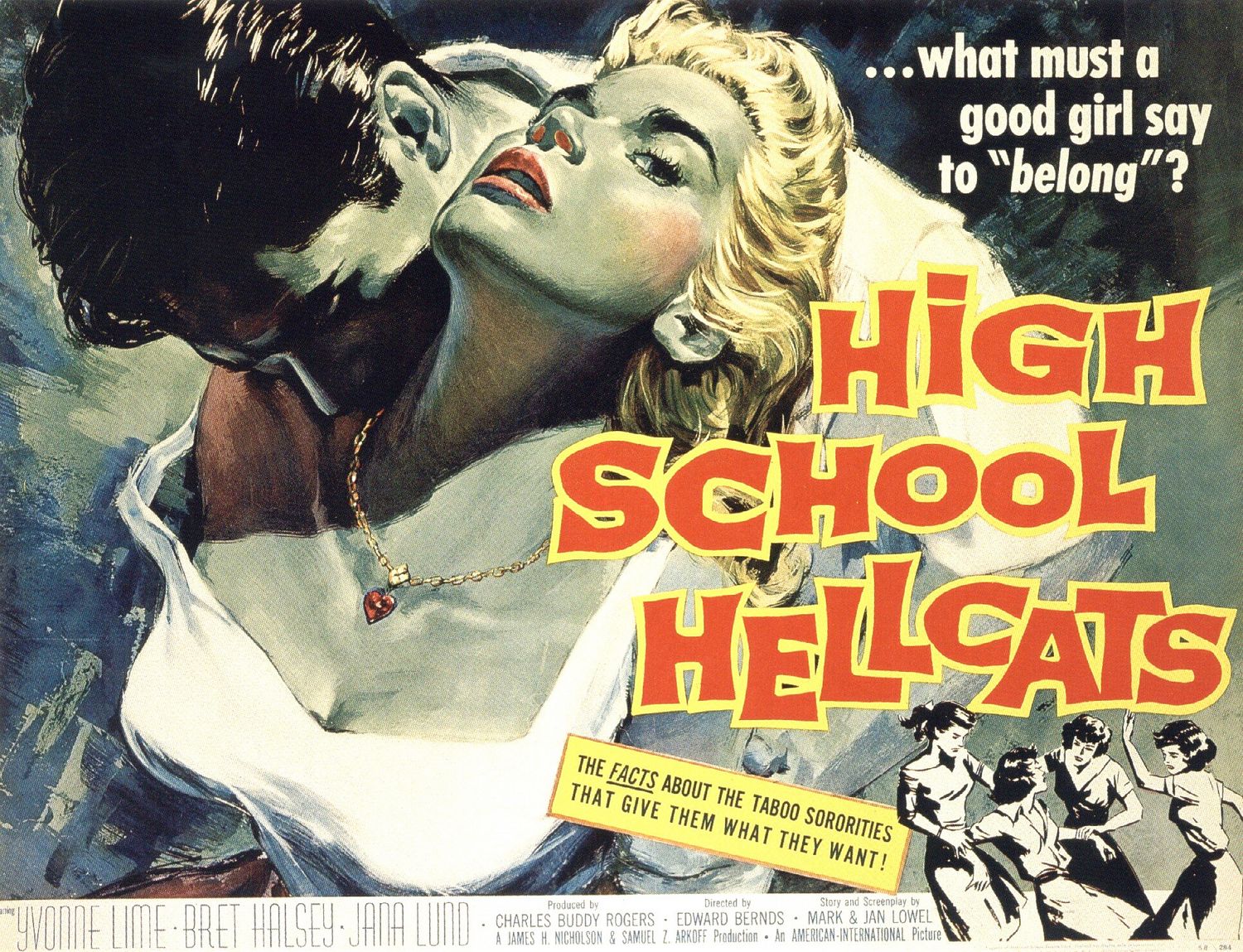
One of the most popular 50’s exploitation subgenres was the “Teenage Girl Gang” movie, with titles like THE VIOLENT YEARS (script by Ed Wood ) and Roger Corman’s TEENAGE DOLL. The plots are pretty much interchangeable: rebellious high school chick, misunderstood by her parents, falls in with the wrong crowd. Soon she’s smoking butts, drinking booze, stealing, staying out late. There’s usually a wild party where something bad happens, and our heroine is placed in peril. If you’re into exploitation flicks, you’ll immediately recognize the storyline, and it’s reused again here to good advantage in HIGH SCHOOL HELLCATS.
Our heroine here is Joyce, the new kid at High School USA. Joyce’s parents just don’t understand her: mom’s always out playing bridge, and dad is just a prick. Joyce longs to be accepted, and is invited to join the Hellcats by anti-social Connie, a rebellious vixen whose attitude seems to be fuck the adult…
In honor of this day, here are 6 trailers that are so patriotic, they’ll make our American readers reconsider their earlier decision to move to Canada!
I’m currently in the process of watching the 36 films that I’ve recorded on my DVR since March. Last night, I was extremely excited as I looked up the 7th film on the DVR and I discovered that I was about to watch the 1977 revenge classic, Rolling Thunder!
Among those of us who love old grindhouse and exploitation film, Rolling Thunder has achieved legendary status. Based on a script by Paul Schrader (though I should point out that Schrader’s script was rewritten by Heywood Gould and Schrader himself has been very critical of the actual film) and directed by John Flynn, Rolling Thunder is quite literally one of the best revenge films ever made. It’s also a great Texas film, taking place and filmed in San Antonio. Quentin Tarantino has frequently cited Rolling Thunder as being one of his favorite films and he even used the name for his short-lived distribution company, Rolling Thunder Pictures.
Rolling Thunder also has one of the greatest trailers of all time. In fact, if not for the trailer, I probably would never have set the DVR to record it off of Retroplex on March 25th. The Rolling Thunder trailer is included in one of the 42nd Street Forever compilation DVDs and, from the minute I first watched it, I knew that Rolling Thunder was a film that I had to see.
Watch the trailer below:
Everything about that trailer — from the somewhat portentous narration at the beginning to the way that Tommy Lee Jones calmly says, “I’ll get my gear,” at the end, is pure genius.
But what about the film itself? Well, having finally seen the film, I can say that Rolling Thunder is indeed a classic. It’s also one of the most brutal films that I’ve ever seen, containing scenes of truly shocking and jarring violence. In fact, the violence is so shocking that it’s also, at times, rather overwhelming. This is one of those films that you will probably remember as being far more violent than it actually is. Because, while Rolling Thunder features its share of shoot-outs and garbage disposal limb manglings, it’s actually a very deliberately paced character study.
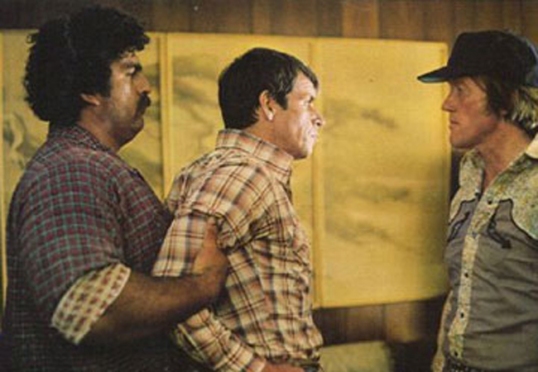
When we first meet Maj. Charles Rane (William Devane), he’s sitting on a plane and looking down on San Antonio. He’s in full military dress uniform. Setting across from him, also in uniform, is John Vohden (Tommy Lee Jones). The year is 1973 and Rane and Vohden have both just spent the past seven years as prisoners in a Vietnamese camp. While they were prisoners, they were tortured every day. Now, they’re returning home and neither one of them is quite sure what’s going to be waiting for them.
Over the imdb, you can find a few complaints from people who feel that Rolling Thunder gets off to a slow start. And it’s true that it takes over 30 minutes to get to the pivotal scene where Maj. Rane loses both his hand and his family. But that deliberate pace is what makes Rolling Thunder more than just a revenge flick with a kickass name. That first half-hour may seem to meander but what it’s actually doing is setting both Rane and Vohden up as strangers in their own country.
The film gets a lot of mileage out of comparing Rane to Vohden. Rane is good with words. When he gets off the plane, he gives a perfect (and perfectly empty) speech about how the whole war experience has made a better American out of him. Rane knows how to fool people but it quickly becomes apparent that, on the inside, Rane feels empty.
Vohden, meanwhile, is not an articulate man. He’s not invited to give a speech when the plane lands. Vohden cannot fake the emotions that he does not feel. At first, Rane and Vohden seem to be complete opposites (and the film wisely contrasts Jones’s trademark taciturn style of acting with Devane’s more expressive technique) but eventually, we learn that they’re actually two sides of the same coin. Both of them have been left empty as a result of their wartime experiences and, in the end, Vohden is the only one who can truly understand what’s going on in Rane’s head while Rane is the only one who can understand Vohden. When Rane needs help getting revenge, Vohden is the one that he turns to. It’s not just because Vohden knows how to kill. It’s also because John Vodhen is literally the only man to whom Charles Rane can relate.
Why does Rane need revenge? After the local bank awards him with 2,000 silver dollars (“One silver dollar for every day you spent in the Hell of Hanoi!,” he is told at the presentation), Rane returns home to discover that a group of men have broken into his house. One of them, known as the Texan (an absolutely chilling performance from James Best), demands that Rane tell them where the silver dollars are hidden. When Rane responds by giving only his name, rank, and serial number, Slim (Luke Askew) reacts by forcing Rane’s arm into the kitchen sink and then turning on the garbage disposal. (A scene was apparently shot that literally showed Rane’s hand getting ripped off by the garbage disposal but it was judged to be too graphic even for this grim little movie.) Even as the disposal mangles Rane’s arm, Rane refuses to tell them where the money is. Instead, he just flashes back to being tortured at the camp and we realize that Rane’s experiences have left him immune to pain.
Of course, the Texan doesn’t realize this. Instead, he glares at Rane and mocks him by declaring him to be “one macho motherfucker.”
When Rane’s wife and son walk in on the men, Slim and the Texan murder them and leave Rane for dead. However, Charles Rane isn’t dead. He survives but he claims that he can’t remember anything about the men who attacked him. It’s only after Rane is released from the hospital and starts to practice firing a shotgun with the hook that has replaced his hand that we realize that Rane does remember. Recruiting a local waitress who also happens to be an amateur beauty queen (Linda Haynes, giving the type of great performance that makes me wonder why I’ve never seen her in any move other than Rolling Thunder) to help, Rane sets out to track down “the men who killed my boy.”
Linda Hayes in Rolling Thunder, giving a great performance in a somewhat underdeveloped role
It’s very telling that Rane continually says that he’s after the men who “killed my boy” but he never mentions his wife. When Rane first arrived home, he had one conversation with his wife. He complained that she had changed her hair and that she wasn’t wearing a bra. “Nobody wears them anymore,” She replied before telling him that, during his seven year absence, she had fallen in love with another man, Cliff (Lawrason Driscoll). And, up until she’s murdered by the Texan, that’s the last conversation that we see Rane have with his wife. Rane still lives in the house and he still tries to talk to his son (even though his son seems more comfortable around Cliff than around Rane) but Rane becomes a stranger to his family. While his wife sleeps in the house, Rane insists on staying out in the garage and continuing to go through the daily routine of calisthenics that he used to maintain his sanity while he was a prisoner.
(When Cliff asks Rane what it was like to be tortured, Rane literally forces Cliff to pull back on his arms in the same way that his Vietnamese captors had to. As I watched these scenes, I was reminded that 2008 presidential candidate John McCain cannot lift his arms above his shoulders as a result of the torture he suffered while a POW.)
When Rane goes to El Paso to recruit Vohden for his mission of revenge, we notice that Vohden also appears to be incapable of speaking to his wife. When Vohden leaves, he says goodbye to his father but not his wife. It’s probably not a coincidence that, when Vohden and Rane find Slim and the Texan, they’re at a brothel, a place where men are in charge, women are subservient, and primal needs are satisfied without the risk of emotional attachment. (It’s also probably not a coincidence that Slim is also identified as having recently returned from Vietnam. He complains that, unlike Rane and Vohden, he was never captured by the enemy and, as a result, he didn’t get a parade when he came back home.) Rolling Thunder is a film about emotionally stunted men who are incapable of interacting in any way other than violence. By the end of the film, you’re left wondering whether Rane’s mission was about revenge or about his own need to destroy.
And what an ending! When I say that the violence in Rolling Thunder is overwhelming, I’m talking about two scenes in particular. There’s the scene where Rane loses his hand and watches as The Texan casually executes his wife and son. And then there’s the ending. The final shootout was quick but it was also so brutal that I was literally shaking by the end of it.
(The scenes leading up the final shootout also featured one of the few humorous moments to be found in this otherwise grim film. When Vohden — who is inside the brothel with a prostitute — starts to put his rifle together, the prostitute asks him what he’s doing. “Oh,” Vohden says, in that perfectly weary way that only Tommy Lee Jones can do, “just going to kill a bunch of folks.”)
I mentioned earlier that Paul Schrader is reportedly not a fan of Rolling Thunder. Apparently, in his original script, Charles Rane was portrayed as being a poorly educated racist, a bit of a prototype for the character that Robert De Niro played in Taxi Driver. Ranes’s final rampage was meant to be an example of the war in Vietnam coming home and it was made much clearer that Rane’s violence was as much fueled by his own racism as by a desire for revenge. Schrader has said that his anti-fascist script was turned into a fascist movie.
A scene from Paul Schrader’s original script
With all due respect to Mr. Schrader (who I think is a very underrated filmmaker), Rolling Thunder is anything but a fascist movie. Instead, it’s a brutal and somewhat disturbing character study of a man who will never truly escape the war in which he fought. The fact that Rane is played by super smooth William Devane (as opposed to the redneck that Schrader apparently envisioned) only serves to make the film’s critique of hyper masculinity all the more disturbing. It’s interesting to note that, on their own, Rane and Vohden are never presented as being particularly likable or heroic. Instead, we root for them because the people who have hurt them are even worse.
This was how Schrader envisioned Johnny and Rane.
Though it may be far different from what Paul Schrader originally envisioned, John Flynn’s Rolling Thunder is a film that works on every level. It is both a visceral revenge film and a character study of a disturbed man. It’s a powerful film that will leave you shaken and it’s one that I will probably never erase from my DVR.
There are some movies that you just don’t dare delete.
Usually, on Sunday, I share trailers that feature a lot of violence. That’s just the nature of grindhouse trailers. But, today, I’m not in the mood for violence, even if it is deliberately over-the-top grindhouse violence.
That’s why these 6 trailers are all for comedic films. They are full of the promise of laughter and good cheer. Well, somewhat good cheer. There really aren’t that many truly cheerful grindhouse trailers.
Laughter, of course, is not the solution to the world’s problems. But, at the very least, it can make it easier to live from day to day.













 Through the Shattered Lens