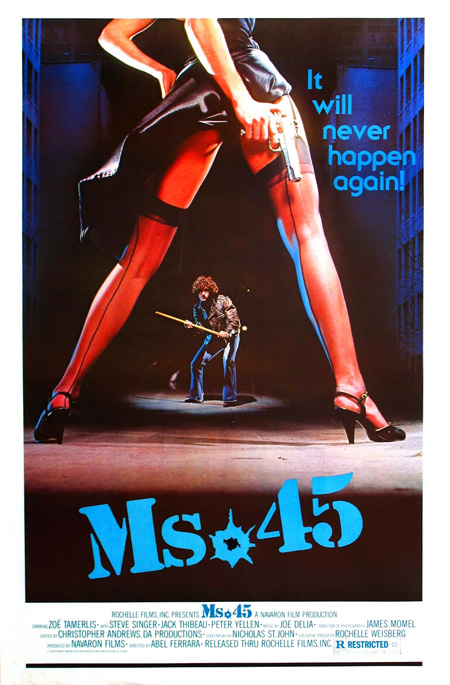
I don’t know who designed the poster for the classic 1981 film, Ms. 45, but it is truly brilliant.
Directed by Abel Ferrara, Ms. 45 tells the story of a mute seamstress named Thana (played by Zoe Tamerlis) who, after being raped twice in one day, uses a 45 caliber pistol to take revenge on almost every man in New York City. The film’s tagline announces, “She was used and abused — and it will never happen again!” and Ms. 45 is a feminist masterpiece, one that exposed and attacked the same type of men who, undoubtedly expecting to see a typically low-budget, nudity-filled revenge flick, probably flocked down to 42nd Street to see the film when it was originally released.
Like the film itself, the poster is a work of transgressive brilliance, promising sex and violence while, at the same time, announcing that Thana was never again going to be a victim of an exploitive and patriarchal society. One can only imagine how many men were lured into the theater by the legs on this poster, just to then by left in a state of shock as they literally watched themselves being blown away and punished for their misogyny on screen. (Reportedly, even the most hardened of grindhouse audiences were left stunned by Ms. 45‘s intense final scene.)
The poster for Ms. 45 is definitely one of the best in grindhouse history and it’s also our latest artwork of the day!
(If you want to read more about my feelings about Ms. 45 and grindhouse cinema in general, please be sure to read my rightfully acclaimed essay on the subject, Too Sordid To Ever Be Corrupted.)
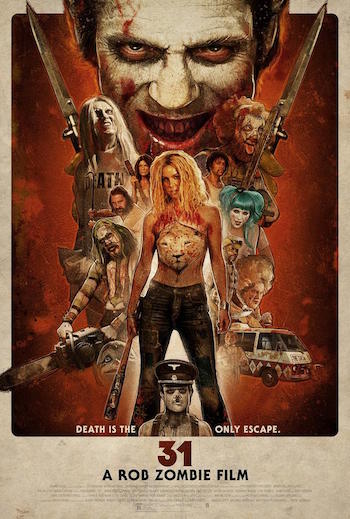
Are you scared of clowns? Sure, you are. All good people fear clowns. However, if you somehow do not find clowns to be frightening, you may change your mind after seeing Rob Zombie’s latest film, 31.
Of course, that’s assuming that you actually see 31. 31 is not a film for everyone. In fact, if you’re not a fan of Rob Zombie or his style of horror, you should probably stay miles away from 31. Bloody, intense, violent, and occasionally rather nihilistic, 31 is perhaps the Rob Zombiest of all the films that Rob Zombie has ever made.
However, if you’re a fan of extreme horror, you’ll appreciate 31. It may not always be easy to take but then again, that’s kind of the point.
The film takes place in the 70s, which means that it has a really kickass soundtrack. A group of carnival workers are driving across the desert in a van when they are attacked and kidnapped. They find themselves in a dark building, being lectured by three people who are dressed like 18th century French aristocrats. The leader of the aristocrats (played by Malcolm McDowell) informs them that they are going to playing a game called 31. For the next twelve hours, they will be locked away in a maze. They will be hunted by five murderous clowns.
Yes, you read that right. Not just one murderous clowns — FIVE! (Even worse, a sixth bonus clown eventually joins the game.)
If they can survive for 12 hours, they win. What do they win? Other than freedom, the film is never particular clear on this point. The motives of the aristocrats remain a mystery for the majority of the film. Are they just sadists, are they perhaps devote fans of The Purge who were so disappointed with Election Year that they decided to recreate the second film on their own, or is there some bigger reason behind this game of 31? The film leaves the question for us to answer.
The rest of the film is a collection of progressively more violent fights between the carnival workers and the clowns. For the most part, the carnival workers are all likable and you don’t want to see any of them harmed. The clowns, meanwhile, are just about the freakiest collection of killers that you’ve ever seen. When one of them is cornered, he pathetically begs, “We’re all pawns! We don’t want to do this!” but you never quite believe him. The deadliest of the clowns is Doom-Head (Richard Brake) and his evil smirk will give you nightmares.
31 is an incredibly intense film and it’s definitely not for the faint of heart. Everything from the acting to the set design to the costumes to David Daniel’s stark cinematography comes together to make 31 into a harrowing horror film. If you can’t stand Zombie’s trademark mayhem, I would suggest avoiding 31. However, if you’re a fan of Zombie’s films, you’ll find 31 to be perhaps the purest distillation of his artistic vision.
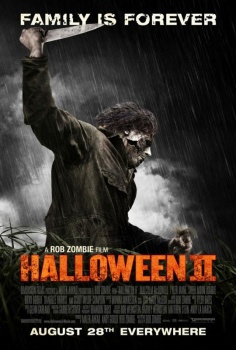
The thing about praising Rob Zombie’s Halloween is that you’re then contractually obligated to talk about the 2009 sequel, Halloween II. While I certainly don’t have any trouble defending the first film, Halloween II is about as big a mess as I’ve ever seen.
Much like the sequel to the original film,Halloween II opens with Laurie (Scout Taylor-Compton) being stalked in the hospital by her murderous older brother, Michael (Tyler Mane). And the hospital scenes are actually pretty good. Zombie makes good use of Nights in White Satin and the scenes of Michael chasing Laurie are genuinely suspenseful.
However, the film then jumps a year into the future and it’s all kind of annoying. Halloween II follows three separate storylines, all of which converge at the rushed conclusion.
My favorite storyline dealt with Dr. Loomis (again played by the brilliant Malcolm McDowell). Loomis has written a book about Michael and is now traveling the country, promoting himself as a true crime expert and dealing with people who think that he’s exploiting the whole tragedy for a quick buck. McDowell is perfect in these scenes, playing Dr. Loomis as a pompous man who secretly knows that he’s a fraud. “I was as much a victim as anyone,” he occasionally sputters. Perhaps the highlight of the film comes when he’s interviewed by a rather sarcastic Chris Hardwick and finds himself being ridiculed by Weird Al Yankovic (playing himself).
The second storyline features Annie (Danielle Harris) and Laurie struggling to get on with their lives. Laurie is now living with Annie and her father (Brad Dourif). As opposed to the virginal Laurie of the first Halloween, this Laurie is pissed off and out of control. On the one hand, I think Zombie deserves some credit for trying to deal with the PTSD that would obviously be the result of surviving being attacked by Michael Myers. On the other hand, to say that Laurie is never not pissed off would be an understatement. Scout Taylor-Compton does a good job playing her but, in Halloween II, a little Laurie Strode goes a long way. You can only watch someone rage at the world for so long before it starts to get boring.
And the third storyline, not surprisingly, is Michael still trying to track down and kill his sister. Michael continually sees visions of his dead mother (Sheri Moon Zombie), occasionally accompanied by a white horse, telling him, “It’s time.” (Eventually, Laurie starts to see the same thing.) Usually, if you come across someone online criticizing Halloween II, one of the first things that they’ll mention will be that white horse. To be honest, the white horse didn’t both me. I actually appreciated the surreal touch of Sheri Moon Zombie and a white horse appearing out of nowhere. But still, as opposed to first film, Michael is just boring in this film. The first film was memorable because it took the time to explore why Michael became who he became. In Halloween II, Michael’s just another killer in a mask. Leslie Vernon would have kicked his ass.
So, no, Halloween II does not really work. The story is too messy and, with the exception of Dr. Loomis, none of the characters are particularly interesting. I still stand by my claim that Rob Zombie is an underrated director but Halloween II is a definite misfire.
That’s the question that every horror fan has to ask themselves at some point. Needless to say, Zombie has a huge following and no one can doubt his love for the genre. And yet, despite that, it seems that Zombie’s detractors will always be as outspoken as his fans. His fans point out that Zombie makes movies that literally feel as if they’re filmed nightmares and that, as a committed horror fan, he’s willing to go further in his quest to shock you than most mainstream filmmakers. His detractors, meanwhile, tend to see Zombie as an excessive filmmaker who often uses an abundance of style to cover for a weak narrative.
Personally, I’m somewhere in the middle when it comes to Zombie. I think, as a storyteller, Rob Zombie does occasionally struggle to maintain a coherent narrative but, at the same time, I think his strengths as a director ultimately overcome his weaknesses. As a visual filmmaker, he’s a lot stronger than he’s often given credit for and I don’t think anyone would criticize the way that he uses music in his films. He may not be the strongest director of actors but he’s got a good eye for casting and he’s given work to some of our best character actors (Sid Haig, Malcolm McDowell, Brad Dourif, William Forsythe, and the late Karen Black, just to name a few). If his films are extremely graphic and bloody … well, that’s the current state of horror. If anything, I would argue that Zombie deserves credit for unapologetically embracing the mantle of being a 21st century grindhouse filmmaker.
That said, Rob Zombie’s films rarely seem to be as good on a second viewing as they were during the first. He’s one of those directors who comes at you strong that, to a certain extent, his films almost beat you into submission. During the first viewing of one of Zombie’s films, it’s not unusual to be overwhelmed by all the style and the music and the gore and the over-the-top characterizations. Even if you don’t like the film itself, it definitely makes an impression on you. It’s only on repeat viewing that you might start to notice that Zombie’s narratives are often rather clumsily slapped together. Several times, Zombie’s visual style seems to dictate the story as opposed to the other way around.
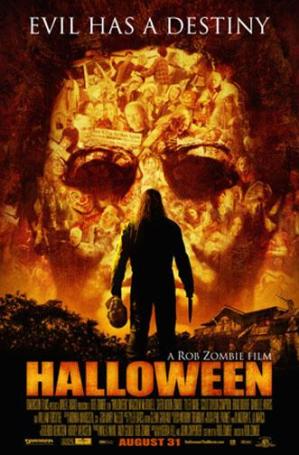
That was certainly the case with his 2007 remake of Halloween. While the film follows the same basic plot as John Carpenter’s original, it also spent a lot more time delving into the past of Michael Myers (Daeg Faerch as a child, Tyler Mane as an adult). It was obvious that Zombie was far more interested in Michael than in any of his victims. (Carpenter took the exact opposite approach, developing the characters of Annie, Laurie, and Linda and allowing Michael to remain a cipher.) As a result, the first half of the film deals with Michael and his dysfunctional childhood while only the second half features Michael escaping and returning to Haddonfield. Laurie, Annie, and Lynda are well-played by Scout Taylor-Compton, Danielle Harris, and Kristina Klebe but ultimately, they all remain rather generic.
The first time I saw Rob Zombie’s Halloween, I thought it was one of the most disturbing films that I had ever seen. I should clarify that I mean that in a good way. Zombie’s Michael was truly terrifying but, at the same time, Zombie portrayed him as a kid who never had a chance. Whereas Carpenter’s Michael started the film as a fresh-faced little boy dressed up like a clown and holding a bloody knife, Zombie’s Michael is born into a world of chaos and darkness. With his dysfunctional childhood, it was hard not to feel that Michael never had a chance. Feeling abandoned by both his family and, eventually, his therapist, Michael retreated into a world of pure anger and hate. Whereas John Carpenter’s Michael rarely seemed to be angry (instead he was just relentless), Zombie’s Michael is rage personified.
Unfortunately, Zombie’s Halloween spends so much time on Michael and his mother (Sheri Moon Zombie) and Dr. Loomis (Malcolm McDowell, perfectly cast) that it doesn’t leave much time for the night he came home. Essentially, the entirety of Carpenter’s original film is crammed into the film’s second half and, on repeat viewings, you can’t ignore how incredibly rushed it all feels. It’s obvious that Zombie’s heart was in the first half of the film. In the second half, he’s just going through the slasher movie motions.
Rob Zombie’s Halloween is definitely a flawed film. John Carpenter’s original remains the superior Halloween but, to be honest, I don’t think Rob Zombie would deny that. Zombie set out not to replace Carpenter’s Halloween but to tell a different version of the same story. When Zombie’s Halloween works, it really works. Flawed as it may be, Halloween proves that Rob Zombie is a talented filmmaker, albeit one with room to grow.
As for Halloween II … well, we’ll talk about that later…
Well, first off, that’s what I tend to do. However, on top of that, I was also stirring because I was watching SyFy’s latest original film, The Night Before Halloween. I was excited because The Night Before Halloween was full of Degrassi actors!
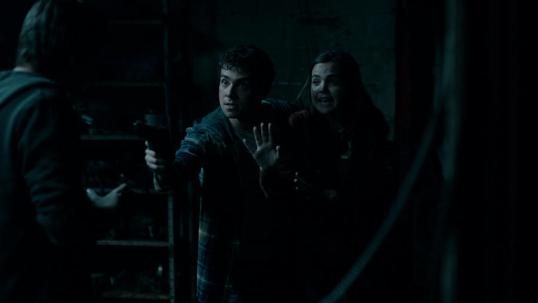
For instance, Jahmil French played the nerdy but cool Dave Turner on Degrassi. In The Night Before Halloween, he plays Kyle. Kyle’s a teenager with a curse. Basically, unless he can trick someone into killing another person, a supernatural creature will kill him on Halloween night. It’s a bit like the It Follows curse, except that the curse isn’t passed on by sex. Instead, it’s passed by fooling someone else into committing murder. In other words, transmitting The Night Before Halloween curse is a lot less fun than transmitting the It Follows curse.
On Degrassi, Justin Kelly played Jake Martin, a handsome and lovable stoner. In The Night Before Halloween, Justin Kelly plays Adam, who is handsome and lovable and probably likes to get high, even though we never see him do so in the film. Adam, unfortunately, is friends with Kyle. When Kyle tricks Adam in taking part in a prank that leads to the electrocution of Beth (Natalie Ganzhorn), Adam finds himself being pursued by the monster. Can he and his girlfriend, Megan (Bailee Madison), survive?
On Degrassi, Alex Harrouch played Leo, the abusive boyfriend (and briefly, husband) of Alli. In The Night Before Halloween, Harrouch plays a much more sympathetic character, Wyatt. At first, Wyatt is likable and nerdy but then Kyle tricks him into helping to kill Beth. Leo is the first of the friends to understand what has happened but, when he tried to inform his friends, they ignored his calls and texts. So, as Leo puts it, he made some new friends, with names like Benny and Oxy. Leo has had to do some terrible things to survive and he’s been left a haunted shell of his former self.
The final member of this group of friends is Lindsay. Lindsay is played by Kiana Madeira, who does not have a Degrassi connection but still does a good job in her role. Lindsay may start as a skeptic but soon, she’s willing to do almost anything to get rid of the curse.
Anyway, of all the It Follows-inspired films that showed up on SyFy this October, The Night Before Halloween was definitely the best. It was well-acted and directed and the supernatural monster (which usually manifested itself as a swarm of flies) was creepy. Best of all, the film fully embraced and explored the question of how far people would go to survive. In The Night Before Halloween, the only way to escape the curse is to betray someone. While you may not be surprised when the friends start to betray each other, you’ll still never guess just how far one of them is willing to go. You may even find yourself considering just how far you would go to save your life.
The Night Before Halloween is a very well-done SyFy shocker. Even if it didn’t have the Degrassi connection, it would still be one to track down.
Are these the scariest films of all time? Well. I’m not going to say that because horror is subjective and what scares me might not scare you and blah blah blah blah.
So, these might not be the scariest ten films of all time. But then again, they might…
You end up with a big ol’ mess of a movie. I just watched Bleed on Netflix and the plot is so convoluted that I’m still trying to figure out what exactly I just watched.
But, before I try to figure this all out, let’s take a look at the trailer:
Sarah (Chelsey Crisp) is a newlywed who appears to have it all. She’s got a wonderful husband, Matt (Michael Steger), they’ve got a beautiful house out in the country, and even more importantly, they’ve got a baby on the way! So what if the nearby town seems to be a little bit creepy and is full of country-accented men with beards? And so what if there’s a deserted prison nearby, one that is rumored to be haunted by the spirit of a preacher-turned-serial killer who died when a fire broke out at the prison? And what about that mysterious woman who keeps showing up in the nearby field and screaming like a banshee? That’s just local color! Anyone who thinks that’s unusual has obviously never lived in Oklahoma or visited Hot Springs, Arkansas.
In order to celebrate their new home, Sarah and Matt decide to invite their best friends out to the house. Dave (Elimu Nelson) and Bree (Brittany Ishibashi) are a likable couple, especially now that Bree is regularly taking her medication. Bree is schizophrenic and hears voices when she doesn’t take her meds. To the film’s credit, it portrays Bree as a positive character and never goes down the path that I feared it would follow.
Suddenly, Sarah’s good-for-nothing brother, Eric (Riley Smith) shows up. His girlfriend, Skye (Lyndon Smith) is with him. The first thing that Eric does is ask for money. The second thing that Eric does is get high. The third thing that Eric does is talk about how he and Skye have spent the past few months driving across America and searching for ghosts. And hey, isn’t there a haunted prison somewhere nearby?
Meanwhile, Skye takes a bath. While she’s in the bathtub, she suddenly see an evil-looking apparition standing over her. She screams for help and Matt responds. The apparition has vanished. Sarah glares at Matt and the towel-clad Skye. “I didn’t know she’d be half-naked!” Matt protests. Of course not! Why would someone get undressed before taking a bath?
Anyway, Eric convinces everyone but Sarah to search for ghosts with them. Sarah drops them off at the ruins of the prison, promises to come back for them in a few hours, and then starts back home. Unfortunately, she has an accident on the way back and ends up getting a ride with a creepy deputy. And it quickly becomes clear that the deputy isn’t in any hurry to get her back home…
Meanwhile, at the prison, all Hell breaks loose. Skye sees another evil spirit. Eric’s throat gets slashed but oddly, it stops bleeding after a few seconds. Voices are heard. Objects move. So many Paranormal Activity-type things occur that I’m actually surprised (and relieved) that Bleed wasn’t a found footage film…
One thing that Bleed does is that it keeps you guessing. At first, I assumed it would be another city folk vs. hillbillies type of film but then it turned into a ghost story. And, for a long while, I thought it was just another ghost story but then it turned out to be something different all together. Admittedly, the film sometimes struggles to handle the constant shift in tone but, oddly, that kinda works. It definitely keeps the viewer off-balance.
As you might expect from a film that’s constantly changing tone, Bleed is a bit uneven but it’s definitely a watchable and intriguing horror film and the film makes good use of that atmospheric prison. For a lot of viewers, Bleed will probably be a love-it-or-hate-it type of film. It’s well-directed but the story is just almost unnecessarily complicated. My recommendation is that you watch it and judge for yourself.
Mary and Roberto Vivaldi (played by Lubka Lenzi and Pascal Persiano) would appear to have a perfect life, perhaps because they do. They’re young. They’re attractive. They’re in love. They’re rich. They have a really nice house and they have two children, a boy and a girl. What could go wrong, right?
Well, they could come home from a party and discover that their house is being burglarized. And the burglar could then proceed to graphically and viscously murder them, smashing in Robert’s head and, since this is a Lucio Fulci film, popping out Mary’s eye. In fact, the opening murder is so graphic and so disturbing that it’s somewhat surprising to learn that this movie was made for television.
Of course, what’s even stranger is that the rest of the film is oddly tame, particularly for a Fulci film. Perhaps they only had enough money in the budget for one graphic gore scene.
Anyway, the parents are now dead and the children are now orphans. At the funeral, the children shock everyone by playing and laughing. However, a few seconds later, they’re standing over the grave and crying. Some people would call this an inconsistency but I think it’s the most realistic part of the film. When you lose someone who you love, you do strange things. There is no one proper way to grieve. As someone who suffered through his share of personal tragedy, this was something that Fulci probably understood.
The parents may be dead but they’re not gone! Instead, they’re haunting the house. The children are overjoyed but their new guardian, Aunt Marcia (Cinzia Monreale, who was Emily in Fulci’s The Beyond) is not. Marcia freaks out upon realizing that the house is haunted and it certainly doesn’t help that she’s attacked by a gigantic fly in the attic. Her husband, the incredibly dense Carlo (Jean Christophe Bretigniere), doesn’t think anything strange is happening. Still, Carlo does agree that it would be a good idea to sell the house and move the children elsewhere.
Nope! The parents have no intention of letting that happen! Of course, the dead parents main concern to kill the man who killed them but, once he’s dead (it doesn’t take that long), they’re free to spend their time pushing a real estate agent down a flight of stairs, harassing Marcia and Carlo and eventually causing an exorcist’s hand to melt.
If you’re getting the feeling that both the dead parents and the living children are pretty obnoxious, that’s because they are. I mean, it’s one thing to not want to be separated. That’s something we can all relate to. It’s another thing to melt a man’s hand and then laugh about it. Add to that, neither Marcia nor Carlo come across as being particularly villainous. It’s not like they’re planning on murdering the kids for their inheritance or sending them to a Dickensian orphanage or anything like that. They just want the kids to stop conducting black magic ceremonies and they want to live in a house that isn’t haunted. No matter how much sympathy you may have for the parents or the kids, it’s hard to deny that Marcia and Carlo aren’t being all that unreasonable.
(It also doesn’t help that the film ends with the suggestion that the dead parents can stay with the kids regardless of whether the house is sold or not.)
And yet, I can’t help but like The Sweet House of Horrors. Even though it doesn’t make much sense and it’s hampered by a low-budget (just check out the floating flames that represent the dead parents), there’s a sincerity to The Sweet House of Horrors. The parents really do seem to love their obnoxious children and the film actually does provide some insight regarding the way that children use imagination to deal with grief. Like many of his later film, The Sweet House of Horrors is hit-and-miss but Lucio Fulci still comes up with a few good visuals, suggesting that his heart may have been in this film in a way that it wasn’t in some of the other films he made during the final years of his storied career. Just the fact that The Sweet House of Horrors tells such an openly sentimental story makes it unique in Fulci’s filmography.
The Sweet House of Horrors cannot be compared to such Fulci classics as The Beyond, The House By The Cemetery, The Black Cat, or Zombi 2. But still, it’s an interesting little film and provides a hint that, even during his decline, Fulci still possessed some of the talent that made his earlier films so iconic.
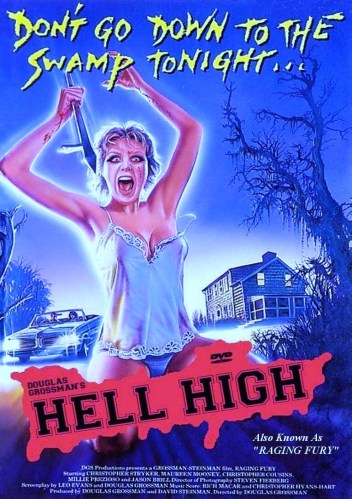
Actually, that’s pretty good advice in general. Swamps are dangerous. They’re full of malaria-carrying flies and crocodiles and ghosts of angry Cajuns. Of course, none of those show up in the 1989 slasher film Hell High. In fact, there’s only one scene set in a swamp and that scene happens during the day.
It involves a little girl who is out in the swamp, playing with her doll and watching two teenage lovers get killed as the result of a macabre motorcycle accident. It’s a pretty disturbing sight, especially since one of the lovers ends up getting impaled and spitting blood all over the place. BLEH!
Anyway, that girl grows up to be a high school science teacher named Brooke Storm (Maureen Mooney). She’s a good teacher but she’s also extremely repressed and haunted by the image of that impaled girl spitting up blood. Unfortunately, one of her students is a sociopath named Dickens (Christopher Stryker). Dickens is the type of student who goes to football games just so he can threaten the injured players with a gigantic switchblade. Oddly, no one seems to notice Dickens standing on the sidelines, holding a gigantic knife over a helpless jock. At first I thought that this meant that Dickens was meant to be either a ghost or a figment of someone’s imagination but no, Dickens is real. I guess people are just so used to being threatened by Dickens that no one even notices anymore.
Anyway, Dickens has three friends. Queenie (Millie Prezioso) is the tough girl who bares her breasts to anyone who stops by her house. Smiler (Jason Brill) is the fat guy who is always smiling, no matter how upset he is. Smiler continually says things like, “What’s gotten into that Dickens?” and “My mamma said there’d be days like this.” And then there’s Jon-Jon (Christopher Cousins). Jon-Jon is Dickens’s newest friend. Jon-Jon’s a good kid but a little weak-willed. He’s got a crush on Queenie and Dickens seems to have a crush on him.
Anyway, Dickens and his friends decide to play a prank on Miss Storm but, in the process of doing so, they cause her to have flashbacks to that day in the swamp. And soon, Miss Storm is stalking all four of them. How dangerous is Miss Storm? Well, she’s dangerous enough that she can kill you with a number two pencil. You think Liam Neeson was a creative and relentless killing machine in Taken? He’s got nothing on Brooke Storm!
Anyway, Hell High is kind of an oddity. On the one hand, it’s pretty much a standard slasher film. On the other hand, the film has just enough strange moments to distinguish it. Yes, there’s Dickens with the knife on the football field. But there’s also Smiler with his nonstop grin. And Queenie with her relentless mood swings. And there’s the strangely 0ff-kilter dialogue, which is full of random song lyrics. And then there’s the film’s twist ending, which makes little sense but it is still satisfying in its own over the top way. Hell High is a thoroughly odd but undeniably effective 80s horror film.
A lot of the credit has to go to the film’s cast, all of whom give far better performances than the material really deserves. Maureen Mooney is both scary and sympathetic as poor Miss Storm while Christopher Cousins is likable as the somewhat weak-willed Jon-Jon. The film, however, is truly dominated by Christopher Stryker. Stryker goes all out as the crazy Dickens and it’s unfortunate that he died shortly after Hell High was released. Had he lived, he’d probably now be a Sid Haig-style character actor, popping up in indie horror movies and Quentin Tarantino films.
So, watch Hell High if you get a chance and definitely stay out of the swamp tonight!


 Through the Shattered Lens