The TSL’s Horror Grindhouse: House of The Dead (dir by Uwe Boll)


You know things are going to be bad when the 2003 video game adaptation House of the Dead opens with a lengthy narration in which we’re told exactly who is going to die in the film and who is going to live. Narration is usually a bad sign, in general. Narration that gives away a huge chunk of the plot during the opening five minutes is even worse.

Things get worse when we’re told that a bunch of college students need to find a boat so that they can attend the “rave of the century,” which is being held on an isolated island. (The island, by the way, is known as the Island of the Dead but no one seems to be that concerned by the name.) From what we see of the greatest rave of all time, it apparently involves one stage, two speakers, and exactly 8 people dancing. The dancers are often shot in slow motion, which I guess is meant to make them look like they’re having more fun than they actually are. Myself, I’m wondering why anyone would hold the “rave of the century” on an island that no one can find. According to the banner above the stage, the whole thing is being sponsored by Sega, the company behind the House of the Dead video game that gave this movie its name.

Things quickly go downhill once the zombies show up and start killing everyone. It doesn’t take long for most of the disposable characters to get killed. The majority of the film is made up of people either running through the forest or hiding in a house or a boat. Because none of the characters really have any personality, you’re never quite sure who anyone is. Their deaths don’t really register because it never seems as if they were living to begin with. Watching the film, it’s hard not to feel that everyone on the island is a member of the living dead. It’s just that some of them haven’t realized it yet.

As mentioned above, House of the Dead is based on a video game and, frequently, the action is punctuated with heavily pixelated scenes that have been lifted straight from the game. On the one hand, you have to admire the film for being honest about what it is. On the other hand, you have to regret that the film itself is never as much fun as the game probably is.

House of the Dead was one of several video game adaptations that German director Uwe Boll was responsible for in the early aughts. Up until he retired from the film industry, it was regularly argued by online film critics that Boll was the world’s worst director. Boll responded to the criticism by challenging his most vehement critics to a boxing match. A few of the critics accepted the challenge and Boll actually did fight them, knocking all of them out. I imagine that’s probably every filmmaker’s secret fantasy.

Myself, I will say that I don’t think Boll is the worst director in the world. He’s not particularly good but there are worst directors out there. That said, House of the Dead is pretty bad. The dialogue is leaden, the characters are bland, and even the intentional attempts at humor fall flat. Seventeen years after it was first released, it still pretty much represents the nadir of video game adaptations.

Anyway, the main lesson of this film is …. well, I don’t think there really is a lesson to be found, other than that it might be a good idea to take names seriously. I mean, Island of the Dead? Can anyone really be surprised that the zombies showed up?

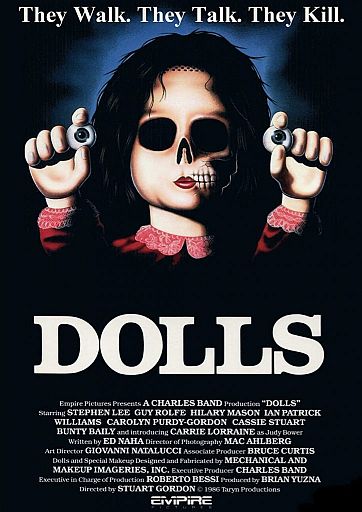
The TSL’s Horror Grindhouse: Dolls (dir by Stuart Gordon)


Sitting out of the middle of nowhere, there’s a house. And in this house, there lives an old man and an old woman. They appear to be very friendly, the type who will happily open up their home to anyone needing a place to stay and have a cup of coffee. They make dolls for a living. They make the type of dolls that smirk at you whenever you trip and that glare at you whenever you say that you don’t care about toys. They’re living dolls and they’re actually kind of vicious. Don’t get on their bad side.

That is exactly the mistake that a few people make when they arrive at the house on one stormy night. Two punk rock girls with exaggerated British accents make the mistake of trying to find something to steal. Uh-oh, here come the dolls! A self-centered man and his wife make the mistake of not caring about their daughter. The dolls aren’t going to stand for that!  Seriously, the dolls may be cute but if they don’t like you, you are doomed!

The dolls, however, do like the daughter. And they appear to be willing to tolerate Ralph, the goofy traveling salesman who made the mistake of picking up the two punk rock girls while they were hitchhiking. Will the dolls continue to like the daughter and Ralph or will they eventually turn on everyone in the house? They may be small but again, you seriously do not want to get these dolls mad.

First released in 1986, Dolls is a seriously strange movie from director Stuart Gordon and producer Charles Band. There’s a lot of good things to be said for Dolls. The house is atmospheric. The dolls are truly creepy. The acting really isn’t that bad, though I do think most viewers won’t necessarily miss the two punks girls.  The movie does take the characters and the dolls in some unexpected directions. But the movie’s tone is all over the place. It starts out as a broad comedy before then turning into a surprisingly violent and bloody horror film and then it turns into this strangely macabre family drama. The movie can’t seem to decide whether it wants you touch your heart or scar your soul. Imagine Home Alone if the movie kept all the heart-warming stuff but then had the kid brutally kill the burglars and laugh while stuffing their corpses in a furnace and you have some idea of what the tone of Dolls is like.

It’s an odd film but it’s hard not to like. Stuart Gordon’s direction is energetic and, since the movie only has a running time of 77 minutes, the whole thing feels like an extra weird episode of Tales From The Crypt or The Twilight Zone. Even the film’s mix of humor and disturbing violence feels strangely appropriate, as if the film itself is an adaptation of a particularly grisly fairy tale.

Watch Dolls and you’ll never look at a toy the same way again!

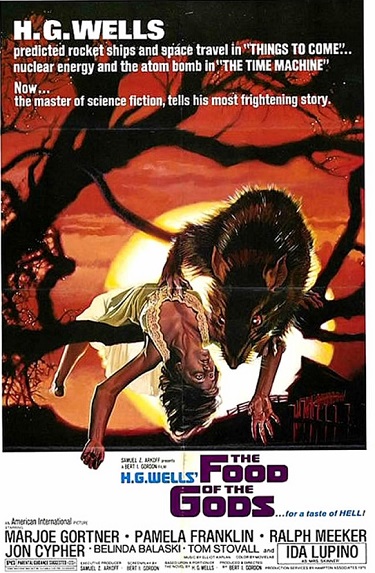
The TSL’s Horror Grindhouse: Food Of The Gods (dir by Bert I. Gordon)


Uh-oh! Something weird has bubbled up to the ground on an island near British Columbia and a farmer and his wife (played by John McLaim and Ida Lupino) foolishly decided to feed it to their farm animals! Soon, they’ve got giant chickens! And listen, that might sound like a good thing to some but I’ve spent enough time around farms to know that giant chickens are not a good thing! Seriously, normal-sized chickens are messy enough. Giant ones? I don’t even want to thinking about it.

Unfortunately, it’s not just the chickens that are eating the food. Rats are eating the food. Wasps are eating the food. All of the animals are turning into giants and now, they’re hunting humans! After his best friend is attacked and killed by giant wasp, a football player named Morgan (Marjoe Gortner) decides to investigate on his own. You would think that a football player would be busy preparing for his next game or something like that but no, not Morgan! Morgan’s determined to find out why there are giant animals off the coast of Canada.

Of course, Morgan isn’t the only one interested in the so-called Food of the Gods. There’s also Jack Bensington (Ralph Meeker), who owns a dog food company. Jack wants to sell the food. Why would Jack want to do that? Does he actually think that causing dogs to transform into giants who would undoubtedly try to kill their masters is somehow going to be good for his company’s reputation? Jack’s main motivation seems to be that he’s a businessman and, in this film’s moral universe, that automatically makes him one of the bad guys. But it seems like even an evil businessman would know better than to kill off all of his customers.

This 1976 film, which is loosely (very loosely) based on a novel by H.G. Wells, was directed by Bert I. Gordon and, if you think the plot sounds a little ludicrous …. well, it is. Nothing about the film really makes much sense but that’s kind of to expected from a Bert I. Gordon film. Gordon specialized in making films about giants destroying stuff. The films were never particularly good but Gordon obviously understood that American filmgoers love big things. Food of the Gods, as silly as it may be, apparently made a lot of money when it was first released.

Today, of course, it’s impossible to watch the film without noticing just how terrible the special effects are. Between the unconvincing use of super-imposed images and the obviously fake rats that are tossed at some of the actors, there’s not a single shot that doesn’t somehow look totally ridiculous. In fact, it’s all so silly and obviously done on the cheap that it becomes rather charming, or at least as charming as the superimposed image of giant wasp ever could possibly be. You have to admire the film’s determination to tell its story despite not having the resources to do so. As for the rest of the film, it’s dumb but it doesn’t take itself too seriously. If you’re specifically searching for a bad giant animal movie, The Food of the Gods is fun in its own goofy, nonsensical, low-budget way.

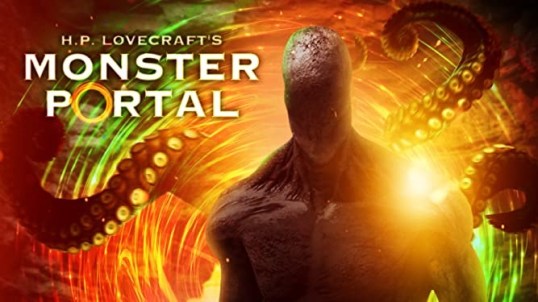
The TSL’s Horror Grindhouse: H.P. Lovecraft’s Monster Portal (dir by Matthew B.C.)


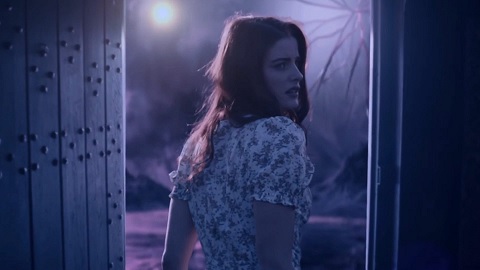
After the mysterious disappearance of her father, Celine (Sian Altman) travels to his estate with her boyfriend, Rich (Louis James) and their friends, April (Sarah Alexandra Marks) and Nick (George Nettleton).  Celine wants to deal with her memories and figure out what led to her father disappearing.  Rich wants to help her.  Nick, meanwhile, just wants to get drunk.  April just wants to be anywhere but near Nick.  It’s a bit of a dysfunctional group.  Personally, I probably would have left Nick behind but I guess the hope was that Nick would lighten the mood whenever things started to get too heavy.

Upon arriving at the estate, they notice a few weird things.  For instance, the housekeeper (Judy Tcherniak) has a habit of chanting and she keeps talking about the old ones.  There are dead rabbits all over the place.  The housekeeper says that the cat must have killed them but there doesn’t seem to be cat anywhere nearby and, as Rich quickly notices, it looks more likely that the rabbits were murdered as a sort of sacrifice.  There are strange books and paintings to be found all over the house and there are black-robed cultists who only seem to come out at night.  And, of course, there’s the portal in the back yard, which leads to another dimension but also from which spring giant, sacrifice-demanding demons.  One should probably be careful about building one of those.  I mean, sure, a gazebo looks nice but is it worth losing your soul over?  It’s something to consider.

You can probably guess where H.P. Lovecraft’s Monster Portal is heading.  Just the appearance of H.P. Lovecraft’s name in the title should tell you all that you need to know.  (The film is also known simply as The Offering, which again kind of gives away the plot.)  To the film’s credit, it actually does make proper and respectful use of the Cthulhu mythos and, even more importantly, it frequently captures the feel of a H.P. Lovecraft short story.  Lovecraft often wrote about people who were investigating the mysterious sins of their family and, of course, he was never hesitant to toss in a robed cultist or two.  Even more importantly, the film captures Lovecraft’s view of humanity as just being an insignificant pawn in the grand scheme of things.  There have been a lot of films that have claimed Lovecraft as an inspiration but Monster Portal is one of the few to really convince you that it was made by fans of his work.

The film’s low budget is obvious in nearly every frame but the monsters themselves are actually pretty impressive and director Matthew B.C. does a good job creating a properly ominous atmosphere.  The estate itself looks great.  The acting is a bit inconsistent but, for the most part, Sian Altman and Sarah Alexandra Marks are sympathetic in the lead roles and Judy Tcherniak goes so over-the-top as the housekeeper that she’s actually a lot of fun to watch.  Monster Portal is an enjoyable tribute to Lovecraft’s work.

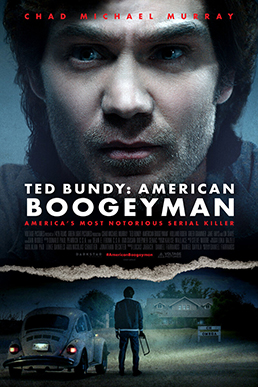
The TSL’s Horror Grindhouse: Ted Bundy: American Boogeyman (dir by Daniel Farrands)


The 2021 film, Ted Bundy: American Boogeyman, is yet another film about the life and crimes of America’s first celebrity serial killer, Ted Bundy.

In this particular film, Bundy is played as being a handsome nonentity by Chad Michael Murray.  The film follows Bundy as he moves from Seattle to Utah to Colorado and eventually to Florida, leaving a path of death in his wake.  Investigating his crimes are Seattle Detective Kathleen McChesney (Holland Roden) and FBI profiler Robert Ressler (Jake Hays).  McChesney not only has to track down Bundy but she also has to deal with her sexist police chief and his idiot son, both of whom think that Bundy’s victims are to blame.

Ted Bundy: American Boogeyman is the latest true crime horror film to be directed by Daniel Farrands.  The frustrating thing about Farrands is that, if you can overlook the subject matter of his recent films, he’s actually a talented horror director who knows how to create suspense and who can be counted on to come up with at least one effective jump scare in all of his films.  That said, he keeps making films that are almost impossible to defend because they exploit real-life tragedy.  Farrands’s best film, The Haunting of Sharon Tate, worked because of Hilary Duff’s committed performance in the title role and the fact that the film itself was fully on Tate’s side.  However, Farrands’s The Murder of Nicole Brown Simpson was a tacky piece of exploitation that, despite Farrands’s strong visuals, appeared to have little compassion for the woman whose murder served as the film’s inspiration.

Ted Bundy: American Boogeyman is neither as effective as The Haunting of Sharon Tate nor as bad as The Murder of Nicole Brown Simpson.  For the most part, the film plays loose with the facts of the case.  At one point, McChesney even shows up at one of Bundy’s crime scenes and takes a shot at him as he flees.  (Tarantino also played around with history in Once Upon A Time In Hollywood but, by allowing Brad Pitt and Leonardo DiCaprio to kill the members of the Mason family, he also allowed their victims to live.  Ted Bundy: American Boogeyman, on the other hand, is willing to change history to allow McChesney to arrive at the crime scene but it’s not willing to change history to allow any of Bundy’s victims to survive.  It’s hard not to feel that the film would have benefitted from following Tarantino’s approach and allowing Bundy’s victims to beat him to death.)  There are a few odd scenes in which Bundy is showing fondling several mannequins.  The scenes appear to pay homage to William Lustig’s Maniac but again, it doesn’t seem to be based on anything the actual Bundy did.  The film hints at the intriguing idea of Ted Bundy being America’s first celebrity serial killer but it doesn’t really follow up on it.  The whole thing feels rushed and rather icky.  It certainly doesn’t add any insight into Bundy or killers in general.

That said, our longtime readers know that I hate to end on a totally negative note so I will say that the film uses its low budget to its advantage.  The sparse sets and the small cast give the film something of a surreal feel, with Bundy as an evil specter who randomly shows up to haunt the dreams of a nation.  Lin Shaye and Diane Franklin appear in small roles.  Franklin plays a distraught mom who asks McChesney to kill Bundy rather than arrest him.  Shaye plays Bundy’s overprotective mother and gives a nicely creepy performance.  As I said earlier, it’s not so much that the film is badly made as the subject matter is so icky and the script is so bereft of any new insight that most viewers will wonder why the film needed to be made at all.

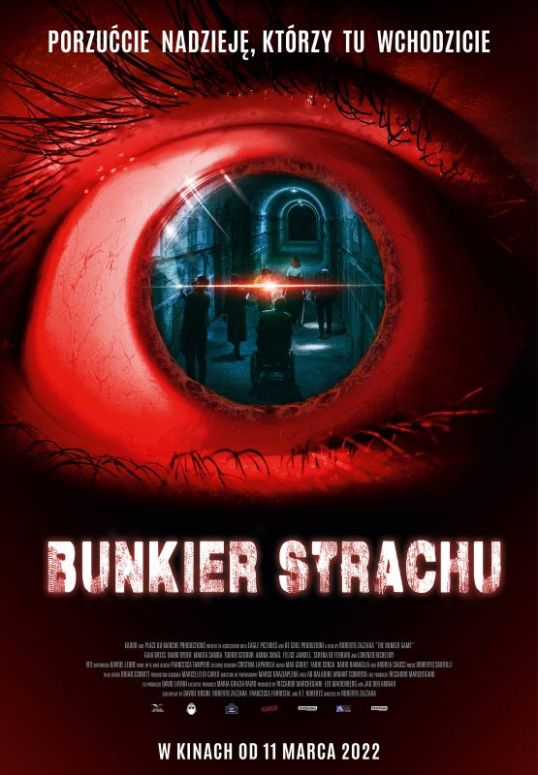
The TSL’s Horror Grindhouse: The Bunker Game (dir by Robert Zazzara)


The Bunker Game, which made its debut on Shudder earlier this year, opens with what appears to be a bit of alternate history worldmaking.   The viewer watches a black-and-white documentary that presents a world in which the Nazis conquered Europe during World War II but, ten years after Germany’s victory, the United States dropped an atomic bomb.  As a result, Europe is now an atomic wasteland.  A handful of survivors managed to find shelter in Italy, hiding out and forming a new society in an underground bunker that was built by Mussolini in the 30s.  The underground society is an authoritarian one, where mad scientists experiment on the citizens and storm troopers seem to be around every corner.  However, there is a small rebellion brewing….

Sounds potentially interesting, right?  Well, don’t get too attached to the alternative history spin because, within the first few minutes of the film, it’s revealed that the people in the bunker aren’t actually citizens of an authoritarian state and, while the Bunker is indeed real, the rest of Europe is just fine.  It turns out that documentary was just a part of an elaborate and very expensive game.  Instead of being the last refuge of the Third Reich, the Bunker is full of LARPers, people who have spent a good deal of money so that they can spend a week pretending to be …. well, Nazis.

Now again, this sounds like it could be potentially interesting.  Why would a group of people pay money in order to enter a real underground bunker and pretend to be some of the most evil people who have ever existed?  It’s an intriguing premise but, just as with the alternate history angle, don’t get to attached to it because it doesn’t take long for the film to abandon the whole LARPing plot.

Instead, unforeseen circumstances lead to the game ending early and most of the LARPers heading home. The Bunker Game proceeds to tell a fairly standard story about a handful of people who find themselves isolated in the now-deserted Bunker.  When one of their friends disappears, they split up to search for him and soon, some sort of supernatural force is killing them one-by-one.  The group is made up of identifiable types.  One person is quirky.  Another person is serious and professional.  Another is a stereotypical zoomer.  Another one is too uptight and obviously destined to go crazy before the movie is over.  For the most part, the film focuses on Laura (Gaia Weiss) and her cousin, Harry (Mark Ryder).  Harry is determined to leave the Bunker and never again deal with any LARPers.  Laura, meanwhile, finds herself strangely drawn to the Bunker, even once it becomes obvious that something is killing all of her friends.  Harry cannot understand why Laura would want to be part of the Bunker Game in the first place.  Laura cannot understand why anyone would want to live in the real world.  Most viewers will probably be able to guess where this is all going.

That said, The Bunker Game gets the job done.  The underground bunker is a wonderfully creepy setting and, even if they are playing types, the cast still does their best to bring their characters to life.  (Of course, all of them are playing characters who spent a lot of money so that they could pretend to be Nazis so, well-acted or not, most viewers will have limited sympathy for them.)  Though it’s hard not to regret that the film didn’t do more with its potentially interesting plot, director Roberto Zazzara does a good job of creating and maintaining a properly ominous atmosphere.  For what it is, The Bunker Game works well enough.  One can regret that it’s not thematically challenging while also acknowledging that, whatever flaws the narrative may have, the film still gets the job done.  Those who are just looking for a well-made horror film and who aren’t necessarily concerned with whether or not the plot makes total sense will probably enjoy The Bunker Game.

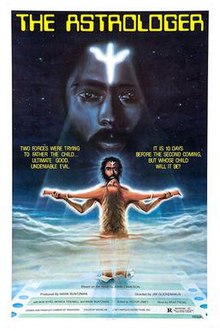
The TSL’s Horror Grindhouse: The Astrologer (dir by James Glickenhaus)


Quite possibly one of the most boring film ever made, 1975’s The Astrologer tells the story of …. well, I’m not really sure what the point of it all is.

Basically, an astrologer named Alexi Abarnel (Bob Byrd) has figured how to combine the zodiac with 70s technology and, as a result, everyone’s potential for good and evil can be determined simply by typing their birthdate into a computer.  The U.S. government funds his agency, which is known as Interzod.  And let’s be honest, that does sound like the type of dumbass thing that the government would fund, especially when the Democrats are in power.

According to the stars, the second coming of Christ is only a few days away.  Alexi is convinced that he has married the woman who is destined to give birth to the Savior.  Because of this, he refuses to consummate his marriage because it’s very important that she remain a virgin.  However, he hasn’t bothered to inform her of any of this so poor Kate (Monica Tidwell) spends all of her time wondering why her husband hasn’t touched her in five years of marriage and why it’s also so important to him that she never tell anyone the actual date of her birth.

Meanwhile, a group of gypsies are traveling the country and, under the leadership of Kajerste (Mark Buntzman), they are both murdering people and also compelling people to commit suicide.  Interzod is concerned about Kajerste because of his “zodiacal” potential but Alexei is also concerned that he doesn’t have Kajerste’s exact birthdate.  But the fact that Kajerste is commanding his followers to kill people should be enough to clue Interzod into the fact that Kajerste is bad guy, regardless of whether he’s a Capricorn or an Aquarius.  Fortunately, Interzod has come up with a plan on how to kill Kajerste, one that involves implanting thoughts in his head via electrodes and tranquilizer dots.  A young congressman (Al Narcisse) wants to help because he’s so interested in Interzod’s work.  However, it turns out that the ludicrously complicated plan to take out Kajerste is …. well, ludicrously complicated.  If my tax money is going to fund Interzod, I would hope they would make better use of it.

The film’s plot definitely has the potential to be interesting but, unfortunately, The Astrologer is a very, very talky film.  It only has a 78-minute running time and the majority of the film is made up people having very long and very dry conversations about how Interzod works and why its work is important.  The problem is that there’s not really any need to convince the viewers that Interzod is important or to show us how it works.  No watching this film is going to be interested in an in-depth examination of a fictional government agency.  Everyone knows that this isn’t 60 Minutes and it’s not like the NSA has hand-picked the correspondent who is going to be reporting on them.  This is a film about spies, astrology, and a killer cult.  It should be a lot of fun but instead it’s incredibly boring.

That’s not to say that it’s a total waste.  This was James Glickenhaus’s first film as a director.  Glickenhaus went to direct some well-regarded action films in the 80s and there are a handful of isolated moments in The Astrologer where it is obvious that the film was made by someone who had a good visual eye.   A cult ceremony scene that is almost totally made up of freeze frames is nicely done.  And, as always, it’s hard not to admire the ambition of someone trying to make a metaphysical thriller and tackle the big questions of existence on a budget.

In the end, though, the most interesting thing about The Astrologer is its insistence on having its characters frequently use the term “zodiacal.”  Take a drink every time that you hear someone say, “zodiacal” but don’t drive afterwards.

6 Trailers For October 2nd, 2022


With Horrorthon underway, it’s time for a special October edition of Lisa Marie’s Favorite Grindhouse Trailers!  Today, I bring you 6 spine-tingling trailers from the 30s and the 40s!  Say hello to old school horror at its best!

  1. Dracula (1931)

First off, here is the original trailer for the 1931 version of Dracula!  Yes, it’s a bit grainy and it’s a bit creaky and …. well, it’s old.  But listen, if I had been around in 1931 and I saw this trailer, I definitely would have been at the theater on opening day.  “Do vampires exist?” the trailer asks.  No, they do not but who knows?  Maybe the trailer would have made me question my beliefs for at least a day or two.

Apparently, the odd scene with Edward Van Sloan and the mirror was taken from an outtake.  The scene itself is not in the film and presumably, that mirror was not supposed to fall off the wall.  Also, it’s interesting to note that Dracula was not a Halloween film but instead, it was released just in time for Valentine’s Day!

2. Frankenstein (1931)

Of course, Universal followed Dracula from Frankenstein.  Again, this is one of the original trailers for the film and not a trailer that was put together and released in later years.  The trailer does, at one point, say, “It’s coming back!,” so I’m assuming that this version was sent to theaters where the film had played previously.  The trailer features a few scenes that were cut from the film and also a few alternate takes,

3. Bride of Frankenstein (1935)

If you have a weak heart …. you better leave now!  The early Universal horror films are not necessarily thought of as being grindhouse films but this trailer is pure grindhouse.

4. The Wolf Man (1941)

In the 40s, Dracula and Frankenstein’s Monster were joined by a werewolf named Larry.  Here is the original trailer for The Wolf Man.

5. Cat People (1943)

In 1943, horror took a new, psychological turn with the original Cat People!

6. House of Frankenstein (1944)

Finally, in 1944, all of the great monster came together.  Before The Avengers, before the Justice League, before the Snyder cut, there was the House of Frankenstein! 

Next week …. more horror trailers!

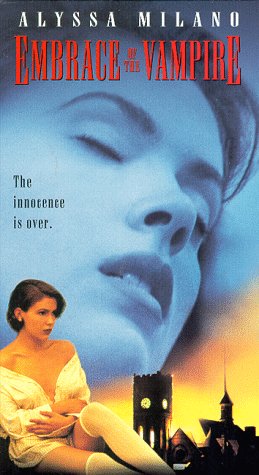
The TSL’s Horror Grindhouse: Embrace of the Vampire (dir by Anne Goursaud)


In this incredibly silly film from 1995, Martin Kemp plays The Vampire.  He doesn’t get a name but he does get a backstory.  Back when he was mortal, the Vampire pursued a secret and forbidden affair with a princess.  One day, after making love, the man who would became the Vampire was laying down next to a stream when he was approached by three naked women who proceeded to bite his neck and vampirize him.

Centuries later, the Vampire is sickly and approaching the end of his existence.  He only has three days to convince the reincarnation of his former lover to allow him to drink her blood so that he can continue to exist.  And apparently it won’t work unless she’s a virgin and unless she rejects all others and loves only him.  That sounds like a lot of rules to me and, to be honest, most of them seem to be kind of arbitrary.  Not only does The Vampire have to find the reincarnation of the Princess but he has to find her before she loses her virginity or otherwise, what?  She’ll cease to be the reincarnation?  Her love will somehow be devalued?  Her blood will no longer be worth drinking?  If this vampire has had to spend centuries only drinking blood from virgins who were in love with him, no wonder he looks so sickly.  I really think that maybe the other vampires were playing a practical joke when they explained the rules to him.  Hazing the new guy, it has consequences!

Anyway, the princess has been reincarnated as Charlotte (a young Alyssa Milano).  Fortunately, for the Vampire, Charlotte was raised in a convent and, even though she is now a college student, she’s still a virgin who blushes when she even hears the word sex.  Unfortunately, Charlotte has a boyfriend named Chris (Harrison Pruett) and she’s thinking about losing her virginity if she can convince herself that she loves Chris more than any other person that she will ever possibly meet.  So, the Vampire not only has to convince Charlotte to fall in love with him but he also has to make sure that she doesn’t have sex beforehand.  It’s going to be difficult because everyone on campus is determined to get Charlotte laid.  This has all the makings of Italian sex comedy but Embrace of the Vampire instead takes its plot very seriously.

The Vampire starts to appear in Charlotte’s dreams.  He gives her an ankh to replace the cross that Chris gave her.  Because the Ankh is a symbol of desire, just wearing it makes Charlotte more sexually aggressive and soon, she’s wearing short skirts, low-cut tops, and white stockings.  She’s also making out with Sarah (Charlotte Lewis), the photographer who lives in the dorm room next to hers.  (As played by Charlotte Lewis, Sarah is actually an interesting character and it’s a shame that the film pretty much just uses her for titillation.)  But since the Vampire’s whole thing is keeping Charlotte from losing her virginity, why would he give her something that would make her more open to sexual experiences?  Again, it’s hard not to think that the Vampire is just the victim of an elaborate practical joke.

As I said at the start of the review, Embrace of the Vampire is incredibly silly.  It’s also a film that seems to be a bit popular with viewers of a certain age.  I’m assuming that’s because of the frequent Alyssa Milano nudity and that one scene with Charlotte Lewis.  For the most part, Alyssa Milano gives a bland performance in Embrace of the Vampire.  It’s not so much that she’s bad as everything about her performance is on the surface.  One gets the feeling that there’s really not much going on with Charlotte’s inner life, both before and after she starts dreaming about The Vampire.  As The Vampire, Martin Kemp appears to be absolutely miserable.  He comes across as if he’d rather be anywhere than appearing in this movie.

That said, the film’s director got her start working with Francis Ford Coppola and she has a good eye for gothic scenery and atmosphere.  A scene where Charlotte imagines a frat party turning into a Hellish orgy is effectively done.  Jennifer Tilly has a small role as a vampire and she has said that Quentin Tarantino approached her at the Oscars to tell her that he enjoyed the movie.  It’s a silly movie (yes, third time I’ve used that specific term and that should tell you just how silly it is) but, for better or worse, it epitomizes an era.

The TSL’s Grindhouse: Steele Justice (dir by Robert Boris)


“You don’t recruit him!  You unleash him!”

That’s what they say about John Steele, the man who Martin Kove plays in 1987’s Steele Justice.  John Steele served in Vietnam and he was one of the best and most fearless members of the special forces.  On the final day of the war, he was on the verge of arresting the corrupt General Kwan (Soon-Tek Oh) until Kwan suddenly announced that the war was over and the Americans were leaving.  Steele laughed, shrugged, and turned his back on Kwan and started to walk away.  Was Steele planning on just walking back to America?  Well, regardless, Kwan shot Steele and his friend in the back.  Fortunately, Steele survived.  Steele may be stupid but he’s strong.

Years later, both Steele and Kwan are now living in California.  Kwan is a prominent businessman who is also the secret leader of the Vietnamese mafia.  Naturally, his main henchman is played by Al Leong.  If Al Leong’s not working for you, are you even evil?  John Steele has not been quite as successful.  He was a cop until he got kicked off the force.  Then he got a job transporting horses across California.  Despite his cool guy name, John Steele doesn’t seem to be that good at anything that doesn’t involve killing people.

But then Kwan murders Steele’s best friend and former partner, Lee (Robert Kim).  In fact, Kawn not only murders Lee but he also kills Lee’s entire family.  The only survivor is Lee’s daughter, Cami (Jan Gan Boyd), a piano prodigy who is supposed to be 14 years old even though she’s being played by someone who is in her 20s.  Steele and Lee’s former boss, Bennett (Ronny Cox), gives Steele permission to track down the people responsible for Lee’s death.

John Steele sets out to destroy Kwan.  The film gives us a lot of reasons to be on Steele’s side but it’s hard not to notice that a lot of innocent people end up getting killed as a result of Steele’s vendetta.  Any time that Steele goes anywhere, Kwan’s people attack and a bunch of innocent bystanders get caught in the crossfire.  For example, Steele’s ex, Tracy (Sela Ward), agrees to look after Cami.  It turns out that Tracy is a music video director and, of course, she takes Cami to work with her.  The video shoot turns into a bloodbath, with even the members of the band getting gunned down.  And yet, not even Tracy seems to be particularly disturbed by that.  One might think that Tracy would at least sarcastically say something like, “Hey, John, thanks for getting the band killed before I got paid,” but no.  Tracy just kind of laughs it all off.  At no point does Steele or Bennett or really anyone seem to feel bad about all of the people who get killed as a result of the decision to unleash John Steele.  Those people had hopes and dreams too, you know.

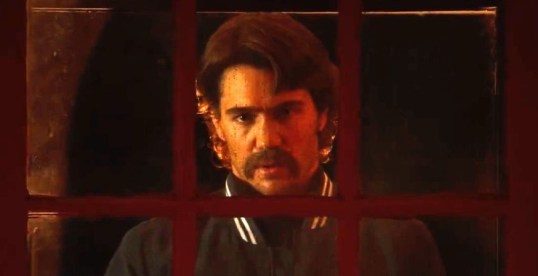
I really like Martin Kove on Cobra Kai.  I love how his portrayal of the over-the-hill and burned-out John Kreese manages to be both intimidating and pathetic at the same time.  I’ve also seen a number of interviews with Kove, in which he’s discussed his career as an exploitation mainstay and he always comes across as being well-spoken and intelligent.  That said, Martin Kove appears to be totally lost in Steele Justice, unsure if he should be playing John Steele as a grim-faced avenger or as a quick-with-a-quip action hero.  Whenever Steele is angry, Kove looks like he’s on the verge of tears.  Whenever Steele makes a joke, Kove smiles like an overage frat boy who, while cleaning out his old storage unit, has just discovered his long lost copy of Bumfights.  It’s a confused performance but, to be honest, no one really comes out of Steele Justice looking good.  This is a film that features a lot of talented actors looking completely and totally clueless as to why they’re there.

On the plus side, Steele Justice did give this world this totally intimidating shot of Martin Kove, preparing to be get and give justice.  Recruit him?  No, just unleash him!