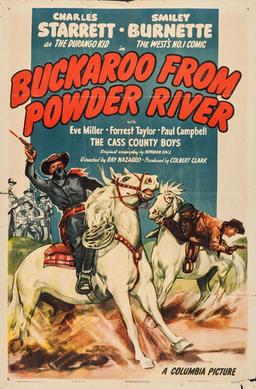
Buckaroo From Powder River (1947, directed by Ray Nazarro)


Pop Ryland (Forrest Taylor) is a frontier outlaw who makes law-breaking a family business.  With his two sons, Pop is planning on flooding the territory with counterfeit bonds.  His stepson, Tommy (Paul Campbell), doesn’t want anything to do with any criminal activity so Pop sends for McCall (Frank McCarroll), an assassin.  In a letter, Pop explains that he wants his stepson murdered.  When federal agent Steve Lacey (Charles Starrett) captures McCall, he finds the letter.  Steve heads into town and goes undercover, pretending to be McCall.  He also uses his other identity, the Durango Kid, to thwart Pop’s plans.

More than usual, this Durango Kid film leans more into the undercover aspect of Steve’s work.  What’s interesting is that, after Tommy fakes his own death, Tommy also disguises himself as the Durano Kid and keeps his stepfather from suspecting that Steve is actually a member of law enforcement.  It’s actually pretty clever, as far as these movies go, and it answers the question of why no one ever wonders why Steve and Durango are never in the same place at the same time.

Smiley Burnette shows up as Steve’s sidekick and he sings a few songs with the The Cass County Boys.  Along with Smiley’s antics, this film has all of the horse chases and gunfights that we expect from a Durango Kid movie.  Most of the usual stock company is present, including Ted Adams and Kermit Maynard.  As always, Charles Starrett looks authentic riding horse and handling a gun.  If you’re not into westerns, this film won’t convert you.  But, for fans of the genre, this is another entertaining outing for the Durango Kid,
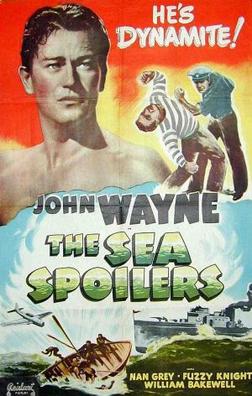
The Sea Spoilers (1936, directed by Frank R. Strayer)


Bob Randall (John Wayne) is a coast guard boatswain, headquartered in Alaska where he and the members of his crew battle evil seal poachers like oily Phil Morgan (Russell Hicks).  When Randall returns to port after his latest patrol, he has to deal with two disappointments.  First off, he is passed over for a promotion to commanding officer, even though everyone knows that he deserves it.  Instead, the promotion goes Lt. Commander Mays (William Blakewell), the son of a commander (George Irving).  Mays doesn’t even want the job.  He’s scared of the water and he’d rather fly airplane as a part of the Coast Guard’s aviation force.  Bob is disappointed but he’s a professional and he’s going to support Mays.  Secondly, Bob’s girlfriend (Nan Grey) witnesses a murder and is kidnapped by Phil Morgan.  Bob and his sidekick (dependable western mainstay Fuzzy Knight) go undercover as fisherman to try to find her.

The Sea Spoilers was the first of six B-movies that John Wayne did for Universal.  Wayne, who had been stuck in the B’s for a while, was trying to prove that he was more than just a singing cowboy so, in this one, he plays a tough and ready sailor.  Wayne is convincing in the role, even if the movie is really just a western set in what was then modern day Alaska.  Though only 30, Wayne shows the no-nonsense professionalism that would become his trademark once he became one of the world’s biggest movie stars.  Unlike some of Wayne’s early films, it’s possible to see the icon that John Wayne would eventually become while watching him here.  The Sea Spoilers is only 66 minutes long but fans of the Duke should enjoy it.

Finally, The Sea Spoilers was written by George Waggner.  Waggner would later go on to direct the original Wolf Man.

Roaring Rangers (1946, directed by Ray Nazarro)


Another frontier town is in trouble.

Sherriff Jeff Conner (Jack Rockwell) is having trouble ridding his town of outlaws so his son, Larry, (Mickey Kuhn) writes a letter to his hero to ask for help.  He addresses the letter to “Durango Kid, Texas.”  That’s all it takes for Steve Randall (Charles Starrett) and his sidekick, Smiley Burnette, to show up in town.

Steve and Smiley apply to be deputies but Sheriff Conner explains that someone is circulating a petition to get him fired.  Steve dresses up as the Durango Kid and pressures the citizens to give the Sheriff another chance.  Realizing that the Durango Kid is making them look bad, the outlaws decide to dress up one of their own as Durango and make the Kid look bad.  With the town turning on Durango, will Durango and Smiley be able to save Sheriff Conner from an assassination attempt?

This Durango Kid film is different from the rest of the series in that, for once, Steve is hired to be a deputy instead of a sheriff.  This really is Sheriff Conner’s story, as he tries to win the respect of the town and keep its citizens safe, even while his own brother (Ed Cassidy) is working with the outlaws.  There are all the usual horse chase and shootouts but this time, Durango and Smiley are mostly around to provide support to a man who is trying to do the right thing.  B-western fans will enjoy it.

Smiley sings a few songs, as always.  This time, musical accompaniment is provided by Merle Travis and his Bronco Busters.

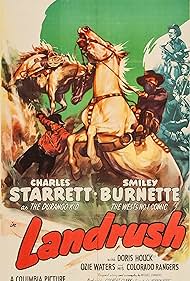
Landrush (1946, directed by Vernon Keays)


Steve Harmon (Charles Starrett) rides again!  This time, he’s investigating the murder of a Pony Express rider.  The murderer is outlaw leader Claw Hawkins (Bud Geary), who is working with rancher Kirby Garvey (Steve Barclay) to cheat the local homesteaders out of their land.

When local newspaper editor Jake Parker (Emmett Lynn) is attacked for trying to expose Claw Hawkins, Steve puts on a mask and dark clothing and, as the Durango Kid, he moves Jake to the carpentry shop owned by Durango’s old friend, Smiley Burnette.  While Jake continues to spread the word to the homesteaders, Durango works to prevent Claw and Kirby from taking all of the land for themselves.

This is a typical Durango Kid film.  This is not the first time that I’ve seen the Durango Kid protect the rights of homesteaders and, as usual, the main villain is not the outlaw that everyone fears but the respectable citizen who is controlling him.  Along with the usual gunfights and horse chases, Landrush has an exciting sequence where Durango and the homesteaders have to deal with a series of fires that have been set by Claw to keep the homesteaders from reaching their land.  Charles Starrett is as authentic a cowboy as ever.  Unfortunately, Bud Geary and Steve Barclay aren’t very interesting as the villains.  People who have watched several Durango Kid films will regret that series regulars Frank Fenton and Jock Mahoney weren’t cast in the roles.

As usual, Smiley Burnette provides comedy relief and sings two songs.  This time, he’s accompanied by Ozie Waters and His Colorado Rangers.

Lawless Empire (1945, directed by Vernon Keays)


For years, outlaws have controlled the frontier town of Dusty Gulch but now their power is threatened by the homesteaders who are moving into the area.  Led by the crusading Rev. Tex Harding, the homesteaders are being progress and reform to the frontier.

Duke (Ethan Laidlaw) and his gang have launched a campaign of intimidation against the new arrivals.  Luckily, the Durango Kid (Charles Starrett) rides into town to protect the homesteaders.  Duke’s boss, businessman Blaze Howard (John Calvert), decides that the town needs a sheriff to go after the Kid.  Blaze offers the job to newcomer Steve Ranson, not realizing that Steve is not only the Durango Kid but also the brother of the former sheriff, who was murdered by Blaze’s men.

Lawless Empire is one of the few Durango Kid films not to feature Smiley Burnette as Durango’s sidekick.  Instead, Durango rides into town with Bob Wills and his Texas Playboys and, while Willis does perform a song or two, there’s still considerable less singing than in the films that featured Burnette.  The role of comic relief is provided by Dub Taylor in the role of Cannonball.  Cannonball gets a job sweeping up Blaze’s saloon and he feeds whatever information he learns back to Durango.  When Blaze figures out what’s going on, he deliberately supplies Cannonball with bad information but it doesn’t make any difference.  The Durango Kid is always one step ahead of the bad guys.

Lawless Empire is a little more serious than the other Durango Kid films.  Steve is not only trying to clean up the town but he’s also seeking to avenge his brother so there’s not as much room for as much comedy as usual.  Lawless Empire does have all of the usual gunfights and horse chases and the film gets off to an exciting start with Durango making his first appearance with his gun already drawn so that he can disarm Duke and his men.  Even without Smiley around to help him out, Durango brings law to a lawless empire.


Six-Gun Law (1948, directed by Ray Nazarro)


Steve Norris (Charles Starrett) has moved to a new frontier town and is making a good living as a cattle rancher.  The sheriff (Ethan Laidlaw) takes a dislike to Steve and even accuses him of being a cattle rustler.  Steve is so angered that he plays right into the hands of Decker (Hugh Prosser), a corrupt businessman who secretly puts blanks into Steve’s gun and then tricks Steve into thinking that he has shot and killed the sheriff.

Decker appoints Steve as the new sheriff but demands that Steve do exactly what Decker orders him to do.  If Steve actually enforced the law, Decker will turn him in as the first sheriff’s murderer.  Steve may not be able to do anything about Decker’s crimes but his alter ego, The Durango Kid, can!  As always, working with Steve is his loyal sidekick, Smiley Burnette.

The stand-out set piece of this Durango Kid film is an exciting stagecoach chase, which features the Durango Kid (in the form of legendary stuntman Jock Mahoney) making some thrilling moves.  The scene was so exciting and popular that it was used in a dozen other Durango Kid films.  These movies were never shy about reusing good scenes, effective stunts, and plot twists.  (It’s easy to lose track of how many times Steve has been appointed as sheriff of a town.)  This was also neither the first nor the last time that Hugh Prosser and Robert Wilke would play bad guys in a Durango Kid movie.  However, this is the only Durango Kid film to feature the Rodeo Rangers providing musical accompaniment  to Smiley Burnette’s songs.

Six-Gun Law will be best appreciated by fans of the western genre.  Charles Starrett is as tough and authentic a cowboy as always and the storyline has some nice twists and turns.  For once, with Steve being blackmailed by Decker, it makes sense that Steve would put on his disguise and solve his problems as the Durango Kid.

Trail to Laredo (1948, directed by Ray Nazarro)


On the frontier, everyone has gold fever.  People are trying to find gold and steal gold and it falls to brave Treasury agents like Steve Ellison (Charles Starrett) and Smiley Burnette (played by Smiley Burnette) to keep things safe.  When Steve needs to find out who is trying steal gold, he puts on his mask and assumes the identity of The Durango Kid.

Near Laredo, a shipment of government gold has been stolen.  Dan Parks (Jim Bannon) is arrested after the gold is found in his wagon but Steve knows that the Durango Kid earlier warned Dan about traveling with gold.  Durango and Smiley set out to prove that Dan was set up by his business partner, Fenton (Hugh Prosser).

This yet another Durango Kid movie where Steve gets a job working for the bad guy while Durango works to thwart his plans.  (Remarkably, no one ever puts two and two together and notices that Steve, Smiley, and Durango always seem to show up in town at the same time.)  Fenton is just one of a long line of corrupt businessmen and land barons that Durango has had to deal with.  Fenton is not above threatening Dan’s young son (Tommy Ivo) to get Dan to do what he wants.  Given that Dan is just trying to make a good life for his family in a rough world, it’s satisfying when Fenton gets his comeuppance.

Almost every Durango Kid film featured at least one good fight scene.  In Trail to Laredo, the big fight takes place in a saloon and it’s pretty exciting.  Not only does the saloon get trashed but there’s a moment where one of the bad guys actually seem to fly through the air.  Even Virginia Maxey, playing Classy the saloon singer, gets in on it.

Both Virginia Maxey and Smiley Burnette get to sing a few songs.  As always, there enough gunfights and horse chases to keep fans of the genre happy.  Charles Starrett was a great cowboy.

The Rough Tough West (1952, directed by Ray Nazarro)


Steve Holden (Charles Starrett) is hired by an old friend, Jack Mahoney (played by Jock Mahoney), to serve as the sheriff of a frontier town.  Steve soon discovers that his old friend has been corrupted by power and is plotting to cheat the locals out of their land and the gold that the land holds.  Despite their friendship, Steve knows that Jack has to be stopped and made to see the errors of his way.  It’s a good thing that Steve is secretly the Durango Kid and that his old sidekick, Smiley Burnette, is the town’s police chief.  But even if Jack Mahoney does eventually see the error of his ways, will it be soon enough to stop his out-of-control henchmen?

This was one of the last of the Durango Kid films and it’s heavy on stock footage and Smiley Burnette musical numbers.  It has all of the usual horse chases and gunfights but making the villain an old friend of the Durango Kid adds a little more emotional weight to this entry than some of the other Durango Kid films.  As always, Charles Starrett is a strong western hero and Smiley Burnette’s antics are nowhere nearly as annoying as the antics of some of the other western sidekicks who were populating matinee movie screens in 1952.  Western fans should enjoy this fast-paced and undemanding film.

This is not the first time that Jock Mahoney played a friend of the Durango Kid who is named Jack Mahoney, though I think the Jack Mahoney who appeared in Pecos River, Junction City, Smokey Canyon, The Hawk of Wild River, and The Kid From Broken Gun was meant to be a different character than the one who appeared in The Rough, Tough West.  If Smiley Burnette could have a rotating cast of musicians who followed him from town-to-town, then the Durango Kid could very well have known multiple Jack Mahoneys.