Retro Television Review: Miami Vice 2.6 “Buddies”


Welcome to Retro Television Reviews, a feature where we review some of our favorite and least favorite shows of the past!  On Mondays, I will be reviewing Miami Vice, which ran on NBC from 1984 to 1989.  The entire show can be purchased on Prime!

This week, Crockett discovers that one of his oldest friends has a secret.

Episode 2.6 “Buddies”

(Dir by Henry Mastrogeorge, originally aired on November 1st, 1985)

When sleazy stand-up comedian Morty Price (a youngish Nathan Lane) attempts to sexually assault a cocktail waitress named Dorothy (Eszter Balint), he ends up getting fatally stabbed with a steak knife.  Dorothy flees from the crime scene, taking her baby and grabbing a bunch of random papers that, unknown to her, prove that Morty Price was placing illegal bets with mobster Frank Doss (Frankie Valli).  This information could keep Doss from being able to get a casino license in Florida.

Because Doss and his partner, Johnny Cannata (Tom Signorelli), are mob-connected, Castillo and Vice take over the investigation of Price’s murder.  Sonny and Tubbs learn, from an informant (Karla Tamburrelli), that Price took Dorothy up to his room before he was murdered.  While Crockett and Tubbs search for Dorothy to find out what happened with Price, Doss and Cannata send their men to track down Dorothy and keep the papers from reaching the police.

During the investigation, Sonny is stunned to come across security footage of one of his oldest friends, Robbie Cann (James Remar), meeting with Doss and Cannata.  Robbie not only served in Vietnam with Sonny but he has also recently asked Sonny to be his son’s godfather.  Robbie has just opened up a club and, as he explains to Sonny, he finally feels like he’s something more than just a loser.  When Sonny confronts Robbie about meeting with the gangsters, Robbie admits that he borrowed money from them to start the club but he insists that he doesn’t have any other type of relationship with them.  However, when Sonny attends the christening of Robbie’s son, he discovers that Robbie’s name is actually Robert Cannata.  He is Johnny Cannata’s son!  Robbie insists that he has nothing to do with his father’s business but Sonny is forced to ask just how much he can trust one of his closest friends.

This episode is a bit of a mess.  On the plus side, fans of character actors will enjoy this episode.  James Remar’s nervy performance keeps you guessing and it’s undeniably interesting to see Nathan Lane playing someone that sleazy.  Frankie Valli and Tom Signorelli make for convincing gangsters.  It’s also the first episode of the series to really feature Sonny talking about what it was like to serve in Vietnam and it deserves some credit for attempting to explore the difficulty that many veterans face when trying to adjust back to civilian life.  Robbie has not had an easy life after returning to the U.S. but now, he finally has a wife, a child, and a business.  Sonny may feel betrayed by Robbie but he’s also aware that his investigation is going to potentially ruin Robbie’s life.

On the other hand, the episode attempts to take on so much that it stretches itself a bit then.  It requires a real suspension of disbelief to accept that Sonny would just happen to be assigned to an investigation that would involve his best friend.  I mean, what are the chances?  The episode also can’t seem to decide if it wants to focus on Robbie or if it wants to focus on Dorothy and her child.  As a result, neither story really feels as if it gets all of the attention that it deserves.

Next week, the Vice Squad investigates jazz legend Miles Davis!
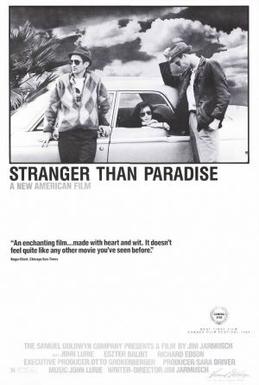
Sundance Film Review: Stranger Than Paradise (dir by Jim Jarmusch)


The Sundance Film Festival is currently taking place in Utah so, for this week, I’m reviewing films that either premiered, won awards at, or otherwise made a splash at Sundance!  Today, I take a look at 1984’s Stranger Than Paradise, which won the Special Jury Prize at the 1985 Sundance Film Festival.

‘You know it’s funny. You come to someplace new, and everything looks just the same.’

— Eddie in Stranger Than Paradise (1984)

Stranger Than Paradise tells the story of three friends.

Willie (John Lurie) lives in a small apartment in New York City’s Lower East Side.  He likes to go to the movies.  He likes to watch TV.  He likes to gamble, putting bets on horses and cheating at poker.  He was apparently born in Hungary, though he doesn’t speak with an accent and, whenever he has to deal with a relative, he always tells them, “Speak English.”  When his best friend asks him about why he never mentioned that he was Hungarian, Willie replies that he’s just as American as anyone.

Eva (Eszter Balint) is Willie’s cousin.  She’s travels to America from Budapest.  The plan is for her to live with her Aunt Lotte (Cecillia Stark) in Cleveland but, because Lotte is in the hospital, she begins her life in America by spending ten days in Willie’s cramped apartment.  Eva enjoys the music of Screamin’ Jay Hawkins.  When she’s walking to Willie’s apartment, I Put A Spell On You blares from the large tape player that she always carries with her.

And then there’s Eddie (Richard Edson).  Eddie may not be too smart but he’s always smiling and easy-going.  Unlike the somewhat churlish Willie, Eddie always seems to be enjoying himself.  When Eddie first meets Eva, most viewers will probably expect them to eventually become a couple.  That doesn’t happen, of course.  That’s not the type of film that this is.

http://www.youtube.com/watch?v=WpdHxSt8f7w

The first thing you notice about Stranger Than Paradise is the look of the film.  As one might expect from a film that reportedly had a budget of $10,000, the film looks cheap but there’s a beauty in that cheapness.  The harsh black-and-white magnifies every detail of the film’s locations.  When we watch Eva walking through New York City, the street may look desolate but it’s an exquisite desolation.

Directing his second film, Jim Jarmusch shoots nearly the entire film in single long takes and refuses to indulge in any of the usual tricks that movies often use to force an audience to identify with its main characters.  The camera rarely moves and every scene ends with a blackout.  It’s a technique that casts the audience as observers.  Willie, Eva, and Eddie may all be outsiders but, while watching the film, so is the audience.  Willie, Eva, and Eddie win us over because of the charm of the actors playing them and the deadpan humor of their dialogue but, at the same time, the film never lets us forget that we’re merely watching their lives unfold.

The humor in Stranger Than Paradise comes less from what these characters do and more from what they don’t do.  When Eva arrives in New York, Willie never offers to show her around.  There’s no trip to Broadway or the Statue of Liberty or anything else that we, as an audience, have been conditioned to expect whenever a stranger comes to New York for the first time.  Instead, Willie and Eva sit in Willie’s apartment and watch TV.  When Eddie asks Eva if she wants to join him and Willie at the movies, Willie tells Eva to stay in the apartment and not go outside.  Eva eventually wins Willie over by shoplifting dinner.

During the film’s second act, Willie and Eddie decided to visit Eva in Cleveland, despite not being sure where Cleveland is.  They ask one random guy standing on a street corner how to get there.  “I’m waiting for a bus,” the guy snarls back.  Later, as they drive drown a highway, Eddie asks Willie if they’re in Ohio yet.  “I think we’re in Pennsylvania,” Willie replies.  When they finally do get to Ohio, it turns out to be a frozen wasteland.  After meeting up with Eva, Willie and Eddie spend most of their vacation watching TV with Lotte.  Eventually, they visit Lake Erie.  It’s frozen but Eva, Willie, and Eddie still dutifully stand at the railing and stare down at it while a freezing wind howls around them.

Eventually, all three of them end up in Florida.  Instead of visiting Walt Disney World or Miami, they end up sitting in a cheap motel room.  Eva goes to the beach, which — when shot in black-and-white — looks just as desolate as Ohio in winter.  Eventually, all three of them stumble into money but that’s just a set up for the film’s final joke…

It’s a deliberately slow-moving film but it’s never less than watchable.  Lurie, Edson, and Balint all give such wonderfully deadpan performances that they’re a joy to watch even when they aren’t actually doing anything.  Stranger Than Paradise was Jim Jarmusch’s second film and also one of the first independent American films to receive widespread attention and acclaim.  (The National Society of Film Critics named it the best film of the year.)  34 years after it was first released, the film is an idiosyncratic joy to behold and definitely one that needs to watched by anyone who loves cinema.

Previous Sundance Film Reviews:

  1. Blood Simple
  2. I Don’t Feel At Home In This World Anymore
  3. Circle of Power
  4. Old Enough
  5. Blue Caprice
  6. The Big Sick
  7. Alpha Dog

Catching Up With The Films of 2017: A Woman, A Part (dir by Elisabeth Subrin)


There’s a great montage during the first half of A Woman, A Part.

An actress named Anna (Maggie Siff) wanders around her home, reading scripts for tv shows and movies.  In between shots of her snorting cocaine, we listen as she reads dialogue aloud.  One of the scripts features her as a dying mother who, with her last words, asks her children to look after their father.  Another script is obviously from a Lifetime film and again, the role that Maggie reads is for a mother.  In another script, she’s a love interest.  And, in another, she’s just a bitchy authority figure.  As becomes obvious from the dialogue, none of the scripts offer her the chance to play a leading or even a fully developed character.  In each script, she’s either a plot device or a part of the scenery.  She reads a script, she does a line.  As she finishes each script, she tosses it into her pool until soon, the water is full of shallow characters and clichéd dialogue.  Soon, Anna is floating in the pool, surrounded by the debris of her career.

Anna moved to Los Angeles from New York.  In New York, she was all about theater and seeking truth through acting.  In Los Angeles, she has a role on a sitcom and a certain amount of fame.  People stare at her in restaurants.  Some ask for autographs.  Anna is exhausted, frustrated, and very aware that Hollywood has little to offer an actress in her 40s.

Anna escapes Los Angeles, heading back to New York.  She hopes to reunite with her former friends but, when she arrives, she discovers that some have moved on and some have not.  Her former acting partner, Kate (Cara Seymour), no longer considers herself to be an actress and resents Anna for having left their show to go to Los Angeles.  Playwright Isaac (John Ortiz) has written a play, one that centers around a flawed character who Anna immediately recognizes as being based on herself.

A Woman, A Part is the first full-length feature film to be directed by the video artist, Elisabeth Subrin.  It’s a flawed but promising debut.  For every moment that runs the risk of falling into cliché, there’s a sequence like that pool scene or the scenes where Kate and Anna deal with their fractured friendship.  It’s in those scenes between Maggie Siff and Cara Seymour that the film really comes alive.  When a fan approaches Anna while she’s talking to Kate and Anna responds by saying that everyone should be asking for Kate’s autograph, Kate rightly calls Anna out for her condescending attempt at kindness.  At the same time, the film is also honest enough in its characterizations to admit that much of Kate’s reaction is due to her own resentment that Anna found the success that Kate didn’t.  This is a film that realizes that friendships are often the most complex of relationships.  Maggie Siff and Cara Seymour both give honest and poignant performances.

As I said, A Woman, A Part is not without its flaws.  To be honest, the character of Isaac never interested me as much as Anna and Kate.  There are a few scenes which are just a little bit too on the nose.  It’s not a perfect film but it is a promising one and I look forward to seeing what Elisabeth Subrin does next.