Retro Television Review: The American Short Story #9: Soldier’s Home


Welcome to Retro Television Reviews, a feature where we review some of our favorite and least favorite shows of the past!  On Saturdays, I will be reviewing The American Short Story, which ran semi-regularly on PBS in 1974 to 1981.  The entire show can be purchased on Prime and found on YouTube and Tubi.
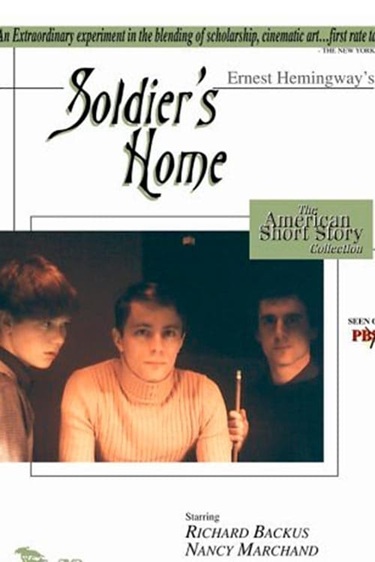
This week, we have an adaptation of a short story by Ernest Hemingway.

Episode #9 “Soldier’s Home”

(Dir by Robert Young, originally aired in 1977)

Having gone from attending college to serving in the Army during the Great War, Harold Krebs (Richard Backus) returns home to Oklahoma.  He arrives home later than most of the other soldiers who served.  (He stayed in Europe until 1919.)  As a result, there’s no big parade waiting for him.  Everyone in town seems to have moved beyond the war and they no longer have much of a desire to talk about it.

Harold, who was once a popular and optimistic member of the town’s social set, no longer feels that he fits in.  He feels detached, watching people as they go about their lives but never feeling any desire to join them.  His mother (Nancy Marchand) pushes him to go out and date and have a good time but Harold feels lost, regardless of how much she prays for him.

Ernest Hemingway’s short story was one of the first to realistically deal with the feelings of soldiers returning from combat.  Though Harold doesn’t talk much about his experiences, one can tell that he saw and experienced things that left him scarred.  After surviving the horror of The Great War, there’s no way Harold can just slip back into his normal routine.

The adaptation sticks closely to Hemingway’s story.  Unfortunately, it doesn’t really find the visual style necessary to capture the power of Hemingway’s words.  Hemingway was a deceptively simple storyteller and Robert Young’s film is a fairly straight-forward portrait of a young man who doesn’t want to do anything, one that fails to truly capture the subtext of Hemingway’s story.  Richard Backus’s blank-eyed acting style worked well when he was playing a member of the undead in Deathdream but, in this one, he just makes ennui seem boring and petulant.  Nancy Marchand, not surprisingly, is far stronger in the role of his well-meaning but clueless mother.

As was almost always the case when it came to attempts to adapt Hemingway, it’s best just to read the original.
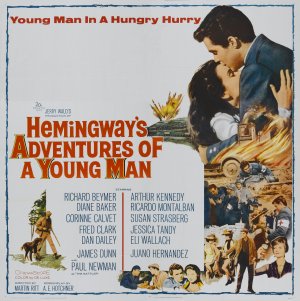
Lisa Cleans Out Her DVR: Hemingway’s Adventures Of A Young Man (dir by Martin Ritt)


(Lisa is currently in the process of cleaning out her DVR!  It’s going to take a while.  She recorded this 1962 literary adaptation off of FXM on January 30th!)

Hemingway’s Adventures Of A Young Man is one of those films that you just know was made specifically to win Oscars.  It’s a big prestige production, complete with a historical setting, an epic scope and big, all-star cast.  That most of those stars appear in relatively small roles was undoubtedly meant to evidence of the film’s importance.

“Look!” the film seems to shout at times, “This is such an important film that even Paul Newman was willing to stop by for a day’s work!”

The film is based on ten short stories by Ernest Hemingway and, loosely, A Farewell to Arms.  The stories all dealt with the early life of Nick Adams, who was a literary stand-in for Hemingway.  Since the Nick Adams stories were autobiographical (and, for that matter, so was A Farewell to Arms), the film can also be viewed as biopic.  Richard Beymer (who, a year earlier, had starred in West Side Story and who is currently playing Ben Horne on Twin Peaks) may be playing Nick Adams but the film leaves little doubt that he was actually meant to be playing Ernest Hemingway.

The film opens with Nick hunting with his father, Dr. Harold Adams (Arthur Kennedy).  He is present when his father travels to an Indian camp and helps to deliver a baby.  He respects his father but Nick wants to see the world and the film follows him as he explores America, working odd jobs and meeting colorful characters along the way.  Paul Newman shows up as a punch-drunk boxer and proceeds to overact to such an extent that he reminded me of Eric Roberts appearing in a Lifetime film.  Nick meets rich men, poor men, and everything in between.  He works as a journalist.  He works as a porter.  Eventually, when World War I breaks out, Nick enlists in the Italian army and the film turns into the 100th adaptation of A Farewell to Arms.

And really, I think it would have been an enjoyable film if it had been directed by someone like Otto Preminger, George Stevens, or maybe even Elia Kazan.  These are directors who would have embraced both the pulpy potential of the Nick Adams stories and the soapy melodrama of the war scenes.  A showman like Preminger would have had no fear of going totally and completely over the top and that’s the approach that this material needed.  Instead, Hemingway’s Adventures Of A Young Man was directed, in a painfully earnest style, by Martin Ritt.  Ritt tries to imitate Hemingway’s famously understated style with his understated direction but, cinematically, it’s just not very interesting.  Ritt portrays everything very seriously and very literally and, in the end, his direction is more than a little dull.

Sadly, the same can be said for Richard Beymer’s performance in the lead role.  Beymer comes across as being the nice guy who everyone says you should marry because he’ll be able to get a good and stable job and he’ll probably never go to jail.  Two months ago, when I watched and reviewed Twin Peaks, I really loved Beymer’s performance as Ben Horne.  He just seemed to be having so much fun being bad.  Unfortunately, in Hemingway’s Adventures Of A Young Man, he never seemed to be having any fun at all.  No wonder he temporarily put his film career on hold so that he could fully devote himself to working as a civil rights activist.

In the end, this is a movie that’s a lot more fun to look at than to actually watch.  Visually, the film is frequently quite pretty in an early 1960s prestige movie so sort of way.  And there are some good performances.  Eli Wallach, Ricardo Montalban, Susan Strasberg, Arthur Kennedy — there’s a whole host of performers doing memorable supporting work.  Unfortunately, even with all that in mind, this well-intentioned film largely falls flat.

Lisa Reviews An Oscar Nominee: A Farewell to Arms (dir by Frank Borzage)


220px-Poster_-_A_Farewell_to_Arms_(1932)_01

Reportedly, Ernest Hemingway hated the 1932 film adaptation of his great novel, A Farewell To Arms.  The novel, of course, tells the story of ambulance driver Frederic Henry (played in the film by Gary Cooper), his service in World War I, and his doomed love affair with an English nurse named Catherine (played by the very American Helen Hayes).  The novel was acclaimed for being tough and unsentimental.  The film is the exact opposite, revealing itself to be more typical of the work of director Frank Borzage than Ernest Hemingway.

How romantic was Borzage’s adaptation of A Farewell to Arms?  It was so romantic that it even changed the novel’s famous ending.  The novel ended with Catherine dying and Frederic Henry walking away, alone and in the rain.  The film, however, ended with Catherine miraculously recovering.  Never mind, of course, that having Catherine survive pretty much defeated the entire purpose of the story.  What was important was to give American audiences a happy ending!

However, European audiences got a more downbeat ending.  In the European version, Catherine does die.  After she dies, Frederic picks up her body and looks up into heaven, which is certainly far more dramatic (and, in its way, sentimentally spiritual) than anything to be found in Hemingway’s novel.  If, like me, you see A Farewell To Arms on TCM, you’ll see the European ending.

So, yes, I can understand why Hemingway would have hated this film.  But I have to admit that I rather enjoyed it.  The film adaptation makes for terrible Hemingway but it’s great Borzage.  Borzage specialized in making grand, lyrical, and sweeping romantic melodramas and that’s what his version of A Farewell To Arms truly is.  Helen Hayes may not be convincingly English and Gary Cooper may be a bit overly earnest for a Hemingway hero but they both look good together and they have great chemistry.  (Plus, Adolphe Menjou gives a good supporting performance as Frederic’s best friend.)  As a director, Borzage keeps the story moving at a steady pace and plays up the romance in every single scene.  There’s a great sequence that’s filmed entirely from the wounded Frederic’s point-of-view as he’s brought into a hospital and looked over by a series of officious nurses.  We see everything through Frederic’s eyes until Catherine finally enters the room and kisses him.  Only then do we see Frederic and Catherine together, leaving us with no doubt that these two belong together.  A Farewell To Arms may not be a great literary adaptation but it is a great cinematic romance.

A Farewell To Arms was nominated for best picture but it won to a largely forgotten film called Cavalcade.

Lisa Reviews An Oscar Nominee: For Whom The Bell Tolls (dir by Sam Wood)


For_whom_movieposter

After I watched The Pride of the Yankees, it was time to watch For Whom The Bell Tolls on TCM.  Based on the classic novel by Ernest Hemingway, the film version of For Whom The Bell Tolls was released in 1943 and, when I first started watching it, I was a little bit worried.

For, you see, For Whom The Bell Tolls is an extremely long film.  It’s a film that takes its time.  It’s also a very talky film and I have to admit that one reason I was worried was because the movie started at 11:30 and it was scheduled to last until 2:15 a.m.  Oh my God, I wondered, as the film started to slowly play out before me, am I going to end up dozing off before this is finished?

Well, I need not have worried.  Yes, For Whom The Bell Tolls does take a while to get started but it all pays off in the end.  By the time the film concludes, you realize why it had to take its time and why we had to spend so much time listening to these characters talk about what they did in the past, why they’re doing what they’re doing in the present, and what they’re hoping for in the future.

Not that all of the characters have a future.  At the start of the film, Robert Jordan (Gary Cooper) gets his palm read by Pilar (Katina Paxinou).  Pilar refuses to tell him what she saw in his future but it’s not difficult to guess.  Robert is on a suicide mission and everyone knows it.  Even when he falls in love with the beautiful Maria (Ingrid Bergman), he does so with the knowledge that he’ll be dead in just a few days.

Robert is an idealistic American who, as the film opens, is in Spain.  It’s the 1930s and Spain is embroiled in a civil war between fascists and guerrillas … well, if you’ve read Hemingway’s novel, you know that the guerrillas are communists.  But this is a Hollywood film so, for the most part, we don’t hear much about ideology.  But, then again, audiences in 1943 undoubtedly remembered the Spanish Civil War and understood that the guerrillas were fighting the forces of Gen. Francisco Franco.  And, for audiences today, all that matters it that the guerrillas are trying to overthrow a government.  Seriously, who doesn’t want to see the government overthrown?

(Full disclosure:  My grandmother on my mother’s side came to this country from Spain and frequently insisted that Franco had not been that bad.  At the time, not knowing one way or the other, I usually just smiled and nodded.)

Robert is fighting on the side of the guerrillas.  In four days, a major offensive is going to be launched against the fascists and, in order to keep fascist forces from pursuing the guerrillas, Robert has been assigned to blow up a mountain bridge.  Robert knows that he won’t survive this mission and, as he waits to die, he camps out with a small guerrilla band that is led by Pablo (Akim Tamiroff).  At first, Pablo refuses to take part in a mission that he considers to be futile but he is overruled by his strong-willed wife, Pilar (Katina Paxinou).

Among Pablo’s group is the beautiful Maria (Ingrid Bergman), a young woman whose family was killed by the fascist forces.  Robert and Maria fall in love, even as Robert prepares for his eventual death.

And then, finally, after two hours of screen time, Robert and the guerrillas head for that bridge and suddenly, we understand why the film took its time to reach this point.  By the time Robert reaches the bridge, we’ve come to know and care about both him and the other guerrillas.  And, as a result, we care about whether or not they survive.  When the fascists launch their own counter attack, every death counts.  We feel the loss of every casualty and we understand what they’re dying for.  After two hours of talk, For Whom The Bell Tolls ends with a genuinely exciting and even moving action sequence.  It all leads up to a final shot that will blow you away in more ways than one.

From Whom The Bell Tolls is a film that will reward those with the patience to stick with it and I’m glad that I turned out to be one of those people.  It was nominated for Best Picture of 1943 but lost to another film about an anti-fascist who fought in Spain, Casablanca.

Song of the Day: For Whom the Bell Tolls (by Metallica)


It took awhile but Metallica has finally made another appearance in the “song of the day” feature. This time around they return with one of their best songs. A song which has become iconic of early-Metallica amongst their most die-hard fans. The song is “For Whom the Bell Tolls”.

This track comes in third on the band’s second album and was inspired by Ernest Hemingway’s 1940 novel, For Whom the Bell Tolls. It is also the song which contains one of the best opening riffs in metal history. A riff not born from lead guitarist Kirk Hammett’s axe, but from it’s bassist Cliff Burton. This opening riff shows Cliff Burton at his best and the fact that people continue to mistake the riff as guitar instead of bass just shows how talented the man was.

This song is all about Burton’s work on the bass with Hetfield supplying the vocals and Hammett’s lead guitar work almost behaving like an accompaniment. It is no wonder that whenever talk comes around as to who is the best metal bassist (or just rock bassist) ever no discussion could ever be considered credible if Cliff Burton’s name was not included.

While Burton died just two years after the single’s release while th eband was on tour in Sweden his contribution as both writer and composer to this song will forever cement his legacy amongst metal and music fans for countless generations.

For Whom the Bell Tolls

Make his fight on the hills in the early day
Constant chill deep inside
Shouting gun, on they run through the endless grey
On they fight, for they are right, yes, but who’s to say?

For a hill, men would kill, why? They do not know
Stiffened wounds test their pride
Men of five, still alive through the raging glow
Gone insane from the pain that they surely know

For whom the bell tolls
Time marches on
For whom the bell tolls

Take a look to the sky just before you die
It is the last time you will
Blackened roar massive roar fills the crumbling sky
Shattered goal fills his soul with a ruthless cry

Stranger now, are his eyes, to this mystery
He hears the silence so loud
Crack of dawn, all is gone except the will to be
Now they see, what will be, blinded eyes to see

For whom the bell tolls
Time marches on
For whom the bell tolls