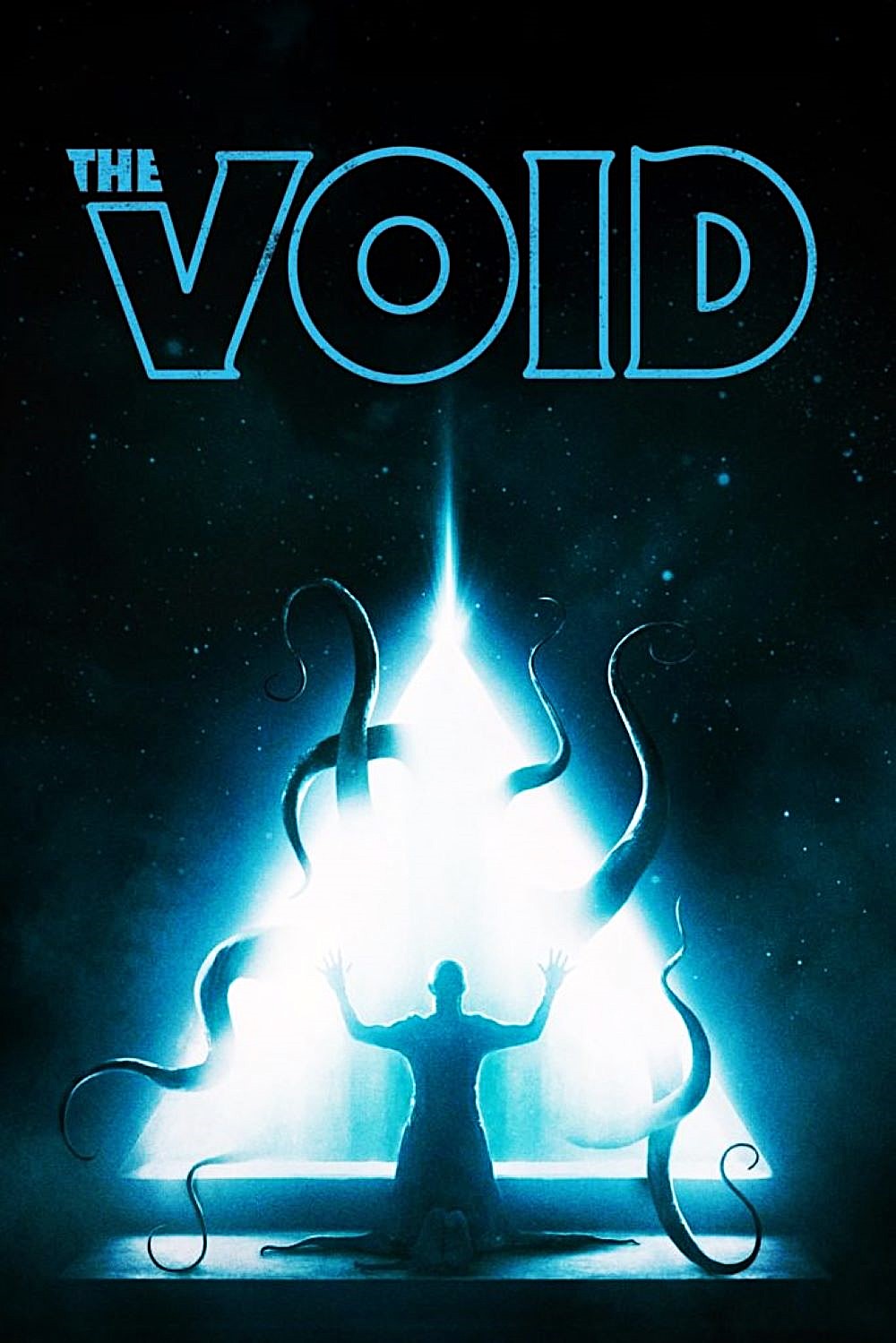
Horror Review: The Void (dir. by Steven Kostanski & Jeremy Gillespie)


“It’s not just the darkness out there… it’s the darkness in here.” — Sheriff Daniel Carter

Steven Kostanski and Jeremy Gillespie’s The Void is a grisly, atmospheric plunge into Lovecraftian cosmic horror and John Carpenter-inspired body horror, set within a nearly abandoned rural hospital shrouded in eerie blue light and creeping shadows. The film expertly conjures anxiety and dread, as fragile boundaries between dimensions begin to dissolve, threatening to swallow all inside.

At the heart of the story is Deputy Sheriff Daniel Carter (Aaron Poole), whose weighty grief and fractured relationships drive his reluctant heroism. He stumbles upon a bloodied man and brings him to the hospital staffed by his estranged wife, Allison Fraser (Kathleen Munroe), a focused nurse haunted by their broken family. Dr. Richard Powell (Kenneth Welsh) looms as the villainous architect of the unfolding nightmare, his obsession with conquering death fueled by personal tragedy, twisting him into a leader of occult horrors.

The supporting characters—Vincent and Simon, survivors hardened by trauma; Maggie, a pregnant woman caught in the web of cosmic corruption; and Kim, a vulnerable young intern—saturate the siege narrative with survival-driven urgency. Though less developed than the leads, they embody the raw desperation and existential threat pervading the hospital.

The Void wears its influences on its sleeve, drawing heavily from the siege tension of John Carpenter’s Assault on Precinct 13 alongside the paranoia and isolation of The Thing. These classic Carpenter motifs—claustrophobic settings, unrelenting external threat, and mistrust among survivors—penetrate the film’s fabric, amplified by a synthesizer-driven score nodding to Carpenter’s sonic signature. The nightmarish body horror, occult elements, and grotesque practical effects owe much to Stuart Gordon’s work adapting Lovecraft’s stories, blending visceral horror with cosmic dread.

Yet, while the homage is clear and affectionate, the film sometimes falters by blending these iconic elements into a decoction that resists full cohesion. Instead of synthesizing the inspirations into an innovative whole, it assembles a patchwork—rich in style and atmosphere but struggling to commit to a coherent, fresh narrative. The mixture of Carpenter’s claustrophobic siege, Gordon’s visceral mythos, and the cultist horror trope occasionally feels like pastiche rather than a confident new voice.

The technical craftsmanship shines throughout. Practical effects—from mutated creatures to grotesque body transformations—are lovingly crafted and tactile, restoring a physicality often lost in digital horror. The cinematography and lighting accentuate the oppressive mood, favoring muted colors punctuated by blood-red and luminous blues, thinking as much about shadows as solid objects.

However, the film’s narrative and character work often leave something to be desired. While Carter’s arc of guilt and reluctant heroism is thematically resonant, key emotional beats suffer from underdevelopment, with his relationships, particularly with Allison, only superficially explored. Dialogue oscillates between exposition-heavy and clipped, hindering audience connection with the cast amid the unrelenting terror. The supporting characters serve primarily functional roles, their deeper motivations and backstories sacrificed for the sake of grim spectacle and escalating horror.

The climax descends into surreal, fragmented sequences that evoke fever dreams more than narrative resolution. This abstract finale, while visually striking, challenges viewers seeking clarity and can be polarizing: some will appreciate the cosmic horror tradition of unsolvable mysteries, while others may experience frustration with the loose plotting and ambiguity. Pacing reflects these shifts—building steadily in the opening act before devolving into frenetic, disjointed bursts that occasionally undermine tension.

Despite these narrative and pacing flaws, The Void remains a memorable experience for lovers of practical effects and cosmic horror texture. It’s a film rich with unsettling imagery and mood, capturing a form of existential terror that goes beyond cheap scares. The filmmakers’ love for classic horror runs deep, even if the resulting fusion occasionally feels like homage without full reinvention.

Ultimately, The Void is a dark, unsettling trip into the unknowable—a sonic and visual descent into a hellish siege where logic unravels and time shatters. It’s a film that prizes atmosphere and physical monstrosity over smooth storytelling, inviting viewers to surrender to dread rather than demand explanation. For fans of Carpenter’s minimalist tension, Gordon’s visceral adaptations, and the tactile nightmares of 80s horror, The Void offers a rewarding, though imperfect, journey into the cosmic abyss—an evocative invocation of terror where humanity is both survivor and prey.
Film Review: The Circle (dir by James Ponsoldt)


Earlier today, I got off work early and I finally saw The Circle!

The Circle is a film that I’ve been curious about for a while.  It’s based on a novel by Dave Eggers, a book that I absolutely loved when I first read it.  It stars Emma Watson, Tom Hanks, Patton Oswalt, and John Boyega.  It’s directed by James Ponsoldt, who may not be a household name but who has previously directed such beloved films as The Spectacular Now and The End of The Tour.  It sounded like a film to which everyone should have been looking forward but instead, even with Watson appearing in the blockbuster Beauty and the Beast at the same time, The Circle opened with very little fanfare.

Then the reviews came out and, with a few notable exceptions, they were all negative.  I did a little research and I discovered that, though filming was initially completed in 2015, The Circle spent a year and a half sitting on the shelf.  In January of this year, 16 months after shooting wrapped, a few scenes were refilmed.  That’s never a good sign.  One gets the feeling that, if not for John Boyega’s role in Star Wars: The Force Awakens and the excitement over Emma Watson starring in Beauty and the Beast, The Circle probably would have ended up going straight to VOD.

But here’s the thing.  I loved the book.  The book managed to put a new spin on the otherwise tired topic of how social media has changed our way of looking at the world.  The book was an Orwellian masterpiece, an homage to 1984 by a writer who, as opposed to most people who are currently claiming to appreciate the novel’s dark vision, understood what George Orwell was actually saying.

In fact, the more I thought about it, the easier it was for me to assume that most critics probably missed the point of the movie.  It was entirely possible, I decided, that the negative reaction to The Circle had to do with audiences not knowing how to deal with a movie that truly challenged their assumptions.  Naively, I assumed that the story and the themes of the novel had been brought to the screen and the critics couldn’t handle it.

Well, as I said earlier, I finally saw The Circle for myself and it turns out that I was wrong.  The Circle is an absolute mess.  Despite being co-written by Dave Eggers, this film actually has very little in common with the novel that it’s based on.  The novel was a sharply satiric portrait of a world that has become brainwashed by technology and social media.  The movie is a nagging anti-internet screed that would have felt out-of-touch in 2002.  The book ends with a powerful “and he loved Big Brother” moment.  The movie ends on a note that feels so completely false that you just know it was studio mandated.

Emma Watson plays Mae Hubbard, a recent college grad whose degree in Art History is pretty much going to waste.  (Speaking as the proud recipient of an Art History degree, I can verify that the film gets this detail absolutely right.)  Through a college friend named Annie (Karen Gillian, for once not having to disguise her Scottish accent), Mae gets a job working for The Circle, an all-powerful internet company that is pretty obviously based on Google Plus.  Through a series of silly events, Mae becomes the public face of The Circle.  The Circle wants to use technology (cameras everywhere, social media addiction, everyone carries tablet, you must have a credit card to join The Circle, oh my!) to do away with the concept of privacy.  When everyone is a member of the Circle, no one will be a stranger.  No one will have any privacy.  Anyone can be found.  Anyone can be watched.  And, of course, it’ll be easier to tell everyone what to think and who to support…

…and all of this would be shocking if The Circle had been made in a time before Twitter and Facebook.

Anyway!  The Circle was founded by three men.  Two of them (Tom Hanks, Patton Oswalt) are totally sinister.  Oswalt glowers in the background.  Hanks appears to channeling Christoph Waltz.  Meanwhile, the third man (John Boyega) has become disillusioned with The Circle.  He shows up occasionally, standing in the background and watching as Mae does stuff.

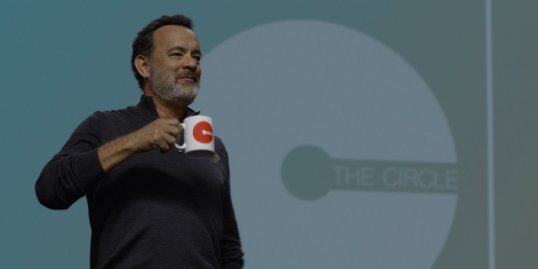
Throughout the film, Tom Hanks gives lectures to his employees.  They all applaud as he introduced the latest technology from The Circle.  These scenes are fun because it looks like Tom Hanks is appearing in a commercial for The Criterion Collection.

Anyway, Mae loves the brave new world but a few people don’t.  Her parents (Bill Paxton and Glenne Headly) are skeptical.  Though his role is small, Bill Paxton gave a good performance in this, his latest released film.  I got a bit emotional watching him, especially as he was playing a character struggling with his own poor health.  Ellar Coltrane, of Boyhood fame, plays the other voice of skepticism, Mae’s childhood friend who wants to live off the grid.  Coltrane is supposed to be the voice of reason but he gives such a strange and awkward performance that the main thing that comes across is that Luddites are weird.

Actually, with the exception of Bill Paxton and Karen Gillan, it’s hard to think of anyone who actually gives a good performance in The Circle.  (This is especially shocking when you consider that, in the past, Ponsoldt has proven himself to be an excellent director when it comes to getting noteworthy work from his cast.)  Everyone comes across like they were wishing that they were somewhere else.  Emma Watson, in particular, is bad.  That said, in her defense, Watson is also totally miscast.  Mae is meant to be someone searching for an identity in an overly complicated world but Watson plays her as just being dourly earnest.  As played by Watson, Mae’s just the boring person that you dread having to take a class with.  Neither Watson nor the film, as a whole, seems to be sure who exactly Mae is.  (In the novel, the character works because Mae isn’t meant to be likable.  The film, however, tries to have it both ways, making her both a true believer in the Circle and a sympathetic character.  It doesn’t work.)

For that matter, the film also appears to be confused as to just why exactly Hanks and Oswalt are villains.  We know that we’re supposed to distrust them because Hanks is way too quick to smile and Oswalt is always standing in the background and looking like he’s just deliberately killed all of his Sims.  But how evil are they actually supposed to be?  What are the stakes?  The film doesn’t appear to be sure.

Now, I’m not totally trashing The Circle.  There were a few moments that I did like.  I enjoyed the scenes that were meant to illustrate the cult-like atmosphere at the Circle.  There’s a hilarious scene where two enthusiastic Circle employees interrogate Mae as to why she never told them that she enjoys kayaking.  (“I enjoy kayaking!  We could have kayaked together!”)  And there’s another scene where Hanks and Oswalt talk about how, if countries allow The Circle to run their elections, they could then require everyone to join The Circle and then make voting mandatory.  Mandatory Voting is a really terrible idea, the type that is always embraced by people who should know better.  I appreciated seeing the idea exposed for being the ticket to totalitarianism that it truly is.

But, for the most part, The Circle was just a mess.  Like a lot of cautionary tales (especially ones dealing with the internet), The Circle will probably eventually become a bit of a camp classic.  But for now, everyone involved with the film has done better work in the past and, hopefully, will continue to do so in the future.