Lisa Reviews An Oscar Nominee: Who’s Afraid of Virginia Woolf? (dir by Mike Nichols)


I’ve starred in a production of Edward Albee’s play, Who’s Afraid of Virginia Woolf?

That’s right.  I’ve played Martha, the heavy-drinking and dissatisfied wife of a burned-out English professor named George.  Yes, I’ve played the same role for which Uta Hagen won a Tony and Elizabeth Taylor won an Oscar.  Among the other actresses that have played Martha on stage: Colleen Dewhurst, Meg Tilly, Diana Rigg, and Kathleen Turner.  And, of course, me.

Now, I should admit that I was only 16 when I played Martha so I was perhaps a bit too young for the role.  Fortunately, my friend Erik — who played George — was only a year and a half older so he was just as miscast as I was.  (It was, at one point, suggested that I should try to put some gray in my hair but I pointed out that, as a redhead, I would never have to worry about that.)  On Broadway and film, Who’s Afraid of Virginia Woolf? runs for over two hours.  The production in which I starred only had a running time of 13 minutes.  Also, the version in which I starred did not feature the characters for Honey and Nick.  I mean, who needed them when you could just watch Erik and me yell at each other for ten minutes straight.

And that’s pretty much what we did.  When we told our drama teacher that we would be doing a scene from Who’s Afraid of Virginia Woolf? for our “Dramatic Duet,” I’m pretty sure that I saw her roll her eyes.  I imagine that’s because she knew that both of us had a tendency towards the dramatic and that the main we picked the play was so we could compete to see who could be the first to go hoarse from yelling.  She was right, of course.  There was no nuance to our performance, largely because neither one of us really understood what the play was about.  We just thought it was funny that some of our classmates covered their ears while we were loudly insulting and taunting each other.  (For the record, I went hoarse before Erik did and I spent the next two days receiving compliments about my new sexy voice.)

Now that I’ve grown up a little, I think I have a better understanding of what Who’s Afraid of Virginia Woolf? is actually about.  At the very least, I now understand that the story is about more than just two burn-outs yelling at each other while a younger couple awkwardly watches.  I now understand that the game that George and Martha play over the course of the night is not a game of hate but instead a game of a very dysfunctional but also rather deep love.  If anything, I now have more sympathy for George and Martha and far less for the play’s judgmental younger couple, Nick and Honey.

Of course, it helps that I’ve seen the 1966 film version of Who’s Afraid of Virginia Woolf?  Directed (in his directorial debut) by Mike Nichols, Who’s Afraid of Virginia Woolf? features Elizabeth Taylor and Richard Burton as George and Martha and George Segal and Sandy Dennis and Nick and Honey.  All four of them were Oscar-nominated for their roles, making Who’s Afraid of Virginia Woolf? one of the few films to see its entire cast nominated.  Elizabeth Taylor and Sandy Dennis both won in in their categories but it really is Richard Burton (who lost to Paul Scofield) who dominates the film.

Burton was a performer who could be shameless in his overacting.  (Just watch his performance in The Exorcist II if you need proof.)  And really, one would expect that the role of George would appeal to all of his worst instincts.  Instead, Burton gives a surprisingly subtle performance.  He growls when you expect him to yell and he delivers the majority of his lines not with fury but instead with a resigned and rather sardonic self-loathing.  He’s actually less showy than Elizabeth Taylor, who gives an overall good performance but still sometimes comes across like she’s trying too hard to convince the audience that she’s a 50 year-old drunk and not one of the world’s most glamorous film stars.  Throughout the film, Burton seems to be digging down deep and exposing his true self to the audience and, watching the action unfold, you can’t take your eyes off of him.  Everyone in the cast does a good job with their roles but Burton is the one who keeps the film moving.  Just as George is ultimately revealed to be stronger than he originally appears, Burton also reveals himself to be a far more compelling actor than you might think if you just knew him from his lesser roles (and performances).

Admittedly, Who’s Afraid of Virginia Woolf? is not my favorite of the many films that have been nominated for best picture over the last 90 years.  Even when the characters are inhabited by skilled performers, a little bit of George and Martha goes a long way.  That said, this is a historically important film.  The film’s language may seem tame today but it was considered to be shockingly profane in 1966.  The fact that the National Legion of Decency declined to condemn the film despite the language was considered to be a major step forward in the maturation of American cinema.  In fact, it can be argued that the MPAA rating system started as a way to tell audiences that a film like Who’s Afraid Of Virginia Woolf? was not morally objectionable but that it was still meant for adults.

Who’s Afraid of Virginia Woolf? received thirteen Academy Awards nominations.  It was nominated in every category for which it was eligible.  It won 5 awards but ultimately lost Best Picture to rather more sedate theatrical adaptation, A Man For All Seasons.


Lisa Reviews An Oscar Nominee: Ivanhoe (dir by Richard Thorpe)


Welcome to England in the 12th century!

That’s the setting of the 1952 best picture nominee, Ivanhoe.  It’s a green and healthy land, full of chivalrous knights and corrupt royalty and outlaws who steal from the rich and give to the poor.  King Richard the Lion Heart (Norman Wooland) left on a crusade and he hasn’t been seen for a while.  Richard’s evil brother, the cowardly King John (Guy Rolfe), rules the country and has little interest in making sure that Richard returns.  Even when Wilfred of Ivanhoe (Robert Taylor) discovers that Richard is being held for ransom, John declines to do anything about it.

Ivanhoe is determined to raise the money to pay the ransom and restore Richard to the throne of England, even if he has to secretly compete in a tournament to do it.  Of course, before he can do that, he’ll have to buy a horse and some armor.  Fortunately, he comes across Isaac (Felix Aylmer) and his daughter, Rebecca (Elizabeth Taylor).  Isaac and Rebecca give Ivanhoe the money necessary to purchase a good horse and equipment.  Rebecca falls in love with Ivanoe, despite the fact that Ivanhoe is in love with Rowena (Joan Fontaine, who spends most of the movie looking rather bored).

Speaking of love, the king’s favorite knight — the hot-headed but honorable Sir Brian De Bois-Guilbert (George Sanders) — has fallen in love with Rebecca.  That, of course, complicates matters when the anti-Semitic King John attempts to have the Jewish Rebecca burned at the stake for witchcraft.  When Ivanhoe invokes the “wager of challenge,” in an effort to save Rebecca’s life, Sir Brian is chosen as the court’s champion.  Needless to say, this leads to some awkward moments….

Listen, I would be lying if I said that it was easy for me to follow the plot of Ivanhoe.  It seemed like every few minutes, someone else was plotting against either Ivanoe or King John and it got a bit difficult to keep track of what exactly everyone was trying to accomplish.  By the time Robin Hood (Harold Warrender) showed up, I have given up trying to make sense of the plot.

Instead of worrying about the exact details of the plot, I decided to just enjoy the film as a spectacle.  If nothing else, Ivanhoe is gorgeous to look at.  The colors are lush and full and the costumes and the sets are all wonderfully ornate.  Apparently, 12 Century England was a very colorful place.  There’s a lot of battles and jousts and sword fights.  I couldn’t always keep track of who was fighting who but at least the film moved at a steady pace.

Robert Taylor and Joan Fontaine make for a dull leading couple but a young Elizabeth Taylor is stunning in the role of Rebecca and George Sanders transforms Sir Brian into a truly tragic figure.  Guy Rolfe is memorably evil as King John, though he’s perhaps not as much fun as Oscar Isaac was in Robin Hood.  Everyone in the movie looks good in their period costuming.  Really, that’s the most important thing.

Ivanhoe was nominated for Best Picture but lost to The Greatest Show On Earth.

Lisa Reviews An Oscar Nominee: Cat On A Hot Tin Roof (dir by Richard Brooks)


The 1958 best picture nominee, Cat On A Hot Tin Roof, opens with a 30-something Paul Newman doing something stupid.

It’s a testament to just how incredibly handsome Paul Newman was in the 1950s that he can still be sexy even while he’s stumbling around in a drunken haze and attempting to jump over hurdles on a high school football field.  Newman is playing Brick Pollitt, youngest son of the wealthy cotton farmer Big Daddy Pollitt (Burl Ives).  Brick was a star athlete in high school but now, he’s a drunk with an unhappy marriage and a lot of bitter feelings.  When Brick attempts to jump over the hurdles, he breaks his ankle.  The only thing that keeps Brick from being as big a loser as Biff Loman is the fact that he looks like Paul Newman.

Brick is married to Maggie (Elizabeth Taylor), a beautiful woman who may have grown up on the wrong side of the tracks but who has married into money.  The only problem is that it doesn’t seem like Brick is ever going to get that money.  With Big Daddy getting older, everyone in Mississippi is wondering which Pollitt son will inherit his fortune.  Will it be drunken, self-pitying Brick or will it be Goober (Jack Carson) and his wife (Madeleine Sherwood)?  One point in Goober’s favor is that he and his wife already have five rambunctious children while Brick and Maggie have none.  In fact, gossip has it that Brick and Maggie aren’t even sleeping in the same bed!  (While Maggie begs Brick to make love to her, Brick defiantly sleeps on the couch.)  The other problem is that, for whatever reason, Brick harbors unending resentment towards … well, everything.  Perhaps it has something to do with the mysterious death of Brick’s best friend and former teammate, Skipper…

Brick, Maggie, Goober, and the whole clan are in Mississippi to celebrate Big Daddy’s 65th birthday.  Big Daddy is happy because he’s just been told that, despite a recent scare, he does not have cancer.  What Big Daddy doesn’t know is that his doctor (Larry Gates) lied to him.  Big Daddy does have cancer.  In fact, Big Daddy only has a year to live.

Whenever I watch Cat On A Hot Tin Roof, I find it’s helpful to try to imagine what it would have been like to watch the movie in the 1950s.  Imagine how audiences, at a time when married couples were still regularly portrayed as sleeping in separate beds and when men were naturally assumed to be the kings of their household, reacted to seeing a film where Elizabeth Taylor was literally reduced to begging Paul Newman to make love to her while Newman hopped around on a crutch and continually found himself getting stuck in embarrassing situations.  Though it may seem tame by today’s standards, the film was undeniably daring for 1958 and watching it is like stepping into a time machine and discovering that, yes, there was a time when Elizabeth Taylor wearing a modest slip was considered to be the height of raciness.

Of course, the film itself is quite toned down from the Tennessee Williams’s play on which it was based.  Williams reportedly hated the changes that were made in the screenplay.  In the play, Skipper committed suicide after confessing that he had romantic feelings for Brick, feelings that Brick claims he did not reciprocate.  That was glossed voter in the film, as was the story of Skipper’s unsuccessful attempt to prove his heterosexuality by having sex with Maggie.  By removing any direct reference to the romantic undercurrent of Brick and Skipper’s relationship, the film also removes most of Brick’s motivation.  (It’s still there in the subtext, of course, but it’s probable that the hints that Newman and Taylor provided in their performances went straight over the heads of most audience members.)  In the play, Brick is tortured by self-doubt and questions about his own sexuality.  In the film, he just comes across as being rather petulant.

And again, it’s fortunate that, in the film, Brick was played by Paul Newman.  It doesn’t matter how bitter Brick becomes or how much he whines about not wanting to be around his family.  One look at Newman’s blue eyes and you understand why Maggie is willing to put up with him.  In the role of Maggie, Elizabeth Taylor gives a performance that manages to be both ferocious and delicate at the same time.  Maggie knows how to play the genteel games of the upper class South but she’s definitely not going to let anyone push her around.  It’s easy to see why Big Daddy prefers the company of Maggie to his own blood relations.  It’s not just that Maggie’s beautiful, though the implication that Big Daddy is attracted to her is certainly present in the film.  It’s also the she’s the only person around who is as strong and determined as him.

Indeed, seen today, Cat On A Hot Tin Roof‘s main strength is that it’s a masterclass in good acting.  Williams’s dialogue is so stylized and his plot is so melodramatic that one bad performance would have caused the entire film to implode.  Fortunately, Newman and Taylor make even the archest of lines sound totally natural while Burl Ives and Judith Anderson are both the epitome of flamboyant charisma as Big Daddy and Big Mama.  It takes a lot of personality to earn a nickname like Big Daddy but Ives pulls it off.

Along with being a huge box office success, Cat On A Hot Tin Roof was nominated for best picture of 1958.  However, it lost to Gigi.

Cleaning Out The DVR: Night Watch (dir by Brian G. Hutton)


I recorded 1973’s Night Watch off of TCM on March 17th!

There’s a tendency, among critics, to dismiss almost every film that Elizabeth Taylor made after Who’s Afraid of Virginia Woolf?  Sure, Reflections In A Golden Eye has its defenders but, otherwise, Taylor’s later films are often viewed as being overproduced and self-indulgent with Taylor giving uncertain, occasionally histrionic performances.

Those criticisms aren’t entirely unjustified.  Some of it may have been due to her own notoriously poor health and her troubled marriage to Richard Burton.  Even more of it was probably due to Taylor’s struggle to remain relevant as a middle-aged actress working in the 1970s.  I have to admit that I’m strangely fascinated by the latter half of Taylor’s film career, just because it does feature so many bizarre films and strange performances.  Taylor was always a good actress but, in her later films, it was hard not to get feeling that her stardom was her own worst enemy.  Taylor was often cast specifically because of her notoriety and she often seemed to work with directors who weren’t willing to reign her in whenever she started to go overboard.

That, however, doesn’t mean that every film that she made in the 70s was a bad one.

Take Night Watch, for instance.  Yesterday, as I watched Night Watch, I asked myself, “How is it that I’ve never seen or even heard of this film before!?”

Because seriously, Night Watch was really good.

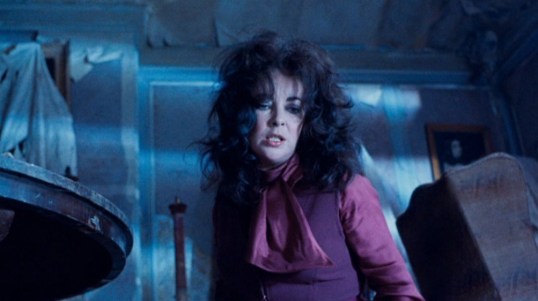
Liz plays Ellen Wheeler, an apparently unstable woman living in the UK.  She’s haunted by the night that her first husband was killed in a car crash, along with his mistress.  Ellen has remarried but she worries that her new husband, John (Laurence Harvey), might be cheating on her with her best friend, Sarah (Billie Whitelaw).  It turns out that she has good reason to be worried because that’s exactly what John is doing!  It’s not that John doesn’t love Ellen.  It’s just that he doesn’t know how to deal with her constant nightmares and delusions.

For instance, Ellen is convinced that she’s witnessed a murder!  She says that, in the abandoned house next door, she saw a man with a slit throat.  Later, she claims that she saw a woman murdered over there as well.  When the police investigate, they find no one in the house.  But Ellen swears she saw something.  She even suspects that her neighbor, Mr. Appleby (Robert Lang), may have buried the bodies in his garden.

(Mr. Appleby is not amused by the suggestion.)

Is Ellen going crazy or did she really see something?  I bet you think you already know the answer.  I know that I did.  But then Night Watch ends with a twist that is shockingly effective and unexpected.  For once, I didn’t know how the movie was going to end and now, a day later, I’m still thinking about those final scenes.

Night Watch has its flaws.  With the exception of when he played Col. Travis in The Alamo, Laurence Harvey was never a particularly sympathetic actor and he comes across as his usual cold self in Night Watch.  And, as good as Taylor is, there are still a few moments where she does go a bit overboard.  During the first half of the film, you have to make your way through a lot of yelling to get to the good part.

But that good part is so good that it’s worth it!  Night Watch is a genuinely atmospheric and surprising film, one that catches you off guard and one in which the tension does not relent until the final credit has rolled across the screen.  Ellen’s nightmares are especially well-realized and the film’s final moments are both frightening and surprisingly graphic.  This is a film that sticks with you.

If you haven’t seen it yet, keep a watch for it!

http://www.youtube.com/watch?v=Aao2hzmuNes

Music Video of the Day: Brando by Scott Walker + Sunn O))) (2014, dir by Gisele Vienne)


Today would have been Marlon Brando’s 94th birthday so it seems appropriate that today’s music video should be for a song that was, at least partially, inspired by Marlon Brando’s career!

In 2014 interview, Scott Walker explained the idea behind this song, saying that he found that there were several movies that features scenes of Marlon Brando being physically assaulted.  Along with detailing some of the assaults that Brando suffered on screen, the song serves as a tribute to sadomasochism in general.

In the third verse, there are several references to Brando’s films.  First there’s mention of Brando getting beat up by John Saxon in The Appaloosa.  “I took it from dad” is probably a reference to One-Eyed Jacks, the only film that Brando ever directed.  Fat Johnny Friendly was the racketeer played by Lee J. Cobb in On The Waterfront while the three vigilantes are a reference to Brando’s role in The Chase.  “I took it for The Wild One” is obviously a reference to the film of the same name.  As “Lizbeth,” that’s presumably a reference to Elizabeth Taylor, who beat Brando with a riding crop in Reflections in a Golden Eye.

Enjoy!

Film Review: The Driver’s Seat (dir by Giuseppe Patroni Griffi)


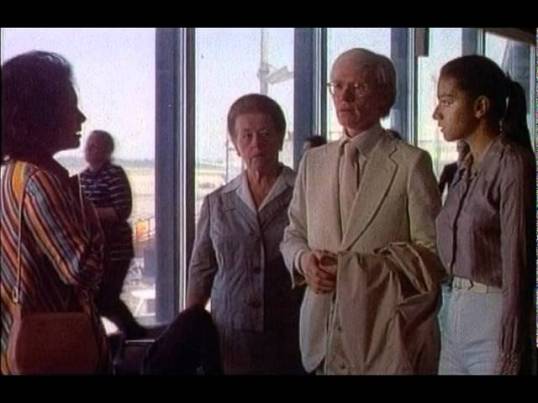
The only reason that I watched the 1974 film, The Driver’s Seat, was because I had heard that Andy Warhol was in it and that he actually played a character other than Andy Warhol.

And that, it turns out, is true.  Andy Warhol does appear in The Driver’s Seat.  He plays a character known as “The English Lord” and he even attempts to speak with a posh British accent.  At the same time, though, it’s hard not to feel that Andy Warhol was still essentially playing himself.  Though not lacking in screen presence, Andy played the role with eccentric detachment.  It’s stunt casting, which Andy himself probably would have appreciated but, in the larger context of the film, his presence never quite makes sense.  Then again, the same can be said about just about every actor in The Driver’s Seat.  It’s not a film that’s overly concerned with making sense.

Andy is only in two scenes and they’re both rather short ones.  In his first scene, he approaches Lise (played by Elizabeth Taylor) in an airport and hands her a paperback book that she dropped earlier.  (The book is called The Walter Syndrome.)  As he and his entourage walk away from her, Lise says, “Why is everyone so afraid of me?”

Later on in the movie, Lise runs into the English Lord for a second time.  She approaches him and tries to talk to him but, just as before, he doesn’t have much to say to her.  He’s deep in conversation with some sort of government minister.  At one point, he says, “The King’s an idiot.”

And that’s pretty much the extent of Andy Warhol’s performance.

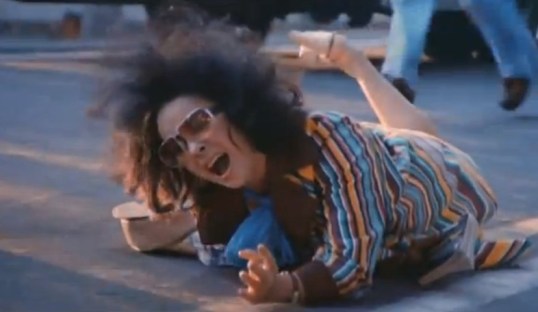
As for the rest of The Driver’s Seat, it’s one of the many oddly surreal films that Elizabeth Taylor made in the 1970s.  Taylor plays Lise, a middle-aged and overweight spinster who goes on an apparently spontaneous trip to Rome.  When she’s not trying to flirt with almost every man that she sees, she is obsessing on death.  (When she spots a police officer, he asks him if he has a gun and points out that, if he did, he could shoot her right that minute.)

Everyone seems to be scared of Lise, or I should say everyone but Bill (Ian Bannen).  Bill is, without a doubt, one of the most annoying characters of all time.  When Lise first sees him and his orange tan, she says, “You look like Little Red Riding Hood’s Grandmother.  Do you want to eat me?”

Bill laughs and happily replies, “I’d like to, I’d like to. Unfortunately, I’m on a macrobiotic diet and I can’t eat meat.”

Bill’s not joking either.  He is obsessed with his macrobiotic diet and won’t shut up about it.  He also tells Lise that, as a result of his diet, “I have to have an orgasm a day.”

When I diet, I diet,” Lise replies, “And when I orgasm, I orgasm!”  Lise also assures him, “I’m not interested in sex, I’m interested in other things!”

Meanwhile, while all this is going on, random people are getting blown up by terrorists and police officers are chasing young men down in airports.  The film is full of flash forwards in which the various characters who have met Lise are roughly interrogated by some sort of shadowy security agency.  Interpol, we’re told, is looking for Lise.  Everyone is looking for Lise!

Why?  Don’t expect an answer.  Why doesn’t matter in this film!  The Driver’s Seat is one of the most pretentious movies that I’ve ever watched.  Fortunately, I have a weakness for pretentious movies from the 1970s.  I’ve seen a lot of incoherent movies but I’ve rarely seen one that embraces and celebrates incoherence with quite the enthusiasm of The Driver’s Seat and it’s hard not to respect the film’s determination to be obscure.  The movie may make no sense but at least it’s weird enough to be watchable.  Elizabeth Taylor actually gives a pretty good performance as Lise, even if you never forget that you’re actually watching Elizabeth Taylor in one of her weird 1970s films.  Taylor plays the role with a conviction that sells even the most overwritten and/or obscure piece of dialogue.  Add to that, in the 70s, Elizabeth Taylor was probably one of the few people who truly could relate to the situation of having everyone in the world searching for her.

The Driver’s Seat is a pretentious mess and that’s just fine.
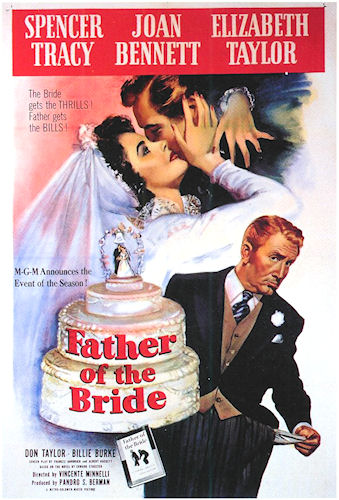
Lisa Watches An Oscar Nominee: Father of the Bride (dir by Vincente Minnelli)


FatheroftheBride1950

After I watched King Solomon’s Mines, I watched yet another 1950 best picture nominee, Father of the Bride.

In Father of the Bride, Spencer Tracy plays a lawyer named Stanley Banks.  As you might expect of any character played by Spencer Tracy, Stanley Banks is a no-nonsense type of guy.  He’s set in his ways and not particularly enthusiastic about the idea of change.  Stanley has worked hard to get a good job and a nice house in the suburbs.  He loves his wife, Ellie (Joan Bennett) and is a firm but good father to his two boys, Tommy (Russ Tamblyn) and Ben (Tom Irish).  If Stanley does have a soft spot, it’s for his daughter, Kay (17 year-old Elizabeth Taylor).  Stanley admits that he’s always given Kay everything that she’s ever wanted and that she is his favorite of all his children.

However, Kay has been acting strangely as of late.  She just seems to be so happy!  Stanley can tell that she’s in love, though he has no idea with whom.  (He is, however, happy that it’s probably not the bespectacled political radical who Kay apparently dated at some point in the past.)  Finally, during an otherwise typical family dinner, Kay announces that not only is she in love but she’s also engaged to be married!

His name is Buckley (Don Taylor, who would later direct Escape From The Planet of the Apes and Damien: Omen II) and, at first, Kay refuses to even introduce him to her parents.  Eventually, however, Stanley does meet Buckley and he’s happy to discover that not only does Buckley come from a wealthy family but he also owns a small business of his own.

However, just because Buckley is the perfect 1950 man, that doesn’t mean that the wedding is going to be easy.  As a befuddled Stanley watches, the wedding grows more and more elaborate (not to mention, expensive!).  All of the expected complications ensue: Buckley and Kay have a fight, a wedding planner makes things difficult, and Stanley does not immediately get along with Buckley’s parents.  But, for the most part, Father of the Bride is about Stanley struggling to accept that his daughter has grown up and is ready to start a life of her own.

Father of the Bride is a sweet little comedy, though it seems a bit out-of-place as a best picture nominee.  It’s definitely a film of its time.  For all of the scenes of Stanley worrying about the extravagance of modern weddings, there’s not a subversive moment to be found in Father of the Bride.  (One can only imagine what Nicholas Ray or Douglas Sirk would have done with the material.)

Fortunately, this is also a Spencer Tracy film and whatever gravitas that the film may have comes from Tracy’s honest and straight forward performance.  Tracy never begs for laughs but he gets them anyway, because of the honesty that he brings to the character.  Perhaps his best moment comes after Buckley and Kay have had a fight.  After comforting his daughter, Stanley discovers that Buckley is at the front door.  At first, the protective Stanley tells Buckley that Kay doesn’t want to see him.  Suddenly, Kay comes running down stairs and embraces Buckley.  Between sobs and kisses, Buckley and Kay dramatically swear to each other that they will never fight again.  The camera pans over to Stanley, standing a little to the side and listening.  At first, Stanley seems befuddled by how overdramatic the two of them are acting over a relatively minor fight but there’s also just a hint of sadness in Stanley’s eyes as he realizes that his daughter truly has moved on.

Father of the Bride was nominated for best picture but it lost to the far more subversive All About Eve.

Embracing the Melodrama Part II #33: Reflections in a Golden Eye (dir by John Huston)


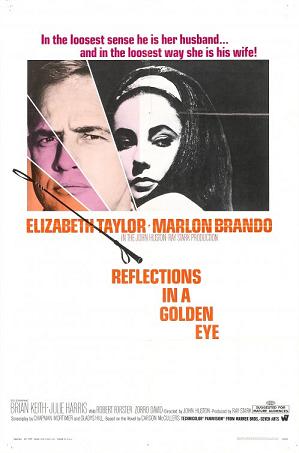
Reflections_in_a_golden_eyeFor the past two weeks, I’ve been reviewing, in chronological order, 126 cinematic melodramas.  I started in the 1920s with Sunrise and Wings and now, 33 reviews later, we have finally reached the end of the 1960s.  And what better way to end the 60s than by taking a mercifully brief look at the 1969 film, Reflections in a Golden Eye.

Now, before I get too critical of this film, I should acknowledge that there are some critics who absolutely love Reflections in a Golden Eye.  They think very highly of Marlon Brando’s performance as Maj. Weldon Penderton, a closeted homosexual who is stationed at a military base in the South.  They think that Elizabeth Taylor’s performance as Brando’s wife isn’t somewhat embarrassing.  And they think that the script isn’t overwritten and that director John Huston doesn’t try way too hard to prove himself worthy of the title auteur.  They feel that Reflections in a Golden Eye is a secret masterpiece that does not deserve to be known as an infamous flop.

I’m definitely not one of those people but they do exist.  There are some very respectable and intelligent critics who happen to love Reflections in a Golden Eye.

Well — vive la différence!

Earlier in this series, I pointed out that the 60s were not a great time for old school Hollywood directors trying to compete with both American television and European film.  It was a time when talented directors found themselves trying to keep up with the times and appeal to new audiences.  As a result, Joseph L. Mankiewicz ended up making Cleopatra.  Edward Dmytryk did The Carpetbaggers.  Elia Kazan directed The Arrangement.  William Wyler did The Liberation of L.B. Jones.  Stanley Kramer made RPM.  

And John Huston made Reflections in a Golden Eye.

This painfully slow film follows the affairs of six people on that Southern army base.  Brando is emotionally repressed and spend most of the movie mumbling in one of the worst Southern accents ever.  Taylor is obsessed with horses and spends most of the movie yelling in one of the worst Southern accents ever. Robert Forster is the object of Brando’s repressed desire, a soldier who likes to ride horses while naked and who is obsessed with sniffing Elizabeth Taylor’s underwear.  Brian Keith is in charge of the army base and is having an affair with Taylor.  Julie Harris is Keith’s suicidal wife.  Zorro David is Harris’s houseboy who, at one point, is nice enough to give this film a title by mentioning something about a golden eye.

What’s particularly insane is that Huston took the idea of making this film a reflection in a golden eye literally.  The entire film is tinted a sickly gold color.  Whenever the characters step outside, the sky looks like the sun has just exploded.  Whenever the characters are inside, they all look like they have jaundice.  On the one hand, you have to respect the fact that Huston so committed himself to potentially alienating the audience.  On the other hand, the yellow-tinting renders almost every image so grotesque that I actually found myself growing physically ill as I watched the film.

Watching Reflections in a Golden Eye, I could understand why The Godfather was such a huge comeback for Marlon Brando.  I wouldn’t necessarily say that Brando gives a bad performance here.  He’s watchable throughout the entire film.  But it’s still a performance that’s so strangely modulated (and which features a Southern accent that is just amazingly bad) that it ultimately distracts from the film itself.  If anything, Brando gives a performance that suggests what happens when a talented and eccentric man gets bored with what he’s doing.

(If you want to see a good Brando performance from 1969, see Burn.)

Reflections in a Golden Eye is a pretentious mess but fortunately, both Huston and American film would make a comeback in the 1970s.  We’ll start on that decade tomorrow.

http://www.youtube.com/watch?v=5U2NssXWO5Y

(Yes, this video is a spoiler but it’ll allow you to see the gold tinting.)

(The film was also released in an untinted version.)

Embracing the Melodrama Part II #26: Cleopatra (dir by Joseph L. Mankiewicz)


Cleopatra_posterWhile watching the 1963 best picture nominee, Cleopatra, I had many thoughts.  The film lasts over 4 hours so I had a lot of time to think.

For instance, I often found myself impressed by the sheer size of the production.  I marveled at the recreation of ancient Greece and Rome.  I loved looking at the ornate costumes.  I loved feeling as if I was taking a look back at what Rome may have actually looked like at the height of the Roman Empire.  Making it all the more impressive was that this film was made in the days before CGI.  When the film’s Romans walked through the streets of Rome, they weren’t just actors standing in front of a green screen.  They were walking down real streets and surrounded by real buildings.  It reminded me of the awe and wonder that I felt when I was in Italy and I was visiting the ruins of ancient Rome.

(I don’t know if any of the cast accidentally flashed everyone like I did when I visited during Pompeii on a windy day but considering how short some of the skirts on the men were, it wouldn’t surprise me if they did!)

And, as I marveled at the recreation of Rome, I also thought to myself, “How long is this freaking movie?”  Because, seriously, Cleopatra is an amazingly long movie.  It’s not just the film is over four hours long.  It’s that the film feels even longer.  Gone With The Wind, The Godfathers Part One and Part Two, Once Upon A Time In America; these are all long films but, because they’re so great, you never find yourself checking the time while watching.  Cleopatra is the opposite of that.  Cleopatra is a film that, at its slowest, will make you very much aware of how many seconds are in a minute.

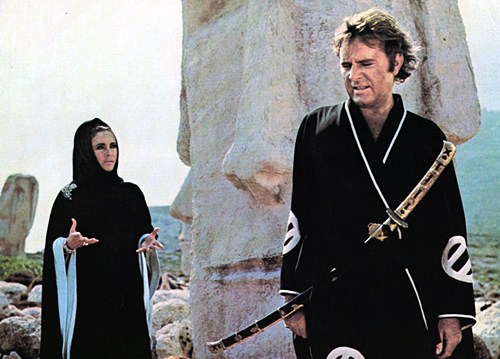
I found myself marveling at the lack of chemistry between Elizabeth Taylor and Richard Burton.  If anything, this is the most shocking thing about Cleopatra.  If Cleopatra is famous for anything, it’s famous for being the film where Elizabeth Taylor (cast in the role of Cleopatra) first met Richard Burton (who was playing Mark Antony).  Their affair dominated the gossip headlines.  (If TMZ and YouTube had been around back then, there would be daily videos of Richard Burton punching out paparazzi.)  Cleopatra was the first of many big-budgeted, overproduced films that Taylor and Burton co-starred in.

(Then again, they also starred in Who’s Afraid of Virginia Woolf, a film that is almost the exact opposite of Cleopatra.)

In the role of Mark Antony, Burton spends most of the film looking absolutely miserable.  Elizabeth Taylor, meanwhile, seems to be having a lot more fun.  It’s almost as if she understood what Cleopatra was going to become so she went out of her way to give the type of over-the-top performance that the film deserved.  The same can also be said about Rex Harrison, who plays Julius Caesar and who, perhaps because he appears to have shared her attitude, actually does have some chemistry with Taylor.

Actually, if anyone gives a truly great performance in Cleopatra, it’s Roddy McDowall.  McDowall plays the future Emperor Augustus with a mesmerizing intensity.  Again, McDowall’s performance is not exactly subtle but Cleopatra is not a film that demands subtlety.

As the film finally neared its end, I found myself wondering how Joseph L. Mankiewicz went from directing two close to perfect films, A Letter To Three Wives and All About Eve, to directing this.  Even more amazing, Mankiewicz had previously directed one of the best Roman Empire films ever, 1953’s Julius Caesar.  (When compared to Cleopatra, the low-key and thoughtful Julius Caesar appears to have been filmed on an entirely different planet.)  Well, in Mankiewicz’s defense, he was not the original director.  He was brought in to replace Rouben Mamoulian, who had previously attempted to make the film with Joan Collins, Ben-Hur‘s Stephen Boyd, and Peter Finch.  When Mankiewicz was brought in, the cast was replaced with Taylor, Burton, and Harrison.  Between the expensive stars, the troubled production, and all of the offscreen romantic melodrama, Mankiewicz probably did the best that he could.

Today, Cleopatra is mostly interesting as an example of a film from the “Only Gigantic Productions Will Save Us From Television!” era of Hollywood filmmaking.  Cleopatra started out as a $2,000,000 production and ended up costing $31,000,000.  It was the number one film at the 1963 box office and it still nearly bankrupted 20th Century Fox.  While the film does have some kitsch appeal, the critics hated it and it’s easy to see why.

And yes, it was nominated for best picture of the year, a tribute to the size of the production and the determination of 20th Century Fox to get something — anything — in return for their money.

Cleopatra is a bit of a chore to sit through but it can be fun if you’re in a snarky mood.  It’ll do until the inevitable Angelina Jolie remake comes along.

Embracing The Melodrama #12: Giant (dir by George Stevens)


Giant

Let’s continue to embrace the melodrama by taking a look at the 1956 best picture nominee, Giant.

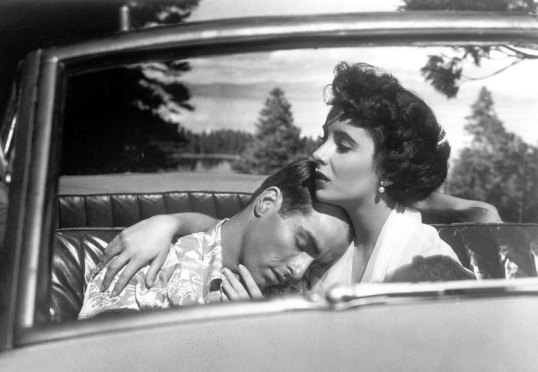
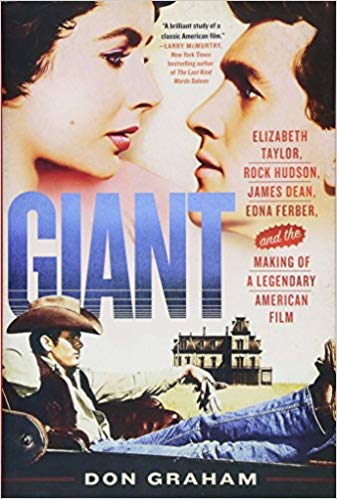
Giant is a film about my home state of Texas.  Texas rancher Bick Benedict (Rock Hudson) goes to Maryland to buy a horse and ends up returning to Texas with a bride, socialite Lesley Lynnton (Elizabeth Taylor).  At first, Lesley struggles to adapt to the harsh and hot Texas landscape.  Bick’s sister, Luz (Mercedes McCambridge) takes an instant dislike to Lesley and Bick is annoyed by Lesley’s concern over the living conditions of the Mexicans that work on Bick’s ranch.  It sometimes seems like the only person who appreciates Lesley is Jett Rink (James Dean), an ambitious ranch hand who secretly loves her and who is planning on becoming a rich man.  That’s exactly what happens when oil is found on the land around Bick’s ranch.  While Bick stubbornly clings to the past, oilman Jett represents both the future of Texas and the nation.  Meanwhile, Bick and Lesley’s son (played by a very young Dennis Hopper) challenges his father’s casual bigotry when he falls in love with a Mexican girl.

Taylor and Hudson

Giant is appropriately named because it is a huge film.  Clocking in at 201 minutes, Giant tells a story that spans several decades and features a big cast that is full of familiar faces, all struggling for their chance to somehow stand out from everyone else around them.  Even the film’s wonderful panoramic shots of the empty Texas landscape only serve to remind us of how big the entire film is.  To a certain extent, the size of Giant‘s production is to be understood.  In the 1950s, Hollywood was having to compete with television and they did this by trying to make every film into a major event.  You watch a movie like Giant and you practically hear the old Hollywood moguls shouting at America, “See!?  You can’t get that on your precious TV, can you!?”

For those of us watching Giant today, the length is both a blessing and a curse.  It’s a curse because the movie really is too damn long.  The opening scenes drag and many of them really do feel superfluous.  It’s hard not to feel that the real story doesn’t really start until about 90 minutes into the movie.  And once the story really does get started,  there’s still way too much of it for it all to be crammed into one sitting.  Oddly enough, you end up feeling as if this extremely long film is still not telling you everything that you need to know.  If Giant were made today, it would probably be a two-part movie on either HBO or Lifetime and it would definitely feature a lot more sex.

However, to be honest, one of the reasons that I did enjoy Giant was because it was as big as it was.  I mean, the film is about Texas so of course it should be a little excessive!  Everything’s bigger in Texas and that includes our movies.  Add to that, Giant may be too long but it uses that length to deals with issues that are still relevant today — oil, immigration, and racial prejudice.  Rock Hudson may not have been a great actor but he is at least convincing as he transitions from bigotry to tolerance.

But really, when it comes to Giant, most people are only interested in James Dean.  And they definitely should be because Dean gives a great and compelling performance here.  Dean brings all of the emotional intensity of the method to material that one would not naturally associate with method acting and the end result is amazing to watch.  Giant was released after Dean had been killed in that infamous car wreck.  I can only imagine what it must have been like to be sitting in a theater in 1956 and to see this compelling and charismatic actor towering above the world on the big screen while aware, all the time, that his life had already been cut short and he would never been seen in another film.

James Dean

Even better, Dean’s new style of acting clashes perfectly with Hudson’s old style of acting, making the conflict between Bick and Jett feel all the more real and intense.  Much as Bick represents old Texas and Jett represents the new Texas, Hudon and Dean represented the two sides of Hollywood: the celebrity and the artist.  Needless to say, Dean wins the battle but, surprisingly, Hudson occasionally manages to hold his own.

I can’t necessarily say that Giant is an essential film.  A lot of people are going to be bored by the excessive length.  But if you’re a fan of James Dean or if you’re from Texas, Giant is a film that you need to see at least once.

elizabeth_taylor_giant_swedish_movie_poster_2a