The SPM Trilogy Revisited : “Slumber Party Massacre II”


Slumber%20Party%20Massacre%202%201987

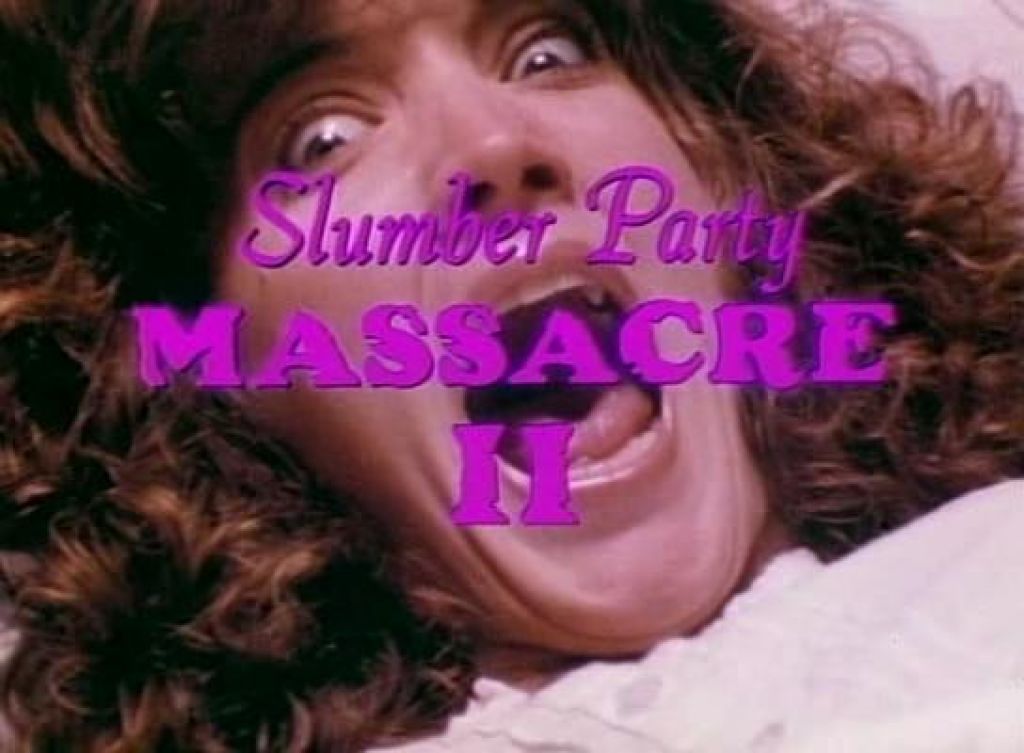
By 1987, I’m not sure that anyone was expecting Roger Corman to trot out a sequel to The Slumber Party Massacre. Sure, the movie had gained something of a cult following thanks to the VHS rental market (it did rather middling business at the box office upon its initial release), but it had been a few years and since most “slasher” sequels at the time tended to pop up within a year or two of the first flick (heck, that’s pretty much still the case), I think it’s pretty safe to say that the general feeling at the time was  that SPM was a one-and-done deal.

We all should have known better, or course. When you’ve got an ultra-simple premise that can be filmed cheaply and quickly using just a couple of different locations, and the original turned a profit (however modest), then there’s no way Corman’s not gonna go back to that well at some point. And so it came to pass that, five years on from its progenitor, Slumber Party Massacre II saw the light of day.
jurkohdkcrtibig

Needless to say, times had changed in the half-decade between the two films. While not strictly a straight-to-video release since Corman was still pulling together limited theatrical runs for all his product at the time (mostly in the Southern California area), those were really just a clevver way to essentially pull “focus group” test audiences together (and have them pay for the privilege of being guinea pigs rather than vice-versa!) to make sure the end result more or less had the effect on folks that it was supposed to. Pretty much all the action for the second Slumber Party Massacre was going to be on home video, and ol’ Roger knew it  — hence a smaller cast, fewer sets, and, I’m willing to bet, probably an even smaller budget (at least in terms of adjusted-for-inflation dollars). Heck, this thing even clocks in with a slightly shorter run time than its predecessor, if you can believe that, at a paltry 75 minutes!

One thing about the SPM modus operandi that Corman didn’t change, though, was hiring a young, relatively fresh-outta-film-school woman to direct the thing, his hire in those case being one Deborah Brock, who also wrote the script.
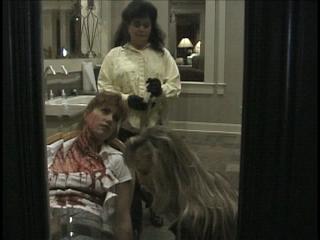
slumberpartymassacre2killer

To Brock’s credit, she tried to do something a little bit different — and, dare I say, maybe even a little bit more ambitious — than the average low-budget, essentially-DTV slasher sequel allows for with this movie. To her discredit, what she tried doesn’t exactly work. To wit:

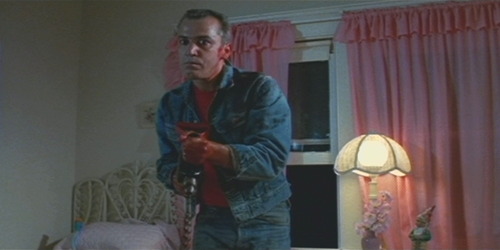
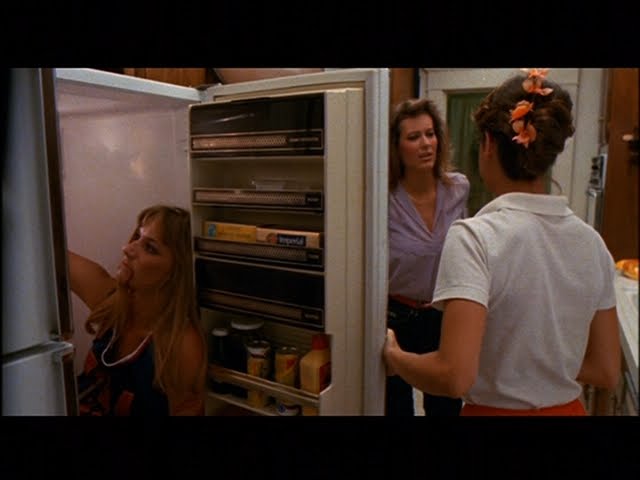
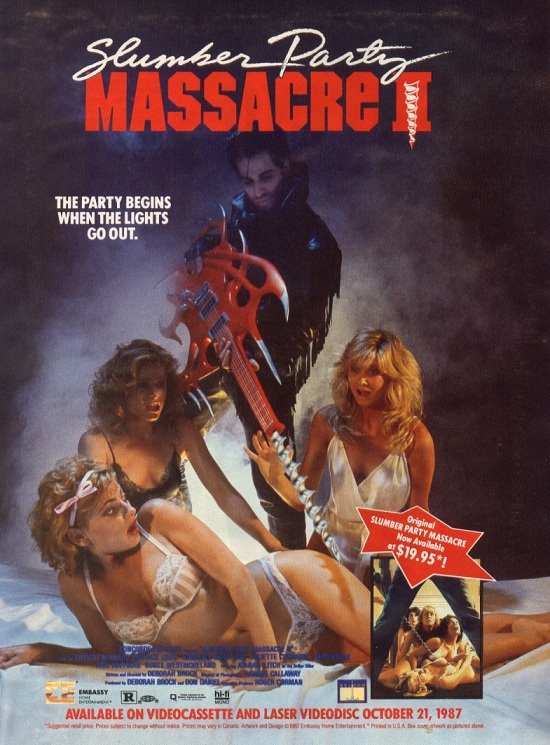
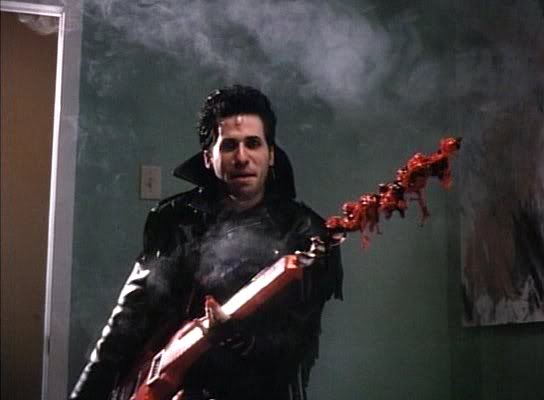
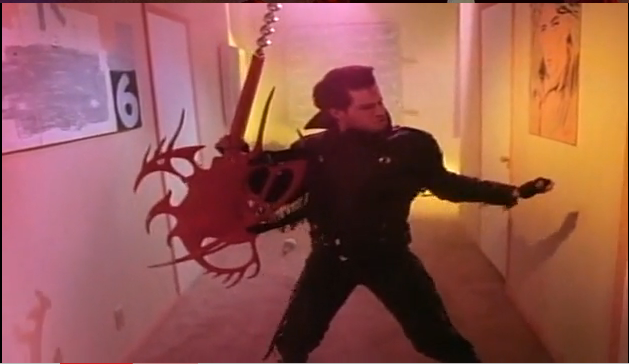
Our story here centers around a young gal named Courtney (Crystal Bernard, who would go on to star on the long-running TV sitcom Wings), who just so happens to be the younger sister of the “final girl” from the first Slumber Party Massacre flick. Courtney fronts an all-girl rock band (gotta vary it up from the high school basketball team premise at least a little bit) that’s headed to a rental condo for weekend of fun n’ semi-naked games with their boyfriends. There’s just one problem, though — she’s also been suffering from horribly vivid nightmares involving things like refrigerated whole chickens coming to life and her friend’s acne boiling, pulsating, throbbing, and eventually exploding all over the place. The one constant in all of these bad dreams, though, is an unnamed “devil rocker” (he’s referred to in the credits only as the “Driller Killer” and is played by Atanas Ilitch, who looks more than just a bit like a young Andrew Dice Clay) who terrorizes Courtney and her gal pals with a murderously-retrofitted guitar that’s equipped with a long, uber- phallic (again) power-drill for a neck.
spm23

Needless to say, once the weekend revelries get going, things don’t go quite as planned, and Courtney, her fellow girl-group rockers, and their fellas are soon experiencing a very violent reduction in their numbers at the hands of the “driller killer,” who turns out to be very real indeed.

Or is he? And that, my friends, is the crux of Slumber Party II‘s problem in a nutshell (besides the fact that the “real” killings don’t start taking place until just after the halfway point of the flick). At first, the whole “is this the real life, is this just fantasy?” (sorry, Freddie!) gimmick is kinda neat, but it definitely starts to wear on the average viewer’s nerves after awhile, and Brock’s decision not to delineate in much of any way what’s actual from what isn’t ultimately makes for kind of a confusing experience. Still, you figure that in a genre this (for the most part) cut-and-dried, things are bound to make sense by the end, right?

zit

Well, not so fast. Brock throws us not one, not two, but three rapid-fire concluding twists that never end up leaving  us with a satisfactory explanation as to whether or not the events we’ve just witnessed “really” happened or not. When we finally learn that Courtney’s locked up in a loony bin, three distinct possibilities emerge —  either it  was all a dream-within-a-dream in her disturbed mind, or she killed all her friends and this “driller killer” is some alternate persona she’s created in order to absolve herself of any guilt, or it all actually happened, she survived, and the ordeal drove her over the brink. And when the “driller killer” pops up again right before the credits roll, this time in the sanitarium with Courtney, Brock doesn’t in the least bit clue us in as to whether he’s there in the flesh or only in her erstwhile heroine’s admittedly traumatized psyche.

Some folks might find this lack of anything even resembling a concrete resolution interesting, maybe even a bit exciting. Hell, we all like to think for ourselves, right? Unfortunately, Courtney and her cohorts are such a largely uninteresting lot that most of us can’t really be bothered to care all that much about solving this film’s wanna-be-mind-fucking puzzle. And the “driller killer” himself is so OTT, and stripped of any pretense of motivation for his murder n’ mayhem, that he never seems “real” enough to make the purported “mystery” all that involving. The whole thing rings both flat and hollow to this wannabe-critic, at the very least.
slumber082710

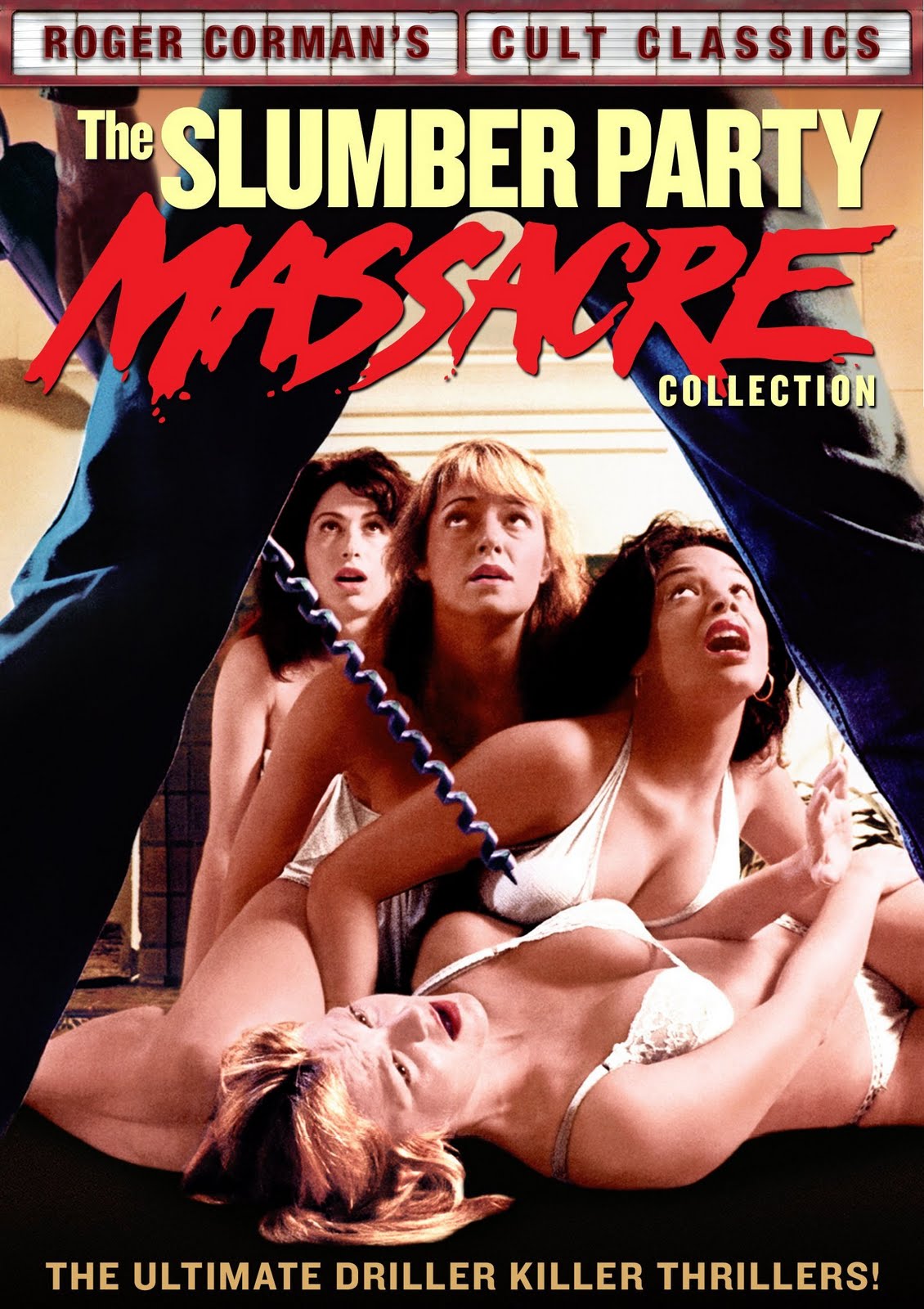
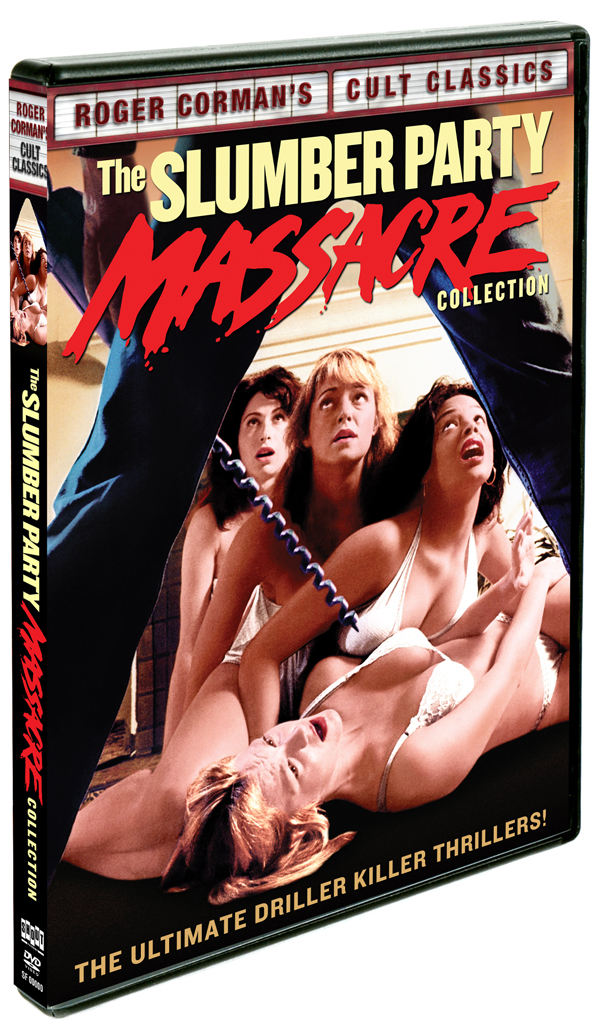
Like the other pics in this soon-to-be-concluded little mini-round-up we’re doing here, Slumber Party Massacre II is available on a two-DVD set from Shout! Factory entitled, appropriately enough, “The Slumber Party Massacre Collection,” which is part of their larger “Roger Corman’s Cult Classics” series. It’s sporting a nicely-remastered widescreen transfer, has good 2.0 stereo sound, and there are extras aplenty including a fairly comprehensive little “making-of” featurette, a full-length commentary from writer/director Brock, a poster and still image gallery, the original theatrical trailer, some trailers for other flicks in this series, and a liner notes booklet by SPM historian Jason Paul Collum. While I may not consider this a great movie by any means, this is certainly a great DVD package.

Still,  ya know what? Flaws n’ all, I’d still go so far as to say that the film itself is at least worth a look. I do admire Brock for her willingness to break the mold and think outside of the usual slasher box. Her intentions for this flick strike me as being pretty solid, and as almost-innovative as her budget would allow for — she just fails in her execution. And let’s face it — a slasher movie that can’t execute properly is saddled with a problem it can never overcome.
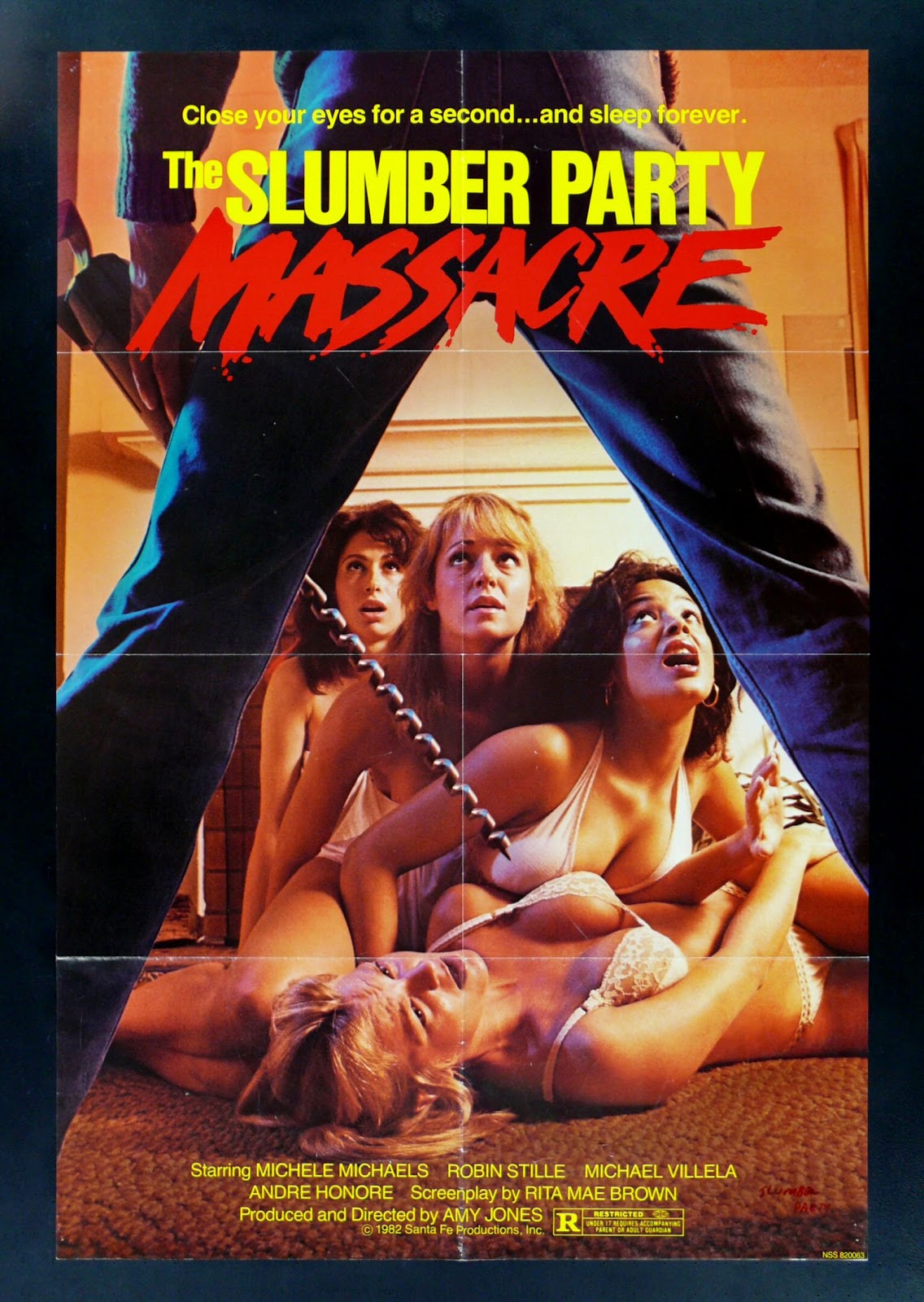
The SPM Trilogy Revisited : “The Slumber Party Massacre”


the film poster only features one actress actually in the film (Andre Honore)

Ah, the folly of youth. When we’re young, we’re so determined to prove we can “make it on our own” that we’ll turn our backs on opportunities that might serve us better in the long run just because they would mean answering to “The Man” in the short term. A hot-shot young chef (a nauseating demographic which our nation is currently, and quite literally, under absolute fucking assault from) will bypass the chance to apprentice under a master of his craft in a popular and established kitchen in order to go start up his own restaurant that will be lucky to last out the year. A promising young journalist will eschew the opportunity to work as a “beat” reporter on a local paper in order to start up a “cutting edge” news website with “attitude” that folds when they can’t get any advertisers. A way-too-full-of-himself young lawyer will say “no thanks” to a “lesser” offer from a major, established firm in order to start his own personal injury practice before realizing that there are already 10,000 other guys in town doing the exact same thing. There’s no doubt about it, my friends — we don’t know jack shit when we’re young, but we know we know better than anybody else.

All of which is to say, I guess, a couple of things : one, that I’m older and wiser now and will gladly give up the “freedom” and “total control” I have over my own website in less than a goddamn heartbeat in order to go work for somebody who actually pays me to write this shit; and two, that back in 1982 a semi-recent USC film school grad named Amy Holden Jones, who was considered something of an up-and-comer behind the camera in Hollywood at the time, turned down the chance to be Steven Spielberg’s cinematographer on a little something called E.T. in order to directmuch littler something for Roger Corman called The Slumber Party Massacre.

I’m sure she’s not kicking herself too badly over that decision today.

spm_za

Corman, of course, as he always seemed to, had an angle figured with this one, as well — in order to deflect, or at least try to deflect, some of the rampant feminist criticism that was just starting to be directed at the “slasher” genre back then, he’d take the  largely (okay, entirely) symbolic step of hiring women to both direct (Jones) and script (Rita Mae Brown) his latest girls-take-off-their-shirts-and-get-butchered-for-being -“slutty” opus, therefore “proving” that he, himself, had no problem with the fairer sex —only his movies did.

To their credit, both Jones and Brown obviously knew full well what they were getting into here (hell, how could you not?) and decided to play the whole thing up for all it was worth by indulging in blatant self-parody at more or less every turn. Their escaped-from-the-loony-bin killer, one Russ Thorne (Michael Villella) is given essentially no motivation whatsoever and goes after his victims with the most overtly phallic power drill ever conceived of; he’s thrust into the middle of a high school all-girls’ basketball team slumber party (hence, ya know, the title) by the most contrived set of circumstances possible; and every one of the nubile young targets of his kill-spree is a paper-thin, less-than-two-dimensional cipher rather than being anything like an actual, proper character.

slumberpartym4

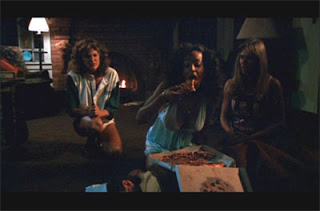
As far as any kind of plot synopsis goes, that’s probably all you really need here, if not more — after all, you know the drill (sorry!), right? The party’s hostess, Trish (Michelle Michaels), despite being listed first in the credits, isn’t gonna be the last girl standing (or limping, or writhing, or crawling), that honor goes to picked-on-for-being-aloof-quiet-and-too-much-better-at-basketball-than-the-others (she’s even a new girl at school, to boot! How many different ways can you say “virgin” without just blurting it out?) Valerie (Robin Stille). All the proceedings here follow the typical cut-and-dried formula more or less to a “T,” with a heavy dose of self-awareness being basically the only wrinkle added into the mix, apart from “keep your eyes open for an early turn by future ‘scream queen’ semi-star Brinke Stevens.”

None of which is to say that I didn’t enjoy The Slumber Party Massacre — the fact of the matter is, this one of those flicks that I always kinda turn to when I want to turn my brain off. It’s solid, if unspectacular, tongue-in-cheek fun, leaves a pleasant-enough grin on your face, and keeps you reasonably involved for its brief-but-just-right-all-things-considered 77-minute run time. If ol’ Russ was as smart and efficient at his job as Holden was at hers, he might still be running around sticking his power drill in high school girls today. And yeah, I realize that last sentence sounded every bit as unsubtle as this movie is, that was kinda the — errrmmm — point (damn! Just can’t help myself).

Slumber Party Massacre 12

Being that this movie and its two sequels (part two being even more OTT farcical than this one, part three being something of a “back-to-basics” straight-to-video affair) have a semi-sizable cult following, Shout! Factory made the wise decision to release ’em all together in one collection on (two-disc) DVD and (single-disc) Blu-Ray. Since I’ll be going to the “effort” of reviewing ’em all here in the next few days, I’ll just take it one at a time with the technical specs and extras. The Slumber Party Massacre is presented in a 1.78:1 widescreen remastered transfer that looks pretty damn stunning, and the remastered mono sound is perfectly serviceable, as well. There’s a really good little “making-of” featurette included , a photo still and poster artwork gallery, and director Jones is on hand for a full-length commentary track. The original theatrical trailer, a smattering of trailers for other titles in the “Roger Corman’s Cult Classics” series, and a solid set of liner notes by Jason Paul Collum round out the package.

spm-new

If you don’t have the time, money, or inclination to break new ground — and let’s face it, Roger Corman never had any of the above — you could do a lot worse than to tread the same ol’ familiar territory with a little bit of style, self-deprecating wit, and a quick little wink to the audience. The Slumber Party Massacre certainly delivers on each of those counts, and while I’ll never be fully on board with those who view this thing as some sort of “classic,” it’s definitely a good — if thoroughly predictable — time.

I’m older and wiser now, remember?  I’m perfectly happy to take what I can get.

Tag It And Bag It : “Toe Tags”


toe-tags

A few weeks back, Lisa Marie blamed/credited me for the fact that she even watched, let alone reviewed, director/star/editor/cinematographer Darla Enlow’s 2003 shot-on-video, direct-to-DVD 68-minute opus Toe Tags, so I’m returning the — ahem! — favor by blaming/crediting her for the fact that I’m gonna do the same thing (well, I say “gonna do” only as it applies to reviewing this flick, since I first watched it several months ago, then gave it a second look last night). See, I kinda think it would be amusing to make Through The Shattered Lens the only site on the entire internet with two different reviews of this movie. Granted, I haven’t checked every single website in the entire universe to make sure this claim holds water, but it’s a pretty safe bet, since I doubt that more than a few hundred people have even seen this thing — and most of them were probably either friends with, or related to, somebody who had something to do with its production.

Shot for around $30,000 in Tulsa, Oklahoma — where SOV slashers got their start with Blood Cult way back in 1985 — the “action” in this film centers around a series of murders at the supposedly high-end Valley Creek apartment complex, where the dynamic police duo of Detectives Mark Weiss (Marc Page) and Kate Wagner (Enlow) are investigating a grisly series of slayings, with a twist — every corpse that comes into the morgue by way of Valley Creek ends up with its titular toe tag going missing somewhere along the way.

Cops

One thing that really stands out here : the movie was quite obviously all shot in the same apartment complex, with one notable exception —- it’s evident that the landlady’s supposed “apartment” is actually an honest-to-God house and is located elsewhere. So that leaves us with a rather incongruous bit of easily-noticeable movie less-than-magic — while the “police station” where a good chunk of this story takes place is almost without question an office in an apartment complex, the supposed headquarters of the actual  apartment complex is not in the apartment complex! Hey, when ya only got 30 grand ta play around with, ya do what ya can.

Enlow doesn’t have much eye for style or perspective when it comes to the camera work, but I do give her points for at least trying to do something more other than simple point-and-shoot stuff, even if her attempts are largely failures, and she’s definitely to be lauded for managing to convince a steady stream of generally pretty attractive women to drop their tops in front of her camera for probably little to no money, but beyond that Toe Tags doesn’t really stand out in any way, shape, or form. The script, by one John Overbey (about the only thing Enlow didn’t do herself when it comes to this flick is write it), takes a pretty straightforward story and messes it up by heaping a bunch of ex-love-interest drama on both of the cops (it turns out they had both been sleeping with separate victims of the killer previously — and Kate makes it clear to Mark that she’s fair game if he feels like taking a crack at her during their off-hours) and having some seriously unconventional, if not downright illegal, police procedural shit towards the end when the captain thinks he’s got the identity of the murderer sussed out, so be prepared to suspend your disbelief beyond its usual, already-stretched-thin levels for this one. As for the “twist” finale, well — you’ll not only see it coming a mile away, but it’s waving its arms in the air, wearing a helmet with a flashing light on it, and setting off road flares.

Peripheral

On the splatter front (hey, admit it, that’s pretty much what you’re watching a movie like this for, apart from the tits), Enlow and her shoestring crew do a pretty nice job with the gore EFX all told, and considering the whole thing runs barely over an hour, the body count is fairly impressive. My best guess is that most of the budget for this one was consumed in an effort to make the numerous murders look reasonably realistic, and by and large it pays off, so hey — credit where it’s due.

MV5BMTI4NjMzNzgwOV5BMl5BanBnXkFtZTcwNTkxOTIzMQ@@._V1_SY317_CR5,0,214,317_

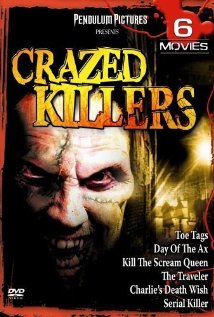
Toe Tags is available either as a stand-alone DVD from Brain Damage Films (as pictured at the outset of this review), which probably contains a fair amount of extras (assuming you actually want  to know more about how this was made), or you can see it like I did, as part of the “Crazed Killers” six-movie, two-disc set from Mill Creek’s sub-label specializing in microbudget/ homemade horrors, Pendulum Pictures. It’s presented full frame with stereo sound, both of which are unspectacular but perfectly adequate considering (which probably isn’t such a bad overall description of the film itself).

The folks who made Toe Tags obviously had a pretty good time with the whole thing, at least if the rather self-indulgent little “blooper reel” that plays during the end credits is any indication (without it the film would clock in under an hour), and I’m glad they enjoyed themselves — I just wish I had as much fun watching it as they did acting in, shooting, and directing it. I’ve certainly seen far worse fare on these Pendulum compilation discs, but often the clunkers are so bad as to be truly memorable, even if for all the wrong reasons. This one just kind of comes on your screen, tries to do its job, and calls it a day. It doesn’t make a mess of you home while it’s in it (like, say, its disc-mate Las Vegas Bloodbath), but it’s not the kind of interesting, unpredictable guest you’re likely to invite around again.

I appreciate all the effort and energy Enlow put into just getting this thing made, and she’s certainly to be commended for that alone as well as for busting her tail to make the financial pittance she had to work with go farther than it probably had any right to, but at the end of the day, the Toe Tags title is an appropriate one — this flick is dead on arrival.

Burn “The Wicker Tree”


Honestly, friends, sometimes a person just doesn’t even know where to begin. I suppose I could individually list the catalogue of atrocities that make up writer-director Robin Hardy’s The Wicker Tree, but frankly that would mean spending more time talking about this film than I really have the energy to, and besides, our nearest thing to a “star” critic here at Through The Shattered Lens, Lisa Marie Bowman, has already done a pretty damn fine job of performing a blow-by-blow dissection of this thing’s rotted corpse in her capacity as occasional scribe over at HorrorCritic.com, so there’s no real need to duplicate what’s been done before. Allow and/or indulge me, then, as I take a slightly different tack and document my personal journey of despair with Hardy’s exercise in highly confused pointlessness.

To begin with, I should point out that the original Wicker Man is quite likely one of my ten-or-so all-time favorite films. Critics who say it’s “not actually a horror movie” are quite right, of course — it’s a unique — hell, frankly singular — amalgamation of so many different styles that the end product is well and truly unclassifiable. Part horror flick, sure, but also part musical, part (very) black comedy, part clash-of-cultures melodrama, part satire on Christian piousness, and part period-piece-albeit-in-a-then-contemporary-setting, it stands on its own as the only thing quite like it ever made. Screenwriter Anthony Shaffer perhaps put it best when he stated that his main goal was to pen a meditation on the nature of sacrifice, and everything else just sort of took off from there.

Obviously, there are so many elements about the first film that the 2011 “thematic sequel” could never hope to duplicate — songwriter Paul Giovanni is no longer with us, so right off the bat we know the music’s not going to be nearly as good because, quite frankly, it can’t be. Anthony Shaffer has passed away and therefore whatever follow-up material comes about wouldn’t in any way be his vision for how the story could or should  continue. Edward Woodward has likewise left behind this mortal coil, and his character died at the end anyway, so replicating his magnificently anally-retentive performance is probably going to prove to be out of the question, as well.  Christopher Lee is, while still awesome as hell,  also extremely frail and old at this point. And anyway — The Wicker Man still retains all its poignancy and power to this day and has only gained luster over the past 40 years. The abominable Nicolas Cage/Neil LaBute remake proved that revisiting the material was a lost cause, so why bother, five years on from that failed experiment,  with any sort of a sequel, “thematic” or otherwise?

Unfortunately, Robin Hardy wrote a book some years back called Cowboys For Christ that updated some of the concepts from his earlier film and he got the notion that it would make a decent-enough little flick. He was able to scour up $7 million-plus worth of financing, and got the folks at Anchor Bay so interested they promised not only a widespread “home viewing platform” release (and I caught this on a free screener copy that was sent my way so therefore can’t fairly comment on any extras the DVD and Blu-Ray might contain), but a even a little theatrical run, as well. It never made it to my area, and disappeared after a week from the markets it did make it into, but still —the fact that they chose to give this thing some theatrical burn when it seemingly had DTV written all over it was enough for me to, foolishly, get my hopes up.

I guess we believe what we want to believe (which is rather one of the points of the first film, after all), and a steady stream of reviews for this one that placed it at the “embarrassingly bad” end of the spectrum at worst to “maybe not quite as horrible as I’d been fearing but still pretty goddamn awful” at best weren’t enough to dampen my enthusiasm at this point. I figured it just had to be better than most folks were giving it credit for, because there’s just no conceivable way it couldn’t retain, say, at least 1/100th of the darkly charismatic charm of the first film, even if entirely by accident, right? After all, the original director was on board, and Anchor Bay wasn’t so ashamed of his finished product that they tried to hide the thing away at the bottom of some film vault (although given that it’s shot on HD, perhaps a “film” vault wouldn’t be the right place to stick it in, anyway).

It’s certainly fair to say that I wasn’t expecting greatness, or even anything of the sort, but something that still somehow cleaved to even a miniscule fraction of the spirit of the original would have been good enough for me. Unfortunately, what I got was a story about two painfully stereotypical Jesus-lovin’ Texas yokels who have gone on a mission (more typical of Mormons than of born-againers, it must be said) to evangelize in some small Scottish town that apparently has never heard the “good news.” One of our less-than-convincingly-portrayed country bumpkins, Beth Boothby (Brittania Nicol), was apparently a famous country singer with something of a “reputation” before turning her life over to Christ, while the other, her fiancee Steve Thomson (Henry Garrett), is little more just a walking, talking cowboy hat. Once in the “heathen land” of Scotland,  they enjoy the decidedly non-Southern hospitality of local nuke plant owner Sir Lachlan Morrison (Graham McTavish, in something more akin to a respectable performance than his colleagues seem capable of) and his OTT-in-the-deception-deaprtment wife, Delia (Jacqueline Leonard), but of course the dastardly couple, whose power plant has through some unexplained (and probably inexplicable, so it’s just as well Hardy doesn’t even try) means left the entire town sterile, have other plans for their simple-minded God-fearin’ visitors, plans that the Texas two-steppers are apparently too stupid to suss out even as they’re practically being openly prepared for the burning stake and, get this, the dinner table!

Yes, evidently the heathen folk of the United Kingdom’s northern reaches have taken to cannibalism in the four decades or so since our last visit, and while Hardy seems to think this somehow ups the “black comedy” factor of the proceedings, really it just serves as a cop-out by more clearly delineating who are the “good guys” here and who are the “bad guys,” a simple-minded, black-and-white approach that the first Wicker Man never resorted to even when Sgt. Howie was being burned alive (in, it must be said, one of the most visually dramatic sequences ever committed to celluloid).

And that’s a pretty much the problem at the crux of The Wicker Tree in a nutshell — sure, there are numerous and obvious others, ranging from wretched acting to dully-executed visuals to poor pacing to obvious run-time padding to inarticulate (at best) dialogue to recycled-into-a-less-involving-context story ideas to laughably one-dimensional caricatures standing in place of real, actual characters — but at the end of the day, it’s Hardy’s mistrust of his audience’s ability to make up our own collective mind, and the blatantly heavy-handed approach he takes in explaining everything for us that stems from that mistrust, that makes this such a condescending failure. I could live with the far-less-subtle approach to the “clash of cultures” theme that he takes here in comparison with the first film. I could live with the nowhere-near-as-compelling music. I could live with the rather — uhmmm — “broad strokes” with which he paints each and every character . I could live with the pointless and frankly even a bit insulting to the guy Christopher Lee cameo. Hell, I could even live with the Christian turning the tables on her pagan pursuers and winning in the end. But what I absolutely can’t abide is that Hardy thinks we’re all so unsophisticated and beneath the task of understanding his apparently-in-his-mind-quite-complex-and-challenging-themes that we need for him to hammer them home with a with a burning wicker stake through our heads. He’s had 40 years to think about how he wants to follow up a genuine, justly-lauded classic and this is what he comes up with? Set fire to me now, please, before the third installment, which he’s already working on, ever sees the light of day.

Grindhouse Classics : “She Freak”


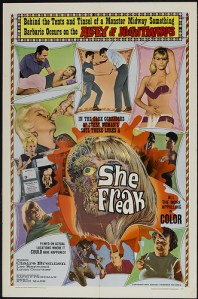
Okay, so it’s not Herschell Gordon Lewis — but 1967’s She Freak is pretty close, at least in terms of style and tone (if not gore content — the only blood on display here is in a very brief screwdriver-through-the-hand moment that frankly isn’t even nauseating) , and why shouldn’t it be? After all, it’s the “brain”child of HGL’s old producing partner, the legendary David F. Friedman, and definitely has a Lewis-like bizarre-on-a-budget sensibility. Oh, and it’s also available on DVD from Something Weird Video (nice full-frame transfer, acceptable mono sound, extras include a feature-length Friedman commentary, a gallery of exploitation art, some SWV trailers, a couple of tangentially-related shorts, etc.), the label that handles more or less all of our guy Herschell’s stuff, so — yeah, there are some similarities, to be sure.

Unfortunately, it’s even closer to Tod Browning’s seminal exploitation classic Freaks — not that there’s anything wrong with Freaks, mind you, and if you’re gonna rip something off  I suppose you might as well rip off one of the all-time greats, but anyway, read on and my use of the term “unfortunately” will, hopefully, make sense. In point of fact,  to call She Freak a rip-off is probably being a little too harsh, since even though it pretty much tells the exact same story as Freaks, it does so from the point of view of the gold-digging damsel rather than her victim. So maybe it’s more a case of an inverse carbon-copy. Which still means it’s nothing too earth-shatteringly original, but I digress.

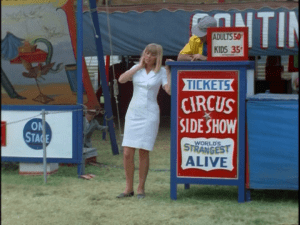
Our story here revolves around one Jade Cochran (Claire Brennen, who bears a rather uncanny resemblance to latter-day Russ Meyer starlet Pandora Peaks minus the surgical — uhhhmmm — “enhancements”), a simple country girl who commits the cardinal exploitation movie sin of wanting something better out of life (of all the nerve!), and isn’t afraid to step on a few toes on her climb to what passes for “the top” in her admittedly limited worldview. At the outset of our little shot-around-Bakersfield-for-$65,000 morality play, Jade’s slinging hash as a waitress at the greasiest of greasy-spoon diners, but when an advance man for a traveling carnival comes though one day, she has the temerity to ask him if there’s any work for a gal with no experience,no skills, no education, but a pretty nice pair of legs in his merry troupe. He tells her to stop by and see the owner of the show after they get the tents set up, she tells her lecherous married creep of a boss to go to shove it (granted, after he fires her first and tells her she’s headed straight to hell — he’s a real charmer, this guy) and the next day she shows up at the box office and quickly finds herself employed — as a waitress (again) at the carnival snack truck. Step one on the road to world domination achieved, I guess.

It’s not long,  though, before our gal Jade really does start her hardscrabble climb up the carnival ladder. First she gets in good with a gal named “Moon” Mullins (Lynn Courtney), the closest thing to a stripper the show employs. “Moon” makes Jade the kindly offer of letting her shack up with her in her motel room while she’s in town, and before you know it Jade’s pestering her for the names of any single men with potential attached to the show. Jade’s already taken a liking to a fella named Blackie Fleming (Lee Raymond), who runs the Ferris wheel, but “Moon” lets her know there’s no future in getting mixed up with lowly ride operators and suggests that Jade should set her sights on Steve St. John (Bill McKinney), the well-to-do widower who owns the freak show — why, he’s even got a house in Tampa!

Jade takes her gal-pal up on her advice and soon begins courting her prey  over coffee and donuts every morning at the snack truck. Cut to a montage of rather listless-looking dates than play out sans dialogue and show our supposed lovebirds going out to dinner, riding around town in his car, and walking around the carnival a whole hell of a lot (when you add in all the extraneous footage of carnival set-up and tear-down activities also included in this flick — hey, Friedman had an “in” with a carny operator and wanted to get his money’s worth — you begin to see why even at a slim 83 minutes plenty of people refer to it as being “padded”) and presto!, before you know it,Ms. Cochran is now Mrs. St. John.

There are, however, a couple of pesky problems she can’t seem to run away from. One is the freaks themselves. We never actually see any of them (until the very end, and I’m sorry to report there’s not a real “freak” in the bunch — they’re all extras in makeup and cheap prosthetics), apart from a garden-variety midget named — amazingly enough — Shorty (Felix Silla),  who seems to have a penchant for following his boss’s new lady-love around, but she makes it clear that she can’t stand the sight of them and that they creep her the hell out. Steve indulges in some painfully wooden dialogue about how they’re his friends, they’re people just like you and me, he’s not exploiting them he’s giving them a chance, etc., but it’s no use. She just doesn’t care for their kind.

Her second (and larger) problem, though, his Blackie. He gives it to Jade rough-and-ready and that’s just how she likes it. In fact, she can’t seem to keep away from the guy. One night the always-underfoot Shorty spies her sneaking out of Blackie’s trailer, and when he tells his best-friend/boss about it, all he gets is a slap in the fact for his trouble. Yes, it appears as though Steve’s truly got rose-tinted glasses on when it comes to looking at his new bride, but when he gets “home” to their motel room (we never do get to see that palatial Tampa estate) and finds Blackie on his way out the door and Jade with a big smile on her face, he knows he’s been had. A fight ensues, Steve gets stabbed, Jade stands above him without lifting a finger to help and then turns her back on him as he dies, Blackie flees into the night,  is caught by the cops, confesses, and goes to jail —and now the freak show is Jade’s property, free and clear.

For the next five minutes or so we see Jade in her new incarnation as super-bitch of the midway — she drives her big Cadillac around recklessly, tells “Moon” to take a hike, spends a lot of time counting her money — and fires poor old Shorty. Which proves, of course, to be her undoing, as Shorty and his fellow losers in the genetic lottery surround her as she’s getting into her car one night, brandishing knives and torches one and all, close ranks around her terrified and convulsing body, and move in for — well, not the kill. To be honest, I have no idea exactly what they do to her, but she ends up like this —

And needless to say, for a gal that got to where she is on her looks, that’s gotta be a career-killer. To complete the homage (how’s that for being polite about it?) to Browning’s earlier film, the whole story is presented between two framing sequences featuring a carnival barker who tells his audience of gasping onlookers (and us) at the beginning that there are two kinds of freaks, those created by God and those made by man , and then we return to hear the end of his spiel before the big “reveal” finale showing us Jade as she is today (or as she was in 1967, at any rate). All in all it’s not a half-bad little time-waster as far as completely derivative and frankly unnecessary “uncredited remakes” go, and Brennen, who was actually a pretty good actress in her day (sadly, she passed away at a fairly early age from cancer in 1977) turns in a deliciously slow-burn-sinister starring turn as Jade that she clearly relishes every second of, but if you’ve seen Freaks then you’ve seen this done a)before, b)better, and c) with real circus “freak” performers.

Still, since the entire exploitation movie business was literally born as a traveling roadshow racket molded on the carny model, it’s nice to see drive-in fare that openly pays tribute to its roots like this one does. And I really shouldn’t do this, but — since exploitation’s the name of the game here, I think it only fitting that I end this whole thing by repeating a particularly salacious rumor that’s been circulating around the internet for some time now : apparently it was revealed shortly after Brennen’s death that she had secretly been seeing Felix “Shorty” Silla on the side for nine years and even bore his child! I have no idea if this is true or just another tinseltown tall tale, but it seems strangely natural that a movie like this would give birth to such a, well — freakish legend, and just think : if She Freak itself were half as interesting as this bit of gossip, it would definitely be remembered as an all-time classic!

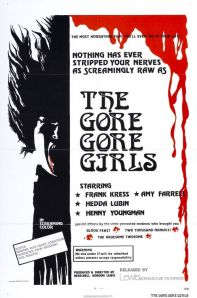
Grindhouse Classics : “The Gore Gore Girls”


Just when you thought the coast was clear, I’m back with more Herschell Gordon Lewis! Between this little haphazard Lewis retrospective Lisa Marie Bowman and I are indulging in, and her exhaustively thorough, and highly readable, Friday The 13th series of recent days, Through The Shattered Lens is really becoming a gore-hound’s delight these days, isn’t it? Hell, even the music reviews around here lately have a bombastic and violent theme to them — Bathory? Hell, I’m impressed — Quorthon’s “Viking trilogy” is my favorite period in Bathory history, truth be told, and Twilight Of The Gods my favorite Bathory album, even though my all-time favorite song of theirs, Blood, Fire, Death appears on the album — well, Blood, Fire, Death. But it’s waaaaaayyyy too early for me to be getting this hopelessly sidetracked, isn’t ? So let’s get back to our guy Herschell.

Having spent my last visit here examining the alpha of Lewis’ “gore cycle,” namely Blood Feast, I figure now would be as good a time as any to take a look at the omega (not just of his gore flicks but of his filmmaking career in general, at least until Blood Feast 2 came along about 30 years later, but we won’t pay any attention to that — nor should you), namely 1972’s The Gore Gore Girls. Somebody a whole lot wiser than I am (though I’m not sure exactly who — truth be told, it was probably several “somebodies”) once said “if you’re gonna go out, then go out with a bang,” and this movie certainly makes it clear that HGL took that advice to heart.

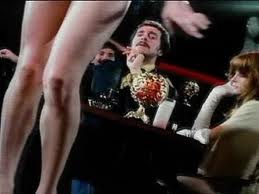
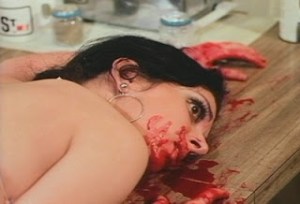
Even by Lewis “standards,” the plot for this one is pretty threadbare — go-go dancers at a local (in this case “local” being the Chicago area) strip joynt are being murdered in downright awesomely grotesque fashion — faces smashed to pulp in mirrors before their heads are dug into, buttocks beaten and — uhhhmmmm — tenderized with a meat mallet before having salt and pepper added to the impromptu (and quite rare, it must be said) “rump roast” for seasoning, nipples clipped off with scissors to reveal squirting biological fountains of both white and chocolate milk, heads shoved into deep-fat fryers — clearly, Herschell’s pulling out all the stops on his way out. And just as clearly, he’s well past the point of even pretending that he’s taking any of this shit seriously. Not that he ever put much effort into such  conceits in the first place, mind you,  but in the case of this film it’s especially fortunate that his tongue was so obviously placed firmly in his cheek, because it really does help to take the edge off what, on paper at least, seems like a truly OTT-in-the-misogyny-department series of murders ( a well-placed subplot involving a local feminist group helps to lessen the impact, as well — even though said group’s inclusion amounts to little more than a red herring plot-wise, the surprisingly level-headed portrayal of them by Lewis comes at least somewhat close to an admission on his part that feminist critics of his work were probably right ). Think of this as Herschell doing what he did best — giving gore-lovers more of what they wanted than they could possibly have hoped for, while not-so-tacitly admitting that it was all crap, anyway.

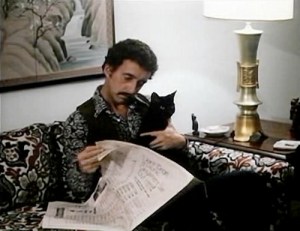
Anyway, back to the story — this was Lewis’ one and only attempt at injecting a bit of mystery into the proceedings, and doing their best to sleuth out the identity of the killer, without murdering each other first, are the truly odd couple of gungo-ho (but hopelessly incompetent) reporter Nancy Weston (Amy Farrell), and fancy-pants private eye Abraham gentry (Frank Kress, who absolutely sinks his teeth into the role of the — ahem! — sexually ambiguous version of Phillip Marlowe and is, in true Lewis fashion, playing the whole thing not just for laughs but for hearty, full-throttle belly laughs from start to finish). Throw in comedy legend Henny Youngman (who must have been broke or something) as the ridiculously fast-talking owner of the strip club the unfortunate victims worked at, and friends, you’ve got a recipe for a winner on your hands.

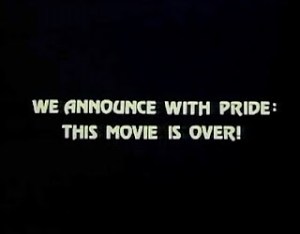
To be sure, you need a strong (hell, a cast-iron) stomach to make it through some of the death and dismemberment on display here (all of which looks pretty darn good on the Something Weird Video DVD release of this film — they did a very nice job remastering the full-frame picture, the mono sound is good, and extras include, of course, a commentary from Lewis and, doubly of course, the “Gallery of Herschell Gordon Lewis exploitation artwork”),  as the effects are, on the whole, somewhat-better-conceived than in the average HGL production, but there’s just no escaping the feeling of “the director’s not taking this whole thing too seriously, so why should I?” that permeates each and every frame of this film. It’s brutally honest in its intentions — “give the audience what they want one more time, rake up a bunch of money, and close the door behind me on the way out” is the best summation of Lewis’ aims here, and his willingness to have a few laughs as he says “thanks for the cash one more time, suckers” is just icing on the cake. Any movie that openly states that it’s proud that it’s over with (see the final screen cap below) is clearly imploring you to do anything other than take it seriously, and with that in mind, I gotta say, while The Gore Gore Girls falls absolutely flat in its attempt to wring anything like dramatic tension out of its poorly-thought-out (to be generous) murder-mystery premise, and while its absolutely appallingly brutal treatment of the female gender should be inexcusably offensive, and while it’s “fourth wall”-busting acting absolutely obliterates any chances the film might have had (not that it really wanted any) of being seen as anything other than a cash-in quickie, the fact is that it’s just about the most fun you can imagine having watching someone’s eyes being pulled out. And tits sliced off. And head deep-fried.

And that’s really the genius of Herschell Gordon Lewis in a nutshell, isn’t it? He could play you for a sucker, openly tell you that was exactly what he was doing, and make you chuckle at what a chump you were as you handed your money over to him anyway. God bless ya, Mr. Lewis — we could sure use more like you today. Thanks for this outrageous parting gift.


Grindhouse Classics : “Blood Feast”


Tell me, friends, have you ever had — AN EGYPTIAN FEAST?

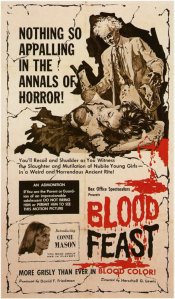
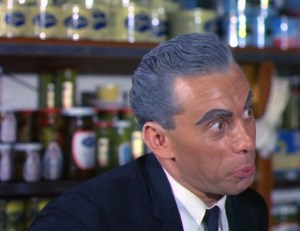
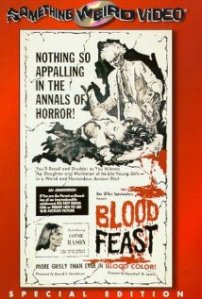
It doesn’t matter how you answer that question, the important thing is in how you ask it. You’ve gotta get all bug-eyed, swerve your neck outwards like a crane, and pause dramatically between  “hand” and “an” before raising your voice for the final three words. Then you, too, can look and sound just like Mal Arnold, the decidedly non-Egyptian “actor” (and I use that term loosely) who plays Egyptian serial-killer/caterer in director Herschell Gordon Lewis’ 1963 classic Blood Feast, and know that you’ll be faithfully imitating a slice of movie history.

And no, I don’t take the phrase “movie history” lightly — but in this case it most certainly applies. Which is not to say that Blood Feast is in any way a good film — heck, in many respects it isn’t even really a competent one (wait, didn’t I just refer to it as a “classic?” — bear with me, all will be explained), but for what it did, and when it did it, well — like it or not, it really does represent a couple of important firsts.


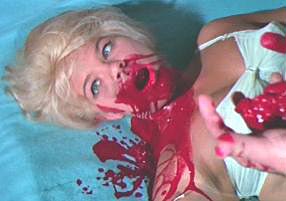
And speaking of firsts — first, a bit of a plot rundown, not that such a thing is really all that necessary. A nubile young female strips down to take a bath while listening to a radio report about a series of brutal, unsolved killings in her area. She gets naked, opens up a book called “Weird Ancient Religious Rituals,” lays back in the tub —and is hacked to pieces by a freaky-looking intruder of vaguely foreign appearance, who leaves what’s left of her to  slowly bleed to death while he makes of with her amputated leg.

Cut to the catering shop of one Fuad Ramses, the killer from the previous scene (no mystery here folks, sorry!), who is conversing with a customer, one Mrs. Dorothy Fremont (Lyn Bolton), who is planning a birthday dinner for her daughter, Suzette (eventual 1963 Playboy Playmate of the Year Connie Mason). Ramses suggests an Egyptian feast (hence our opening quote), and Mrs. Fremont agrees that would be a lovely idea given that her daughter is taking a night class on Egyptian history and culture.

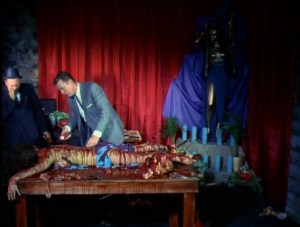
The cops, led by one Detective Pete Thornton ( Lewis regular William Kerwin, operating here under the pseudonym of “Thomas Wood”) are hot on the trail of the killer, of course. We’re informed that the “entire force” is working around the clock on tracking the psychopath down, and even though said “entire force” apparently consists of only two guys, they follow the leads they’ve got pretty well, and those leads —- uhhmmmm — lead them to the aforementioned Egyptian studies night class, where our good detective takes an instant liking to our Ms. Fremont The Younger. Of course, in between trying to make time with the wealthy young socialite, he’s still got a case to work, and a couple more bodies (of the female variety, naturally) pile up, one with its tongue removed, the other sans its brain (both shown in lovingly agonizing detail by Lewis, with the tongue scene especially being a standout for hardened gore-hounds to this day — and yes, the rumors are true, they used a sheep tongue procured from a local butcher shop), and of course both unfortunate ladies are connected with that apparently-cursed night-school class (which makes you wonder why everybody doesn’t just drop the course, but I digress).

Anyway, as events play out, clues finally lead the cops right to Ramses’ doorstep — or, more specifically, to the back room of his shop, where he’s got an impromptu shrine set up to the supposedly Egyptian goddess of death, Ishtar. The ever-enterprising Fuad is apparently attempting to serve up a bunch of body parts from different victims to people at the Fremont party as a cannibalistic sacrifice to his savage goddess  in order to facilitate her reincarnation upon the Earth into human form. Or something. And he’s got Suzette in mind as his final victim. Or to be Ishtar’s new human hostess. Or something.

I suppose none of it really matters because Fuad walks with a comically over-pronounced limp and isn’t gonna get too far once the cops show up (he makes it into the back of a garbage truck in his feeble escape attempt and is compacted therein, with Thornton intoning that he ended up exactly where he belonged because he’s nothing but human garbage anyway — whoops, sorry to give away the ending), and it’s not for its gripping and dramatic story that anyone cared — or, for that matter, still cares — about this movie anyway.

Nor, frankly, is it due its performances, most of which fall below even community theater standards,  that Blood Feast is still talked about to this day . Oh, sure, Arnold’s all kinds of fun if you can get past the blatant offensiveness inherent in the idea of a guy of course being a bloodthirsty maniac because he’s disabled, vaguely effeminate, and even — gasp! shudder! — an immigrant. He’s clearly playing the whole things for laughs (as is Lewis himself, for that matter), but the same charitable view really can’t be extended to the truly awful non-acting of Connie Mason, whose “talents” were best summarized by HGL when he famously said “I’ve often thought that if one took the key out of Connie’s back, that she’d simply stand still” — nor to Bolton, who, if anything, is even worse in her turns as Mason’s cinematic mother. Neither actress emotes in the slightest, nor are they aware enough of their own shortcomings to intentionally over-do things — they’re just basically reciting dialogue, and not even doing that very well.

So what does at leave us with? Why, surely the answer’s right in the title — blood, and lots of it (and specially-concocted blood at that — Lewis didn’t care for how any of the standard-at-the-time stage blood looked on camera, so he had a local Miami (like most of HGL’s flicks, this was lensed in the South Florida area) cosmetic company come up with a new blend just for this film that he would end up using on all his subsequent efforts — on the plus side it was entirely edible, on the minus side the base ingredient was Kaopectate) . And brains. And tongues. And entrails. And limbs. But mostly, just lots and lots — and lots! — of blood.

All of which is pretty much standard stuff these days, of course, but it certainly wasn’t back in 1963. This is well and truly the first “gore film,” and while that fact has been justly acknowledged by the horror community at large, what’s less talked about, but no less true, is the fact that Blood Feast is also the first modern slasher film. Oh, sure, Lewis and producer David F. Friedman make a big deal of pointing this out on numerous occasions on the occasionally-self-congratulatory-but-on-the-whole-pretty-lively-and-enthralling commentary track that accompanies this film’s DVD and Blu-Ray releases from Something Weird Video (it’s presented full frame with mono sound and also includes the standard “Gallery Of Herschell Gordon Lewis exploitation artwork” that all these come with), but for some reason the largely-self-appointed gatekeepers of horror-dom don’t seem to want to go there. It’s almost as if they’re willing to give Blood Feast some “props,” but not too many. You want us to admit you were the first gore flick? Fine. We can do that. But the first slasher? No way. We’ve gotta save that for a more “respectable” picture, thank you very much. It’s gotta be Halloween. Or Black Christmas. Or —

Well, folks, I’m here to call bullshit on that. Horror on the whole is already marginalized and ghetto-ized by the (again, largely self-appointed) arbiters of all that is right and good in “mainstream” cinema — to see the same thing done on a “micro” level within horror fandom itself as is done to the genre on a more “macro” level reeks of hypocrisy of the highest order. Let’s give Blood Feast its due. I’m not here to tell you it’s a great example of the slasher subgenre, or frankly even of the gore subgenre, but it did ’em both first, and everyone who came along later owes a debt of gratitude to what Lewis and Friedman did here, even if they didn’t necessarily do it all particularly well. Besides, numerous and readily-apparent flaws aside, this is good, solid, brainless fun. If more horror flicks were to put their various pretenses aside and just embrace the sense of good-time movie-making that Blood Feast positively revels in, maybe — just maybe — the genre as a whole wouldn’t find itself in the mess it’s in today. Just a thought.

Grindhouse Classics : “The Gruesome Twosome”


Ask most people what their favorite Herschell Gordon Lewis flick is, and the common answers you’re likely to hear will be either Blood Feast, 2,000 Maniacs, or  The Gore-Gore Girls, with the occasional vote for The Wizard Of Gore simply because it was mentioned in Juno, they saw it due to the fact that Diablo Cody gave it her “certified cool” stamp of approval, and they then proceeded to go no further in the “Godfather of Gore”‘s cinematic ouevre than that.

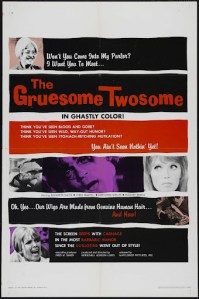
Fair enough. But for this armchair critic’s money, Lewis’ most fun — and most deranged (they usually go hand-in-hand with HGL) — work is 1967’s The Gruesome Twosome. The premise is pure genius, the humor is right up there at the forefront, and it’s as subtle as a hammer-blow to the forehead. What more could you possibly ask for?

Old Mrs. Pringle (Elizabeth Davis) is an eccentric yet hopelessly entrepreneurial senior citizen who runs not one, but two home-based businesses — a wig shop downstairs primarily catering to co-eds from the local college (yes, there was once a day when wigs were considered very hip fashion accessories by the under-65-and-without-cancer set), and a boarding house  upstairs that pretty much rents rooms solely to — those same co-eds from the local college. It doesn’t take a seasoned exploitation viewer like myself or unobtainium13 vet Lisa Marie Bowman (who you can either thank, or blame, for getting me to start contributing to this site) to figure out at this point why Mrs. Pringle’s wigs have such fine-quality, completely-realistic-feeling hair, does it?

Well, okay, in case you’re slow on the uptake,the not-so-good Mrs. P.’s demented full-grown son, Rodney (Chris Martell), is taking the girls into the back room of the shop, scalping them, and then killing them — thus ensuring that their “room for rent” sign never has to come down, and that they never run out of wigs. And this is almost always shown in loving, close-up, excruciating, far-less-than-realistic detail. Truth be told, although Lewis had taken something of an extended hiatus from the gore genre he basically started single-handedly  before returning to it with this film, he hadn’t been away so long that he forgot we wouldn’t have it any other way and he knew that his job was simply to deliver the goods. Sure, there’s a “plot” here of sorts — college student Kathy Baker (Gretchen Wells), a self-appointed “female James Bond,” starts doing the cops’ job for them and investigating the disappearances of all her classmates when one of her fellow residents of the all-girls’ dormitory doesn’t come home one night, much to the chagrin of her boyfriend, but as with any Lewis film, the payoff here comes primarily in the form of the ingenious set-up and the resultant heavy doses of viscera said set-up inevitably gives rise to — the rest is all filler.

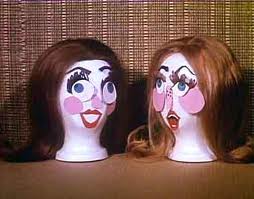
And it’s the quality of that filler that sets The Gruesome Twosome apart. Whether it’s the truly hysterical conversation between two styrofoam wig-form heads at the beginning of the film (a scenario Lewis had to improvise quickly on the fly to pad out the runtime to 70 minutes when the original opening scene was inadvertently destroyed, thus making it a genuine example of necessity being the accidental mother to genius), or the extended slapstick-style sequence where Kathy sics the cops on the poor German- immigrant gardener/handyman who works at the school who just likes to bury bones for his dog in his back yard, or Mrs. Pringle’s constant back-and-forth (in her mind, at any rate) dialogue with her stuffed bobcat, Napoleon, the downright clever nature of the padding in this film marks it as a cut above (pun only somewhat intended) its contemporaries.

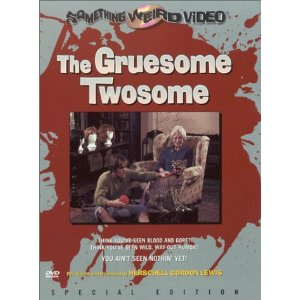
As is the case with pretty much every Herschell Gordon Lewis flick, The Gruesome Twosome is available on DVD from Something Weird Video in a “special edition” that features a remastered (and quite nice-looking) full-frame transfer, remastered mono sound, a full-length, and very entertaining, commentary track from Lewis himself, and the ubiquituous-on-these-things “Gallery of Herschell Gordon Lewis exploitation artwork.” Definitely an essential purchase either on its own or as part of the HGL box set that also contains A Taste Of Blood, She-Devils On Wheels, Something Weird, The Wizard Of Gore and The Gore-Gore Girls. If you haven’t got it, get it — and if you’ve got it already, there’s no such thing as a bad time to watch it again. Have fun — and don’t touch my hair.

The Lisa Marie Bowman Bad DVD Commentary Drinking Game


If there’s one thing that experienced film watchers like you and me know, it’s that a bad DVD commentary track can really be a traumatic experience.  There’s nothing worse than sitting down to watch your favorite film, turning on the commentary track, and discovering that the film was essentially made by a bunch of dullards.

Luckily, that’s why God created alcohol.

And, to help you through the trauma of it all, here’s the official rules to the Lisa Marie Bowman Bad DVD Commentary Track Drinking Game.

Director On A Commentary Track:

Take a drink anytime:

  1. The director claims that an unimpressive scene shot around a staircase is meant to be an homage to Battleship Potemkin.
  2. The director claims a poorly edited sequence is meant to be an homage to the French New Wave.
  3. The director cites Orson Welles as the reason he became a director.
  4. The director brags about fighting with the ratings boards.
  5. The director clearly cannot remember an actor’s name.
  6. The director says that a certain scene would have been better if he’d been allowed more time to film it.
  7. The director whines about how the movie was marketed.
  8. The director spends five minutes telling you how an obvious special effect was achieved.  Take another drink for each subsequent minute that he spends on it.
  9. The director claims that his main concern, while filming a sex scene, was to make sure the actress was comfortable.
  10. The director brags about ignoring the script while filming.
  11. The director claims that people still approach him and say that they love the mediocre film that you’re currently watching.

Actor On A Commentary Track:

Take a drink every time:

  1. The actor describes his acting technique as being “intuitive.”
  2. The actor brags about performing his own stunts.
  3. The actor describes a co-star as being “the most dedicated performer” he’s ever worked with.
  4. The actor admits to not being sure how he got his role.
  5. The actor says that he’d spent the night before filming a difficult scene getting either drunk or stoned.
  6. The actor claims that people in airports still shout lines from the film at him.

Actress On A Commentary Track:

Take a drink every time:

  1. The actress starts to nervously talk about everything but the film while her nude scene is currently playing out on-screen.  Or:
  2. The actress suddenly stops talking from the minute her nude scene begins until it ends.
  3. The actress makes it a point to loudly gasp every time there’s an act of violence on-screen.
  4. The actress claims to have voluntarily “taken time off to raise my family” after making the film you’re currently watching.
  5. The actress attempts to argue that the terribly exploitive movie you’re both watching is actually a celebration of “strong women.”

Producer On A Commentary Track:

Take a drink every time:

  1. The producer explains that he hired someone because “we had the same lawyer.”
  2. The producer spends five minutes detailing how he raised the money to make the movie.  Take another drink for each subsequent minute until the producer loses his train of thought.
  3. The producer spends five minutes detailing how he decided to market the film.  Take another drink for each subsequent minute until the producer loses his train of thought.
  4. The producer takes credit for a funny line, a good performance, or a well-executed shot.
  5. The producer starts a story with “There’s a funny story about that…”
  6. The “funny story” turns out to not be that funny.

Executive or Associate Producer On A Commentary Track:

Take a drink when the executive producer starts talking and then another one for each subsequent minute and just keep at it until the movie’s over.  Seriously, executive producers always offer up the most boring commentary imaginable.

Screenwriter On A Commentary Track:

Take a drink every time:

  1. The screenwriter spends 5 minutes telling his life story as opposed to commenting on anything happening on-screen.  Take another drink for each subsequent minute until he finally get back to the movie.
  2. Anytime the screenwriter admits that he essentially received credit for “rewriting” a spec script written by some younger writer who had to settle for a “story” co-credit.
  3. Anytime that the screenwriter describes the film as a “comment on” some faddish social or political issue.
  4. Anytime the screenwriter comments that a scene was in a different place in his original script.
  5. Anytime the screenwriter complains that a one-liner was ad libbed.
  6. Anytime the screenwriter spends five minutes on an anecdote about how he grew up in the streets and knows how to fight.  Take another drink for each subsequent minute of chest pounding.
  7. Anytime the screenwriter claims to have based the story on a personal experience that you’d rather not know about.
  8. Anytime the screenwriter says that his script was inspired by a Greek or Egyptian myth.
  9. Anytime the screenwriter claims the idea for the film came to him while at a spiritual retreat.
  10. Anytime the screenwriter brags about how he massively improved the source material in his version of the script.
  11. Anytime the screenwriter specifically drops the names of a famous person who has nothing to do with the film you’re watching.  Take another drink if the screenwriter refers to that famous person with a nickname — i.e., Marty Scorsese, Bobby Zemeckis, Steve Spielberg.
  12. Anytime the screenwriter says, “So-and-so called my agent and said it was the best script he’d ever read but it could still be better.”  Take another drink if the screenwriter starts to laugh in the middle of the word “better.”
  13. Anytime the screenwriter brags about getting paid to rewrite someone else’s script.
  14. Anytime the screenwriter mentions that he had to write quickly to make sure the script was done “before the strike started.”
  15. Anytime the screenwriter uses a big word in such a way that it’s obvious that he wants to make sure you understand that he’s a writer.

Film Critics or Historian On A Commentary Track:

Take a drink every time the critic spends 5 minutes explaining his own incoherent interpretation of what the film is actually supposed to be about.  Take a drink for each subsequent minute until the critic finally starts to make some sort of sense.  Expect to get drunk fairly quickly.

Anyone on the Commentary Track:

Take a drink every time:

  1. Somebody says, “And welcome to (insert name of movie here).”
  2. Somebody says that they are very excited to be there.
  3. Somebody says that they’re excited that the DVD release will now allow the movie to get the audience that it deserves.
  4. Somebody audibly sighs.
  5. Somebody makes a political comment.
  6. Somebody awkwardly lies, “I’d forgotten how good this film is.”
  7. Somebody admits that this is the first time they’ve ever actually sat through the entire film.
  8. Somebody says, “We couldn’t make this film today.”
  9. Somebody says, “I love this line,” at the exact moment that the line is being delivered, therefore keeping you from hearing the line that they supposedly love.
  10. Somebody admits to not remembering much about making the movie.
  11. Somebody says something in such a low voice that you can’t understand a word he or she just said.
  12. Somebody starts to laugh for no clear reason.
  13. Somebody spends up to five minutes talking about another film they’ve worked on, as opposed to the film that you’re currently watching.  Take another drink for each minute until they finally start talking about the film you’re watching again.
  14.  Five minutes go by without anyone saying anything.  Do another shot for each subsequent minute until someone finally says something.
  15. Somebody actually apologizes for the poor quality of the commentary track.
  16. Somebody says, “Thank you for watching this film with me.”

Film Reviews: The Airport Terminal Pack


 Sometimes, you have to be careful which films you choose to watch over the course of the day. 

Such as, last Friday night, I heard the news that Jill Clayburgh had died and I ended up watching An Unmarried Woman.  This, along with the fact that I also watched the Black Swan trailer, led to me dancing around the house in my underwear, en pointe in bare feet, and doing a half-assed pirouette in the living room.  And I felt pretty proud of myself until I woke up Saturday morning and my ankle (which I don’t think has ever properly healed from the day, seven years ago, that I fell down a flight of stairs and broke it in two places) literally felt like it was on fire.  That was my body’s way of saying, “You ain’t living in a movie, bitch.  Deal with it.”

So, come Sunday, I decided to play it safe by watching something that I was sure wouldn’t lead to any imitative behavior on my part.  Since I had previously reviewed Earthquake on this site, I decided that I would devote some time to the movies that started the entire 1970s disaster movie genre — Airport.  Watching Airport led to me watching Airport’s three sequels.

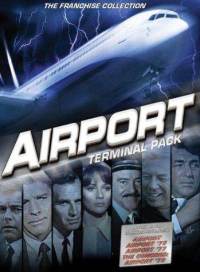
I was able to do this largely because I own the Airport Terminal Pack, a two-disk DVD collection that contains all four of the Airport films and nothing else.  There’s no special features or commentary tracks.  That’s probably a good thing because these films are so extremely mainstream that I doubt the commentary tracks would be all that interesting except to people who love “Me and Jennings Lang had the same lawyer…” style stories.

The movies are a mixed bag of ’70s sexism, mainstream greed, and casts that were described as being “all-star” despite the fact that they featured very few stars.  They’re all worth watching as time capsules of a past time.  Some of them are just more worthy than others.

Below are my thoughts on each individual film in the collection…

Airport (directed by George Seaton)

First released in 1970, Airport was nominated for 10 Academy Awards (including best picture), broke box office records, and started the whole 70s disaster movie trend.  It also has to be one of the most boring, borderline unwatchable movies ever made.  The fact that I managed to sit through the whole thing should be taken as proof that I’m either truly dedicated to watching movies or I’m just insane.  Take your pick.

Anyway, the film is painstakingly detailed account of the every day operations of an airport.  Yeah, sounds like a lot of fun, doesn’t it?  Burt Lancaster runs the airport.  His brother-in-law Dean Martin flies airplanes.  Both of them have mistresses but we’re told that’s okay because Lancaster’s wife expects him to talk to her and Martin’s wife is cool with him fucking around as long as he comes home at night.  I would be tempted to say that this is a result of the film having been made in 1969 and released in 1970 but actually, it’s just an introduction to the sexual politics of the typical disaster film.  Men save the day while women get in the way.  And if you think things have changed, I’d suggest you watch a little film calledf 2012

The only interesting thing about the film is that Lancaster’s mistress is played by Jean Seberg who, ten years earlier, had helped change film history by co-starring in Jean-Luc Godard’s classic film Breathless.  Nine years later, after years of being hounded by the American press and the FBI for her radical politics, Seberg committed suicide.

Airport 1975 (directed by Jack Smight)

As opposed to its predecessor, Airport 1975 is actually a lot of fun in its campy, silly way.  This is the one where a small private plane (flown by Dana Andrews, the star of the wonderful film noir Laura) collides with a commercial airliner.  The entire flight crew is taken out and head stewardess Karen Black has to pilot the plane despite the fact that she’s obviously cross-eyed.  Luckily, since Black is a stewardess, she has a pilot boyfriend who is played by Charlton Heston.  Heston talks her through the entire flight despite the fact that she was earlier seen trying to pressure him into not treating her like an idiot.  Anyway, Heston does his usual clench-jaw thing and if you need a drinking game to go with your bad movie, just take a shot every time Heston calls Black “honey.”  You’ll be drunk before the plane lands.

There’s some other stuff going on in this movie (for instance, Gloria Swanson appears as “herself” and doesn’t mention Sunset Boulevard or Joseph Kennedy once!) but really, all you need to know is that this is the film where Karen Black acts up a storm and random characters keep saying, “The stewardess is flying the plane!?”

Odd trivia fact: Airport 1975 was released in 1974.

Airport ’77 (directed by Jerry Jameson)

In Airport ’77, a group of art thieves attempt to hijack an airplane which, of course, leads to the airplane crashing into the ocean and somehow sinking down to the ocean’s floor without splitting apart.  The crash survivors have to try to figure out how to get to the surface of the water before they run out of oxygen. 

In this case, our resident sexist pilot is Jack Lemmon who has a really ugly mustache.  He wants to marry head stewardess Brenda Vaccarro.  Vaccarro doesn’t understand why they have to get married to which Lemmon responds, “Because I want a wife and kids!”  The film also gives us Lee Grant as a woman who is married to Christopher Lee but who is having an affair with another man.  She also drinks a lot and dares to get angry when she realizes that the airplane is underwater.  While this sort of behavior is acceptable from Dean Martin, Charlton Heston, and Jack Lemmon, the film punishes Lee Grant by drowning her in the final minutes.

Technically, Airport ’77 is probably the best of the Airport films.  The cast does a pretty good job with all the melodrama, the film doesn’t drag, and a few of the scenes manage to generate something resembling human emotion.  (For instance, when the blind piano player died, I had a tear in one of my freaky, mismatched eyes.)  Unfortunately, the movie’s almost too good.  It’s not a lot of fun.  Everyone plays their roles straight so the silly plot never quite descends into camp and the key to a good disaster film is always camp.  This film also has the largest body count of the series, with most of the cast dead by the end of the movie.  (And, incidentally, this film did nothing to help me with my fear of water…)

The Concorde: Airport ’79 (directed by David Lowell Rich)

The last Airport movie is also the strangest.  Some people have claimed that this film was meant to be a satire of the previous Airport films.  I can understand the argument because you look at film like Concorde and you say, “This must be a joke!”  However, the problem with this theory is that there are moments of obvious “intentional” humor in this film (i.e., J.J. from Good Times smokes weed in the plane’s bathroom, another passenger has to go to the bathroom whenever she gets nervous) and none of them show any evidence of the type of wit and outlook necessary to come up with anything this silly on purpose.  Add to that, the film’s story is credited to Jennings Lang, a studio executive.  Studio execs do not take chances.  (Plus, the actual script was written by Eric Roth, who went on to write the amazingly humorless The Curious Case of Benjamin Button).

No, this film is meant to be taken seriously and oh my God, where do I start?

Our pilots are George Kennedy and Alain Delon.  The head stewardess (and naturally, Delon’s girlfiend) is played by Sylvia “Emanuelle” Kristel who, at one point, says, “You pilots are such men!”  “Hey, they don’t call it a cockpit for nothing, honey,” Kennedy replies. 

Meanwhile, Robert Wagner is trying to destroy the Concorde because one of the passengers is his girlfriend who has proof that Wagner has been selling weapons to America’s enemies.  So, he attempts to blow the plane up with a guided missile and when that fails, he sends a couple of fighter planes after them.  Kennedy responds by opening up the cockpit window — while breaking the sound barrier mind you — and firing a flare gun at their pursuers.  

After this, there’s stop over in Paris where Delon arranges for Kennedy to sleep with a prostitute who assures Kennedy that he made love “just like a happy fish.”

The next day, everyone returns to the exact same Concorde — despite the fact that just a day earlier they’d nearly been blown up by a squadron of fighter planes — and take off on the second leg of the flight.  Let me repeat that just to make sure that we all understand what this film is asking us to believe.  After nearly getting blown up by a mysterious squad of fighter planes, everybody shows up the next morning to get on the exact same plane.

Oh, and it never occurs to Wagner’s ex-girlfriend that Wagner might have something to do with all of this.

Now sad to say, Concorde is the one of those films that’s a lot more fun to talk about than to actually watch.  It should be a lot more fun in its badness than it actually is.  Still, the movie has just enough camp appeal to make it fun in a “what the fuck…” sorta way.

And that’s how the Airport series comes to an end.