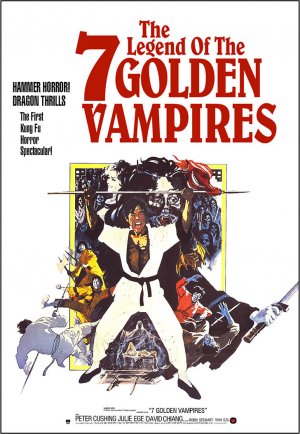
As some of our more frequent readers may remember, I shared the 1974 Dracula-martial arts hybrid The Legend of the 7 Golden Vampires as one of our horrors on the lens last October. Judging from the comments that I got last year, this was apparently one of the more popular films that we featured.
And why not? The film is one of those rather ludicrous movies that really could have only been made in the early 1970s. It combines two genres that really should not go together — martial arts and the Hammer Dracula series — and somehow, it all works. Don’t get me wrong. The film doesn’t make a bit of sense. I’ve seen it a few times and I still have a hard time following just what exactly is going on. But you don’t watch a film called The Legend of the 7 Golden Vampires for the plot. This is one of those movies that you watch for the style. Fortunately, The Legend of the 7 Golden Vampires is all about style.
The Legend of the 7 Golden Vampires is the final entry in Hammer’s Dracula series. Or, at least, it might be. It all depends on whether or not you consider 7 Golden Vampires to actually be a part of the series. I do but quite a few people don’t.
Why the controversy?
Well, first off, Christopher Lee does not appear in this film. Much as he did with Brides of Dracula, Lee read the script and announced that he would not be returning to play Dracula. Of course, when Lee refused to appear in Brides of Dracula, Hammer responded by creating an entirely new vampire for Prof. Van Helsing to battle. This time, however, they simply recast the role. An actor by the name of John Forbes-Robertson took on the role of Dracula and, unfortunately, he gave a rather bland and unmemorable performance. If Lee’s Dracula seemed to be motivated by rage, Forbes-Robertson is merely petulant.
The other issue that purists have with the film is that it violates the continuity of the previous Dracula films. The film opens in 1805 and features Dracula leaving his castle for China, where he will spend the next 100 years as the leader of the infamous 7 Golden Vampires. The problem with this, of course, is that there had already been 7 other films that established that Dracula spent the 19th Century going between England and Eastern Europe.
It would be easy to declare that 7 Golden Vampires has nothing to do with the other Hammer Films except for the fact that Peter Cushing returns of Prof. Van Helsing. When the film opens, Van Helsing is in China, lecturing to skeptical students about the legend of the 7 Golden Vampires. After one lecture, Van Helsing is approached by a man (David Chiang), who explains that the 7 Golden Vampires have been attacking his village. Van Helsing agrees to help the man vanquish the 7 Golden Vampires and, along the way to the village, he even tells some stories about his previous battles with Dracula.
So, here’s my theory. The Legend of the 7 Golden Vampires does take place in the same continuity as the Christopher Lee Dracula films but I do not believe that the vampire played by Forbes-Robertson is actually Dracula. I think he’s just an upstart who has claimed the infamous name while the actual Dracula is inconvenienced.
As for the film itself, it works far better than you might expect. At the time 7 Golden Vampires went into production, Hammer was struggling to survive with their once racy products now seen as being rather tame when compared to what other studios were releasing. 7 Golden Vampires was a co-production between Hammer and the Shaw Brothers, which means that the film was full all of the gothic trappings that I love about Hammer while also featuring all of the martial arts action that fans of the Shaw Brothers would have expected. It’s an odd combination that works exactly because it is so unexpected.
Finally, one word about the 7 Golden Vampires. Not only are they far more desiccated than the average Hammer vampire but whenever they ride up on their horses, they’re filmed in slow motion, just like the zombies from Amando De Ossorio’s Blind Dead films. As a result, those 7 Golden Vampires are pure nightmare fuel.
The Legend of the 7 Golden Vampires may have been the final entry in Hammer’s Dracula franchise but at least the series went out on a memorable note.
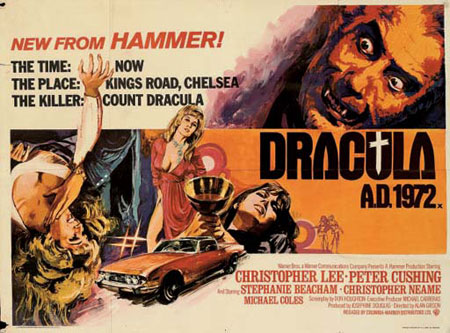
Dracula A.D. 1972 opens in 1872 with a genuinely exciting fight on a runaway carriage that ends with the death of both Count Dracula (Christopher Lee) and his nemesis, Prof. Van Helsing (Peter Cushing). However, as Van Helsing is buried, we see one of Dracula’s disciples (played by Christopher Neame, who had an appealingly off-kilter smile) burying Dracula’s ashes nearby. The camera pans up to the clear Victorian sky and, in a sudden and genuinely effective jumpcut, we suddenly see an airplane screeching across the sky.
Well, it’s all pretty much downhill from there. Suddenly, we discover that a hundred years have passed and we are now in “swinging” London. The city is full of red tourist buses, hippies wearing love beads, and upright policemen who always appear to be on the verge of saying, “What’s all this, then?” We are introduced to a group of hippies that are led by a creepy guy named Johnny Alculard (also played — quite well, actually — by Christopher Neame). One of those hippies (Stephanie Beacham) just happens to be the great-great-granddaughter of Prof. Van Helsing. Apparently, she’s not really big on the family history because she doesn’t notice that Alculard spells Dracula backwards. Then again, her father (played by Peter Cushing, of course) doesn’t either until he actually writes the name down a few times on a piece of a paper.
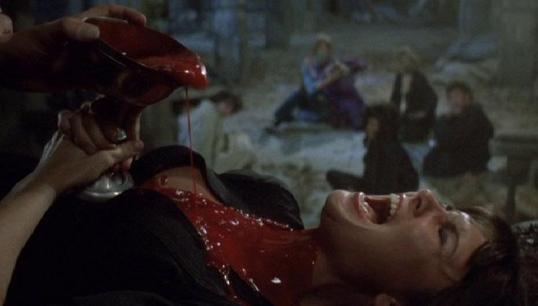
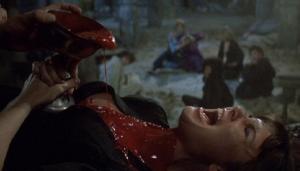
Anyway, the film meanders about a bit until finally, Alculard convinces all of his hippie friends to come take part in a black mass. “Sure, why not?” everyone replies. Well, I don’t have to tell you how things can sometimes get out-of-hand at black mass. In this case, Dracula comes back to life, kills a young Caroline Munro, and eventually turns Johnny into a vampire before then setting his sights on the modern-day Van Helsings.
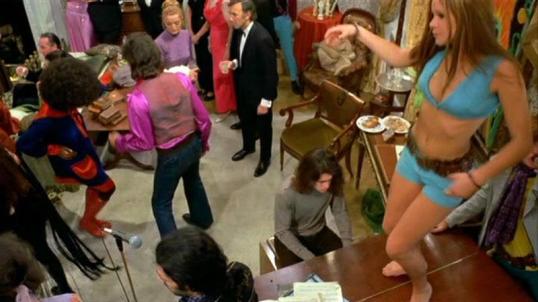
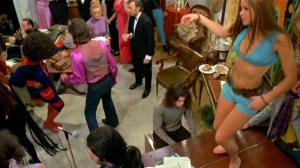
Dracula A.D. 1972 was Hammer’s attempt to breathe some new life into one of its oldest franchises and, as usually happens with a reboot, its critical and (especially) commercial failure ended up helping to end the series. Among even the most devoted and forgiving of Hammer fans, Dracula A.D. 1972 has a terrible reputation. Christopher Lee is on record as regarding it as his least favorite Dracula film. And the film definitely has some serious flaws. Once you get past the relatively exciting pre-credits sequence, the movie seriously drags. There’s a hippie party sequence that, honest to God, seems to last for about 5 hours. As for the hippies themselves, they are some of the least convincing middle-aged hippies in the history of fake hippies. You find yourself eagerly awaiting their demise, especially the awkward-looking one who — for some reason — is always dressed like a monk. (Those crazy hippies!) But yet…nothing happens. All the fake hippies simply vanish from the film. Yet, they’re so annoying in just a limited amount of screen time that the viewer is left demanding blood. Add to that, just how difficult is it to notice that Alculard is Dracula spelled backwards? I mean, seriously…
To a large extent, the charm of the old school Hammer films comes from the fact that they’re essentially very naughty but never truly decadent. At their heart, they were always very old-fashioned and actually quite conservative. The Hammer films — erudite yet campy, risqué yet repressed — mirrors the view that many of my fellow Americans have of the English. For some reason, however, that Hammer naughtiness only works when there’s the sound of hooves on cobblestone streets and when the screen is populated by actors in three-piece suits and actresses spilling out of corsets. Dracula A.D. 1972 did away with the support of the corset and as a result, the film is revealed as a formless mess with all the flab revealed to the world.
Still, the film isn’t quite as bad as you may have heard. First off, the film — with its middle-aged hippies — has a lot of camp appeal. It’s the type of film that, once its over, you’re convinced that the term “groovy” was uttered in every other scene even though it wasn’t. As with even the worst Hammer films, the film features a handful of striking images and Christopher Neame is surprisingly charismatic as Alculard.
As with the majority of the Hammer Dracula films, the film is enjoyable if just to watch the chemistry between Christopher Lee and Peter Cushing. Both of these actors — so very different in image but also so very stereotypically English — obviously loved acting opposite of each other and whenever you see them on-screen together, it’s difficult not to enjoy watching as each one tried to top the other with a smoldering glare or a melodramatic line reading. As actors, they brought out the best in each other, even when they were doing it in a film like Dracula A.D. 1972. In this film, Cushing is like the father you always you wished you had — the stern but loving one who protected you from all the world’s monsters (both real and cinematic).
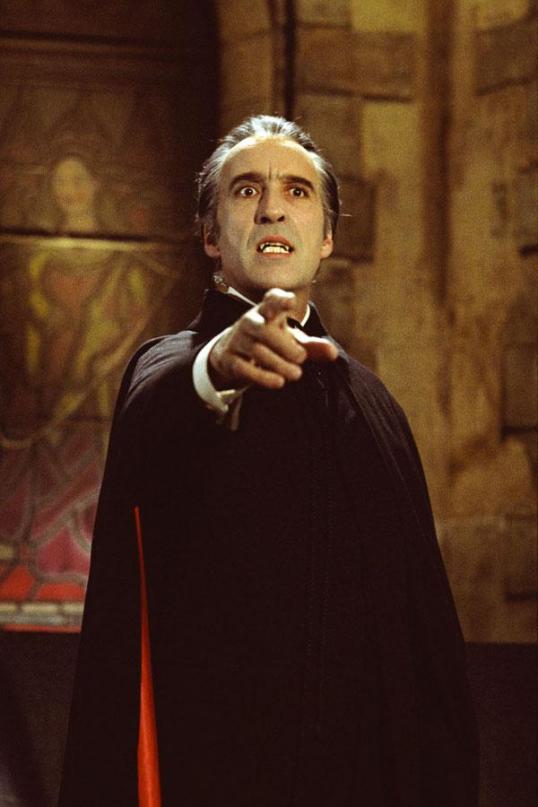
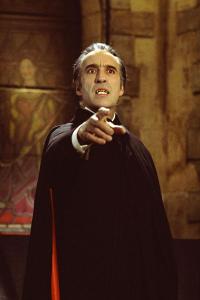
As for Lee, he’s only in six or seven scenes and he has even fewer lines but, since you spend the entire film wondering where he is, he actually dominates the entire movie. Lee apparently was quite contemptuous of the later Hammer Dracula films and, oddly enough, that obvious contempt is probably why, of all the Draculas there have been over the years, Lee’s version is the only one who was and is actually scary. F0rget all of that tortured soul and reluctant bloodsucker crap. Christopher Lee’s Dracula is obviously pissed off from the minute he first appears on-screen, the embodiment of pure destructive evil. And, for whatever odd reason, the purity of his evil brings a sexual jolt to his interpretation of Dracula that those littleTwilight vampires can only dream about. Even in a lesser films like Dracula A.D. 1972, Christopher Lee kicks some serious ass.
So, in conclusion, I really can’t call Dracula A.D. 1972 a good film nor can I really suggest that you should go out of your way to see it.. I mean, I love this stuff and I still frequently found my mind wandering whenever Cushing or Lee wasn’t on-screen. However, it’s not a terrible movie to watch if you happen to find yourself trapped in the house with 90 minutes to kill.
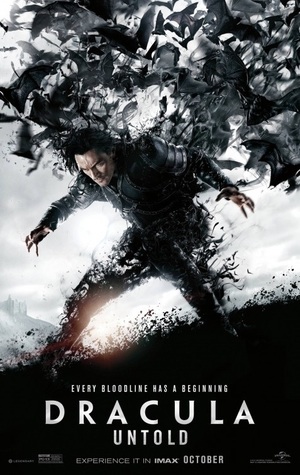
Last night, I finally got a chance to see Dracula Untold, the new film that claims to show us not only who the world’s most famous vampire used to be but also how he became a vampire in the first place. And I have to admit that I had strong hopes for Dracula Untold. I certainly did not think that it would be a great film but I was hoping that it would at least be fun.
And can you blame me?
After all, it is October and what better time of the year is there to see a film about the early days of a horror icon? Add to that, the film’s commercials all hinted that, at the very least, Dracula Untold would be full of over-the-top action, melodramatic performances, and ornate costumes. Sure, there was no hint to be found that Dracula Untold would actually turn out to be a good movie but how can you go wrong with the promise of a little baroque spectacle?
As well, who doesn’t love vampires? Who hasn’t, at some point, been intrigued by the mix of romance and morbid dread that epitomizes the vampire legend? And, of course, long before there was ever an Edward Cullen or a Lestat, there was Dracula.
So, yes, I had high expectation for Dracula Untold but I don’t think they were unrealistic. Ultimately, I was just hoping to see a fun and entertaining vampire film.
And, in all fairness, there were a few moments when Dracula Untold managed to be just that. Unfortunately, those moments were few and far between. For the most part, this latest Dracula film turned out to be rather bland and predictable, a well-produced film that failed to leave much of an impression. It was neither good enough to be memorable nor bad enough to be enjoyable. Instead, it just kind of was.
Dracula Untold opens in the Middle Ages, with the man that we know as Vlad the Impaler (Luke Evans) ruling Transylvania. Despite his fearsome reputation, we quickly see that Vlad is actually a very wise and benevolent king who truly loves his wife (Sarah Gadon) and his young son (Art Parkinson). However, when the new sultan of Turkey (played by Dominic Cooper) demands that Transylvania send him 100 young men to serve as slaves (much as Vlad himself was forced to do when he was younger), Vlad goes to war against the Ottomon Empire.
With his forces outnumbered, Vlad does what any self-respecting ruler would do. He goes to a cave and he talks to the Master Vampire (Charles Dance, under a ton of makeup). The Master Vampire agrees to give Vlad all the powers of a vampire but there’s a condition. In order to become human again, Vlad must go for three whole days without drinking any blood. If Vlad does drink blood, he will be cursed to be a vampire for the rest of his life.
Vlad takes the deal, fully intending not to drink any blood. As a result, Vlad can do all sorts of neat CGI tricks, like turning into a bat and fighting his enemies in slow motion. However, he can’t go out in the sun without his skin starting to burn and silver causes his eyesight to go all blurry. And, of course, he starts to crave blood almost immediately. As Vlad tries to defeat the Turks before losing his special powers, he also discovers that his own soldiers now fear him and his dark powers…
I don’t want to be too hard on Dracula Untold because, while my overall reaction was one of disappointment, there are still bits and pieces of the film that works. Charles Dance, for instance, gives a great performance as the Master Vampire. Dominic Cooper camps it up as the film’s nominal villain and, as a result, he’s a lot of fun to watch. Luke Evans is pretty to look at. The final showdown between Evans and Cooper is well-directed.
But, ultimately, the things that worked in Dracula Untold were the exception to the rule. For the most part, Dracula Untold is uninspiring and forgettable. Clocking in at 92 minutes, Dracula Untold is almost too short and quick for its own good. You never really find yourself becoming immersed in the film’s world and the majority of the film’s supporting characters were so thinly drawn that I struggled to keep straight who was who. (I swear, at first, it seemed as if one of Dracula’s friends was actually killed three separate times. It was only afterward, as I looked over the film’s credits, that I discovered that “friend” was actually three different characters who were so indistinguishable from each other that I had just naturally assumed that they were all meant to be the same guy.) There are occasionally hints of an intriguing political and sexual subtext, particularly in the scenes between Evans and Cooper, but the film is always in such a hurry to get to the next battle scene that those hints are often pushed to the side within minutes of having been brought up. It becomes obvious early on that Dracula Untold was mostly made to serve as the cornerstone of a new franchise and, as such, the film ultimately feels like a 90-minute prologue to a story that you’re not really sure will be worth all the build-up.
It’s not so much that Dracula Untold was a terrible film as much as it was just a painfully generic and predictable one. And a character as iconic as Dracula deserves better.
Two posts in one month? What sort of madness is this? Well, I’ve been drinking a lot, so makes sense that I should attempt to ramble here where I have free reign to do so. But never mind that, what’s important here is that in addition to my aforementioned Another, if you’re going to watch another horror anime this month, you should give serious consideration to Hellsing Ultimate.
Now, let’s be clear on one important fact. I’m talking about the OAV series, as opposed to the TV series which came out 3 years prior to the much better OAV series. The main problem with the TV series was that it came out when the manga was proving to be popular, however, Kouta Hirano was a very slow writer. In fact, the manga was only a 10 volume series, yet it ran from 1997 until 2008. For the math challenged among us, that’s 11 years to release 10 volumes of manga. To give you all a very relevant comparison, another series that I’ve wrote about, One Piece, also started in 1997. To date, One Piece has produced 67 volumes. Even if we say that Eiichiro Oda is a freak of nature, most normal mangaka would produce three times what Kouta Hirano did in the same amount of time. The point being that the original TV series came out early on in the run of the manga, so the ending has absolutely nothing like the manga. Now, the OAV series was able to take its time and wait on the source material. Hence, why I’m insisting that if you watch any Hellsing show, you should make it the OAV series. It’s much more faithful to the manga, and while that doesn’t mean the TV series is bad, when compared against the original it just doesn’t hold up.
So, the long and short of Hellsing is that vampires are real. Very real. So what is your average person to do against such a threat? Don’t expect your average army to save you. Oh no, what you need is what the British government has. You need the Hellsing Organization. What makes the Hellsing Organization able to handle these freaks of nature better than your average army? Well, they have themselves a trump card known as Alucard. Anyone that has ever played a Castlevania game should know that name, but if you don’t, well then beware because I”m about to drop a very obvious spoiler on you. See, Alucard is actually Dracula backwards. GASP! So, now do we understand why the Hellsing Organization is badass? But Alucard is not the sort who cares to do all the work himself. Not that he can’t, just he’s not above recruiting those in whom he sees potential. And doesn’t every master want a pupil? That’s largely why he “recruits” Seras Victoria as his student by turning her into a vampire as well. In the TV series, Seras is shown almost as the main protagonist, while in the OAV series she shares the spotlight with Alucard and their boss, Integra Hellsing.
But it’s no fun if the protagonist is unbeatable and has no rival. Well, enter Father Anderson. Not only is he opposed to Alucard, but his group is entirely opposed to the whole Hellsing Organization. See, the Hellsing Organization basically represent the Anglican Church, while Father Anderson represents the Catholic Church. But this isn’t some regular human that miraculously is able to hang with a vampire. Oh no, Father Anderson has a few tricks up his sleeve. I could go on, but I’d say this video best sums up what kind of man he is.
But all that is just a taste of what’s to come. A huge part of the divergence between the TV series and the OAV is that the overall villain is not really described in the TV series. In the OAV, we find out that who the Hellsing Organization is ultimately fighting is not the Catholic Church as was hinted at this that video, but rather remnants from the Nazi party. Yes, if the Nazis had access to this kind of army, World War II might have turned out vastly different. Make no mistake though, this in no way tries to make the Nazi party out to be cool. Every person involved with the Nazis are batshit insane. It’s hard to say that there’s a “good guy” here, but certainly the Nazis are not them. But isn’t that the worst kind of villain? The ones who are fully aware that what they’re doing is pure evil and they just plain don’t care? That’s exactly how the Nazis here are portrayed. They’re not supposed to be misguided idealists, or innocents brainwashed against their will. No, they know what they’re doing, what they represent, yet they don’t care. They love it and embrace it, and they are shown to be completely nuts. And frankly, that’s the only way this could work, because Alucard and the Hellsing Organization themselves are not, nor are they trying to be, paragons of virtue. I mean, they rely on the power of vampires, and while Seras occasionally has some qualms about what she does, Alucard never cares if so called innocents are killed in the pursuit of his enemies. The entire lack of caring for human life makes it very difficult to label any one group as good or evil.
So, I’ll readily admit that as far as “Oh hell, I just wet myself” type of horror goes, this doesn’t really fit the bill. But really, do most people consider Dracula to be a horror movie? Most would. This is in the same vein as that. It’s horror in that “Look at all these people being slaughtered, isn’t that horrible?” sort of way, and not in the freak you out sort. The fact remains that this is a very well written anime. Also, a fun fact is that this shares a link with another manga/anime, High School of the Dead. It may not be readily apparent, but look at the character names in HSotD and then look at the name of the author of Hellsing. See if there are any similarities.
All in all, Hellsing is a very entertaining show, and it could at times be considered gore porn more than a horror anime. But, there’s little doubt that either way it’s definitely an anime worth watching.
If you’re following the news then you probably heard that Dallas got hit with like a 100 inches of snow yesterday. Seriously, more snow fell yesterday than has even fallen in recorded history (or, at the very least, in my recorded history). You want to talk about Snowmageddon? Well, we had a Snowpocalypse.
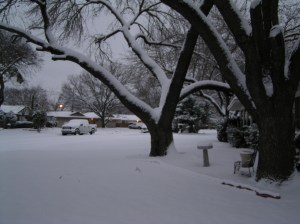
The neighborhood on Friday morning (picture taken by Erin Nicole Bowman)
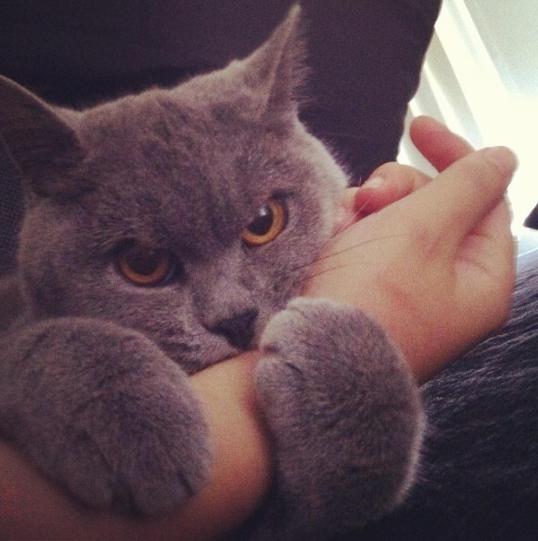
So, I spent most of yesterday cooped up inside with my sister and our cat and once we got over the whole fun of being able to go outside and scream, “SNOW DAY!” at the top of our lungs, there really wasn’t much to do. So, in an attempt to fight off cabin fever, I raided my DVD collection and we ended up watching one of the old Christopher Lee-as-Dracula-films from Hammer Studios. Specifically, we ended up watching Dracula A.D. 1972.
The film opens in 1872 with a genuinely exciting fight on a runaway carriage that ends with the death of both Count Dracula (Christopher Lee) and his nemesis, Prof. Van Helsing (Peter Cushing). However, as Van Helsing is buried, we see one of Dracula’s disciples (played by Christopher Neame, who had an appealingly off-kilter smile) burying Dracula’s ashes nearby. The camera pans up to the clear Victorian sky and, in a sudden and genuinely effective jumpcut, we suddenly see an airplane screeching across the sky.
Well, it’s all pretty much downhill from there. Suddenly, we discover that a hundred years have passed and we are now in “swinging” London. The city is full of red tourist buses, hippies wearing love beads, and upright policemen who always appear to be on the verge of saying, “What’s all this, then?” We are introduced to a group of hippies that are led by a creepy guy named Johnny Alculard (also played — quite well, actually — by Christopher Neame). One of those hippies (Stephanie Beacham) just happens to be the great-great-granddaughter of Prof. Van Helsing. Apparently, she’s not really big on the family history because she doesn’t notice that Alculard spells Dracula backwards. Then again, her father (played by Peter Cushing, of course) doesn’t either until he actually writes the name down a few times on a piece of a paper.
Anyway, the film meanders about a bit until finally, Alculard convinces all of his hippie friends to come take part in a black mass. “Sure, why not?” everyone replies. Well, I don’t have to tell you how things can sometimes get out-of-hand at black mass. In this case, Dracula comes back to life, kills a young Caroline Munro, and eventually turns Johnny into a vampire before then setting his sights on the modern-day Van Helsings.
Dracula A.D. 1972 was Hammer’s attempt to breathe some new life into one of its oldest franchises and, as usually happens with a reboot, its critical and (especially) commercial failure ended up helping to end the series. Among even the most devoted and forgiving of Hammer fans, Dracula A.D. 1972 has a terrible reputation. Christopher Lee is on record as regarding it as his least favorite Dracula film. And the film definitely has some serious flaws. Once you get past the relatively exciting pre-credits sequence, the movie seriously drags. There’s a hippie party sequence that, honest to God, seems to last for about 5 hours. As for the hippies themselves, they are some of the least convincing middle-aged hippies in the history of fake hippies. You find yourself eagerly awaiting their demise, especially the awkward-looking one who — for some reason — is always dressed like a monk. (Those crazy hippies!) But yet…nothing happens. All the fake hippies simply vanish from the film. Yet, they’re so annoying in just a limited amount of screen time that the viewer is left demanding blood. Add to that, just how difficult is it to notice that Alculard is Dracula spelled backwards? I mean, seriously…
To a large extent, the charm of the old school Hammer films comes from the fact that they’re essentially very naughty but never truly decadent. At their heart, they were always very old-fashioned and actually quite conservative. The Hammer films — erudite yet campy, risqué yet repressed — mirrors the view that many of my fellow Americans have of the English. For some reason, however, that Hammer naughtiness only works when there’s the sound of hooves on cobblestone streets and when the screen is populated by actors in three-piece suits and actresses spilling out of corsets. Dracula A.D. 1972 did away with the support of the corset and as a result, the film is revealed as a formless mess with all the flab revealed to the world.
Still, the film isn’t quite as bad as you may have heard. First off, the film — with its middle-aged hippies — has a lot of camp appeal. It’s the type of film that, once its over, you’re convinced that the term “groovy” was uttered in every other scene even though it wasn’t. As with even the worst Hammer films, the film features a handful of striking images and Christopher Neame is surprisingly charismatic as Alculard.
As with the majority of the Hammer Dracula films, the film is enjoyable if just to watch the chemistry between Christopher Lee and Peter Cushing. Both of these actors — so very different in image but also so very stereotypically English — obviously loved acting opposite of each other and whenever you see them on-screen together, it’s difficult not to enjoy watching as each one tried to top the other with a smoldering glare or a melodramatic line reading. As actors, they brought out the best in each other, even when they were doing it in a film like Dracula A.D. 1972. In this film, Cushing is like the father you always you wished you had — the stern but loving one who protected you from all the world’s monsters (both real and cinematic).
As for Lee, he’s only in six or seven scenes and he has even fewer lines but, since you spend the entire film wondering where he is, he actually dominates the entire movie. Lee apparently was quite contemptuous of the later Hammer Dracula films and, oddly enough, that obvious contempt is probably why, of all the Draculas there have been over the years, Lee’s version is the only one who was and is actually scary. F0rget all of that tortured soul and reluctant bloodsucker crap. Christopher Lee’s Dracula is obviously pissed off from the minute he first appears on-screen, the embodiment of pure destructive evil. And, for whatever odd reason, the purity of his evil brings a sexual jolt to his interpretation of Dracula that those little Twilight vampires can only dream about. Even in a lesser films like Dracula A.D. 1972, Christopher Lee kicks some serious ass.
So, in conclusion, I really can’t call Dracula A.D. 1972 a good film nor can I really suggest that you should track down a copy of the DVD. I mean, I love this stuff and I still frequently found my mind wandering whenever Cushing or Lee wasn’t on-screen. However, it’s not a terrible movie to watch if you happen to find yourself trapped in the house by a mountain of snow.


 Through the Shattered Lens