Horror Film Review: Dracula’s Daughter (dir by Lambert Hillyer)


draculas_doughter_original_poster_1936

Did you know that Dracula had a daughter!?

Well, Bram Stoker might disagree but, according to Universal Studios, he did.  Her name was Countess Marya Zaleska and, as played by Gloria Holden, she is the title character in 1936’s Dracula’s Daughter!  Like her father, the Countess was also a vampire.  The film never gets into just how she became a vampire.  Was she born a vampire or, far more disturbingly, was she once a mortal who turned into a vampire by her own father?  The film doesn’t tell us but it does establish early on that she hates being one of the undead.  Unlike her father, she struggles with her urge to drink blood.  When she discovers that Dracula has been staked, she and her servant, Sandor (Irving Pichel), steal the body from the morgue and burn it.  The Countess thinks that this will cure her of her urges.

Sadly, it does no such thing.

So, what’s a reluctant, 20th century vampire to do?  Well, she can always go to a psychiatrist and hope that science can somehow break the curse.  She ends up as a patient of Dr. Jeffrey Garth (Otto Kruger).  By coincidence, Dr. Garth has another famous patient — Dr. Edward Von Helsing.  (That’s right, they changed the “van” to a “von” in Dracula’s Daughter.  Despite the name change, Edward van Sloan returns to play the veteran vampire hunter.)

Von Helsing in on trial, accused of murdering Dracula in the previous film.  Oddly enough, nobody mentions Renfield who, seeing as how we’re told Dracula’s Daughter starts exactly where Dracula left off, would have been found dead in the crypt as well.  Even stranger, no one steps forward to defend Von Helsing.  Dr. Seward, Mina, Johnathan Harker?  Forget about them.  Not a single one is to be found while Von Helsing is accused of murder.

Bastards.

Fortunately, Von Helsing has a defense!  Since Dracula was already dead and had been for 500 years, Von Helsing could not have killed him.  Helping him out with this defense is Dr. Garth…

Meanwhile, the Countess tries to resist the urge to attack every woman that she sees.  She pours her frustrations out into painting.  One night, Sandor brings the Countess a new model, a beautiful young woman named Lil (Nan Grey).  The Countess orders Lil to undress and then, after staring at her, gives into her urges and attacks…

If you’re thinking that there’s a subtext here, that’s because there is.  (In fact, Universal’s tagline for the film was, “Save the women of London from Dracula’s Daughter!”)  Perhaps even more so than in Dracula, Dracula’s Daughter uses vampirism as a metaphor for forbidden sex.  When the Countess stares at Lil and, later, when she prepares to bite the neck of Dr. Garth’s fiancée, she is embodying the hysterical fears of a puritanical society.  When she unsuccessfully seeks a cure for her vampirism, we’re reminded that, in the 1930s, psychiatry classified homosexuality as being a mental illness.  When the Countess struggles with her urge to drink blood, she is a stand-in for everyone who has struggled with their sexuality.

Gloria Holden plays the Countess as being as much a victim as a victimizer.  Whereas Bela Lugosi turned Dracula into the epitome of evil, Gloria Holden gives a performance that is full of ambiguity.  In fact, she at times seems to be so tortured by her vampiric state that, when she finally fully embraces the fact that she’s a vampire, you have to cheer a little.  At least she’s finally being honest with herself!  At least she’s no longer making apologies or allowing society to punish her for being who she is.  Was Countess Zaleska the first reluctant vampire in film history?  I’m not sure but Holden’s performance undoubtedly set the bar by which all other self-loathing vampires should be judged.

Dracula’s Daughter holds up surprisingly well.  It’s definitely one to look for during this Halloween season.
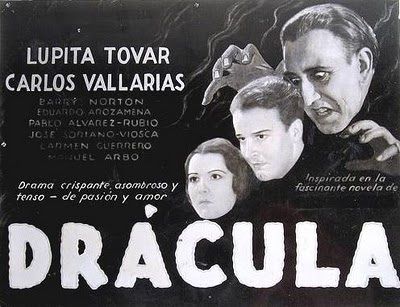
Horror Film Review: Drácula (dir by George Melford)


drac

One of the wonderful oddities of film history is that, in 1931, Universal produced not one but two versions of Dracula.  There’s the version that we all know, the one with Bela Lugosi.  And then there was the Spanish language version.

It was a common practice during the early days of the sound era for the studios to concurrently shoot Spanish-language versions of their films.  In the case of Dracula, the cast and the crew for the Spanish version would shoot at night, after Lugosi, Edward van Sloan, Dwight Frye, and everyone else had gone home.  The crew and the actor cast as Dracula, Carlos Villarias, were allowed to watch the dailies, with Villarias being specifically told to model his performance as much on Lugosi’s as possible.

Most of the early Hollywood’s Spanish films have been lost but Drácula has survived.  In fact, among some horror critics, it’s become a bit trendy to declare that the Spanish language version is superior to the English version.  While I was preparing for our annual October horrorthon, I decided to watch Drácula and see for myself.

In some ways, Drácula is indeed superior.  The film uses the same script as the English version and was filmed on the same sets.  But visually, it’s a far more interesting film.  Because director George Melford (who was quite an acclaimed silent film director) had a chance to watch Dracula‘s dailies, he also had the benefit of hindsight when it came to making decisions regarding lighting and camera angles.  If the English language Dracula suffers because its stationary camera work makes it feel like a filmed stage play, the Spanish-language Drácula feels like a real movie.

As well, there’s a passion to the Spanish language Drácula, a passion that often seems to be missing from the English language version.  The English language version often seems to be going out of its way not to offend — the screen fades to black whenever Dracula starts to bite anyone, Jonathan Harker and Mina Seward are both portrayed rather dully, and, with the exception of Lugosi, Dwight Frye, and Edward van Sloan, everyone seems to be a bit too restrained in their performances.

Perhaps because it was specifically being filmed for foreign distribution, the Spanish language Drácula is far less restrained.  We see what Dracula actually does to his victims.  We see Eva and Lucia’s ecstatic reactions to being bitten by the vampire.  As oppose to Dracula, where everyone was very proper and very covered, Drácula embraces cleavage and moaning in the same way that, 20 years later, would make Hammer Studios famous.  The actors in Drácula are far more passionate, emotional, and sensual than their English-language counterparts.  They’re far more … well, Spanish.  Spanish is an exciting language and it’s pretty much impossible for someone speaking it to be boring.

But, unfortunately, Drácula fails where it matters most.  In the role of the count, Carlos Villarias never exhibits the charisma that we associate with the best Draculas.  I get the feeling that he was mostly cast because he bore a passing resemblance to Bela Lugosi.  Since he was instructed to imitate Lugosi, that’s what his performance comes across as being.  While Villarias does a better Lugosi imitation than that guy that Ed Wood used in Plan Nine From Outer Space, it’s still just an imitation.

And unfortunately, you really can’t have a good Dracula film unless you have a good Dracula.  In a perfect world, we would have a combination of the two versions, with Bela Lugosi starring in the Spanish version.  However, we live in an imperfect world but at least it’s a world where we can watch both Dracula and Drácula.

dracula-spanish-language

Horror Film Review: Dracula (dir by Tod Browning)


dracula_movie_poster_style_f

It pains me to say it but, of all the classic Universal monster films, Dracula is probably my least favorite.

I hate to say that because I love vampires and I love the story of Dracula.  I have read the book several times, I’ve seen several productions of the stage play, and I’ve seen a countless number of  Dracula films.  (Christopher Lee’s version is my favorite.)  The 1931 version of Dracula — while hardly being the first vampire movie — was still a very important moment in the history of horror cinema.  Every vampire film that has come out since owes a debt of gratitude to Dracula.  Bela Lugosi’s performance set the standard against which almost all vampires are judged.

I always want to love Dracula but … no, the film just doesn’t work for me.

Of course, we all know the film’s story.  Dracula (Bela Lugosi) comes to England from Transylvania.  He turns Lucy (Frances Dade) into a vampire and attempts to do the same thing to Mina Seward (Helen Chandler).  Mina’s fiancée, John Harker (David Manners) and father, Dr. Seward (Herbert Bunston), attempt to stop him with the help of Prof. Van Helsing (Edward van Sloan).  Renfield (Dwight Frye) serves as Dracula’s servant and eats bugs.  Dracula tells us that he does not drink … wine.  He talks about the music of the night.  His eyes get wide at the sight of blood and he hides his face when confronted with a cross.

Of course, though Dracula may have first appeared in Bram Stoker’s novel, the film is actually an adaptation of a stage play that was based on the novel.  That’s the main problem with Dracula as a movie.  It’s a very stagey film, one that never seems to quite break free of its theatrical origins.  It’s a rather slow-moving film, one that is full of awkward scene transitions and moments of dead air.  One need only compare it to F.W. Murnau’s Nosferatu or Carl Theodor Dreyer’s Vampyr to see just how visually bland Dracula really is.

Dracula‘s blandness is especially surprising when you consider that the direction is credited to Tod Browning.  Browning directed some of the best horror films of the silent era and, after the release of Dracula, he went on to direct the brilliant Freaks.  Dracula doesn’t feel like a Browning film but perhaps that’s because it actually wasn’t.  Reportedly, Tod Browning was struggling with depression during the filming of Dracula and was rarely on set.  Instead, most of the film’s direction was handled by cinematographer Karl Freund.  Freund had never directed a film before (though he would later acquit himself quite well with The Mummy) and Dracula‘s flaws were largely a result of that inexperience.

Well, that may be true or it may not.  Here’s what we can say for sure: Bela Lugosi’s work as Dracula holds up surprisingly well.  When seen today, it can be difficult to fairly judge Lugosi’s performance.  We’ve seen so many parodies and bad imitations that it’s difficult to imagine the impact that it may have had on audiences in 1931.  Lugosi was recreating his stage performance and it’s a very theatrical performance but, at the same time, Dracula is a character that doesn’t demand or require subtlety.  There’s a power to Lugosi’s performance.  Maybe it’s the piercing stare or the unbridled blood lust that seems to be reflected in his eyes.  Maybe it’s the accent.  Maybe it’s the haughty and arrogant way that he carries himself.  Whatever it is, it works.

No, Dracula does not hold up as well as you might hope.  But Bela Lugosi’s performance remains a classic.

4 Shots From Horror History: Dracula, Frankenstein, Vampyr, White Zombie


This October, I’m going to be doing something a little bit different with my contribution to 4 Shots From 4 Films.  I’m going to be taking a little chronological tour of the history of horror cinema, moving from decade to decade.

Today, we take a look at the start of the 1930s.

4 Shots From 4 Films

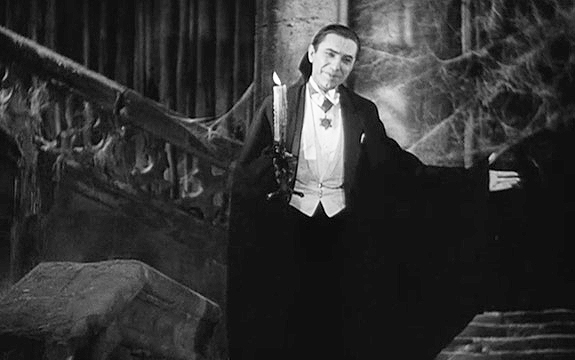
Dracula (1931, dir by Tod Browning)

Dracula (1931, dir by Tod Browning)

Frankenstein (1931, dir by James Whale)

Frankenstein (1931, dir by James Whale)

Vampyr (1932, dir Carl Theodor Dryer)

Vampyr (1932, dir Carl Theodor Dryer)

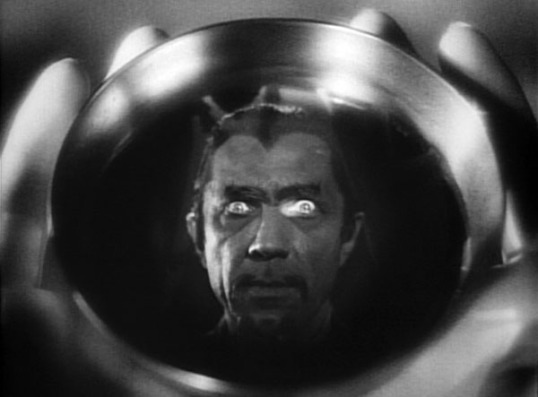
White Zombie (1932, dir by Victor Halperin)

White Zombie (1932, dir by Victor Halperin)

6 Trailers For Halloween!


Hello there!  Welcome to a special Halloween edition of Lisa Marie’s Favorite Grindhouse and Exploitation Film trailers!  The trailer kitties went out this morning (despite the fact that it’s been raining nonstop down here since yesterday) and they came back with these 6 horrific trailers for Halloween!

Let’s see what they’ve brought us!

(By the way, some of these trailers may be NSFW and some may contain excessive gore or even nudity so use your best judgment when it comes to watching.  The TSL accepts no responsibility for the occasionally over-the-top choices of the trailer kitties.)

Zombi 2 (1979)

Axe (1974)

Welcome to Arrow Beach (1974)

Dracula (1979)

Andy Warhol’s Dracula (1974)

Halloween (1978)

What do you think, Trailer Kitty?

"Happy Halloween!"

“Happy Halloween!”

Awwwwwww!

4 Shots From 4 Films: Dracula, Island of Lost Souls, The Black Cat, Son of Frankenstein


Bela Lugosi was born 133 years ago today.  These 4 shots from 4 films are dedicated to him.

4 Shots From 4 Films

Dracula (1931, directed by Tod Browning)

Dracula (1931, directed by Tod Browning)

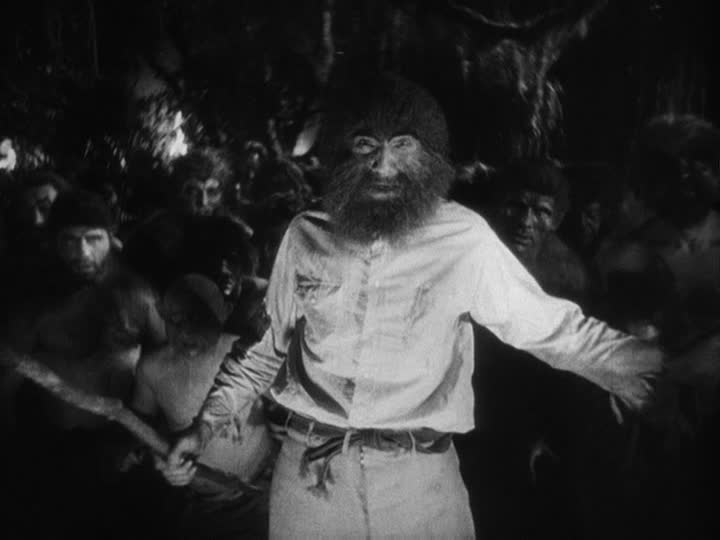
Island of Lost Souls (1932, directed by Erle C. Kenton)

Island of Lost Souls (1932, directed by Erle C. Kenton)

The Black Cat (1934, directed by Edgar G. Ulmer)

The Black Cat (1934, directed by Edgar G. Ulmer)

Son of Frankenstein (1939, directed by Rowland V. Lee)

Son of Frankenstein (1939, directed by Rowland V. Lee)

Horror Film Review: Zoltan, Hound of Dracula (dir by Albert Band)


Were you aware that Dracula owned a dog?  And that dog was a vampire?  And that dog’s name was Zoltan?

It’s true!  Or, at least, it’s true according to a low-budget 1977 film called Zoltan, the Hound of Dracula.

Zoltan opens with a bunch of Russians unearthing an underground tomb that, we’re told, once housed Dracula.  Inside the tomb, they find two coffins.  One contains a man with a stake in his chest.  The other contains the body of a dog that has a stake in its chest.  Foolishly, the Russians remove the stakes and bring back to life both Zoltan and Veidt Smit (played by a very creepy-looking actor named Reggie Nalder, who also played the vampire in the made-for-tv adaptation of Stephen King’s Salem’s Lot).  Veidt is a former servant of Dracula who can walk around in the daylight.  As for Zoltan — well, he’s Dracula’s dog.  His eyes glow.  He has gigantic fangs.  He’s a vampire dog!

It turns out that, in order to survive, Veidt and Zoltan have to find the last human descendant of Dracula and turn him into a vampire.  So, Veidt and Zoltan had to Los Angeles and start to stalk family man Michael Drake (Michael Pataki).  Drake (and yes, his last name was shortened from Dracula) has little knowledge of his heritage.  Oddly enough, we’re told repeatedly that he’s the last member of the Dracula bloodline but he has two kids so it seems like they would actually be the last descendants of Dracula and…

Oh, who cares!?  Why are we worrying about logic when it comes to reviewing a film called Zoltan, the Hound of Dracula?

Michael and his family leave Los Angeles so that they can spend the weekend at a campground and, needless to say, they are followed by Zoltan and Veidt.  Soon, Zoltan is turning every other dog in California into a vampire and chasing Michael and his family.

Fortunately, a vampire hunter (played by Jose Ferrer) shows up and offers to help Michael survive.  But will his help be enough?

Okay, so Zoltan, the Hound of Dracula is technically a pretty bad film.  The budget is very low.  Director Albert Band doesn’t really bother much with things like subtext or suspense.  With the exception of the genuinely intimidating Reggie Nadler, the actors pretty much just go through the motions.  But, with all that in mind — how can you not love a film called Zoltan, the Hound of Dracula?  It’s fun because the film is just so ludicrous.  Criticizing a film like this for being bad ultimately feels like being way too much of a scold.

Add to that, there’s a vampire puppy!  And yes, he is just adorable!

I have to say that I am very disappointed that Zoltan did not make an appearance in last year’s Dracula Untold.  Hopefully, any future Dracula movies will make room for Zoltan. He may have been a vampire but seriously, Zoltan was a good dog!


4 Shots From 4 Films: Frankenstein, Dracula, The Mummy, White Zombie


4 Shots From 4 Films is just what it says it is, 4 shots from 4 of our favorite films.  As opposed to the reviews and recaps that we usually post, 4 Shots From 4 Films is all about letting the visuals do the talking.

4 Shots From 4 Films

Frankenstein (1931, directed by James Whale)

Frankenstein (1931, directed by James Whale)

Dracula (1931, directed by Tod Browning)

Dracula (1931, directed by Tod Browning)

The Mummy (1932, directed by Karl Freund)

The Mummy (1932, directed by Karl Freund)

White Zombie (1932, directed by Vincent Halperin)

White Zombie (1932, directed by Victor Halperin)

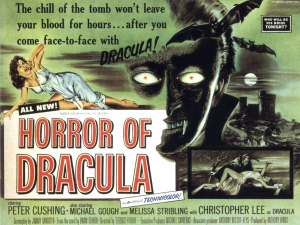
GODS OF THE HAMMER FILMS 2: Peter Cushing, Christopher Lee, and HORROR OF DRACULA (1958)


gary loggins's avatarcracked rear viewer

hor drac4

(second of a series)

Hammer Films Ltd. knew they were on to something with the release of 1957’s THE CURSE OF FRANKENSTEIN. The Gothic horror was box office gold on both sides of the Atlantic, and Hammer wasted no time finding a follow up. Reuniting CURSE OF FRANKENSTEIN costars Peter Cushing and Christopher Lee with director Terence Fisher, the company set its sights on giving the full Eastmancolor treatment to Bram Stoker’s immortal Count Dracula.

View original post 554 more words

Christopher Lee, R.I.P.


Jinnah

The picture above is Christopher Lee in the 1998 film Jinnah.  In this epic biopic, Lee played Muhammad Ali Jinniah, the founder of modern Pakistan.  Up until yesterday, I had never heard of Jinnah but, after news of Lee’s death broke, Jinnah was frequently cited as being Lee’s personal favorite of his many roles and films.

Consider that.  Christopher Lee began his film career in the 1940s and he worked steadily up until his death.  He played Dracula.  He played The Man with the Golden Gun.  Christopher Lee appeared, with his future best friend Peter Cushing, in Laurence Olivier’s Oscar-winning Hamlet.  He played Seurat in John Huston’s Moulin Rouge.  He appeared in both The Lord of the Rings and the Hobbit trilogies.  He appeared in several films for Tim Burton.  He even had a small role in Martin Scorsese’s Hugo.  He appeared in two Star Wars prequels.  He appeared in the original Wicker Man (and reportedly considered it to be his favorite of his many horror films).  He appeared in Oscar winners and box office hits.  And, out of all that, Christopher Lee’s personal favorite was Jinnah, a film that most people have never heard about.

Unless, of course, you live in Pakistan.  When I did a google search on Christopher Lee, I came across several Pakistani news sources that announced: “Christopher Lee, star of Jinnah, has died.”

And really, that somehow seems appropriate.  Christopher Lee was the epitome of an international film star.  He worked for Hammer in the UK.  He worked with Jess Franco in Spain and Mario Bava in Italy.  He appeared in several movies in the United States.  And, in Pakistan, he played Jinnah.  And I haven’t seen Jinnah but I imagine he was probably as great in that role as he was in every other role that I saw him play.  Over the course of his long career, Christopher Lee appeared in many good films but he also appeared in his share of bad ones.  But Christopher Lee was always great.

It really is hard to know where to begin with Christopher Lee.  Though his death was announced on Thursday, I haven’t gotten around to writing this tribute until Friday.  Admittedly, when I first heard that Lee had passed away, I was on a romantic mini-vacation and had promised myself that I would avoid, as much as possible, getting online for two days.  But, even more than for those personal reasons, I hesitated because I just did not know where to start when it came to talking about Christopher Lee.  He was one of those figures who overwhelmed by his very existence.

We all know that Christopher Lee was a great and iconic actor.  And I imagine that a lot of our readers know that Lee had a wonderfully idiosyncratic musical career, releasing his first heavy metal album when he was in his 80s.  Did you know that Lee also served heroically during World War II and, after the war ended, helped to track down fleeing Nazi war criminals?  Did you know that it has been speculated that Lee may have served as one of the role models for James Bond?  (Ian Fleming was a cousin of Lee’s and even tried to convince Lee to play Dr. No in the first Bond film.)  Christopher Lee lived an amazing life, both on and off the screen.

But, whenever one reads about Christopher Lee and his career or watches an interview with the man, the thing that always comes across is that, for someone who played so many evil characters, Christopher Lee appeared to be one the nicest men that you could ever hope to meet.  Somehow, it was never a shock to learn that his best friend was his frequent screen nemesis, Peter Cushing.

Christopher Lee is one of those great actors who we assumed would always be here.  The world of cinema will be a sadder world without him.

Legends together

Legends together

Here is a list of Christopher Lee films that we’ve reviewed here on the Shattered Lens.  Admittedly, not all of these reviews focus on Lee but they do provide a hint of the man’s versatility:

  1. Airport ’77
  2. Dark Shadows
  3. Dracula A.D. 1972
  4. Dracula Has Risen From The Grave
  5. Dracula, Prince of Darkness
  6. Hercules in the Haunted World
  7. The Hobbit
  8. The Hobbit: Battle of the Five Armies
  9. Horror Express
  10. The Horror of Dracula
  11. Hugo
  12. Jocks
  13. The Man With The Golden Gun
  14. The Satanic Rites of Dracula
  15. Scars of Dracula
  16. Scream and Scream Again
  17. Season of the Witch
  18. Starship Invasions
  19. Taste The Blood of Dracula
  20. The Wicker Tree

Sir Christopher Lee was 93 years old and he lived those 9 decades in the best way possible.  As long as there are film lovers, he will never be forgotten.