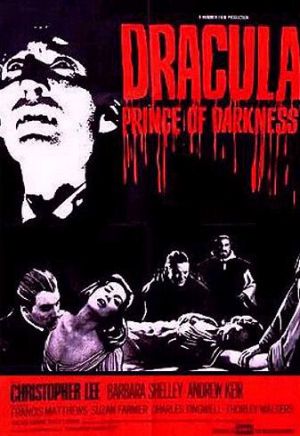
Christopher Lee often went on record about how much he disliked most of the Hammer films in which he played Dracula, feeling that Hammer didn’t really understand the character of Bram Stoker’s famous vampire. In fact, when Lee agreed to appear in 1966’s Dracula: Prince of Darkness, he did so with the requirement that he would not have any dialogue.
While it’s possible that Lee may have been hoping that his demand would force Hammer to release him from his contract, his requirement actually works to the film’s advantage. In the scene below, Lee shows that he didn’t need dialogue to make Dracula into a terrifying and malevolent force. Lee’s otherworldly and dangerous charisma and Dracula’s feral and vicious nature come through without him saying a word.
The picture above is Christopher Lee in the 1998 film Jinnah. In this epic biopic, Lee played Muhammad Ali Jinniah, the founder of modern Pakistan. Up until yesterday, I had never heard of Jinnah but, after news of Lee’s death broke, Jinnah was frequently cited as being Lee’s personal favorite of his many roles and films.
Consider that. Christopher Lee began his film career in the 1940s and he worked steadily up until his death. He played Dracula. He played The Man with the Golden Gun. Christopher Lee appeared, with his future best friend Peter Cushing, in Laurence Olivier’s Oscar-winning Hamlet. He played Seurat in John Huston’s Moulin Rouge. He appeared in both The Lord of the Rings and the Hobbit trilogies. He appeared in several films for Tim Burton. He even had a small role in Martin Scorsese’s Hugo. He appeared in two Star Wars prequels. He appeared in the original Wicker Man (and reportedly considered it to be his favorite of his many horror films). He appeared in Oscar winners and box office hits. And, out of all that, Christopher Lee’s personal favorite was Jinnah, a film that most people have never heard about.
Unless, of course, you live in Pakistan. When I did a google search on Christopher Lee, I came across several Pakistani news sources that announced: “Christopher Lee, star of Jinnah, has died.”
And really, that somehow seems appropriate. Christopher Lee was the epitome of an international film star. He worked for Hammer in the UK. He worked with Jess Franco in Spain and Mario Bava in Italy. He appeared in several movies in the United States. And, in Pakistan, he played Jinnah. And I haven’t seen Jinnah but I imagine he was probably as great in that role as he was in every other role that I saw him play. Over the course of his long career, Christopher Lee appeared in many good films but he also appeared in his share of bad ones. But Christopher Lee was always great.
It really is hard to know where to begin with Christopher Lee. Though his death was announced on Thursday, I haven’t gotten around to writing this tribute until Friday. Admittedly, when I first heard that Lee had passed away, I was on a romantic mini-vacation and had promised myself that I would avoid, as much as possible, getting online for two days. But, even more than for those personal reasons, I hesitated because I just did not know where to start when it came to talking about Christopher Lee. He was one of those figures who overwhelmed by his very existence.
We all know that Christopher Lee was a great and iconic actor. And I imagine that a lot of our readers know that Lee had a wonderfully idiosyncratic musical career, releasing his first heavy metal album when he was in his 80s. Did you know that Lee also served heroically during World War II and, after the war ended, helped to track down fleeing Nazi war criminals? Did you know that it has been speculated that Lee may have served as one of the role models for James Bond? (Ian Fleming was a cousin of Lee’s and even tried to convince Lee to play Dr. No in the first Bond film.) Christopher Lee lived an amazing life, both on and off the screen.
But, whenever one reads about Christopher Lee and his career or watches an interview with the man, the thing that always comes across is that, for someone who played so many evil characters, Christopher Lee appeared to be one the nicest men that you could ever hope to meet. Somehow, it was never a shock to learn that his best friend was his frequent screen nemesis, Peter Cushing.
Christopher Lee is one of those great actors who we assumed would always be here. The world of cinema will be a sadder world without him.
Legends together
Here is a list of Christopher Lee films that we’ve reviewed here on the Shattered Lens. Admittedly, not all of these reviews focus on Lee but they do provide a hint of the man’s versatility:
Sir Christopher Lee was 93 years old and he lived those 9 decades in the best way possible. As long as there are film lovers, he will never be forgotten.
“My master is dead but he left instructions that the house should always be ready for visitors.”
“Who was your master?”
“His name was Count Dracula…”
— A snatch of dialogue from Dracula, Prince of Darkness (1966)
Dracula, Prince of Darkness is notable for many reasons.
First off, this movie marked Christopher Lee’s return to the role that he played 8 years earlier in The Horror of Dracula. After being forced to make one Dracula film without Dracula, Hammer Films was finally able to make a direct sequel to The Horror of Dracula.
As a result of Lee returning, this was also the first of the Hammer Draculas to feature the previously destroyed Lord of the Vampires being revived through a splash of blood. This was a plot element that all subsequent films in the series would feature and, to a certain extent, you have to admire Hammer’s efforts maintain some form of continuity. Whereas it would have been easy enough to just have Dracula show up with no explanation as to why he’s back, the Hammer films at least tried to make sure everything followed some sort of identifiable logic. (Or, at least they did until Dracula A.D. 1972 but we’ll get to that movie later…)
This was the first Dracula film not to feature (with the exception of the footage from Horror of Dracula that opens the film) Peter Cushing in the role of Van Helsing. And while the film probably would have been improved by the presence of Cushing, the film does come up with a more than adequate substitute in the form of Andrew Keir’s Father Sandor. Whereas Cushing’s Van Helsing always seemed to be a rather rational vampire hunter, Keir brings a truly demented energy to the role.
And finally, Dracula, Prince of Darkness is probably best remembered for being the Dracula film in which Dracula does not speak. He does hiss a few times but, for the most part, Dracula is silent throughout this entire film and, instead, relies on his servants Klove (Philip Latham) and Ludwig (Thorley Walters) to do most of the talking.
Why Dracula doesn’t speak is a matter of debate. Christopher Lee has claimed that he refused to say any of the dialogue that had been written Dracula while screenwriter Jimmy Sangster wrote, in his autobiography, that Dracula was specifically written to be a silent role. (Or, as Sangster put it, “Vampires don’t chat.”)
Regardless of why Dracula is silent, it actually works quite well. Sangster’s right. Vampires don’t chat and Christopher Lee’s haughty Dracula would be the least likely of all to make small talk. Dracula’s silence both reminds us of the contempt with which he views the living and it also plays up the animalistic aspects of the character. It helps, of course, that Christopher Lee is one of those actors who can do more with one dismissive glare than most actors could do with 20 pages of the most florid and overwritten dialogue.
As for the film itself, it serves as a reminder that the only thing that need happen for evil to be triumphant is for stupid tourists to take a holiday in Transylvania. Ignoring the warnings of practically everyone else on the planet, the Kents — Alan (Charles Tingwell) and wife Helen (Barbara Shelley) and Charles (Francis Matthews) and wife Diana (Suzan Farmer) — spend the night at Dracula’s castle. Dracula’s servant, Klove, murders Alan and drains his blood over Dracula’s ashes. Soon, Helen is a vampire, Diana has been selected to be Dracula’s latest bride, and it’s up to Sandor and Charles to save everyone’s soul.
Dracula, Prince of Darkness is a lot of fun. It’s full of all the usual Hammer touches — melodramatic dialogue, ornate castles, pretty costumes, plentiful gore, unfriendly villagers, and not-quite-brilliant heroes — and, best of all, it’s got Christopher Lee proving that Dracula doesn’t need to speak to be frightening. Subsequent films in the Hammer Dracula series would grow increasingly uneven but Dracula, Prince of Darkness is a worthy entry.


 Through the Shattered Lens