Retro Television Reviews: Miami Vice 1.3 “Heart of Darkness”


Welcome to Retro Television Reviews, a feature where we review some of our favorite and least favorite shows of the past!  On Mondays, I will be reviewing Miami Vice, which ran on NBC from 1984 to 1989.  The entire show is currently streaming on Tubi!

This week, Crockett and Tubbs drive into the abyss and discover what happens when you lose yourself in vice.

Episode 1.3 “Heart of Darkness”

(Dir by John Llewellyn Moxey, originally aired on September 28th, 1984)

The third episode of Miami Vice appears to be take place at least a month or two after the end of the pilot.  Tubbs is not only now a member of the Miami Vice Squad but he and Crockett are now best friends.  Gone is all the animosity and mistrust that characterized their initial relationship.  Now, Crockett is willing to open up to Tubbs and Tubbs is willing to defend Crockett’s pet alligator, Elvis, when Sonny briefly flies into rage mode and threatens to throw away its favorite blanket.

(Sonny is upset because Elvis, who doesn’t like being left on the boat alone, ate one of Sonny’s records.)

Though Tubbs has been accepted by the Vice Squad, he’s still struggling to adjust to Miami, which is a bit more laid back than New York.  Early on, he complains to Lt. Rodriguez about his apartment.  Rodriguez just rolls his eyes.  Sorry, Tubbs.  Only one Miami cop gets to live with an alligator on a houseboat.  Everyone else is stuck with a one-bedroom.

Crockett and Tubbs’s current assignment is to penetrate the world of Southern Florida porn kingpin, Walter Kovics (Paul Hecht).  Kovics is involved with the Mafia and is suspected of having ordered several murders.  When one of his actresses (played by Suzy Amis, making her television debut) is not only murdered but also turns out to be an underage runaway from Kansas, the case becomes personal.  Crockett and Tubbs want to take down Kovics but the only way to get to Kovics is through his second-in-command, Artie Rollins.  At first glance, Artie seems to be a typical coked up criminal but, upon further investigation, Crockett and Tubbs learn that Artie Rollins is actually Arthur Lawson, an FBI agent who has spent the last few years of his life working undercover.  Now, no one is sure if Artie is still working undercover or if he’s truly gone over to the other side.  Artie claims that he’s still working to bring down Kovics but when Kovics discovers that Crockett and Tubbs are undercover cops, Artie is the one who is ordered to shoot them.  Which side is Artie on?  Not even he seems to know for sure.

Artie is played by Ed O’Neill.  The future star of Married With Children and Modern Family star was in his mid-thirties when he appeared in Miami Vice and this was one of his earliest television roles.  O’Neill gives an unpredictable performance, one that is often frightening and sometimes even a bit poignant.  As played by O’Neill, Arthur is a man who has truly lost himself and the character is compelling because Arthur himself doesn’t seem to know what he’s going to do from minute-to-minute.  He may want to take down Kovics but he’s also spent so many years in Kovics’s world that he knows he won’t ever be able to adjust to anything else.  In the end, Arthur does the right thing but he sacrifices his soul as he does it and his joy at gunning down Kovics is almost as disturbing as the look he had in his eyes when he was previously considering whether to execute Crockett and Tubbs.  The show’s final moments find Crockett and Tubbs sitting in a cop bar.  Crockett confesses that he saw a lot of himself in Arthur Lawson.  Rodriguez approaches them and informs them that, while being debriefed at FBI headquarters, Arthur committed suicide.

This was an interesting episode.  The plot was a bit conventional but it was elevated by Ed O’Neill’s performance as the unstable Arthur.  (O’Neill kept the viewer guessing, along with Crockett and Tubbs, as to who Arthur really was.)  And, of course, just when it seems like everyone’s gotten their happy ending, Rodriguez reminded us that happy endings are never guaranteed.  Everything comes with a price.  Indeed, that’s one of the major themes of Miami Vice.  Arthur sacrificed his identity, his soul, and ultimately his life to see that justice was done but, in the end, someone will quickly replace Kovics and the business of vice will continue with little interruption.  Arthur will be largely forgotten and only mentioned as a cautionary tale.  Can anyone blame Sonny for wanting to spend all of his time on a boat with an alligator?

Retro Television Reviews: Miami Vice 1.2 “Brother’s Keeper: Part Two”


Welcome to Retro Television Reviews, a feature where we review some of our favorite and least favorite shows of the past!  On Mondays, I will be reviewing Miami Vice, which ran on NBC from 1984 to 1989.  The entire show is currently streaming on Tubi!

This week, we learn who Tubbs really is and one scene changes television forever.

Episode 1.2 “Brother Keeper: Part Two”

(Directed by Thomas Carter, originally aired on September 16th, 1984)

The pilot for Miami Vice originally aired as a two-hour made-for-TV movie but, when it was released in syndication, it was split into two separate episodes.  That’s the way it’s usually aired on the retro stations and that’s also the way that it’s featured on Tubi.  And, as you can tell, that’s the way that I’ve decided to review it for this site.

Picking up where the first half ended, Brother’s Keeper: Part Two finds Sonny and Tubbs searching through the deceased Leon’s apartment.  Calderone’s men obviously visited the place and ransacked it before Sonny and Tubbs arrived but Sonny still manages to find Leon’s collection of important phone numbers.  Tubbs is surprised to discover that Leon lived in a very nice apartment but that’s the way things work in Miami.  Cocaine means big money and any one willing to take the risk can live like a king.  While the cops and the regular people go home to small apartments and houses that they can barely afford, the successful criminal lives a life of relative luxury.  The question is less why so many people are dealing drugs as why so many people aren’t.

While searching the apartment, Tubbs suddenly realizes that Sonny Crockett used to be a football star with the University of Florida.  (“You were a funky honky!” Tubbs exclaims.)  Apparently, Sonny was one of the best but a series of injuries ended his NFL dreams and, instead of going pro, Sonny did two tours of duty in Vietnam.  (The South Asian conference, Sonny calls it.)  Myself, I’m wondering how a semi-famous former football player can also be an undercover detective, working under a false name.  Wouldn’t he always be worried that a drug dealer would recognize him from the college days and figure out that Sonny Burnett was actually Sonny Crockett?

Sonny’s co-worker and girlfriend, Gina (Saundra Santiago), takes a break from working the undercover prostitution detail and lets Sonny know that she did a background check on Raphael Tubbs and he’s dead!  Raphael was a New York cop who was killed in shootout weeks before the other Tubbs landed in Miami.  When Sonny confronts him about this, Tubbs admits that he’s actually Ricardo, Raphael’s younger brother.  Raphael was a decorated Brooklyn detective.  Rico Tubbs, on the other hand, was a Bronx beat cop who forged a lot of documents in order to come down to Florida and convince Vice to allow him to work the Calderone case.  Sonny isn’t happy about being lied to but he has a lot more to worry about because, the night before, he apparently rolled over to Gina and whispered his ex-wife’s name in her ear!  Needless to say, things are a bit awkward between just about everyone.

Actually, awkward doesn’t even begin to describe what happens when Tubbs suggests that Lt. Rodriguez could be Calderone’s mole.  Sonny refuses to consider it until he overhears Rodriguez talking about enrolling his son in a pricey private school.  Fortunately, Rodriguez is innocent and the real mole’s number is found in Leon’s apartment.  Unfortunately, that number belongs to Sonny’s former partner, Scott Wheeler (Bill Smitrovich)!

After getting Wheeler to confess and turning him over to Rodriguez, Sonny and Tubbs drive down the dark streets of Miami at night, heading towards a rendezvous  with Calderone.  They don’t say much.  Tubbs loads his shotgun.  Sonny stops and makes a call to his ex-wife, something that his former partner Eddie didn’t get to do before he was killed.  The neon of Miami glows menacingly in the darkness.  Meanwhile, in the background, Phil Collins sings In the Air Tonight….

And it’s an absolutely beautiful sequence.  Between the surreal menace of Miami at night, the atmosphere of impending doom, and the moody song playing in the background, this sequence plays out like a surreal dream.  Both Tubbs and Crockett know that they are quite possibly driving to their death but, at this point, they have no other choice.  Too many people have died to turn back.  Neither Sonny nor Tubbs has anything in their life at that moment, beyond arresting Calderone.

And they do manage to arrest Calderone, along with killing quite a few of his associates.  However, Calderone is released by a crooked judge and flies away in a private airplane while Sonny and Tubbs can only stand on the runway and watch.  Sonny says that Calderone will return eventually.  Tubbs replies that he probably doesn’t have a job anymore.  Sonny asks Tubbs if he’s interested in a “career in Southern law enforcement.”

The second part of the pilot was dominated by that one scene of Tubbs and Sonny driving down the street.  And that scene was so strong and it made such an impression that it’s easy to ignore that the rest of Brother’s Keeper Part Two was not quite as exciting as Part One.  If the first part of the pilot set up Miami as a hedonistic playground of the rich and corrupt, the second part felt a bit more conventional in its approach.  Or, at least, it did until Phil Collins started to sing and play the drums.  One cannot understate the importance of that one scene.  That one scene, done with next to no dialogue, pretty much told the viewer everything that they needed to know about the show, about Miami, and about Crockett and Tubbs as partners.  In that scene, the show reminded us that no one is guaranteed to get out alive.

Next week: Crockett and Tubbs infiltrate an undercover pornography ring and Ed O’Neill appears as an FBI agent who may have gone over to the dark side.

Retro Television Reviews: Miami Vice 1.1 “Brother’s Keeper: Part One”


Welcome to Retro Television Reviews, a feature where we review some of our favorite and least favorite shows of the past!  On Mondays, I will be reviewing Miami Vice, which ran on NBC from 1984 to 1989.  The entire show is currently streaming on Tubi!

Legend has it that Miami Vice was originally pitched as being “MTV Cops.”  That may or may not be true but what is known is that it was a show that, for many people, continues to epitomize the 80s.  Its cynical and frequently surrealistic portrait of life in Miami continues to be influential to this day.  With Florida currently being at the center of so many discussions, it just seemed like a natural pick for Retro Television Reviews.

(Up until a few days ago, the mayor of Miami was running for President and two other Florida residents are currently the front runners for one party’s presidential nomination.  As I sit here writing this, national politics are often described as Florida vs California.  Even more than in the past, America revolves around Florida.)

Though Miami Vice is often describe as being a Michael Mann production, the show itself was actually created by Anthony Yerkovich, who felt that Miami in the 80s had become the American equivalent of Casablanca during World War II.  Mann served as executive producer and he played a big role in creating the show’s trademark visual style.  And, of course, the theme song was provided by Jan Hammer:

Episode 1.1 “Brother’s Keeper, Part One”

(Dir by Thomas Carter, originally aired on September 16th, 1984)

Though the show is considered, to this day, to be the epitome of the Southern Florida aesthetic, Miami Vice actually begins in New York City.

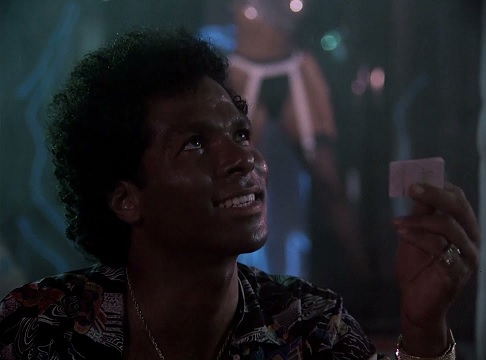
On a dark and wet New York Street, a detective named Tubbs (Philip Michael Thomas) sits in his car.  When a group of young men approach the car and demand that Tubbs give them some money, Tubb responds by coolly pointing a shotgun at them.  The men take the message and leave.

Tubbs is staking out a Colombian drug dealer named Calderone (Miguel Pinero).  Tubbs follows Calderone and his associates to a club, the type of place where even the neon lighting seem to be shadowy.  When Tubbs gets into a fight with some of Calderone’s bodyguards, Calderone flees into the dark night.

The action moves to Miami, which is as bright and sunny as New York was cold and dark.  Undercover vice cop Sonny Crockett (Don Johnson), wearing a white suit and a green t-shirt, gives advice to his partner, Eddie Rivera (a young and charismatic Jimmy Smits, making his television debut).  Eddie talks about how his wife is nervous about him being a cop.  Sonny tells Eddie to call her after they get finished dealing with a local drug dealer named Corky.

Corky knows Crockett as “Sonny Burnett” and he believes Eddie is a buyer from California.  When Corky arrives, they drive out to an underpass.  Corky and Eddie walk over to another car to check out Corky’s product.  Sonny spots the bomb that’s been taped under car’s hood but he’s too late to keep it from blowing up both Corky and Eddie.

When Lt. Rodriguez (Gregory Sierra) arrives on the scene, he’s not amused to discover two of his detectives — Stan Switek (Michael Talbott) and Larry Zito (John Diehl) — joking about how the police dogs are going to get hooked on all of the cocaine residue.  However, he’s even more annoyed with Sonny, who is quickly established as being the type of cop who does not “do it by the book!”  Rodriguez also says that Sonny hasn’t changed since his “football days.”  Sonny says that Eddie was killed by a mysterious dealer known as The Colombian.  Rodriguez replies that Sonny can’t even prove that the Colombian exists.  Rodriguez is particularly angered when Sonny says that there must be a mole working in the department.

While Sonny tells Eddie’s wife the bad news and then heads over to his son’s birthday party (it’s established that Sonny is divorced), Tubbs lands in Miami.  Hanging out at a strip club and doing an elaborate dance to Rockwell’s Somebody’s Watching Me, Tubbs is approached by a man named Scott Wheeler (Bill Smitrovich).  Pretending to be a Jamaican named Teddy Prentiss, Tubbs arranges to meet a drug dealer that Wheeler claims to know.

What Tubbs doesn’t know is that Wheeler is an undercover DEA agent and that he’s also Sonny Crockett’s former partner.  Sonny is the “dealer.”  That night, Sonny and a real-life drug dealer, Leon (Mykelti Williamson) show up at the meeting with Wheeler and “Teddy.”  Unfortunately, Zito and Switek show up earlier than expected and they end up arresting everyone before Leon can lead Sonny to the Colombian.  Tubbs makes a run for it, jumps into the boat that Sonny drove to the meeting, and speeds away.  Sonny jumps into his own car and chases the boat while the Miami Vice theme song plays in the background.  (Trust me, it’s a supercool scene.)

Finally confronting Tubbs on a bridge, Sonny reveals that he’s a detective.  Tubbs produces his own badge and introduces himself as Raphael Tubbs of the NYPD.  He explains that he’s in Miami because he’s after a Colombian drug dealer named Calderone.  Sonny explains that he’s too busy searching for the Colombian to worry about Tubbs’s search.  Finally, Lt. Rodriguez shows up and helps them to understand that they’re both looking for the same guy.  Rodriguez suggests that they work together but Sonny refuses.

The next morning, Tubbs tracks Sonny down on the houseboat on which he lives.  It’s a tense meeting, with Sonny punching Tubbs for suggesting that he wasn’t a good enough cop to save Eddie’s life.  Sonny apologizes afterwards and Tubbs accepts the apology and then punches Sonny so that they’ll be even.  Sonny then introduces Tubbs to his pet alligator, Elvis.  It’s male-bonding, 80s style!

Sonny and Scott head over to the courthouse so that they can be “arraigned,” along with Leon.  I really liked the performance of Howard Bergman, who played the eccentric judge, Clarence Rupp.  At one point, the lights went out in the courtroom and when they came back, everyone from the judge to the bailiffs to the court reporter had drawn a gun.  After mentioning his appreciation of the second amendment, Judge Rupp announces that Leon is free to go without bail because he’s cooperating with the police.  A panicked Leon yells that he’s not cooperating.

Later, a fearful Leon calls Rodriguez and offers to cooperate in return for protective custody.  Leon is hiding out at the beach, where Tubbs is keeping an eye on him.  When Sonny arrives, he’s not amused to see Tubbs there.  Meanwhile, a hitman who has disguised himself as a woman shoots and kills Leon while Girls Just Want To Have Fun plays on the soundtrack.

And so ends part one of Brother’s Keeper.  And you know what?  Even after all this time, it’s still easy to see why Miami Vice took off and why it continue to inspire a slew of imitators.  The pilot was genuinely exciting, with the perfect mix of music, visuals, and charismatic performances.  Jimmy Smits broke my heart in his tiny role.  Mykelti Williamson made Leon into an almost sympathetic character as he realized that the cops were willing to sacrifice him to get at his boss.  From the start, Don Johnson’s gruff performance as Sonny feels like a perfect match for Philip Michael Thomas’s more earnest portrayal of Tubbs.  If Sonny is a cynic, Tubbs seems to feel that he can make a difference by taking down men like Calderone. We’ll have to see how long that lasts.

Next week, we’ll finish up the pilot with part two of Brother’s Keeper!

Retro Television Reviews: The City (dir by Harvey Hart)


Welcome to Retro Television Reviews, a feature where we review some of our favorite and least favorite shows of the past!  On Sundays, I will be reviewing the made-for-television movies that used to be a primetime mainstay.  Today’s film is 1977’s The City.  It  can be viewed on YouTube!

“Civilization began when man realized that he could not survive alone. He left the wilderness and built his citadels, security against intruders and erosion from within. The cities of the world have since become the crossroads of trade and ideas. Ideas that have made the human race more powerful than primitive man could ever have dreamed. Among these was an invention, a machine that conquered to contemporary enemies of man: time and distance….”

So goes the opening narration of 1977’s The City.  The narrator is the veteran character actor (and television producer) William Conrad and, as he speaks, we sees images of the California desert eventually being conquered by the growing city of Los Angeles.  It’s a bit of a portentous opening for a film that turns out to be fairly standard police procedural but it makes sense when you consider that The City was apparently meant to be a pilot for an anthology series about the people of Los Angeles.

The City features Mark Hamill, shortly before Star Wars would turn him into a cultural icon.  Hamill plays Eugene Banks, a sweaty, wild-eyed petty criminal who has made his way to Los Angeles from Texas.  Banks manages to get a nice apartment and a job working at a gas station.  One day, after a lawyer demands that Banks fill the tank of his Porsche, Banks snaps.  He grabs a wrench and attacks the car.  Then, he attacks the lawyer, beating the man until he dies.  Banks proceed to go on a crime and killing spree across Los Angeles, flashing a particularly scary-looking knife whenever he gets the chance.

Searching for Banks are two mismatched cops.  Matt Lewis (Robert Forster) is the tough-as-nails, emotionally reserved veteran with a bad knee and a determination to catch the bad guys.  The case becomes personal for Lewis after Banks kills his partner.  Brain Scott (Don Johnson) is a shaggy-haired country boy, much like Banks.  Brian comes from a wealthy family and is a bit more idealistic in his approach than Lewis.

Banks, it turns out, is obsessed with a country singer named Wes Collins (Jimmy Dean).  Banks not only resents the fact that Collins has everything that Banks has ever wanted but he’s also convinced that Collins is actually the father who abandoned him when he was a baby.  Banks wants to get revenge and he’s not going to let anyone, whether they be a bystander, a cop, or a dog, stand in his way.

Yes, Eugene Banks kills a dog in this film.  Fortunately, it happens off-screen but it’s still an indication of just how different this role is from Hamill’s best-known live action role.  As the two cops, Forster and Johnson work well together and bring their somewhat stereotypical characters to life but the main reason most people will watch this film will be for the chance to see Mark Hamill play an absolute lunatic.  With the exception of his somewhat dodgy Texas accent, Hamill does a good job with the role.  He’s got the crazy eyes down and he’s actually frightening when he attacks the lawyer at the start of the film.  The film itself is a bit predictable (i.e., the mismatched partners learn to work together, the bad guy gives a speech at an inopportune time) but The City is worth watching for the cast.

Cease Fire (1985, directed by David Nutter)


Tim Murphy (Don Johnson, with a huge mustache) is a Vietnam vet who is still haunted by his actions during the war. As a result, he can’t hold down a job, he’s abusive to his wife, and he’s woken up in the middle of the night by constant nightmares.  One day, at the unemployment office, he meets another vet named Luke (Robert F. Lyons) and the two of them bond over their shared experiences.  While Tim tries to come to terms with what happened during the war, his wife Paula (Lisa Blount) tries to keep the household together.

Barely released in 1985, Cease Fire is a largely but unfairly forgotten Vietnam film.  According the film’s imdb page, Don Johnson once told an interviewer that he couldn’t even remember starring in a film called Cease Fire.  That piece of trivia sounded too good to be true and, after doing a google search, I have not been able to come across any interviews where Johnson says that.  In fact, in an interview with the AV Club, Johnson says that he filmed Cease Fire in Miami shortly after doing his first audition for Miami Vice.  According to Johnson this was in the early stages of Miami Vice‘s development, before Michael Mann was even attached to the project.  Since Miami Vice premiered (with Mann producing and Johnson starring) in 1984, that probably means that Cease Fire was filmed in either 1982 or 1983.  Considering that it was a low-budget and talky film about a very unpopular war, it is not surprising to discover that it sat on the shelf for a few years before finally being released in order to capitalize on the sudden stardom of its main actor.

Even though both take place in Miami and feature Don Johnson as a Vietnam vet, Miami Vice and Cease Fire are as different as night and day.  Cease Fire is a low-key and muted character study of a traumatized man who is struggling to face what happened in the past.  There’s not much action but there is a lot of talking.  Some of the dialogue is clumsy and obvious but both Don Johnson and Robert F. Lyons give good performance as the traumatized vets and Cease Fire is honest enough to admit that, even if he does take a few steps in the right direction, Tim still has a long road ahead of him.  Cease Fire, which never got a DVD release but which is available on Amazon Prime, is a sincere look at the reality of PTSD and the struggle that many vets face when they first return home.  It’s not a perfect movie but it’s saved by its own good intentions and Johnson’s sincere performance in the main role.

Cease Fire was also the first film to be directed by David Nutter.  Nutter is today probably best known for directing several episodes of Games of Thrones, a show that has even less in common with Cease Fire than Miami Vice.

Film Review: The Hot Spot (dir by Dennis Hopper)


As befits the title, the 1990 film, The Hot Spot, is all about heat.

There’s the figurative heat that comes from a cast of characters who are obsessed with sex, lies, and murder.  There’s the literal heat that comes from a fire that the film’s “hero” sets in order to distract everyone long enough so that he can get away with robbing a bank.  And, of course, there’s the fact that the film is set in a small Texas town that appears to be the hottest place on Earth.  Every scene in the film appears to be drenched by the sun and, if the characters often seem to take their time from getting from one point to another, that’s because everyone knows better than to rush around when it’s over a hundred degrees in the shade.  As someone who has spent most of her life in Texas, I can tell you that, if nothing else, The Hot Spot captures the feel of what summer is usually like down here.   I’ve often felt that stepping outside during a Texas summer is like stepping into a wall of pure heat.  The Hot Spot takes place on the other side of that wall.

The Hot Spot is a heavily stylized film noir, one in which the the traditional fog and shadows have been replaced by clouds of dust and blinding sunlight.  Harry (Don Johnson) is a drifter who has just rolled into a small Texas town.  Harry’s not too bright but he’s handsome and cocky and who needs to be smart when you’ve got charm?  Harry gets a job selling used cars, though he actually aspires to be a bank robber.  Harry finds himself falling in love with Gloria (Jennifer Connelly), a seemingly innocent accountant who is being blackmailed by the brutish Frank Sutton (William Sadler).  Meanwhile, Harry is also being pursued by his boss’s wife, Dolly (Virginia Madsen), an over-the-top femme fatale who is just as amoral as Harry but who might be a little bit smarter.  Complicating matters is that, while Harry’s trying to rob a bank, he also ends up saving a man’s life.  Only Dolly knows that Harry isn’t the hero that the rest of the town thinks he is.  She tells him that she’ll keep his secret if he does her just one little favor….

The Hot Spot was directed by Dennis Hopper (yes, that Dennis Hopper) and, from the start, it quickly becomes apparent that he’s not really that interested in the film’s story.  Instead, he’s more interested in exploring the increasingly surreal world in which Harry has found himself.  The Hot Spot plays out at a languid pace, which allows Hopper to focus on his cast of small-town eccentrics.  (My particular favorite was Jack Nance as the alcoholic bank president who also doubles as the town’s volunteer fire marshal.)  The film is so hyper stylized that it’s hard not to suspect that every character — with the possible exception of Harry — understands that they’re only characters in a film noir.  For instance, is Dolly really the over-the-top femme fatale that she presents herself as being or is she just a frustrated housewife playing a role?  Is Gloria really an innocent caught up in a blackmail scheme or is she just smart enough to realize that the rules of noir requires her to appear to be Dolly’s opposite?  And is Harry being manipulated or is he allowing himself to be manipulated because, deep down, he understands that’s his destiny as a handsome but dumb drifter in a small town?  Do any of the characters really have any control over their choices and their actions or has everyone’s fate been predetermined by virtue of them being characters in a film noir?  In the end, The Hot Spot is more than just a traditional noir.  It’s also a study of why the genre has endured.

It’s a long and, at times, slow movie, one that plays out at its own peculiar pace.  As a result, some people will be bored out of their mind.  But if you can tap into the film surreal worldview and adjust to the languid style, The Hot Spot is a frequently entertaining and, at times, rather sardonic slice of Texas noir.

Rian Johnson unsheathes the Knives Out Trailer


A filmmaker is sometimes only as good as their last film. If you mentioned director Rian Johnson’s name around 2012, it was probably met with wild applause. After all, he gave us the time travelling thriller Looper, with Bruce Willis, Emily Blunt and Joseph Gordon-Levitt.

Mentioning Johnson now breeds a bit of contempt after his outing on Star Wars: The Last Jedi. The film was hit with reviews ranging from daring to awful, and most of the Star Wars fanbase don’t think of what he’s done there.

With his newest film, Knives Out, Johnson looks like he’s moving forward. The film appears to be a classic whodunit with a fantastic cast. Christopher Plummer, Chris Evans, Ana de Armas, Jamie Lee Curtis, Toni Collette, Daniel Craig, Don Johnson, Lakeith Stanfield, Michael Shannon, Katherine Langsford, and Jaeden Martell round out the cast list, which is pretty great overall. The story seems to cover the murder of a patriarch, and a family of suspects which reminds me of the classic Infocom game, Deadline.  Hoping for the best with this one.

Enjoy.

Drive-In Saturday Night 3: MACON COUNTY LINE (AIP 1974)/RETURN TO MACON COUNTY (AIP 1975)


gary loggins's avatarcracked rear viewer


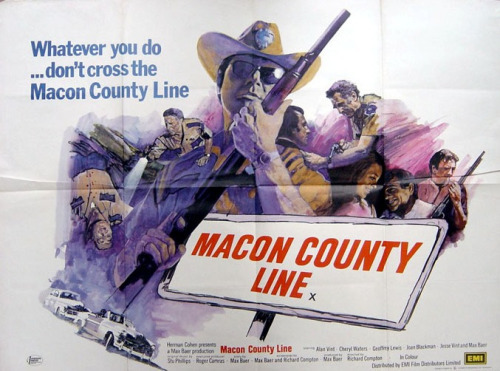
Yee-haw! Southern Fried Exploitation was box office gold during the 1970’s, a  genre that usually had one or more of the following elements: race cars, moonshine, redneck sheriffs, scantily clad country girls, shotguns, and/or Burt Reynolds .  One of the foremost practitioners of this art was Max Baer, namesake son of the heavyweight boxer and erstwhile Jethro Bodine of TV’s THE BEVERLY HILLBILLIES, who scored a surprise hit when he produced, wrote, and costarred in 1974’s MACON COUNTY LINE.

The story’s set in the 50’s, complete with some vintage tunes on the soundtrack (The Chords’ “Sh-Boom”, Laverne Baker’s “Jim Dandy”, Big Joe Turner’s “Corrine, Corrina”). “The story is true”, reads a pre-credits scrawl, “only the names have been changed” (Actually, the story was concocted by Baer and director Richard Compton, but what the hey…). Brothers Chris and Wayne Dixon (played by brothers Alan and Jesse Vint ) are a pair…

View original post 781 more words

The TSL’s Grindhouse: A Boy And His Dog (dir by L.Q. Jones)


(Nearly every Saturday night, the Late Night Movie Gang and I watch a movie.  On January 20th, we watched the 1975 science fiction satire, A Boy and His Dog.)

A Boy and His Dog begins, quite literally, with a bang.  A bang followed by a mushroom cloud.  And then a second mushroom cloud.  And then another.  And another.  When the explosions finally stop, we are informed that World War IV only lasted five days.  Of course, it destroyed most of society.  The year is now 2024 and … well, things aren’t great.

(For those of you keeping track, that means we’ve got another six years left.  Enjoy them!)

The world is now a barren wasteland, an endless stretch of desert.  There are a handful of survivors but they’re not exactly the types who you would want to survive an apocalypse.  Take Vic, for instance.  Vic (played by Don Johnson) is an absolute moron.  He can’t read.  He’s not very good at thinking.  He has no conscience.  He’s someone who kills and rapes without giving it a second thought.  When Vic isn’t scavenging for food and supplies, he’s obsessing on sex.  When we first meet him, the only thing redeeming about Vic is that almost everyone else in the world is even worse than he is.

That Vic has managed to survive for as long as he has is something of a minor miracle.  Vic has been lucky enough to team up with a dog named Blood.  Blood is not only surprisingly intelligent but he’s also telepathic.  Unfortunately, the same experiment that granted him telepathy also caused him to lose his instinct as a hunter.  So, Blood and Vic have an arrangement.  Vic keeps Blood supplied with food and Blood helps Vic track down women.

Blood’s voice is provided by actor Tim McIntire and, from the minute we first hear him, it becomes obvious that Blood may be cute on the outside but, on the inside, it’s a totally different story.  Blood rarely has a good word for anyone or anything.  He delights in annoying Vic, calling him “Albert” while still demanding that Vic get him food.  He’s a surprisingly well-read dog but you wouldn’t necessarily want to get stuck in a kennel with him.  Much as with Vic, Blood’s only redeeming trait is that everyone else is marginally worse than he is.

(Sadly, if there was an apocalypse like the one that starts this movie, most of the survivors probably would be like Vic.  The only people who would survive something like that would be the people who were solely looking out for themselves.)

A Boy and His Dog is a highly episodic film, following Vic and Blood as they wander across the wasteland and bicker.  They fight other scavengers.  They spend a rather depressing night at a makeshift movie theater.  Eventually, they come across a young woman named Quilla June (Suanne Benton).  Blood dislikes her but Vic says he’s in love.  (Mostly, he’s just excited that he’s now having sex regularly.)  Eventually, through a whole series of events, Vic discovers an underground city named Topeka, where everyone wears clown makeup.  The head of the town (Jason Robards) informs Vic that his sperm will be used to impregnate 35 women.  Vic is excited until he finds out that reproduction in Topeka is a matter of artificial insemination.

(Both the wasteland and Topeka are nightmarish in their own different ways.  The wasteland is world without morality or compassion.  Topeka is a world where everyone looks like a mime, there’s always a marching band, and order is maintained by a robot wearing overalls.)

Of course, while Vic is dealing with life underground, Blood waits above ground.  By the end of the film, Vic is forced to make a choice between settling down or remaining loyal to his dog.  It all leads to a final comment from Blood that will either make you laugh or throw a shoe at your TV.  I did both.

A Boy and His Dog is a strange movie.  It definitely isn’t for everyone.  It’s a comedy but the humor is pitch black.  Still, that strangeness — along with the talent of the dog playing Blood and Tim McIntire’s savagely sarcastic voice work — is what makes the film watchable.  There’s literally no other film like A Boy and His Dog.  By the time Vic ends up in Topeka, the film has become almost a fever dream of apocalyptic paranoia and satire.  The ultimate message of the film appears to be that the apocalypse would really suck so let’s try to not blow each other up.

Who can’t get behind that?