Lisa Reviews an Oscar Winner: The Sting (dir by George Roy Hill)


Earlier tonight, as a part of their 31 Days of Oscar, TCM aired The Sting, the film that the Academy selected as being the best of 1973.  I just finished watching it and what can I say?  Based on what I’ve seen of the competition (and there were a lot of great films released in 1973), I would not necessarily have picked The Sting for best picture.  However, the movie is still fantastic fun.

The Sting reunited the director (George Roy Hill) and the stars (Robert Redford and Paul Newman) of Butch Cassidy and the Sundance Kid and told yet another story of likable criminals living in the past.  However, whereas Butch Cassidy largely satirized the conventions of the traditional Hollywood western, The Sting is feels like a loving homage to the films of 1930s, a combination of a gritty, low-budget gangster film and a big budget musical extravaganza.  The musical comparison may sound strange at first, especially considering that nobody in The Sting randomly breaks out into song.  However, the musical score (which is famously dominated by Scott Joplin’s The Entertainer) is ultimately as much of a character as the roles played by Redford, Newman, and Robert Shaw.  And, for that matter, the film’s “let-pull-off-a-con” plot feels like an illegal version of “let’s-put-on-a-show.”

The film takes place in the 1936 of the cultural imagination, a world dominated by flashy criminals and snappy dialogue.  When con artists Johnny Hooker (Robert Redford) and Luther Coleman (Robert Earl Jones) inadvertently steal money from a gangster named Lonnegan (Robert Shaw), Lonnegan has Luther murdered.  Fleeing for his life, Hooker goes to Chicago where he teams up with Luther’s former partner, veteran con man Henry Gondorff (Paul Newman).  Gondorff used to be one of the great con artists but he is now living in self-imposed obscurity, spending most of his time drinking and trying to avoid the FBI.  Hooker wants to get revenge on Lonnegan by pulling an elaborate con on him.  When Gondorff asks Hooker why, Hooker explains that he can either con Lonnegan or he can kill him and he doesn’t know enough about killing.

The rest of the film deals with Hooker and Gondorff’s plan to con Lonnegan out of a half million dollars.  It’s all very elaborate and complicated and a bit confusing if you don’t pay close enough attention and if you’re ADHD like me.  But it’s also a lot of fun and terrifically entertaining and that’s the important thing.  The Sting is one of those films that shows just how much you can accomplish through the smart use of movie star charisma.  Redford and Newman have such great chemistry and are so much fun to watch that it really doesn’t matter whether or not you always understand what they’re actually doing.

It also helps that, in the great 70s tradition, they’re taking down stuffy establishment types.  Lonnegan may be a gangster but he’s also a highly respected and very wealthy gangster.  When Newman interrupts a poker game, Lonnegan glares at him and tells him that he’ll have to put on a tie before he’s allowed to play.  Lonnegan may operate outside the law but, in many ways, he is the establishment and who doesn’t enjoy seeing the establishment taken down a notch?

As entertaining as The Sting may be and as influential as it undoubtedly is (Steven Soderbergh’s Ocean films may be a lot more pretentious — which makes sense considering that Soderbergh is one of the most pretentious directors in film history — but they all owe a clear debt to The Sting), it still feels like an unlikely best picture winner.  Consider, for instance, that The Sting not only defeated American Graffiti and The Exorcist but Ingmar Bergman’s Cries and Whispers as well.  On top of that, when you consider some of the films that were released in 1973 and not nominated — Mean Streets, Badlands, The Candy Snatchers, Day of the Jackal, Don’t Look Now, Jesus Christ Superstar, and The Long Goodbye — it’s debatable whether The Sting should have been nominated at all.  That’s not a criticism of The Sting as much as it’s an acknowledgement that 1973 was a very good year in film.

So, maybe The Sting didn’t deserve its Oscar.  But it’s still a wonderfully entertaining film.  And just try to get that music out of your head!
Embracing the Melodrama #29: The Other Side of Midnight (dir by Charles Jarrott)


The Other Side of Midnight 1977

First released in 1977, The Other Side of Midnight is one of those film that literally seems to have everything a viewer could want: sex, love, betrayal, sex, war, melodrama, intrigue, sex, expensive clothes, private island, see-through nightgowns, sex, hurricanes, murder, a surprise twist ending that involves a convent, and sex.  Did I mention that this film has sex in it, because it so does.

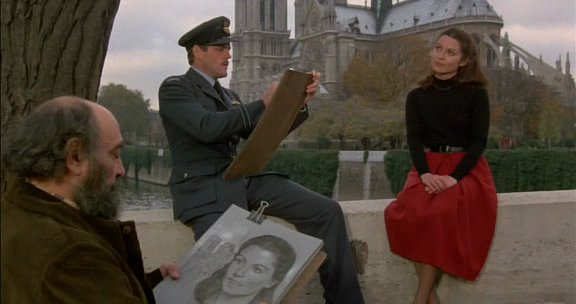
The film opens in Paris during the years leading up to World War II.  Beautiful Noelle (Marie-France Pisier) meets Larry Douglas (John Beck), a handsome American who is serving with the Canadian Air Force.  Noelle agrees to go out on a date with Larry and they get to have the of the movie’s many falling-in-love montages.  Fortunately, they’re in Paris which has a lot of great scenery in front of which they can pose.  Unfortunately, Larry is ordered back to the United States.  He promises Noelle that he’ll return but he never does.  What Larry doesn’t realize is that Noelle’s pregnant — or at least she is until a harrowing scene where she climbs into a bathtub with a wire hanger.

Montage!

Montage!

This is followed by another montage.  Call this the “Out-of-Love-And-Growing-Bitter” montage.  Noelle survives the German occupation by seducing and using every powerful man that she meets.  Along the way, she becomes one of the most glamorous and famous film stars in all of Europe.  Finally, she becomes the mistress of the wealthy and somewhat shady Constantin Demaris (Raf Vallone, doing his best Anthony Quinn impersonation).

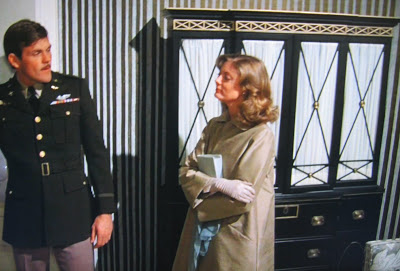
Meanwhile, Larry is back in America and, after going through another falling-in-love montage, has ended up married to innocent Catherine Alexander (Susan Sarandon).  What Larry doesn’t realize is that Noelle has hired a detective to keep track of him.  After the war, Larry gets a job as a commercial airline pilot but Noelle secretly arranges for him to lose that job.  Unemployed and desperate, Larry accepts a job to work as the private pilot for Demaris and his mistress.

Montage!

Montage!

Though it takes him a while to recognize her, Larry eventually does realize that his new boss is his former lover, Noelle.  As Larry starts to truly fall in love with Noelle all over again, Noelle starts to pressure him to do something about his new wife.  As is the case with several Hollywood melodramas, it all ends in a courtroom.  The courtroom scenes may not be exactly exciting but they do feature my favorite image from the entire film: at one point, we see that literally every single character who has appeared in the movie up to this point is sitting in that courtroom, all lined up like a bunch of disparate figures in an Edward Hopper painting.

The Other Side of Midnight is one of those big films where a lot of stuff happens but very little of it really seems to add up to anything.  It has a nearly 3 hour running time but it’s story could have just as easily been told in 90 minutes.  Instead, director Charles Jarrott pads out the running time with endless falling-in-love and falling-out-of-love montages.  This is the type of film that never says anything once that it can say an extra three times.

Montage!

Montage!

Susan Sarandon and Marie-France Pisier both give good performances.  Susan Sarandon is likable, even if her character is unbelievably naive while Marie-France Pisier gives a performance worthy of any good film noir but neither one of them has much chemistry with John Beck.  Fortunately, some of the supporting players — like Raf Vallone and Christian Marquand — take full advantage of every chance that they get to chew every piece of scenery that’s available.  Clu Gulager, the father of horror director John Gulager, pops up as well, playing perhaps the only good male in the entire film.

In the end, The Other Side of Midnight (and what the Hell does that title mean anyway?) is a rather silly movie about a bunch of shallow characters wearing beautiful clothes and wandering through wonderfully baroque locations.  Fortunately, I love elaborately decorated locations and glamorous outfits so I enjoyed The Other Side of Midnight despite myself.

Montage!

Montage!

One final thing about The Other Side of Midnight: 20th Century Fox was so sure that The Other Side of Midnight would be a huge success that they used it to blackmail theater owners into agreeing to show an obscure science fiction film called Star Wars.  Theaters would only be allowed to show The Other Side of Midnight if they also agreed to show Star Wars during the week before Midnight opened.

The end result, of course, is that The Other Side of Midnight was a bomb at the box office and Star Wars is still making money.

Below is a behind-the-scenes documentary on the making of The Other Side of Midnight.