Deputy Marshal Ed Garry (Jon Hall) is pursuing two bank robbers in Wyoming when he comes across a wounded man. Harley Masters (Wheaton Chambers) has been shot in the gut but his main concern is holding onto his hat. Ed takes Harley into town. They go into the local saloon, where Harley reveals a map hidden in his hat. He slips the map to Ed before an unseen gunman shoots him a second time. This time, Harley does not survive.
With the current sheriff “laid up,” Ed decides to stay in town and not only catch the bank robbers but also solve Harley’s murder. Ed soon finds himself in the middle of a conflict between two rival women (Frances Langford and Julie Bishop) who own ranches and stand to make a lot of money when the railroad comes through.
Deputy Marshal is one of the B-westerns that was produced by Robert Lippert and directed by William Berke in the 40s and 50s. This one is a step above the usual Lippert production because it combines a murder mystery with the standard western action and there are enough suspects to keep the story interesting. Jon Hall was best-known for appearing in exotic adventure films, often playing islanders. His career was in decline when he starred in Deputy Marshal but he makes for a surprisingly believable western hero. It helps that Hall was older than the typical B-western hero. His weathered looks make him convincing as an experienced lawman who understood the ways of the west.
Frances Langford, who plays the nicer of the two ranchers, was married to Jon Hall when she appeared in this film. She gets to sing two songs because this is a Lippert production and Robert Lippert believed that every western should open with a horse chase and should feature at least one song.
While it obviously never won any awards for originality, Deputy Marshal is a better-than-average B-western with an interesting mystery story and a convincing hero.
1942’s The Mummy’s Tomb picks up 30 years after the end of The Mummy’s Hand.
Archeologist Steve Banning (Dick Foran) is now living a peaceful life in the small town of Mapleton, Massachusetts. As the film opens, he is telling his guests about the time that he and his friend, Babe Hanson (Wallace Ford), went to Egypt and discovered the tomb of an Egyptian princess. He tells them how Andoheb (George Zucco) tried to use the ancient mummy, Kharis, to protect the tomb. Steve assures everyone that Andoheb is now dead and Kharis is no longer a threat to anyone.
The film then travels to Egypt where we discover that Steve was not quite correct. Adoheb survived being shot at the end of The Mummy’s Hand. He’s now an old man, dying but still obsessed with getting revenge. He instructs his disciple, Mehemet Bey (Turhan Bey), to travel to America with Kharis (now played, under a bunch of bandages, by Lon Chaney, Jr.) and to get revenge on the remaining members of the Banning expedition.
Bey and Kharis travel to Massachusetts and soon, the entire town of Mapleton is gripped in fear as Kharis starts to murder people. Steve Banning is the first victim. Then Steve’s sister, Jane (Mary Gordon). Kharis even kills Babe Hanson, whose role in the previous film was largely comic relief. Seriously, not even Frankenstein’s Monster killed the comic relief. Kharis is a ruthless and unstoppable killer and, in a performance that is totally focused on his hulking physicality, Lon Chaney, Jr. makes for a frightening mummy. Kharis moves slowly, dragging one foot behind him. But when he does attack, he’s relentless. This movie reminded me of why the mummy has, to me, always been the scariest of the old Universal monsters.
Despite the fact that Kharis is leaving bandages and ancient mold all over the place, the authorities are not quite convinced that an ancient mummy has come to their small town. However, the townspeople have no doubt what’s happening and, since this is a Universal film, they are soon running around with torches and pitchforks. Meanwhile, Steve’s son, John (John Hubbard), tries to figure out how to destroy the mummy and how to protect his fiancée, Isobel (Elyse Knox). Bey has decided that he’s in love with Isobel and he orders Kharis to bring her to him. Even under all the bandages, Kharis’s facial expression still suggests that he knows this isn’t a good idea.
The Mummy’s Tomb suffers from the same problem that afflicted The Mummy’s Hand. It feels like it takes forever to actually get to the good stuff. This is only a 60-minute film and ten of those minutes is taken up with a flashback to The Mummy’s Hand. But no matter! Once Kharis arrives in America, the pace of the film picks up and it becomes an effective little horror film. Lon Chaney, Jr. is frightening Kharis. I wouldn’t want him following me down a dark alley!
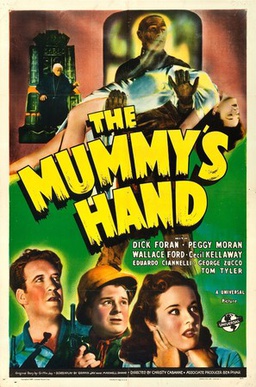
In 1940, having brought back The Invisible Man and Frankenstein’s Monster, Universal Pictures decided that it was also a good time to bring back The Mummy!
The Mummy’s Hand takes place in what we’re told is Egypt, though it’s obvious just a Universal backlot. Two archeologists — Steve Banning (Dick Foran) and Babe Jenson (Wallace Ford) — are penniless and stuck in Egypt. Babe wants to find a way to return to Brooklyn and his ex-girlfriend. Steve is a bit more serious about archeology, though it must be said that he’s no Indiana Jones when it comes to discovering relics and taking them to museums. If Indiana is the type who will risk his life to search a hidden cave in the Amazon Rain Forest, Steve is far more likely to just wander around an Egyptian market until he comes across someone selling an ancient vase.
Which is exactly what happens! Steve finds someone selling a vase and, after he learns where it came from, he buys the vase. He takes the vase to Prof. Andoheb (George Zucco), not knowing that Andoheb is an Egyptian high priest who has been sworn to protect the tomb of Princess Ananka. When Andoheb realizes that the vase could lead to the discovery of the tomb, he lies and claims that it’s a forgery. He then “accidentally” breaks it in order to keep Steve from showing the vase to anyone else. Steve, however, is not deterred and a chance meeting with an American magician named Tim Sullivan (Cecil Kellaway) leads to Sullivan agreeing to finance Steve’s expedition to discover where the vase came from. Sullivan’s daughter, Marta (Peggy Moran), worries that Steve and Babe are just trying to steal her father’s money so she insists on coming on the expedition with Steve. Also following the expedition is Andoheb, who is himself starting to fall for Marta and who is hoping that he can use a secret serum hidden in the tomb to make both himself and Marta immortal.
Of course, the tomb itself is protected by Kharis (Tom Tyler, under a ton of bandages), a mummy who is immortal due to the serum and who has sworn to protect the tomb from any outsiders. Kharis moves slowly but efficiently. He’s a ruthless and silent killer, one whose eyes appears to just be two black holes, the better to reflect his own lack of a soul.
The main problem with The Mummy’s Hand is that it takes forever for the Mummy to actually show up. This is only a 67-minute film and the Mummy mayhem doesn’t really start until around the 50 minute mark. As a result, the viewer spends a lot of time watching Steve and Babe wander around Egypt and essentially act like stereotypical American tourists. Even when the expedition finally gets started, the audience still has to sit through endless scenes of Marta accusing Steve of being some sort of con artist. This is a movie that will truly leave you saying, “When is the mummy going to show up!?”
That said, The Mummy itself is a frightening creature, especially with his empty eyes. Mummy’s are naturally frightening, especially when they’re walking towards you and dragging their decaying bandages behind them. The Mummy is effective, I just wish he had been featured in more of the movie.
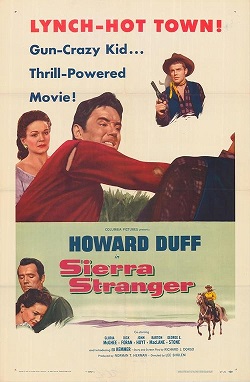
Sierra Stranger starts with a familiar western situation. Jess Collins (Howard Duff), a penniless but honorable drifter, comes across two men tying another man to the back of a horse. The two men claim that Sonny Grover (Ed Kemmer) is an outlaw and a claim jumper and not to be trusted. Sonny says that he’s innocent and the two men are actually the claim jumpers. Jess does what many a western hero has done. He sides with the underdog and saves Sonny. To thank him, Sonny gives Jess a part of his claim.
Jess rides into the nearby town to claim his new property. He meets and befriends Sonny’s half-brother, Bert (Dick Foran). He also meets and falls in love with Bert’s fiancée, Meg (Gloria McGeehee). However, soon after arriving, Jess discovers that he made a mistake and he saved the wrong man. Sonny really is the dangerous outlaw that everyone says he is. After Sonny robs a stagecoach and murders the driver, Jess risks his new friendship with Bert by trying to bring Sonny to justice.
Howard Duff appeared in his share of B-westerns in the 50s. He was always a solid hero, even if he didn’t really have the screen presence of some of the other stars of the genre. He’s pretty good in Sierra Stranger and the fact that, for once, the town is right while the drifter is wrong is an interesting twist on an otherwise standard story. This is the rare western where the hero makes a pretty big mistake and then has to spend the rest of the movie trying to make up for it. If you’re not a western fan, this is not the type of B-movie that’s going to change your mind. But, for those who do like the genre, it’s an interesting twist on what we’ve been led to naturally expect.
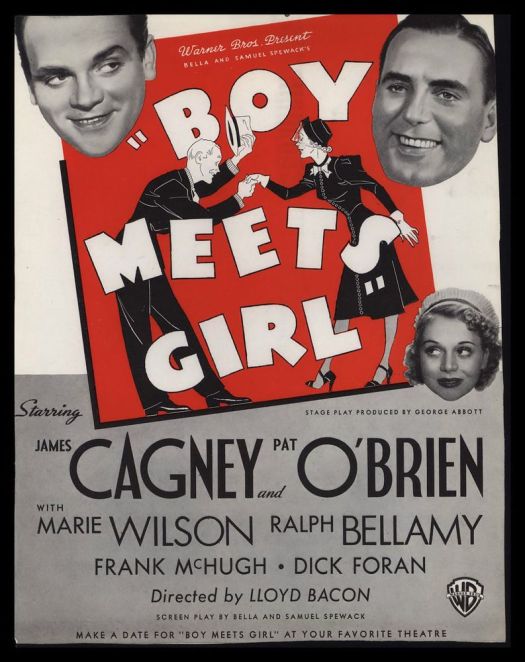
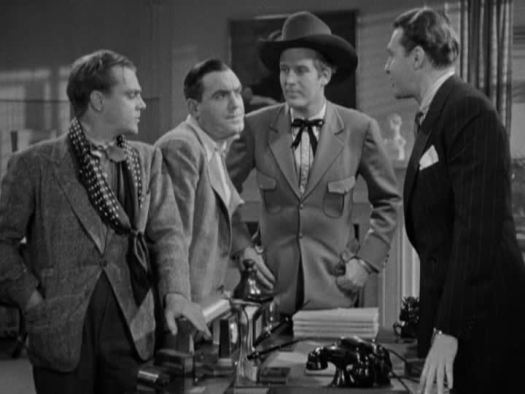
Tomorrow’s the day when everybody’s Irish, and America celebrates St. Patrick’s Day! The green beer will flow and copious amounts of Jameson will be consumed, the corned beef and cabbage will be piled high, and “Danny Boy” will be sung by drunks in every pub across the land. Come Monday, offices everywhere will be unproductive, as all you amateur Irishmen will be nursing hangovers of Emerald Isle proportions. They say laughter is the best medicine, so my suggestion is to start your workday watching an underrated screwball comedy called BOY MEETS GIRL, starring James Cagney and Pat O’Brien, both members in good standing of “Hollywood’s Irish Mafia”!
Jimmy and Pat play a pair of wacky screenwriters working for Royal Studios on a vehicle for fading cowboy star Dick Foran. Pretentious producer Ralph Bellamy has enough problems without these two jokers, as rumor has it Royal is about to be sold…
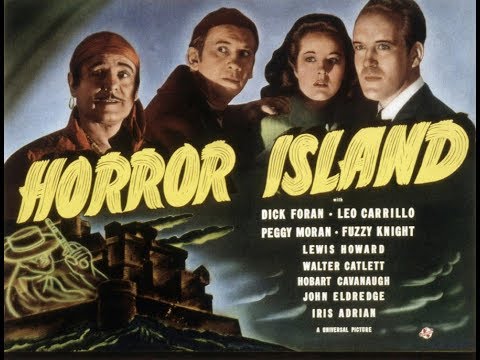
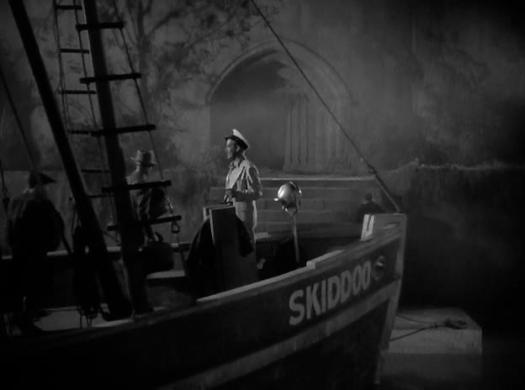
Universal Pictures kept cranking out the horrors, but HORROR ISLAND isn’t one of them. It’s as misleading a title as Hollywood ever produced, more of a comedy/mystery with some “old dark house” elements thrown in for good measure. This little ‘B’ was released as a double feature with MAN MADE MONSTER, and while its good for what it is, it ain’t horror!
Atmospherically directed by George Waggner and shot by Universal workhorse Woody Bredell , HORROR ISLAND begins spookily enough with a peg-legged sailor trodding the docks attacked by the mysterious Phantom. Rescued from the briny water by hard-pressed for cash entrepreneur Bill Martin and his pal Stuff Oliver, we learn the sailor is Tobias Clump, a Spaniard who claims he has half a map of Sir Henry Morgan’s buried treasure – and The Phantom just stole the other half! Bill happens to have inherited Morgan’s Island, where twenty…
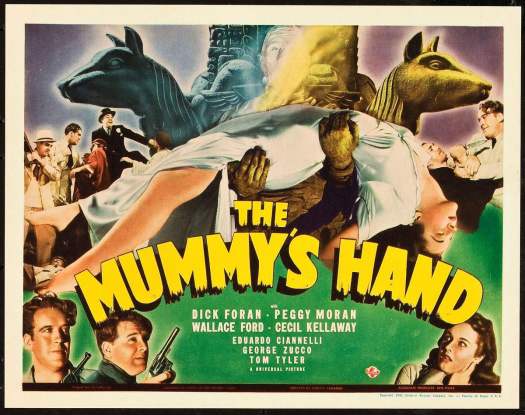
Universal revived The Mummy in 1940’s THE MUMMY’S HAND, but except for the backstory (and judicious use of stock footage), there’s no relation to the 1932 Karloff classic . Instead of Imhotep we’re introduced to Kharis, the undead killing machine, as the High Priest of Karnak (Eduardo Cianelli in old age makeup) relates the tale of Princess Ananka, whose tomb is broken into by Kharis, who steals the sacred tanna leaves to try and bring her back to life. Kharis gets busted, and is condemned to be buried alive! For he “who shall defile the temple of the gods, a cruel and violent death shall be his fate, and never shall his soul find rest for all eternity. Such is the curse of Amon-Ra, king of all the gods”. So there!
The High Priest croaks, making Andoheb (George Zucco ) the new High Priest. Meanwhile in Cairo, Americans Steve…
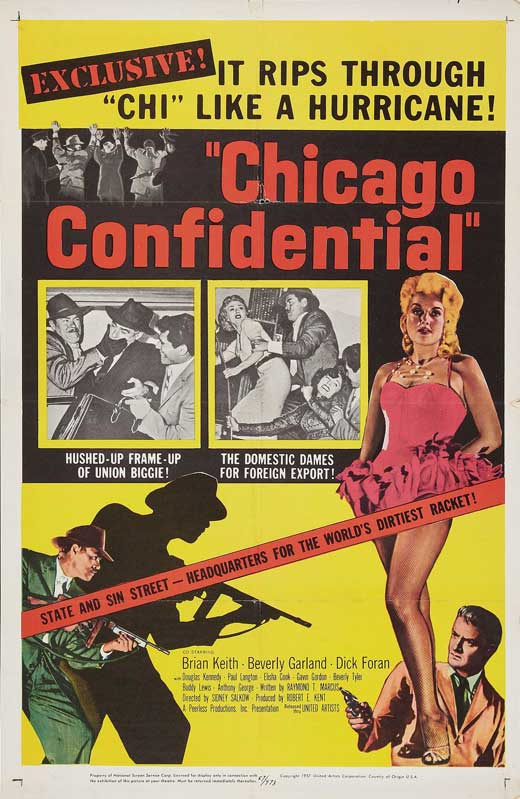
CHICAGO CONFIDENTIAL is just a routine ‘B’ crime drama, one of many churned out in the 50’s. Yet the performances of stars Brian Keith , Beverly Garland , and an above-average supporting cast helped elevate the by-the-numbers material into something watchable. It’s those Familiar Faces we all know and love from countless movies that made CHICAGO CONFIDENTIAL work for me.
The story revolves around racketeers muscling in on the Worker’s National Union so they can bring their “numbers rackets and ‘B’ girls” to the city. Politically ambitious State’s Attorney Jim Fremont is dead set on busting them up, and when the union’s treasurer is murdered, the finger of suspicion is pointed at honest Union President Artie Blane. Blane’s been framed by his rival, VP Ken Harrison, who takes his orders from “disbarred attorney” Alan Dixon, “one of the masterminds of the old Capone gang”. Blane is brought to trial and, thanks to some chicanery by an “old derelict” with the…
Last night, after I finished watching My Sweet Audrina, I decided to watch one more film off of the DVR. Seeing as how I had already watched a coming-of-age drama, a classic war film, and a Lifetime melodrama, I decided that my final film of the night would be 1938’s Four Daughters. According to the plot description, it was the story of four musically talented sisters and their father. It sounded nice and undemanding.
I recorded Four Daughters off of TCM, where it was shown as a part of the 31 Days of Oscar. When it originally aired, I was warned about it by some of my fellow Oscar fanatics. They all told me that it was an okay movie but it was nothing special. “Don’t let the best picture nomination fool you!” they all said. And, it’s true that the Four Daughters is one of the more forgotten best picture nominees. Go check out the list of external reviews on the imdb and you’ll see that only a handful of reviews have been posted for Four Daughters.
But you know what? I liked Four Daughters. Yes, when compared to some of the other films that have been nominated for best picture, Four Daughters may seem rather slight. Just compare it to some of the other films that were nominated for best picture of 1938: Grand Illusion, The Adventures of Robin Hood, Jezebel, and the winner, You Can’t Take It With You. Interestingly enough, Michael Curtiz directed both The Adventures of Robin Hood and Four Daughters. Curtiz was nominated for directing Four Daughters, though Robin Hood is certainly the better regarded film.
And yet, with all that in mind, Four Daughters is still a perfectly charming and rather sweet movie. Adam Lemp (Claude Rains) is a musician who loves classic music. He has four daughters, all of whom are musically talented. The oldest, Emma, is played by Gale Page while the other three daughters are played the Lane Sisters, who were apparently a very popular singing act in the 30s. Lola Lane plays Thea Lemp, Rosemary Lane plays Kay Lemp, and the youngest daughter, Ann, is played by Priscilla Lane.
While the film was obviously designed to capitalize on the popularity of the Lane Sisters, it’s not all just music and performing. The Lemps also own a boarding house, which is frequently visited by potential suitors. While Kay Lemp struggles with whether or not to accept a music scholarship and leave home, Emma is pursued by Ernest (Dick Foran) and Thea is courted by Ben (Frank McHugh), a wealthy older man.
And then there’s Ann, the youngest daughter and the one to whom I most related. Despite saying that she never wants to marry, Ann finds herself being pursued by two men. One of them is a composer named Felix Deitz (Jeffrey Lynn). The other is Felix’s best friend, Mickey (John Garfield).
John Garfield was one of the first Method actors to make the transition from stage to screen. (It’s generally argued that, in the beginning, Paul Muni begat John Garfield who begat Montgomery Clift who begat Marlon Brando who begat Robert De Niro who begat Leonardo DiCaprio.) Four Daughters was one of his first major roles and it also provided him with his first Oscar nomination. It’s interesting to contrast Garfield’s brooding and internalized performance with the somewhat more bland actors who play the other suitors. He grounds Four Daughters, giving the film a necessary jolt of reality.
However, I have to admit that my main reason for liking Four Daughters is a personal one. I am the youngest of four sisters and there was so much about Four Daughters that I related to. (I saw a lot of myself in Ann Lemp.) From the opening scenes of the sisters fighting and laughing at the same time to the countless scenes of the sisters supporting each other, Four Daughters gets it right. The film may have been made in 1938 but sisterhood is eternal.
In the end, I glad that I took the time to record and watch Four Daughters. It’s a sweet movie, one that will be enjoyed by sisters everywhere.
Did you know that 75% of people are sick of hearing the results of polls about what people think about other polls? It’s true!
Me, I first got sick of polls back in 2012. That was when, every day, everyone on twitter would be talking about the result of another political poll. A poll would come out showing that Obama was ahead of Romney in the presidential election and all of my Republican friends would immediately start tweeting about why the poll could not be taken seriously. Then 2014 came along and polls started to show that the majority of American citizens did not approve of the job Obama was doing. And all of my Democrat friends would immediately start tweeting about why those polls could not be trusted.
As for me, I was always more concerned with what the polls said over on Rotten Tomatoes. Really?I would think. Only 35% of critics gave California Scheming a good review? 67% of moviegoers want to see the new Transformers film?
Oh my God, I thought, those numbers have to be so fake…
Because, let’s face it. The only time that we believe a poll is when we agree with it. Otherwise, we assume that they’re either the result of subtle manipulation, selective interpretation, or just completely and totally untrue.
Believe it or not, this suspicion is not a new phenomena. I’ve always felt that you can learn a lot about history by watching the movies. That doesn’t mean that movies are historically accurate. One need only read my review of Magnificent Doll to see that. However, movies do reflect the culture and concerns of the time in which they were made.
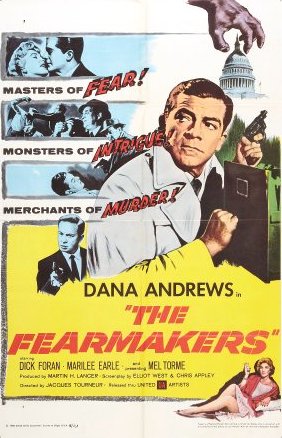
For instance, The Fearmakers was made in 1958 and it shows that not only has polling been around for a while but so has the fear of being manipulated by a fraudulent poll.
In The Fearmakers, Dana Andrews plays Alan Eaton. Before the start of the Korean War, Alan owned one of the best and most respected polling firms in Washington D.C. However, while serving in the army during the war, Alan was captured and held prisoner by the Chinese. After years of being tortured and perhaps brainwashed, Alan is finally released.
He returns to an America that is far different from the country that he left. For instance, while on a flight to Washington, D.C., he finds himself sitting next to a shifty scientist (Oliver Blake) who tries to convince Alan to support a group that believes in nuclear disarmament. Even worse, once the plane lands, Alan discovers that he’s been forced out of his polling firm and that his partner has died under mysterious circumstances.
The firm’s new owner, the outwardly friendly, inwardly cold-hearted Jim McGinnis (Dick Foran), offers to hire Alan as a special consultant. Alan is at first resistant but then he has a meeting with his old friend, Senator Walder (Roy Gordon). Walder explains that he suspects that Alan’s old polling firm has been infiltrated by outside forces and that it might be using its polling to try to push communist propaganda on the American people. Alan agrees to work for Jim and to help track down any and all subversives….
The Fearmakers is better than it sounds. Beyond the fact that the story remains relevant in our poll-driven times, it was directed by Jacques Tourneur, who directed several atmospheric and intelligent horror films in the 30s and 40s. He brings a similar atmosphere of doom to The Fearmakers. Perhaps the film’s best scenes are the ones where Tourneur just focuses his camera on Andrews’s face while Alan struggles to understand the country to which he has returned. As played by Andrews, Alan is troubled and hardly your typical hero. You’re never quite sure how much of the film’s danger is real and how much of it is just the result of Alan’s own paranoia.
I first saw The Fearmakers on Netflix. The next time you’ve got 84 minutes to kill, check it out.
 Deputy Marshal Ed Garry (Jon Hall) is pursuing two bank robbers in Wyoming when he comes across a wounded man. Harley Masters (Wheaton Chambers) has been shot in the gut but his main concern is holding onto his hat. Ed takes Harley into town. They go into the local saloon, where Harley reveals a map hidden in his hat. He slips the map to Ed before an unseen gunman shoots him a second time. This time, Harley does not survive.



 Through the Shattered Lens