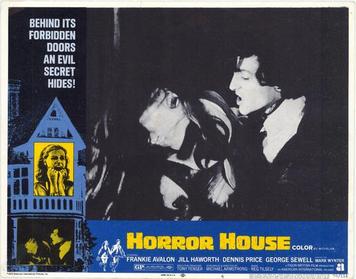
First released in 1969, The Haunted House of Horror features a group of 20-somethings who, bored with the usual parties, decide to that it might be a kick to hang out in a supposedly haunted mansion. Once they’re in the mansion, they decide that it might be even more fun to hold a seance!
(Seriously, what is the deal with people holding séances in haunted mansions? That really seems like the last place where you would want to mess with potentially malevolent spirits!)
The party becomes much less fun once someone starts killing off the group, one-by-one.
This film is notable for two reasons. First off, it features Frankie Avalon in one of his attempts to break free of his Beach Party typecasting. Secondly, the role of Richard, who is played by Julian Barnes, was originally offered to a young singer named David Bowie. Reportedly, Bowie was quite excited about doing the film but, in the end, the producers worries that he and Frankie Avalon would not get along. I’m not sure why. David Bowie had a sense of humor and, judging from his Casinocameo, so does Frankie.
They had the hook in me, and I was caught like a large mouth bass. The bait was the stuff my dreams were made of, a heady concoction of gangsters and femmes fatale, of faded Hollywood stars and references to Mickey Spillane and Ross MacDonald. I had let my guard down and plunged headlong into the trap, forgetting you can’t judge a book by its cover, especially one luridly titled PULP.
It all started so promisingly. I was introduced to Mickey King, a second-rate English hack writing under the pseudonym “Guy Strange”, scribbler of paperback trash like “Kill Me Gently” and “My Gun is Long”. Mick’s paid a visit by a gravel-voiced goon called Dinuccio, a Neanderthal throwback who hires the wordsmith to ghost a biography for his mysterious boss. Next thing Mickey knows, he’s on a tour bus and told he’ll be contacted. An American named Miller could be the one, but Miller…
The 1948 film Good Time Girl is currently available on Netflix and I have to admit that, based on the name alone, I was expecting it to be another somewhat campy exploitation film about juvenile delinquency, something along the lines of Damaged Lives and Gambling With Souls.
And that’s certainly how the film began. A troubled teenager named Lyla (Diana Dors) has been arrested and is sent to the juvenile court where the concerned Miss Thorpe (Flora Robson) tells Lyla that if she doesn’t change her ways, she could end up just like Gwen Rawlings. Who is Gwen Rawlings? That’s what we spend the rest of this short film finding out.
The film shows how Gwen (Jean Kent) was raised in an abusive household and how, at the age of 16, she ran way from home. The first person she met was the handsome and charming Jimmy (Peter Glenville) who turns out to be a low-level gangster. (His pinstrip suit and mustache give him away.) Jimmy gets Gwen a job as a hat-check girl at a club run by the enigmatic Maxey (Herbert Lom). Gwen meets and falls in love with a musician named Red (Dennis Price) but Red explains that he’s not only too old for her but he’s married as well. Soon, Gwen is living with Jimmy and Jimmy is regularly abusing her. When Maxey sees that Jimmy has given her a black eye, he has Jimmy beaten up and fired. Jimmy responds by slashing Maxey’s face and then framing Gwen for jewelry theft.
Gwen is sent to reform school, where she falls under the influence of the somewhat demonic Roberta (played, in a genuinely menacing performance, by Daniel Day-Lewis’s mother, Jill Balcon). Reform school only succeeds in making Gwen tougher and angrier. When a mini-riot breaks out in the cafeteria, Gwen takes advantage of the confusion and escapes.
Back on the streets and with the police searching for her, Gwen falls in with a succession of different criminals. When she meets two military deserters, it leads to the type of tragedy that could just as easily befall Lyla if Lyla doesn’t change her ways.
This is one of those films where the worst possible thing that could happen always happens and, as a result, it’s all rather melodramatic. But, as opposed to a film like Reefer Madness or Sex Madness, it never gets so melodramatic that it becomes implausible. Instead, it’s actually a very watchable portrait of people living on the margins of acceptable society. Director David MacDonald fills the screen with menacing images and the pace never lags. The film is also full of great performances from character actors that you’ll probably recognize from countless Hammer horror films. Herbert Lom is especially impressive as the quietly intimidating Maxey.
I wasn’t expecting much from Good Time Girl but it’s definitely worth watching.


 Through the Shattered Lens