In Praise of Easy Rider’s Captain America


1969 was a watershed year for both America and the movies.  While the war in Viet Nam dragged on and turmoil raged at home, movie audiences watched as two generations of Fondas appeared in movies about the American dream.  In Sergio Leone’s Once Upon A Time In The West, Henry Fonda played Frank, a gunslinger so ruthless that he shoots a child during his first scene.  In They Shoot Horses, Don’t They?, daughter Jane Fonda played a woman struggling to survive the Great Depression.  And, in Easy Rider, Peter Fonda played Captain America.

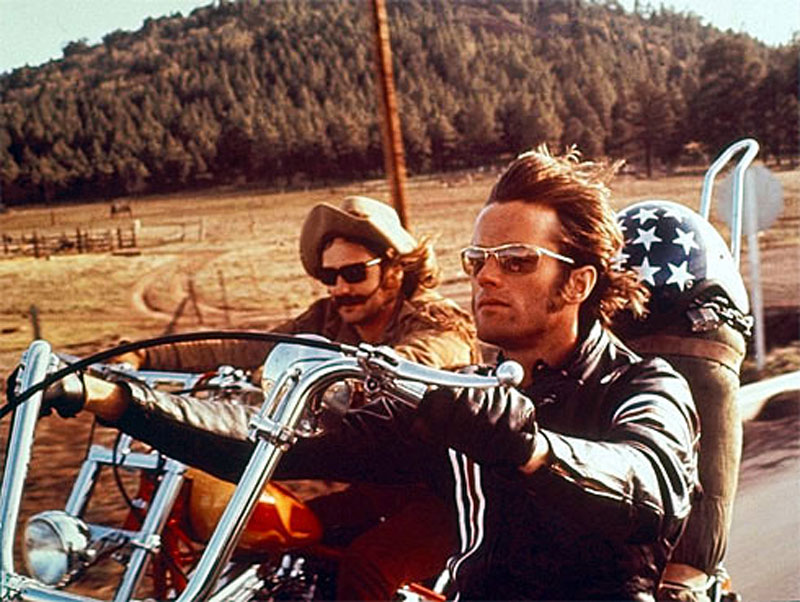
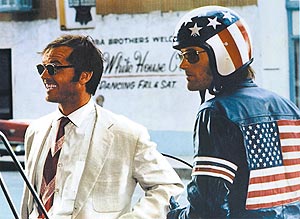
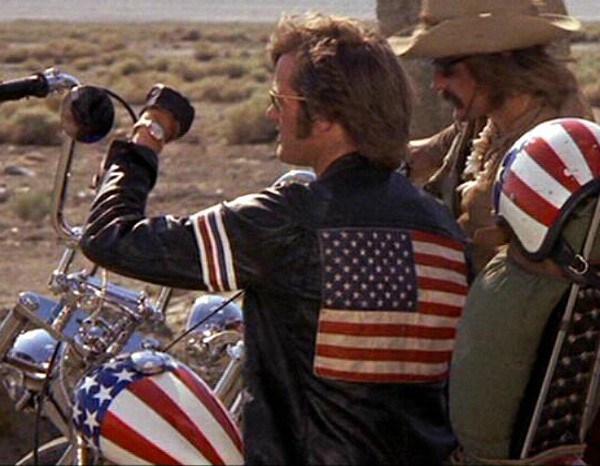
Peter FondaThe Captain America of Easy Rider should not be mistaken for the super soldier played by Chris Evans.  Instead, this Captain America is actually Wyatt Williams, a motorcycle rider who is planning on going to Mardi Gras with his friend Billy (Dennis Hopper, who also directed).  Wyatt is nicknamed Captain America because he wears a leather jacket with an American flag on the back.  It is an appropriate nickname because Wyatt represents everything that is good about America.

When we first meet Captain America, he and Billy are engaged in a business transaction, bringing to mind the old saying that the business of America is business.  They are selling cocaine to none other than Phil Spector.  Taking Spector’s money, Wyatt stuffs it into a plastic tube that he keeps hidden in his motorcycle’s fuel tank.  It is no coincidence that the fuel tank is decorated with the stars and bars.

Peter-Fonda-and-Dennis-Hopper-in-Easy-RiderHaving made their money, Wyatt and Billy ride across the country to celebrate.  At the start of their journey, Wyatt takes off his watch and leaves it on the ground, declaring that time has no meaning to a man who has freedom.  If you replaced their motorcycles with horses, there would be little to distinguish Wyatt and Billy from the American outlaws who might show up in an old Henry Fonda western.

On their way to New Orleans, Wyatt and Billy interact with many different people.  If the always paranoid and nervous Billy represents America’s worst impulses, Wyatt represents the best.  When Wyatt and Billy eat dinner with a rancher and his family, Wyatt alone appreciates what the rancher has accomplished and says, “You’ve got a nice place. It’s not every man that can live off the land, you know. You do your own thing in your own time. You should be proud.”  When they later stop off at a ramshackle hippie commune, Wyatt is the one who says, in the best tradition of American optimism, that “They’ll make it.”

EasyRider2When they stop to pick up a hitchhiker and then later when alcoholic lawyer George Hanson (Jack Nicholson) joins them on their trip, it’s always Wyatt who volunteers to share his bike.  (Billy always rides alone.)  Whenever they stop for the night, it is always the generous Wyatt who offers to share his grass with whomever is traveling with them.  When George smokes for the first time, Wyatt is the one who teaches him.  It is the stoned George who tells Wyatt and Billy that they represent freedom.

It is only after George is beaten to death by a group of rednecks that Wyatt loses his optimistic outlook and his generous spirit.  George’s death opens Wyatt’s eyes in much the same way that the turmoil of the 1960s did for the rest of America.  After George’s murder, Wyatt loses his faith in himself.  When he and Billy reach New Orleans, Mardi Gras is a letdown.  When he takes the acid that was given to him by the hitchhiker, Captain America’s journey becomes a bad trip both figuratively and literally.

0603-peter-fonda-and-easy-riderjpg-b0f5351afb0a53df_mediumWhile Billy insists that they had a great time in New Orleans (in much the same way that some insist that America is just as strong a nation as it has ever been), Wyatt knows the truth.  “We blew it,” Wyatt says, speaking for the entire nation.

Despite his mistakes and despite having blown it, Wyatt, much like America itself, remains good at heart.  When Captain America dies at the end of the film, it is because he is trying to protect his friend Billy.  In the best American tradition, he sacrifices himself to protect another.

This Independence Day, let us all take a few moment to appreciate Wyatt Williams, the man known as Captain America.

Wyatt Williams (aka Captain America) RIP

Wyatt Williams (aka Captain America) RIP


Embracing the Melodrama Part II #64: Out of the Blue (dir by Dennis Hopper)


Out_of_the_Blue_Film“Subvert normality.”

— Cebe (Linda Manz) in Out of the Blue (1980)

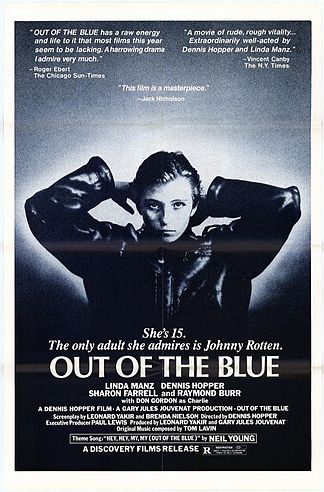
The 1980 Canadian film Out of the Blue opens with a terrifying scene.  Don Barnes (Dennis Hopper), drinking a beer and playing with his daughter while driving a truck, crashes into a school bus.  The bus is full of children, many of whom are seen being thrown into the air as the truck literally splits the bus in half.

Don is sent to prison.  His wife, Kathy (Sharon Farrell), becomes a drug addict.  His daughter, Cebe (Linda Manz), grows up to be an angry and alienated teenager.  Cebe spends her time either aimlessly wandering around her economically depressed hometown or else ranting about the phoniness of society to anyone who will listen (and quite a few who won’t).  Much like the killer cops in Magnum Force, all of her heroes are dead.  Occasionally, she sees a pompous therapist (Raymond Burr) whose liberal humanism turns out to be just as empty as the reactionary society that Cebe is striking out against.  Cebe’s heroes are Elvis, Sid Vicious, and her father.

When Don is finally released from prison, he returns home and he announces that he’s straightened out his life.  He promises that he’ll stay sober and he’ll be a good father.  That, of course, is all bullshit.  Soon, Don is struggling to hold down a job and spending his time drinking with his friend Charlie (Don Gordon).  Anyone who has ever had to deal with an alcoholic father will be able to painfully relate to the scenes where Don goes from being kind and loving to demonic in a matter of seconds.

Eventually, it all leads to a violent ending, one that is powerful precisely because it is so inevitable.

Out of the Blue is one of my favorite films, one that I relate to more than I really like to admit.  Directed in a raw and uncompromising manner by Dennis Hopper, Out of the Blue is a look at life on the margins of society.  And while some would argue that not much happens in the film between the explosive opening and the equally explosive ending, nothing needs to happen.  The power of the film comes not from its plot and instead from the perfect performances of Linda Manz, Dennis Hopper, Sharon Farrell, and Don Gordon.  Only Raymond Burr feels out of place but there’s a reason for that.

As much as I love Out of the Blue as a movie, I love the story of its production as well.  Originally, Out of the Blue was to be your typical movie about a rebellious teen who is saved by a patient and compassionate counselor.  Dennis Hopper was originally just supposed to co-star.  However, after the shooting started to run behind schedule, the film’s original director was fired.  Hopper talked the producers into letting him take over as a director.

This was the first film that Hopper was allowed to direct since the 1971 release of the infamous flop, The Last Movie.  Hopper, who was then best known for his drug use and his alcoholism, promised to be on his best behavior.  However, he then proceeded to secretly rewrite the entire film.

When Raymond Burr showed up to shoot his scenes, he was under the impression that he was still the star of the film.  Hopper essentially proceeded to shoot two separate films.  One film followed the original script and starred Raymond Burr.  The other was Hopper’s vision.  When it came time to take all of the footage and edit together the film that would be called Out of Blue, only two of Burr’s scenes made it into final cut and, in both of those scenes, Burr’s character is portrayed as being clueless.

Out of the Blue is not a happy film but it’s a good one.  More people need to see it.

Shattered Politics #84: Swing Vote (dir by Joshua Michael Stern)


Swing_vote_08

Have you ever heard the old saying about how one vote can make all the difference?  I’ve always had to laugh whenever I hear that because I know that, every election, my sister Melissa is going to cancel out my ballot by voting the exact opposite of how I vote.  As a result, even though I’ve participated in almost every election since 2004, my vote has hardly ever really mattered.

(Then again, neither has my sister’s….)

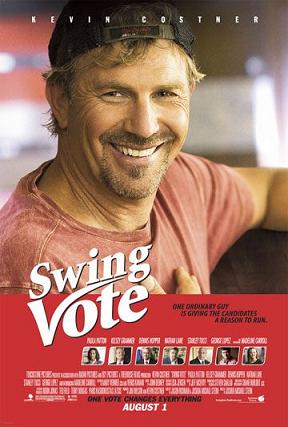
But anyway, the idea of one vote making all of the difference is taken to its logical extreme in the 2008 comedy Swing Vote.  In Swing Vote, a presidential election comes down to who wins the state of New Mexico.  And who wins the state of New Mexico will be determined by just one vote.  You see, the popular vote in New Mexico is tied between the two candidates but it turns out that, due to a voting machine error, one man’s vote has not been counted.  And now, that man has ten days to recast his vote.

(Why does he have ten days?  Mostly because there would not be a movie if they just said, “Please cast your vote again…now!”)

Of course, the problem is that the guy never cast a vote in the first place.  Instead, his vote was cast by his daughter (Madeline Carroll), who basically committed an act of vote fraud and violated federal law.  But it’s cute because she’s super precocious and she just wants her Dad to stop being such a fuck-up.

Oh, did I mention that?

That’s right — the fate of America is in the hands of a complete and total fuck-up.  His name is Bud and he’s played by Kevin Costner.  He’s a rather stupid guy who has never been responsible a day in his life.  He’s also a former felon, which really should have made him ineligible to vote in the first place.  And, on top of that, he’s the type of alcoholic who promises his little girl that he’ll meet her at a scheduled place and time and then proceeds to get drunk inside.

OH MY GOD, WHAT A GREAT GUY!

But, we’re supposed to like Bud because he’s played by Kevin Costner and I really don’t get that logic.  I always find it odd that, every year, we hear about how Kevin Costner is going to be in a few dozen films and how they’re all going to be hits and he’s suddenly going to be a big star again.  I’m never quite sure why people are excited about this prospect.  Whenever I see Costner on-screen (which, admittedly, doesn’t happen that often), I’m always struck by the fact that, regardless of the role, he really does come across as being an asshole.  That really does seem to be his screen presence.  That’s certainly the case in Swing Vote.

And maybe that’s the point of the film.  Be sure to vote so that the fate of America doesn’t end up in the hands of Kevin Costner.

That said, I will say that Swing Vote deserves some credit for casting Kelsey Grammer as the President and Dennis Hopper as his opponent.  Personally, I probably would have voted to reelect Kesley but I think Dennis would have done a good job as well.

(By the way, if ever do find yourself watching Swing Vote, imagine how much funnier the film would have been if it ended with Costner casting his vote and then announcing, “I voted third party!”)


Horror on TV: Twilight Zone 4.4 “He’s Alive”


TheTwilightZoneLogo

Tonight’s episode of the Twilight Zone was originally broadcast on January 24th, 1963 and it’s one of the rare hour-long episodes of the original Twilight Zone. In He’s Alive, a very young Dennis Hopper plays Peter Vollmer, an aspiring Neo-Nazi who isn’t having much luck bringing fascism to America until he meets a mysterious benefactor who teaches him the tricks of the trade.

It’s a pretty good (if heavy-handed) episode, distinguished by both Dennis Hopper’s lead performance and a message that is probably even more relevant today than when the show was first broadcast.

This episode was written by Rod Serling and directed by Stuart Rosenberg.

Back to School #43: River’s Edge (dir by Tim Hunter)


In his film guide, Heavy Metal Movies, Mike McPadden describes the disturbing 1987 teen crime drama River’s Edge as being “666 Candles“.  It’s a perfect description because River’s Edge appears to not only be taking place in a different socio-economic setting than Sixteen Candles and The Breakfast Club but perhaps on a different planet as well.

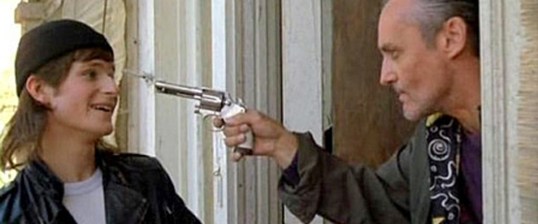
River’s Edge opens with a close-up of a dead and naked teenage girl lying on the edge of a dirty, polluted river and it gets darker from there.  The dead girl was the girlfriend of the hulking John Tollet (Daniel Roebuck, playing a character who is miles away from his role in Cavegirl).  As John explains to his friends, he strangled her for no particular reason.  His friends, meanwhile, respond with detachment.  Their unofficial leader, the hyperactive Layne (Crispin Glover), insists that since nothing can be done about the dead girl, their number one concern now has to be to keep John from getting caught.  While Layne arranges for John to hide out with a one-legged drug dealer named Feck (Dennis Hopper), two of John’s friends, Matt and Clarissa (played by Keanu Reeves and Ione Skye), consider whether or not they should go to the police.  Oddly enough, John really doesn’t seem to care one way or the other.

Seriously, River’s Edge is one dark film.  If it were made today, River’s Edge would probably be directed by someone like Larry Clark and, in many ways, it feels like a distant cousin to Clark’s Bully.  The teenagers in River’s Edge live in a world with little-to-no adult supervision.  Matt’s mom is more concerned with whether or not Matt has been stealing her weed than with the fact that Matt might be covering up a murder.  The local high school teacher is a former hippie who won’t shut up about how much better his generation was compared to every other generation.  In fact, the only adult with any sort of moral code is Feck and he’s usually too busy dancing with a sex doll to really be of much help.  It’s a world where no one has been raised to value their own lives so why should they care about a dead girl laying out on the banks of the river?

The film features good performances from Keanu Reeves, Ione Skye, and Daniel Roebuck but really, the entire movie is stolen by Crispin Glover and Dennis Hopper.  In the role of Layne, Glover is a manic wonder, speaking quickly and gesturing even when he isn’t making a point.  When Layne first shows up, he seems like he’s just overly loyal to his friend John but, as the film progresses, it becomes more apparent that he’s less concerned about protecting John and more interested in ordering other people to do it.  For Layne, protecting John is ultimately about maintaining power over Matt, Clarissa, and the rest of their friends.

As for Dennis Hopper — well, this is one of those films that you should show to anyone who says that Hopper wasn’t a great actor.  The role of a one-legged drug dealer who lives with a sex doll sound like exactly the type of role that would lead Hopper to going totally over-the-top.  Instead, Hopper gave a surprisingly subtle and intelligent performance and, as a result, he provided this film with the moral center that it very much needs.

Glover and Hopper


Back to School #4: Rebel Without A Cause (dir by Nicholas Ray)


You may have heard of this one.

Traditionally, films about teenagers tend to age terribly.  The language, the clothes, the attitudes, and even the humor; it’s all usually out-of-date within five years or so.  One need only watch something like A Summer Place to both see how dated a film can become and to see how one generation’s idol can appear rather ludicrous to future generations.  (And yes, I am talking about Troy Donahue…)  What makes Rebel Without A Cause unique is that it’s a movie about teenagers that was released way back in 1955 and yet, nearly 60 years later, it still feels fresh and relatable.

Of course, it helps that the title character is played by James Dean who, to put it lightly, was no Troy Donahue.

Rebel Without A Cause tells the story of three alienated teenagers trying to survive in the suburbs of Los Angeles.  (“…and they all came from good homes!” the film’s poster informs us.)  Plato (Sal Mineo) is a painfully sensitive 15 year-old who has been abandoned by his parents and is being raised by the family’s maid.  (Since this movie was made in 1955, the fact that Plato is gay is obvious but never explicitly stated.)  Judy (Natalie Wood) is the girlfriend of Buzz (Corey Allen) and is acting out because she feels that’s the only way she can can get her father to pay attention to her.  And then there’s Jim Stark (James Dean), whose family has just moved to Los Angeles and who is constantly in the middle of the fights between his overbearing mother (Ann Doran) and his weak-willed father (Jim Backus).

Rebel Without A Cause 2

During Jim’s first day at high school, he not only manages to make an enemy when Buzz spots him attempting to flirt with Judy but he also gets to go on a field trip to the Griffith Observatory, where the students are told that the entire universe is going to end eventually.  After the field trip, Buzz challenges Jim to a knife fight.  Jim agrees only after the rest of Buzz’s gang (including a young Dennis Hopper) accuse him of being “chicken.”  However, after a security guard breaks up the fight, Buzz challenges Jim to a “chicken run.”

(People in the 50s were obsessed with chickens.)

That night, Jim and Buzz both drive stolen cars towards the edge of a cliff.  The first driver to jump out of his car loses.  Before they start their engines, Buzz smiles and tells Jim, “I like you.”  Yay!  Jim’s finally made a friend!  Uh-oh, Buzz just drove over the cliff and his car exploded!  Well, so much for that friendship.  Now, with Buzz’s gang swearing revenge and their parents incapable of understand what happened, Jim, Judy, and Plato are on the run.  They end up hiding out in an abandoned house and find a brief moment of happiness before the gang and the police show up to ruin everything.

NW-nataliewood-rebel-love

The challenge of reviewing Rebel Without A Cause is trying to find a new way to say what everybody already knows.  Rebel Without A Cause is a great film that’s distinguished by Nicholas Ray’s sensitive direction and James Dean’s iconic performance in the lead role.  Whenever I see Rebel Without A Cause, I’m always struck by just how much unexpected nuance there is Dean’s interpretation of Jim Stark.  We always think of James Dean as being the epitome of cool and I think we tend to forget that, at least in the beginning of the film, Jim is anything but that.  Instead, he’s awkward and shy.  His attempts to flirt with Judy lead to her calling him “a real yo-yo.”  As much as he tried to fit in with the rest of his classmates, he’s a permanent outsider.  (Just consider what happens with his infamous “moooo” during the presentation at the observatory.)  He has a lot to say but he doesn’t know how to say it and every time that he tries to express what he’s feeling, he’s ignored by adults who don’t have the patience to listen.  Dean brings such a raw intensity to these scenes that I always find myself wanting to reach out and hug him and tell him that everything’s going to be okay, even though I know that it’s not.  Even today, it’s still easy to see why every teenager in the 50s either wanted to be or to be with Jim Stark.

Also, whenever I watch the film, I’m reminded of how much I relate to the character of Judy.  I think that’s because, when I was 16, I might as well have been Judy.  Natalie Wood’s performance might not be as showy as James Dean’s but it’s equally effective.

Of course, one reason why Rebel Without A Cause has become iconic is because James Dean died shortly after filming ended.  (In fact, some of his scenes had to be redubbed by Dennis Hopper, who reportedly could do an exact imitation of Dean’s voice.)  It’s interesting to wonder what would have become of James Dean if he had lived.  Would he have continued to be one of our best actors or would he have eventually been forgotten or forced to appear on television?  Personally, I like to think that James Dean would have remained a great actor but he would have been too much of an iconoclast to remain in Hollywood.  Eventually, in my alternative universe, James Dean moved to Europe and teamed up with Klaus Kinski to star in a series of spaghetti westerns.  And they were great.

As for Rebel Without A Cause, it remains a great movie nearly 60 years after it was first made.  And really, what more needs to be said?

Rebel


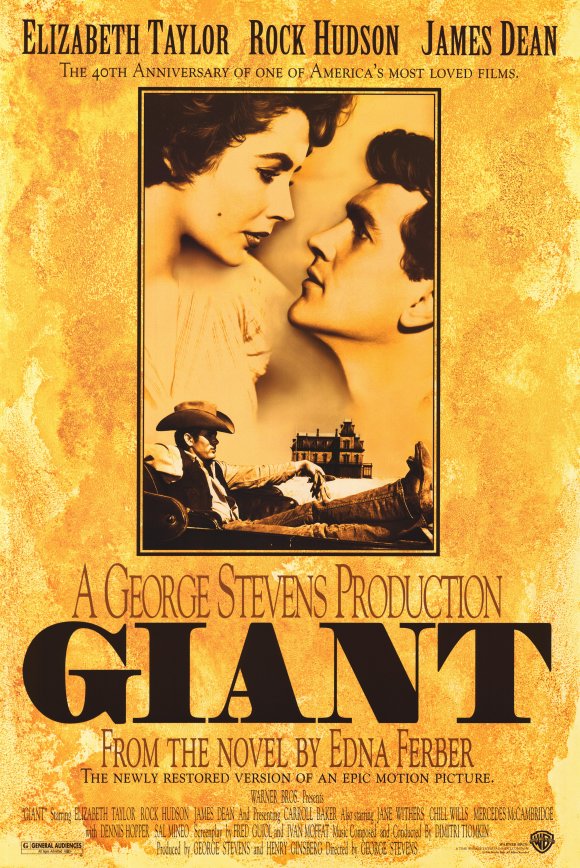
Embracing The Melodrama #12: Giant (dir by George Stevens)


Giant

Let’s continue to embrace the melodrama by taking a look at the 1956 best picture nominee, Giant.

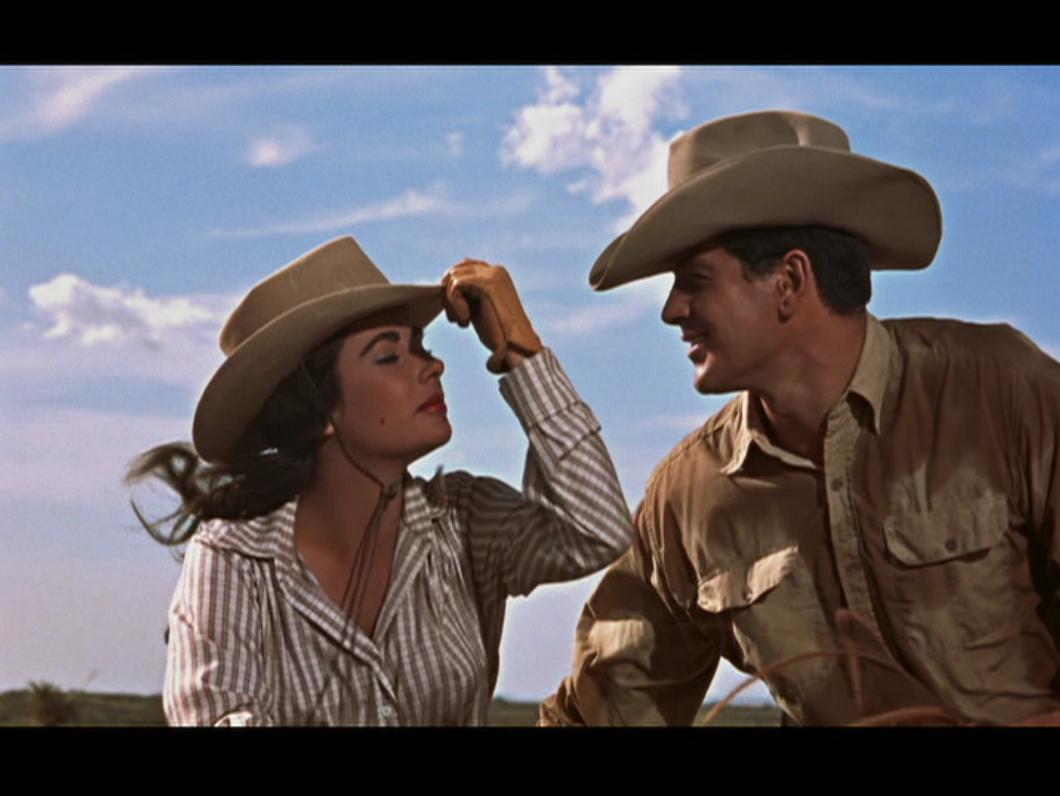
Giant is a film about my home state of Texas.  Texas rancher Bick Benedict (Rock Hudson) goes to Maryland to buy a horse and ends up returning to Texas with a bride, socialite Lesley Lynnton (Elizabeth Taylor).  At first, Lesley struggles to adapt to the harsh and hot Texas landscape.  Bick’s sister, Luz (Mercedes McCambridge) takes an instant dislike to Lesley and Bick is annoyed by Lesley’s concern over the living conditions of the Mexicans that work on Bick’s ranch.  It sometimes seems like the only person who appreciates Lesley is Jett Rink (James Dean), an ambitious ranch hand who secretly loves her and who is planning on becoming a rich man.  That’s exactly what happens when oil is found on the land around Bick’s ranch.  While Bick stubbornly clings to the past, oilman Jett represents both the future of Texas and the nation.  Meanwhile, Bick and Lesley’s son (played by a very young Dennis Hopper) challenges his father’s casual bigotry when he falls in love with a Mexican girl.

Taylor and Hudson

Giant is appropriately named because it is a huge film.  Clocking in at 201 minutes, Giant tells a story that spans several decades and features a big cast that is full of familiar faces, all struggling for their chance to somehow stand out from everyone else around them.  Even the film’s wonderful panoramic shots of the empty Texas landscape only serve to remind us of how big the entire film is.  To a certain extent, the size of Giant‘s production is to be understood.  In the 1950s, Hollywood was having to compete with television and they did this by trying to make every film into a major event.  You watch a movie like Giant and you practically hear the old Hollywood moguls shouting at America, “See!?  You can’t get that on your precious TV, can you!?”

For those of us watching Giant today, the length is both a blessing and a curse.  It’s a curse because the movie really is too damn long.  The opening scenes drag and many of them really do feel superfluous.  It’s hard not to feel that the real story doesn’t really start until about 90 minutes into the movie.  And once the story really does get started,  there’s still way too much of it for it all to be crammed into one sitting.  Oddly enough, you end up feeling as if this extremely long film is still not telling you everything that you need to know.  If Giant were made today, it would probably be a two-part movie on either HBO or Lifetime and it would definitely feature a lot more sex.

However, to be honest, one of the reasons that I did enjoy Giant was because it was as big as it was.  I mean, the film is about Texas so of course it should be a little excessive!  Everything’s bigger in Texas and that includes our movies.  Add to that, Giant may be too long but it uses that length to deals with issues that are still relevant today — oil, immigration, and racial prejudice.  Rock Hudson may not have been a great actor but he is at least convincing as he transitions from bigotry to tolerance.

But really, when it comes to Giant, most people are only interested in James Dean.  And they definitely should be because Dean gives a great and compelling performance here.  Dean brings all of the emotional intensity of the method to material that one would not naturally associate with method acting and the end result is amazing to watch.  Giant was released after Dean had been killed in that infamous car wreck.  I can only imagine what it must have been like to be sitting in a theater in 1956 and to see this compelling and charismatic actor towering above the world on the big screen while aware, all the time, that his life had already been cut short and he would never been seen in another film.

James Dean

Even better, Dean’s new style of acting clashes perfectly with Hudson’s old style of acting, making the conflict between Bick and Jett feel all the more real and intense.  Much as Bick represents old Texas and Jett represents the new Texas, Hudon and Dean represented the two sides of Hollywood: the celebrity and the artist.  Needless to say, Dean wins the battle but, surprisingly, Hudson occasionally manages to hold his own.

I can’t necessarily say that Giant is an essential film.  A lot of people are going to be bored by the excessive length.  But if you’re a fan of James Dean or if you’re from Texas, Giant is a film that you need to see at least once.

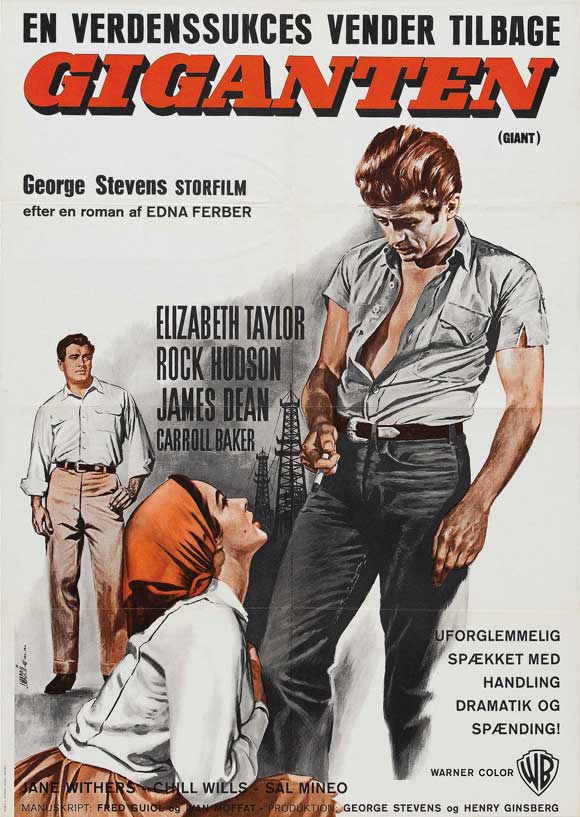
elizabeth_taylor_giant_swedish_movie_poster_2a

Horror On The Lens: Night Tide (dir by Curtis Harrington)


Night Tide

First released in 1961 and directed by Curtis Harrington, Night Tide stars a young Dennis Hopper as Johnny, an awkward sailor.  Johnny meets Mora (Linda Lawson), who works as a “mermaid” on the pier.  For Johnny, it’s love at first sight.  However, the more that Johnny pursues her, the more he learns about both her mysterious past and the dark fate of her previous boyfriends.

Night Tide is low-key and atmospheric gem of a movie, one that serve as an inspiration for low-budget filmmakers every where.  Lawson is perfectly cast as the enigmatic Mora but the film really belongs to Dennis Hopper.  Hopper’s naturally off-key presence made him perfect for the role of Johnny.

Night Tide is one of those low-budget movies that, because it’s in the public domain,  has been released on DVD (often in inferior form) by dozens of different companies.  Often times, films like this turn out to be fairly forgettable.  Night Tide, however, is an exception.

Artist Profile: Dennis Hopper (1936 — 2010)


Fractured Girl

Fractured Girl

Dennis Hopper was best known as an actor but he was also a prolific and influential sculptor, painter, and photographer.  He took up photography as a hobby in the 1960s and eventually became so acclaimed that he was even profiled in an issue of Better Home and Gardens Magazine as a “photographer to watch” for in the future.  Hopper was also an important art collector.

Below are some of my favorite Hopper photographs:

Double Standard

Double Standard

Andy Wahol

Andy Wahol

Bruce Conner (in tub), Toni Basil, Teri Garr, and Ann Marshall

Bruce Conner (in tub), Toni Basil, Teri Garr, and Ann Marshall

Donald Factor

Donald Factor

Larry Bell

Larry Bell

Paul Newman

Paul Newman

Tuesday Weld

Tuesday Weld

Biker Couple

Biker Couple

After the Fall

After the Fall

6 Trailers in Tribute to Roger Corman


On Thursday night, my twitter timeline briefly exploded when it was reported that legendary filmmaker Roger Corman had just passed away.  I immediately jumped over to Wikipedia and I saw that Roger Corman was officially listed as being newly deceased.  Quickly, I jumped back over to twitter and I tweeted, “R.I.P. to one of the most important figures in American film history — the legendary Roger Corman.”  I then sent out another tweet in which I pointed out that this meant that two of the men who has played senators in The Godfather, Part II — G.D. Spradlin and Roger Corman — had died this year and within months of each other.

Immediatly, one of my twitter friends tweeted back, “If only real Senators would die as quickly.” 

“Agck!” I thought to myself, “how do I respond to that?  If I get all offended or humorless, I might lose a follower.  If I say yes, that’s a good point, I might end up getting put on some sort of super secret government list…”

Even as I worried about my future as a subversive, I was thinking to myself that the best way I could pay tribute to the late Roger Corman was to devote my next edition of Lisa Marie’s Favorite Grindhouse and Exploitation trailers to his memory.  Yes, I decided, the next edition would have be all Corman, a celebration of the man, his life, and his movies…

And then it turned out that Roger Corman wasn’t dead.  Turns out that some idiot journalist named Jake Tapper tweeted that Corman was dead and that’s what set off a chain reaction of false assumptions and early tributes.  However, Roger Corman is still alive but you know me.  Once I get an idea in my head,  I have to see it through.  Letting things go is not one of my talents. 

So, with that in mind, here are 6 trailers in tribute to Roger Corman, who is not dead.

1) The Trip (1967)

In 1967, Roger Corman directed this film in which Peter Fonda plays a tv director who drops acid and ends up having a really bad trip.  The script was written by Jack Nicholson and Dennis Hopper plays a random guru guy.  Bruce Dern is in it too.  As far as drug movies go, The Trip is actually pretty good though it does indulge in some of the standard Renaissance Faire imagery that all movies seem to use whenever attempting to visualize an acid trip.

2) St. Valentine’s Day Massacre (1967)

I recently saw this movie, Roger Corman’s first “studio” film.  I have to admit that I thought it was a little bit slow but it had some fun performances and Jack Nicholson gets a memorable cameo where he explains why he dips his bullets in garlic.

3) The Intruder (1962)

In 1962, Roger Corman and William Shatner teamed up to make this look at racism and the people who exploit it.

4) The Raven (1963)

This is one of Corman’s famous Poe films.

5) The Wild Angels (1966)

Peter Fonda again.  In this seminal biker film, Fonda again costars with Bruce Dern.  Fonda’s girlfriend is played by Nancy Sinatra who, by the way, is one of the few celebs on twitter who will not only follow back but who will also actually respond to her followers.

6) It Conquered The World (1956)

Finally, let’s end things off with some truly old school Corman — It Conquered the World!  This was Corman’s 3rd film as a director and his first major success.

Here’s to you, Roger Corman!  Thank you for the movies and congratulations on still being with us.