Days of Paranoia: Serpico (dir by Sidney Lumet)


In 1973’s Serpico, Al Pacino plays a cop who doesn’t look like a cop.

Indeed, that’s kind of the start of Frank Serpico’s problems.  He’s a New York cop who doesn’t fit the stereotype.  When we see him graduating from the Academy, he’s clean-shaven and wearing a standard patrolman uniform and he definitely looks like a new cop, someone who is young and enthusiastic and eager to keep the streets safe.  However, Serpico is an outsider at heart.  The rest of the cops have their homes in the suburbs, where they spend all of their time with their cop buddies and where they go also go out of their way not to actually live among the people that they police.  Serpico has an apartment in Greenwich Village and, as a plainclothes detective, he dresses like a civilian.  He has a beard.  He has long hair.  He has a succession of girlfriends who don’t have much in common with the stereotypical (and there’s that word again) cop’s wife.  Serpico is an outsider and he likes it that way.  In a world and a career that demands a certain amount of conformity, Frank Serpico is determined to do things his own way.

However, the real reason why Serpico is distrusted is because he refuses to take bribes.  While he’s willing to silently accompany his fellow officers while they collect their payoffs from not only the people that they’re supposed to be arresting but also from the storeowners that they’re meant to be protecting, Serpico refuses to take a cut.  Serpico understands that the small, everyday corruption is a way of forcing his silence.  The corruption may help the cops to bond as a unit but it also ensures that no one is going to talk.  Serpico’s refusal to take part makes him untrustworthy in the eyes of his fellow cops.

Serpico and Bob Blair (Tony Roberts), a politically-connected detective, both turn whistleblower but it turns out that getting people to listen to the truth is not as easy as Serpico thought it would be.  The Mayor’s office doesn’t want to deal with the political fallout of a police conspiracy.  Serpico finds himself growing more and more paranoid, perhaps with good reason.  When words gets out that Serpico has attempted to turn into a whistleblower, his fellow cops start to turn on him and, during a drug bust, Serpico finds himself deserted and in danger.

Serpico opens with its title character being rushed to the hospital after having been shot in the face.  This actually happened to the real Serpico as well.  What the film leaves out is that hundreds of New York cops showed up at the hospital, offering to donate blood during Serpico’s surgery.  That’s left out of the film, which at times can be more than a little heavy-handed in its portrayal of Serpico as an honest cop surrounded by nonstop corruption.  Filmed just three years after Serpico testified before New York’s Knapp Commission (which was the five-man panel assigned to investigate police corruption in the city), Serpico the movie can sometimes seem a bit too eager to idealize its title character.  (Vincent J. Cannato’s excellent look at the mayorship of John V. Lindsay, The Ungovernable City, presents far more nuanced look at the NYPD corruption scandals of the early 70s and Serpico’s role as a whistleblower.)  Director Sidney Lumet later expressed some dissatisfaction with the film and even made other films about police corruption — The Prince of the City, Q & A, Night Falls On Manhattan — that attempted to take a less heavy-handed approach to the subject.

That said, as a film, Serpico works as a thriller and as a portrait of a man who, because he refuses to compromise his ideals, finds himself isolated and paranoid.  Al Pacino, fresh from playing the tightly-controlled Michael Corleone in The Godfather, gives an intense, emotional, and charismatic performance as Serpico.  (One can see why the image of a bearded, hippie-ish Pacino was so popular in the 1970s.)  Sidney Lumet brings the streets of New York to vibrant and dangerous life and he surrounds Pacino with an excellent supporting cast, all of whom bring an authentic grit to their roles.  Serpico may not be a totally accurate piece of history but it is a good work of entertainment, one that works as a time capsule of New York in the 70s and as a portrait of bureaucratic corruption.  It’s also the film in which Al Pacino announced that he wasn’t just a good character actor.  He was also a movie star.
Days of Paranoia: Glengarry Glen Ross (dir by James Foley)


“Always be closing!” Alec Baldwin shouts at a group of seedy salesman in 1992’s Glengarry Glen Ross and, as tempting as it can be to be snarky about Alec Baldwin, I have to admit that he delivered that line so well that even I briefly worried about my job and I was just watching the movie!

Baldwin plays Blake, the top salesman at a company that sells worthless real estate to people who are dumb enough or trusting enough to believe what its salesmen tell them about always pursuing their dreams.  Murray and Mitch, the never-seen but often-mentioned owners of the company, send Blake to the New York office to try to inspire its salesmen to stop whining about their terrible leads and to actually start selling.  Blake inspires through bullying.  Coffee isn’t for losers, he hisses.  The salesman who makes the most money will win a car.  The salesman who makes the second-most money will get a set of steak knives.  (Blake even brings the knives with him.)  Everyone else will get fired.  Blake’s speech and Baldwin’s cameo are justifiably famous.  Baldwin is only in the film briefly but he’s unforgettable, whether he’s bragging about how much his watch costs or if he’s holding up a pair of brass balls to tell the salesmen (and they are all men) what they’re lacking.  He not only attacks them for not being good at their jobs.  He also attacks their masculinity.  It’s a totally ludicrous speech but it works because the film is taking place in a ludicrous world, one where desperate men try to appear confident as they sell worthless land.

The only salesman who misses Blake’s speech is Ricky Roma (Al Pacino), who is busy conning a friendly but nervous fellow named James Lingk (Jonathan Pryce) out of his money.  Roma is probably the only salesman who could have stood up to Blake and that’s because Roma is the only one who has any confidence.  Roma’s on a streak.  Roma’s winning that car!

Dave Moss (Ed Harris) isn’t going to win that car.  Moss is steak knife bound.  Moss is bitter and angry and won’t stop talking about how he’s not being treated with enough respect by Murray and Mitch.  When the hated office manager, John Williamson (Kevin Spacey), hands out a bunch of leads, Moss is quick to point out that the leads are worthless.  When Williamson refuses to hand out the leads identifying prospective customers for the “Glengarry Heights Development,” Moss tells another salesman, the neurotic and weak-willed George Aaronow (Alan Arkin), that they should break into the office, steal them, and sell them to a competitor.  Aaronow isn’t a thief but Moss insists that, just because he listened to Moss talk about it, Aaronow is now legally considered to be an accomplice.

And then there’s Shelley Levene (Jack Lemmon), who used to be the top salseman but who is now a desperate mess, begging people to listen to his pitch and insisting that he’s only hit a temporary dry spell.  He has a sick daughter.  He needs the job and he needs the money and he needs the good leads.  Williamson offers to sell them to Levene but the two men then get caught up in arguing about the specifics.

Welcome to Mamet World.  Glengarry Glen Ross is a film adaptation of a David Mamet play so it’s not surprising that the film is about a group of men who can argue about anything.  The characters in this film talk a lot and the dialogue is so profane, angry, and desperate that it can be easy to overlook that it’s often very funny as well.  Roma is having fun.  He loves his job, even when he’s yelling at Williamson for ruining a possible sale.  Even when the salesmen come to the office and discover that someone has robbed the place and that they’re now all suspects, they continue to try to outhustle everyone around them.  Roma tries to sell Lingk on some worthless land.  Aaronow, Levene, and Moss try to sell the cops on their innocence.  Williamson tries to sell the salesmen on the idea that he’s a boss who is worthy of respect.  They’re all born salesmen, even if some of them aren’t very good at it.

Glengarry Glen Ross is very much a filmed play, dialogue-heavy and largely confined to that office and the restaurant nearby.  (Levene does visit one prospective investor at home but it doesn’t reduce the film’s staginess.)  Fortunately, the combination of Mamet’s dialogue and the performances of the amazing cast holds our interest.  Pacino was nominated for an Oscar for his performance.  Jack Lemmon should have been as well.  (Lemmon’s tendency to overact works well with Levene’s character.)  Alec Baldwin and Kevin Spacey, problematic as they may be for modern audiences, both give outstanding supporting performances.  You’ll want to hug Alan Arkin.  You’ll want someone to punch Ed Harris.  Glengarry Glen Ross holds up as a darkly humorous examination of desperate men.

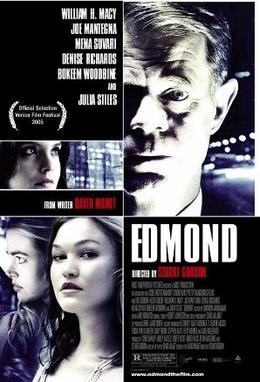
Days of Paranoia: Edmond (dir by Stuart Gordon)


Based on a one-act play by David Mamet, 2005’s Edmond tells the story of Edmond Burke (William H. Macy).

Edmond shares his name (if not the actual spelling) with the philosopher Edmund Burke.  Edmund Burke was a strong believer that society had to put value in good manners to survive and that religious and moral institutions played an important role in promoting the idea of people treating each other with respect and decency.  Edmund Burke knew what he believes and his writings continue to influence thinks to this day.  Edmond Burke, on the other hand, doesn’t know what he believes.  He doesn’t know who he wants to be.  All he knows is that he doesn’t feel like he’s accomplished anything with his life.  “I don’t feel like a man,” he says at one point to a racist bar patron (played by Joe Mantegna) who replies that Edmond needs to get laid.

On a whim, Edmond steps into the shop of a fortune teller (Frances Bay), who flips a few Tarot cards and then tells Edmond that “You’re not where you’re supposed to be.”  Edmond takes her words to heart.  He starts the night by telling his wife (played by Mamet’s wife, Rebecca Pidgeon) that he’s leaving their apartment and he won’t be coming back.  He goes to the bar, where he discusses his marriage with Mantegna.  He goes to a strip club where he’s kicked out after he refuses to pay $100 for a drink.  He goes to a peep show where he’s frustrated by the glass between him and the stripper and the stripper’s constant demand that he expose himself.  He gets beaten in an alley by three men who were running a three-card monte scam.  Edmond’s problem is that he left home without much cash and each encounter leads to him having less and less money.  If he can’t pay, no one wants to help him, regardless of how much Edmond argues for a little kindness.  He pawns his wedding ring for $120 but apparently, he just turns around and uses that money to buy a knife.  An alley-way fight with a pimp leads to Edmond committing his first murder.  A one-night stand with a waitress (a heart-breaking Julia Stiles) leads to a second murder after a conversation about whether or not the waitress is actually an actress leads to a sudden burst of violence.  Edmond ends up eventually in prison, getting raped by his cellmate (Bookem Woodbine) and being told, “It happens.”  Unable to accept that his actions have, in one night, led him from being a businessman to a prisoner, Edmond says, “I’m ready to go home now.”  By the end of the film, Edmond realizes that perhaps he is now where he was meant to be.

It’s a disturbing film, all the more so because Edmond is played by the likable William H. Macy and watching Macy go from being a somewhat frustrated but mild-mannered businessman to becoming a blood-drenched, racial slur-shouting murderer is not a pleasant experience.  Both the play and the film have generated a lot of controversy due to just how far Edmond goes.  I don’t see either production as being an endorsement of Edmond or his actions.  Instead, I see Edmond as a portrait of someone who, after a lifetime of being willfully blind to the world around him, ends up embracing all of the ugliness that he suddenly discovers around him.  He’s driven mad by discovering, over the course of one night, that the world that is not as kind and well-mannered as he assumed that it was and it all hits him so suddenly that he can’t handle it.  He discovers that he’s not special and that the world is largely indifferent to his feelings.  He gets overwhelmed and, until he gets his hands on that knife, he feels powerless and emasculated.  (The knife is an obvious phallic symbol.)  It’s not until the film’s final scene that Edmond truly understands what he’s done and who he has become.

Edmond is not always an easy film to watch.  The second murder scene is truly nightmarish, all the more so because the camera remains on Edmond as he’s drenched in blood.  This is one of William H. Macy’s best performances and also one of his most disturbing characters.  That said, it’s a play and a film that continues to be relevant today.  There’s undoubtedly a lot of Edmonds out there.