Meek-looking accountant Sanford Lagelfost (Bronson Pinchot) is on trial for embezzlement. It’s supposed to be a simple, up-and-shut case but when the beautiful star witness (Tracy Scoggins) testifies that Sanford is an amazing lover, it becomes a tabloid sensation and the jurors are sequestered in a hotel, where they have to deal with their own restlessness and several distractions, the majority of whom are also played by Bronson Pinchot. Pinchot plays a total of four characters but it’s not like he’s Peter Sellers or even Eddie Murphy. He looks and sounds like Bronson Pinchot in every role.
The jurors are played by a bunch of a familiar television actors. Alan Thicke plays a yuppie named Phil and Lynn Redgrave plays a hippie named Abby and they end up getting married. Stephen Baldwin is the waiter who falls for Heather Locklear, an actress who is a former call girl who is being threatened by her pimp. Madchen Amick is the spoiled rich girl. Television mainstays Mark Blankfield, Ilene Graf, William G. Schilling, Danny Pintauro, and Bill Kirchenbauer are all present and accounted for. Adding to the overall sitcom feel of the movie is the presence of Reginald VelJohnson as the judge. No one in the cast tries very hard, though I do think a case can be made that Madchen Amick was the most beautiful woman on television in 1990.
With the film failing to achieve either a consistent tone or a single laugh, the best thing that I can say about Jury Duty is that it didn’t feature Pauly Shore. Instead it featured Alan Thicke driving a BMW with a license plate that read, “BMW4Phil.” It’s hard to believe that this film was directed by Michael Schultz, who was responsible for movies like Car Wash, Cooley High, and Greased Lightning in the 70s and Berry Gordy’s The Last Dragon in the 80s.
In 1988’s To Heal A Nation, Eric Roberts stars as Jan Scruggs.
When we first meet Scruggs, the year is 1971 and he’s taking his seat on a commercial airliner. When the blonde woman sitting beside him starts to flirt with him, Scruggs mentions that he’s happy because he’s finished up his tour of duty in Vietnam. Upon hearing that Scruggs is a Vietnam vet, the woman immediately requests to be moved to a different seat.
Eight years later, things haven’t gotten much better. Scruggs works for the Department of Labor in Washington D.C. He’s married to Becky (Glynnis O’Connor) but he’s struggling to deal with the past. He drinks too much. He has trouble sleeping. He doesn’t feel like he can open up about the things that he saw in Vietnam because nobody wants to talk about it. He was one of the thousands of people who served in Vietnam who now feel as if they’ve been abandoned by their country. However, after attending a showing of The Deer Hunter, Scruggs has a vision of a monument that that features the name of every American who was killed in the Vietnam Conflict.
Scruggs devotes the next several years of his life to getting the monument built, appealing to both the government and private citizens for funding. At first, everyone treats Scruggs and his efforts like a joke. Even some fellow veterans feel that Scruggs is pushing too hard and that he’s just going to end up embarrassing himself. But Scruggs refuses to give up and finally, with the support of a senator (Laurence Luckinbill) and a Texas millionaire named H. Ross Perot (Conrad Bachmann), Scruggs is able to make his dream a reality.
Based on the true story of the struggle to build the Vietnam Veterans Memorial in Washington, D.C., To Heal A Nation features a young Eric Roberts giving a nervy but likable performance as Jan Scruggs, a man who becomes so obsessed with building a monument to those who lost their lives in Vietnam that he occasionally seems like he’s close to going over the edge himself. It’s a good film for Memorial Day and one that still feels relevant today. The way that Scruggs was treated after returning from Vietnam is the way a lot of our veterans were treated and continue to be treated after returning from Iraq and Afghanistan. We love our soldiers when they fight in popular wars that result in a definite victory. When they serve in an unpopular war, they’re often deserted by people who don’t want to be reminded of recent history. One can certainly see that in the attempts by the national media to gloss over what happened during our final days in Afghanistan. This film is a reminder that no one should be forgotten.
Previous Eric Roberts Films That We Have Reviewed:
John Carpenter has directed 18 features film, from 1974’s Dark Starto 2010’s The Ward. Some of his films have been huge box office successes. Some of his films, like The Thing, were box office flops that were later retroactive recognized as being classics. Carpenter has made mainstream films and he’s made cult favorites and, as he’s always the first to admit, he’s made a few films that just didn’t work. When it comes to evaluating his own work, Carpenter has always been one of the most honest directors around.
Amazingly, Carpenter has only directed one film that received an Oscar nomination.
That film was 1984’s Starman and the nomination was for Jeff Bridges, who was one of the five contenders for Best Actor. (The Oscar went to F. Murray Abraham for Amadeus.) Bridges played the title character, an alien who is sent to Earth to investigate the population and who takes on the form of the late husband of Jenny Hayden (Karen Allen). The Starman takes Jenny hostage, though its debatable whether or not he really understands what it means when he picks up her husband’s gun and points it at her. He and Jenny drive across the country, heading to Arizona so that he can return to his ship. Pursued by the government (represented by the sympathetic Charles Martin Smith and the far less sympathetic Richard Jaeckel), the Starman learns about emotions, eating, love, and more from Jenny. Jenny goes from being fearful of the Starman to loving him. Carpenter described the film as beingIt Happened One Night with an alien and it’s not a bad description.
After Jenny and the alien visitor make love in a boxcar, the Starman says, “I gave you a baby tonight,” and that would be an incredibly creepy line coming from a human but it’s oddly charming when uttered by an alien who looks like a youngish Jeff Bridges. Bridges definitely deserved his Oscar nomination for his role here. Speaking with an odd accent and moving like a bird who is searching for food, Bridges convincingly plays a being who is quickly learning how to be human. The Starman is constantly asking Jenny why she says, does, and feels certain things and it’s the sort of thing that would be annoying if not for the way that Bridges captures the Starman’s total innocence. He doesn’t mean to be a pest. He’s simply curious about everything.
Bridges deserved his nomination and I would say that Karen Allen deserved a nomination as well. In fact, it could be argued that Allen deserved a nomination even more than Bridges. It’s through Allen’s eyes that we see and eventually come to trust and then to love the Starman. Almost her entire performance is reactive but she makes those reactions compelling. I would say that Bridges and Allen deserved an Oscar for the “Yellow light …. go much faster” scene alone.
Carpenter agreed to make Starman because, believe it or not, The Thing had been such a critical and commercial flop that it had actually damaged his career. (If ever you need proof that its best to revisit even the films that don’t seem to work on first viewing, just consider Carpenter’s history of making films that were initially dismissed but later positively reevaluated. Today, The Thing, They Live, Prince of Darkness, and In The Mouth of Madness are all recognized as being brilliant films. When they were first released, they all got mixed reviews.) Carpenter did Starman because he wanted to show that he could do something other than grisly horror. Starman is one of Carpenter’s most heartfelt and heartwarming films. That said, it also features Carpenter’s trademark independent streak. Starman not only learns how to be human but, as a result of the government’s heavy-handed response to his arrival, one can only assume that he learns to be an anti-authoritarian as well.
Starman is one of Carpenter’s best films and also a wonderful showcase for both Karen Allen and Jeff Bridges.
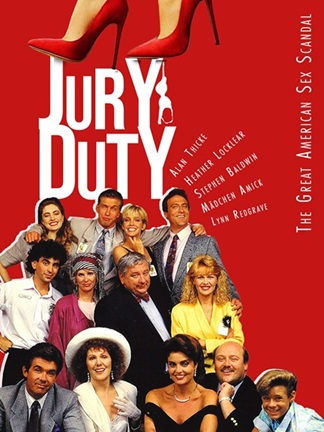 Meek-looking accountant Sanford Lagelfost (Bronson Pinchot) is on trial for embezzlement. It’s supposed to be a simple, up-and-shut case but when the beautiful star witness (Tracy Scoggins) testifies that Sanford is an amazing lover, it becomes a tabloid sensation and the jurors are sequestered in a hotel, where they have to deal with their own restlessness and several distractions, the majority of whom are also played by Bronson Pinchot. Pinchot plays a total of four characters but it’s not like he’s Peter Sellers or even Eddie Murphy. He looks and sounds like Bronson Pinchot in every role.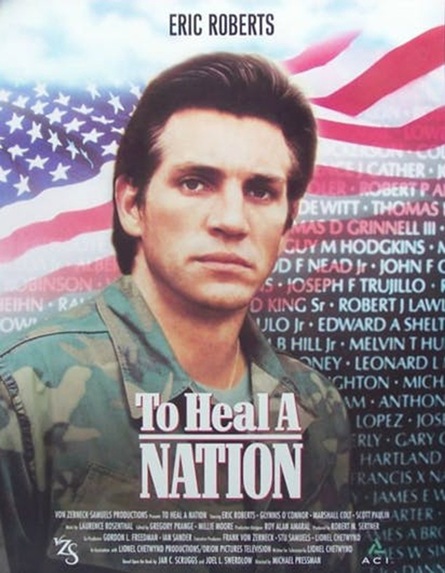
 Through the Shattered Lens