It’s been 9 weeks since we originally embarked on this journey that I called Embracing The Melodrama Part II. At that time, my plan was to do 126 reviews in just three weeks. It didn’t quite work out that way, did it? But still, I had fun doing this series of reviews and I hope that you’ve had at least a little fun reading them. If I’ve inspired you take a chance on any of the films that I’ve reviewed — whether it be Sunrise or An American Hippie In Israel or Cocaine: One Man’s Seduction or Calvary — then this has all been worth it!
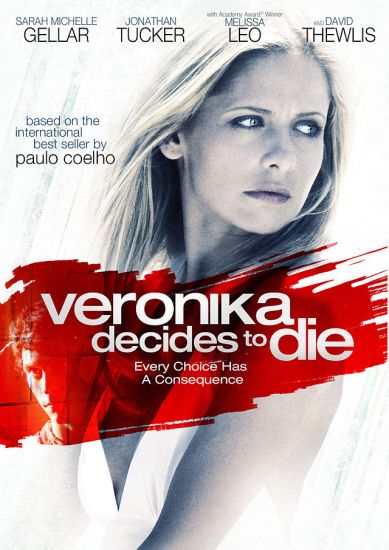
So, for my final review in this series, I want to take a quick look at one of the most melodramatic films to be released this year so far, Veronika Decides To Die.
Veronika Decides To Die finally got an American release in 2015, six years after it initially premiered on the festival circuit. Years before it was available here in the States, Veronika played in Europe. Not surprisingly, the American release felt much like an afterthought, one final attempt to make a little money off the film before moving on. It’s spent about a week in theaters and two months later, it is now showing up on cable and Netflix. And while Veronika didn’t get many reviews, the few that it did get were rather dismissive.
But you know what?
I like Veronika Decides To Die.
Don’t get me wrong. It’s not a great film. In many ways, it’s a very silly film. The entire plot hinges on a character doing something that makes no sense. Frustrated with her life as an anonymous and lonely office worker, Veronika (Sarah Michelle Gellar) attempts to commit suicide. She survives the suicide attempt and, upon waking in a mental hospital, she’s told by a mysterious psychologist (David Thewlis) that, as a result of her attempt, she now has a heart condition that will kill her in a matter of weeks. And what does Veronika decide to do after learning that she’s going to die? She voluntarily remains in the mental hospital and goes to sessions of group therapy!
And you never really believe that Veronika would do that. But, if you can bring yourself to accept that one implausibility — well, you’ll soon be confronted by a lot of other implausibilities. You’ll meet Veronika’s glassy-eyed roommate (Erika Christensen) and a mysterious older patient (Melissa Leo). You’ll also meet Edward (Jonathan Tuker), who is mute but has such a sexy stare that he really doesn’t need to speak. And as Veronika gets to know her fellow patients, she starts to come to terms with her own issues of anger and regret and she realize that importance of embracing life and doing what you love.
Of course, that’s a little hard to do when you’re in a mental hospital. Luckily, there’s a piano that Veronika can play while Edward silently watches her. If you’re guessing that this eventually leads to Veronika sitting naked at the piano and masturbating in front of Edward, well, you’re right…
Listen, Veronika Decides To Die is one of those films that takes itself way too seriously and it ends with a plot twist that you’ll see coming from a thousand miles away. I can understand why the film’s release was delayed because the film’s tone is all over the place.
But, dammit, I liked Veronika Decides To Die!
When taken on its own defiantly melodramatic terms, it works. That’s largely because Sarah Michelle Gellar really commits herself to the role. You forget that you’re watching Buffy. Instead, Gellar truly becomes Veronika, this tragically sad and lonely young woman who finds inner peace by masturbating at a piano. Veronika Decides To Die is a movie that really shouldn’t work but Sarah Michelle Gellar saves it. When the film starts, she beautifully captures Veronika’s lonely desperation, her feelings of isolation and worthlessness. (I don’t care who you are, we’ve all felt like Veronika at some point in our life.) As the film progresses, she portrays both Veronika’s anger and her growing appreciation of life. She has a nice chemistry with Jonathan Tucker and, in the end, Sarah Michelle Gellar probably gives a better performance than the material really deserves.
Of course, another reason that Veronika Decides To Die works is because it is so silly and melodramatic. This is one of those films that goes so far over-the-top that it creates an almost heightened sense of reality. It becomes, almost despite itself, compulsively watchable.
It’s also the perfect film with which to complete Embracing the Melodrama Part II. I hope y’all have enjoyed reading these 126 reviews because I’ve certainly enjoyed writing them! To everyone who has read these reviews and clicked on the “like” button and occasionally left a comment or two, thank you so much! Love you! However much effort or work it may take, all of you make it worth it.
And now I’m going to go pass out for a little while…
Every year there’s always going to be that one filmmaker who takes on the challenge of putting their personal take on one of William Shakespeare’s classic dramas. It’s been going on since the advent of motion pictures and I don’t see it ending anytime soon.
This year it looks like we may have a winner with the latest adaptation of Shakespeare’s MacBeth. The film stars Michael Fassbender and Marion Cotillard as Lord and Lady MacBeth with Australian filmmaker Justin Kurzel in the director’s chair.
MacBeth has been getting such advance rave reviews due to it’s screening at this year’s Cannes Film Festival where it entered for competition for the Palme d’Or. The film itself just judging from the trailer below looks like a visual feast that one’s up the dark, gritty aesthetic of HBO’s Game of Thrones.
There’s still no announced release date for MacBeth for the North American market but with the critical buzz surrounding the film after Cannes it won’t be too long til it get one.
Earlier this year, when I was sitting in the audience for the unfortunate Nicholas Sparks film The Best Of Me, I found myself staring at the sight of an oil rig worker (played by James Marsden) relaxing by reading Stephen Hawking’s A Brief History of Time. And, before I could stop myself, I laughed out loud and I may have even loudly said something along the lines of, “Oh come on!”
At the time, I got a lot of dirty looks but I stand by my reaction. It’s such a cliché. Any movie character who is meant to be intelligent and soulful will be seen casually reading a copy of Hawking’s book and scrunching up his brow as he considers whatever it is that Hawking has to say. It makes sense, of course. If the current cult surrounding Neil deGrasse Tyson proves anything, it’s that it is currently in to pretend to be fascinated by science.
I have to admit, though — science has never been my subject. The cold logic of it all bores me to tears and there’s no bigger turn-off then listening to someone brag about being a “rational thinker.” (Rational thought is incredibly overrated.) As long as things work like they’re supposed to, the how and the why don’t really concern me. Whenever I hear someone complain that there are “too many unanswered questions,” I think to myself, “Good.” I like unanswered questions. I like irrational feelings. I like mysteries that can never be solved. They fuel imagination. They inspire great art. They make life interesting and unpredictable.
(Please understand, I am not anti-science. I’m anti-pretending-to-care-when-I-don’t.)
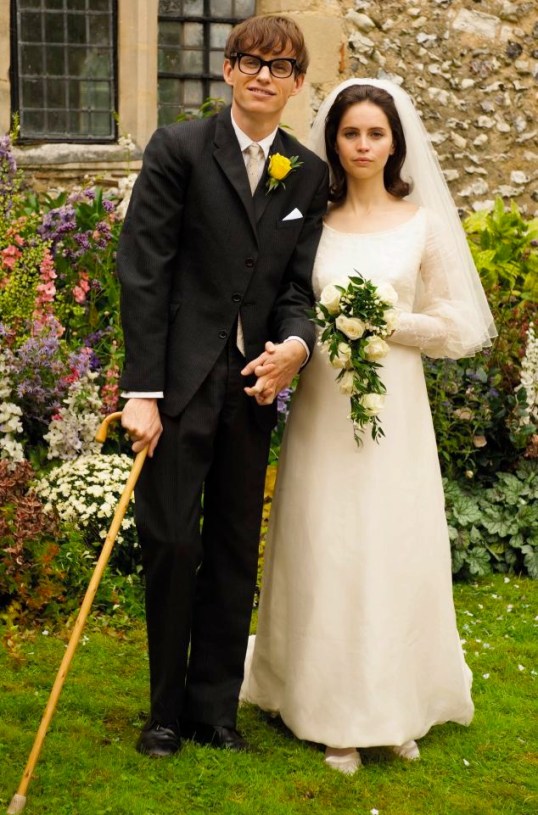
With all that in mind, you might think that I would be bored by The Theory of Everything, the recently released biopic about Stephen Hawking (Eddie Redmayne) and his marriage to Jane Hawking (Felicity Jones). And, I’ll be honest. If not for the fact that the film has been pegged as being a certain Oscar contender, I might not have ever wanted to see The Theory of Everything. However, seeing as how The Theory of Everythingis a certain Oscar contender, I did want to see it.
And, up until the final 30 minutes of the film, I was surprised with just how much I liked The Theory of Everything. I have to admit that the film’s science still went over my head. As far as that was concerned, the only thing I really learned is that there’s a difference between General Relativity and Quantum Field Theory but don’t ask me to explain that difference. (And, for the love of all that is good, please don’t try to explain it to me…) But, to be honest, the exact details of Hawking’s theories aren’t really that important to The Theory of Everything. Instead, the film is content to have supporting characters assure us that Hawking’s work is brilliant and important and that’s really all that it has to do. After all, everyone in the audience already knows that Stephen Hawking is a genius. The appeal of The Theory of Everything is not the science but instead the human behind the science.
The Theory of Everything works for two very old-fashioned reasons — it’s well-directed by James Marsh and it’s well-acted by Eddie Redmayne and Felicity Jones. For all the time that the film devotes to people talking about how Hawking challenged the conventional view of the universe, The Theory of Everything is, in many ways, a conventional biopic. But that’s not necessarily a bad thing. A familiar story well-told is still a well-told story.
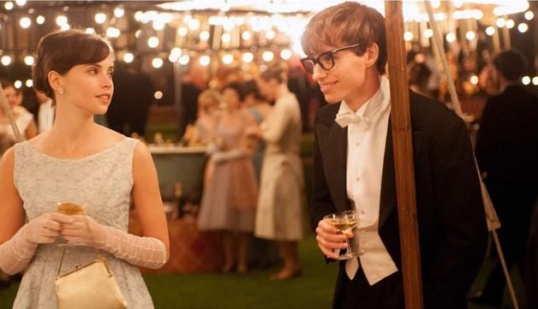
The film starts with Stephen as a student at Cambridge and we follow him as he awkwardly courts Jane and takes her on an amazingly well-filmed and soul-achingly romantic date. Shortly after this, he’s diagnosed with motor neuron disease. (As I discovered while doing some research for this review, Hawking was actually diagnosed before he even met Jane.) Told he only has two years to live, Stephen’s first instinct is to isolate himself from the world but, largely as a result of Jane’s love and support, Stephen instead continues his work and becomes world famous. The film suggests that it took a combination of Stephen’s logical (and skeptical) genius and Jane’s devout and unwavering faith (in both his genius and the God that Stephen doesn’t believe in) for him to eventually become the Stephen Hawking that we all recognize today.
And it’s all extremely well-done and touching, up until the final 30 minutes of the film. Going into the film, I did not know much about Stephen Hawking but (thanks to Wikipedia), I did know that he eventually left Jane for another woman. I have to admit that I did not expect the film to deal with this part of the story. To the film’s credit, it does attempt to deal with the end of Stephen and Jane’s marriage but it does so in such an awkward way that it’s obvious that the filmmakers weren’t quite sure how they should handle the situation.
After all, the film had just spent 90 minutes presenting Jane as being an occasionally frustrated saint and Stephen as being idiosyncratic but likable. And now, suddenly, Stephen is going to have to act like a jerk. The film doesn’t know how to handle this and, as such, those final 30 minutes feel fake in a way that the rest of the film does not. When Stephen tells Jane that he’s leaving her for another woman, it’s presented as being an almost mutual decision made by the two of them. Tears are shed but there’s little visible anger, with the film going so far as to suggest that Stephen is leaving Jane because he wants her to be able to live the life that she put on hold to take care of him. It’s even implied that Stephen was kind enough to pick out a new husband for her.
That new husband is played, quite well, by Charlie Cox. When he first told Jane that he’s attracted to her, I assumed that the scene was included so that Jane could gently rebuff him and show us how devoted she is to Stephen. However, thinking back on it now, it almost feels as if that scene was largely included so it could provide some cover for Stephen. It’s as if the filmmakers are saying, “See? Stephen wasn’t the only one tempted to end the marriage…”
And I have to admit that the way the film handled the end of Stephen and Jane’s marriage felt so false to me and the way Jane was treated and portrayed seemed so unfair that, as soon as I got home, I actually did the following google search: “Was The Theory Of Everything unfair to Jane Hawking?”
Reading the article, I discovered that, according to Jane’s autobiography (upon which the film is ostensibly based), both her marriage to and divorce from Stephen Hawking was far more complex and intriguing than what was presented in the film. For one thing, the marriage ended not with tears of acceptance but instead with a shouting match. And trust me, if any actress could have done justice to Jane Hawking’s anger, it would be Felicity Jones. By the time the film ends, both the character and the actress have earned the right to express their anger. But neither one of them gets that opportunity, largely because that version of the Hawking marriage would also have been far less crowd pleasing.
And, if anything, The Theory of Everything is specifically designed to be a crowd pleaser.
And don’t get me wrong. It’s a good film and it’s one that left me with tears in my eyes. Do I recommend the film? You bet I do.
I just wish that, during those final 30 minutes, the film could have been a little bit more honest with itself. It’s a good film but it’s hard not to regret missing out on the film that it could have been.
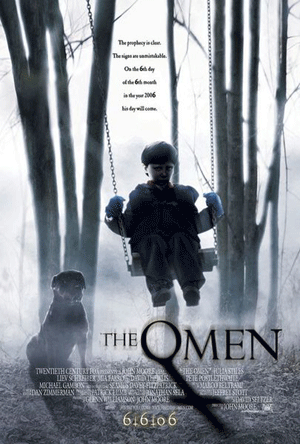
There’s really only one reason to see the 2006 remake of The Omen and that’s the fact that the priest who convinces Ambassador Thorn to adopt the Antichrist is played by the great Giovanni Lombardo Radice.
If you’re a fan of Italian horror, you’ll immediately know who Radice is and, whenever he appears in The Omen, you’ll be momentarily excited. After all, Radice is an actor who has given memorable performances in films made by iconic directors like Lucio Fulci, Ruggero Deodato, Antonio Margheriti, Michele Soavi, and Martin Scorsese. He’s appeared in everything from City of the Living Dead to Cannibal Apocalypse to The House On The Edge of the Park toStagefright to Gangs of New York. As both a horror icon and an excellent actor who has always been gracious and friendly to his fans, Giovanni Lombardo Radice is one of those actors who movie bloggers like me are always happy to see in any film.
(And, if anyone deserves a role in a Quentin Tarantino film, it’s Giovanni Lombardo Radice.)
And Radice gives a really great performance in The Omen. He plays the role with just the right combination of menace and regret. When he first appears, you can tell that he’s determined to get Robert Thorn to adopt Damien but that he’s not particularly happy about having to do it. He may be one of the bad guys but he’s a bad guy with a conscience. Later, when Radice makes a second appearance, it momentarily re-energizes the film. He’s just got such a unique screen presence that, whenever he’s on-screen, Radice reminds you of the film that you want The Omen to be.
As for the rest of the remake — well, it’s all kind of pointless. The film is largely a scene-by-scene remake of the first Omen and, unfortunately, it never quite answers the question of why the film needed to be remade in the first place. The Gregory Peck role is played by Liev Schrieber while his wife is played by Julia Stiles. The doomed photographer is played by David Thewlis. Mia Farrow shows up in the role of the sinister nanny and Mia actually does a pretty good job but whenever she was delivering her lines, it was impossible for me not to imagine a remake of The Final Conflict where Ronan Farrow plays Damien.
Otherwise, the same characters die as in the original film and, often times, they die in the exact same way. It’s really almost lazy how little the remake changes from the original. And, ultimately, it makes the entire movie feel more than a little pointless. You’re left with the feeling that the only reason the Omen was remade was so that it could be released on June 6th, 2006 (a.k.a. 6-6-06).
So, when it comes to The Omen, stick with the original but watch the remake for Giovanni Lombardo Radice.
Well, we all knew it would have to end someday and now, it’s over. The Harry Potter film series, which began way back in 2001, is concluding right now in a theater near you. On Friday night, me, Jeff, my sister Erin, and our friend Evelyn went down to the AMC Valley View and we saw Harry Potter and the Deathly Hallows, Part 2.
The cinematic story of Harry Potter is over and yes, I did cry as I watched it end. I didn’t just cry because of the movie, though the movie itself is one of the best of the year and it has one of those wonderful endings that just makes it impossible to remain dry-eyed. No, I cried because — with this film — an era of my life is truly over.
When the first Harry Potter film came out, I was only 16 and still trying to deal with the fact that I had been diagnosed as being bipolar just a few weeks earlier. I felt alone and broken and destined to spend the rest of my life on the outside looking in. The three hours that I spent watching Harry Potter and the Sorcerer’s Stone were three hours when I didn’t have to worry about suddenly bursting into tears and having everyone around me worrying about whether or not I was actually taking my hated medication. For three hours, I could escape to another world where those who were different were celebrated precisely because they were different. For three hours, I could imagine that just maybe I had a special purpose for existing too and maybe I had benevolent wizards and witches looking out for me too. And I’m sorry if all that sounds trite in retrospect but, when you’re 16 and you think you’re too damaged to love, anything that gives you hope and pleasure in the present is a precious treasure.
Over the years, I eventually came to realize that being bipolar was hardly a curse and, as I matured and grew up and discovered new things, there was always a Harry Potter film either playing or about to come out. Whether I was escaping high school, graduating college, or dealing with just every good or bad thing that makes up life, Harry Potter — this character who I first met (in book form) when I was 13 — was always there. So, at the risk of sounding overdramatic, the end of Harry Potter is the end of a chapter of my life.
One final personal note: As I watched Harry Potter and the Deathly Hallows, Part Two, I had three dolls (or action figures, as boys insist on calling them) in my purse. These dolls — Harry, Hermione, and Ron — came out around the same time as the second Harry Potter film and my mom (who collected dolls) ordered them off of Ebay three years ago, shortly before she entered the hospital for the final time. Now, my mom was not a huge fan of the Harry Potter series but she knew that I loved it and that’s why she made those dolls her final gift to me.
And those are some of the reasons why I found myself crying as I watched the finale of Harry Potter. However, there’s another reason why I cried and that’s that this is just a great film and the perfect conclusion to the series.
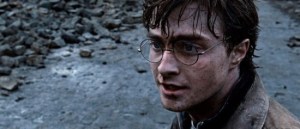
Essentially, Harry Potter and the Deathly Hallows, Part Two starts up immediately after the conclusion of Part One. Dobby is dead, Lord Voldemort (a wonderfully neurotic Ralph Fiennes) and the Death Eaters are intent on destroying everything, and Severus Snape (Alan Rickman, wonderful as always) is in charge of Hogwarts. After spending the first part of Deathly Hallows as fugitives, Harry Potter, Ron Weasley, and Hermione Granger (Daniel Radcliffe, Rupert Grint, and Emma Watson) return to Hogwarts to take a final stand against Voldemort. Things end in a surprisingly bloody battle (this film is not for children) that leaves several characters dead and ultimately reveals that one wizard wasn’t the saint we always assumed he was while another is revealed to be the secret hero of the entire series.
Let’s get one question out of the way right now: will non-Harry Potter fans be able to follow this film? Uhmmm…no. Sorry. Then again, why would a non-Harry Potter fan be at a film called Harry Potter and The Deathly Hallows Part Two anyway? I mean, seriously, if you’re just going to film because everyone else is doing it than who are you to bitch anyway? This is what you non-Harry Potter fans need to do. Stop reading this review. Go watch the previous Harry Potter films. Watch them in order. Take your time because Deathly Hallows is going to be in theaters for a while. And then, once you’ve become immersed in the story, go see how it all concludes. And then come back here and read rest of this review.
Okay, so is everybody up to date?
Cool.
One of the more interesting features of the Harry Potter series is that so many different directors (each with his own definite, individual style) have been involved in bringing these films to the screen. Among Harry Potter fans, hours can literally be spent debating the merits (and weaknesses) of Chris Columbus, Alfonso Cuaron, Mike Newell, and David Yates. My own theory is that each director was perfectly suited for each film he directed. The audience-friendly vision of Chris Columbus was what the first two films needed, just as Prisoner of Azkaban needed Cuaron’s far darker vision and Mike Newell’s attention to character made Goblet of Fire one of the best of the Harry Potter films. And while David Yates may not be as well-known (or critically acclaimed) as Newell or Cuaron, he brings exactly the right tone to Harry Potter and the Deathly Hallows, a perfect combination of spectacle and humanity. It is to Yates’ credit that the scenes in which the characters simply talk to each other are just as compelling as the dramatic sequences where Voldemort and the Death Eaters attack Hogwarts. Yates understands that this material could easily come across as silly or childish and to his credit, he never allows the audience to simply dismiss this film as a lot of blathering about wands and CGI magic. As opposed to other directors who have given us summer blockbusters, Yates takes his film seriously.
And, fortunately, so does his cast.
One of the great pleasures of the Harry Potter series is that it’s given American audiences the chance to discover (and rediscover) some of the great British character actors and a lot of them show up (some for only a matter of minutes) here in the finale. Maggie Smith, Jim Broadbent, Julie Walters, Robbie Coltrane, Gary Oldman, John Hurt, David Thewlis, Emma Thompson, and Jason Isaacs all put in appearances. Kelly MacDonald has a great scene playing a ghost, Helena Bonham Carter is perfect as the evil Bellatrix Lestrange, and Alan Rickman is brilliantly ambiguous as Severus Snape. (And yes, Snape’s actions are explained in this film and yes, I did cry.)
Ralph Fiennes plays so many villains that I now find myself expecting him to show up killing people in every movie I see. He’s like a British Christopher Walken. Still, it’s easy to take an actor like Fiennes for granted. For the entire Harry Potter series to work, Lord Voldemort can’t just be an ordinary villain. He’s got to be the sum total of all things evil and deadly. You’ve got to believe that people would be scared to speak his name. Great heroes need a great villain and Fiennes’ Voldermort is a great villain.
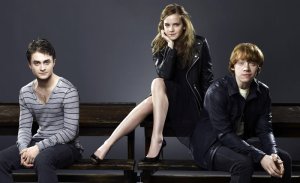
Ultimately, however, the true credit for the success of the Harry Potter series belongs to three actors who have literally grown up on the movie screen — Daniel Radcliffe, Rupert Grint, and Emma Watson. The producers are fortunate indeed that the cute kids that they cast over a decade ago have all grown up to be talented, attractive, and likable actors. If the first part of Harry Potter and the Deathly Hallows seemed to showcase both Grint and Watson (almost to Radcliffe’s expense), part 2 is most definitely centered on Harry Potter. That doesn’t mean that Watson and Grint aren’t good in this film. They are and they get to share one of the best movie kisses of 2011. (As well, for those who keep count, Grint says “Bloody Hell,” three times in the film.) But, for obvious reasons, this film is all about Harry and Radcliffe’s performance as Harry. It’s a challenge for Radcliffe and it’s a challenge that he more than succeeds at conquering. As the film ended, I realized that I was sad to know that the adventures of Harry Potter were done but I was excited to see what the future will hold for Radcliffe, Grint, and Watson.
Incidentally, Harry Potter and the Deathly Hallows Part 2 has been released in both 3-D and 2-D. We saw the 3-D version and if you have any knowledge of how I feel about 3-D (and how motion sick I tend to get while watching 3-D films) then that should show you just much I love the Harry Potter series. I loved it so much that I was even willing to overlook my hatred of 3-D. The 3-D here (which was added after the film has already been filmed) doesn’t really add much to the movie. There were a few cool moments where I was all like, “Look, I can reach out and grab a piece of Voldemort,” but otherwise, the 3-D was a negligible factor as far as the overall film was concerned.
Still, there was one interesting thing about the 3-D. The theater we saw the movie in was half-way empty. At the same time, the neighboring theater — in which the 2-D version was playing — had a line of people waiting to get in. They were not only waiting to see the 2-D version, they were waiting to see a showing that wouldn’t even begin until a full 90 minutes after the 3-D version started. I mention this because, in the wake of Avatar, so many people have taken it for granted that 3-D is the future of movies and soon, as long as a film is in 3-D, we won’t have to worry about the difficult stuff like an interesting plot or compelling characters. However, 3-D has become an overexposed gimmick. For every film like Cave of Dreams that uses 3-D to craft an actual artistic statement, there’s a 1,000 films like Priest which use 3-D just because it’s an easy way to trick sucks into spending an extra dollars to see a crappy film.
What so many filmmakers seem to forget is that the majority of film goers are not looking for 3-D. We’re just looking for a good film. And sometimes — like with Harry Potter and the Deathly Hallows — we get lucky and we find a great film.
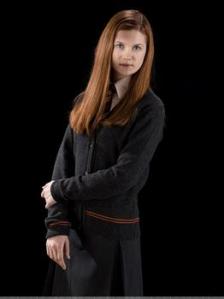
(Oh, and one last thing: I know everyone always expects me to claim to be just like Hermione but actually, I’ve always related more to Ginny Weasley. Like her, I’m the youngest of four siblings, I’ve got red hair, and I always get my man, in the end.)
 Well, here we are!


 Through the Shattered Lens