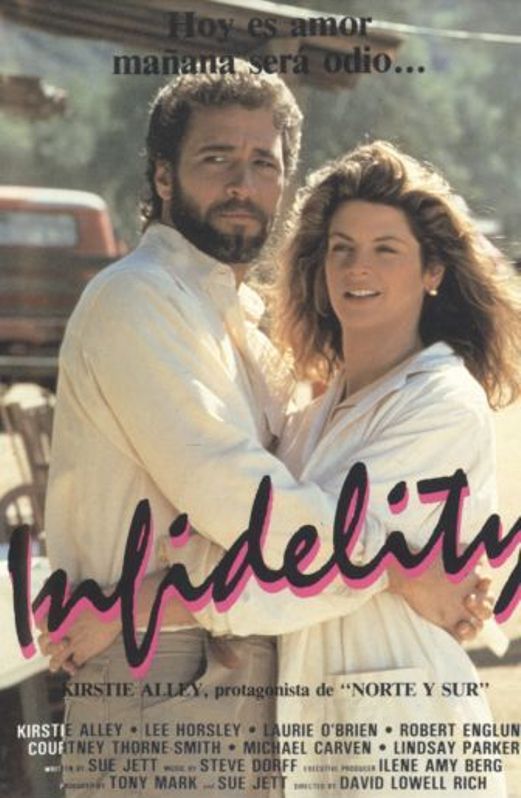
Nick Denato (Lee Horsley) is a world-famous photographer. His wife, Ellie (Kirstie Alley!), is a renowned doctor. They have homes in San Francisco and Africa and they regularly fly from one continent to another. The Denatos used to be called “jet-setters,” back when flying back and forth was seen as a positive instead of as a crime against the environment.
Despite the fact that Ellie is pregnant, Nick leaves his wife behind in San Francisco so that he can explore Nepal with his buddy Scott (Robert Englund!!) and Scott’s young and leggy assistant, Robin (Courtney Thorne-Smith!!!!). While Nick is away, Ellie has a miscarriage. Nick flies home but it’s too late. His wife already resents him for not being there when she needed him. It doesn’t help that, a week later, Scott and Robin come to visit and Scott tells a story about how he nearly fell off a cliff. “And where were you, buddy!?” Scott says to Nick with a laugh, forgetting that Nick was back home with his hospitalized wife. An awkward silence follows.
Ellie can tell that there is an obvious attraction between Nick and Robin. Nick denies it and then, to prove Ellie wrong, he cheats on her but not with Robin. Instead, Nick cheats with Ellie’s best friend, Eileen (Laura O’Brien). Ellie divorces Nick, stops talking to Eileen, and gets involved with Etienne (Michael Carven). Nick returns to Africa, where he spends his nights listening to opera in a tent and thinking about how much he loves his his ex-wife.
Infidelity was made for television and it used to come on late night television frequently in the 90s, mostly because of its cast. Not only did the cast features Rebecca Howe but also Freddy Krueger and whoever it was that Courtney Thorne-Smith played on Melrose Place. The main problem with the film is that Kirstie Alley and Lee Horsley have zero chemistry so you don’t really care if they get divorced or if they get back together. The other problem is that Lee Horsley is a convincing cowboy but he’s not as convincing as a sophisticated Italian-American photographer who spends his spare time listening to opera. The movie also cops out by having Nick cheat with a fairly minor character rather than with Robin. On the plus side, the movie’s got Robert Englund playing the type of role that he almost always played in his pre-Nightmare on Elm Street days, the loyal friend. What’s interesting about Englund’s performance here is that he had already played Freddy Krueger three times before playing Scott in Infidelity. In fact, Infidelity aired at the same time that Nightmare on Elm Street 3: Dream Warriors was still playing in theaters. Englund is likable as Scott and the film shows what type of career Englund probably would have had if David Warner hadn’t turned the role of Freddy down in the first Nightmare on Elm Street.
“So be it,” journalist Helen Grant dramatically announces as she lifts up her camera and starts snapping pictures of a body in a casket, “I’m …. a ….. WHORE!”
That is just one of the many wonderfully, over-the-top moments that can be found in the 1985 film, Scandal Sheet. Directed by David Lowell Rich, Scandal Sheet stars Burt Lancaster as Harold Fallen. If this movie were being made today, Fallen would be in charge of a TMZ-style website. Since this movie was made in the 80s, Fallen is the publisher and editor of a sleazy tabloid magazine. He specializes in stories about aliens and ghosts. When someone brings him in a story about the ghost of Grace Kelly haunting the beaches of Malibu, he announces, “Front page!” When someone else tells him about a woman who wants to marry a man from outer space but who can’t find anyone to perform the ceremony, Fallen arranges to get the woman a lawyer.
When Fallen isn’t tracking down ghosts and arranging for interplanetary marriages, he’s trying to destroy celebrities. When the film begins, he’s obsessed with taking down Ben Rowan (Robert Urich). We’re told that Ben Rowan is one of the world’s top movie star. (It’s important that we’re told this because there’s nothing about Urich’s bland performance that would lead us to suspect that to be the case.) Ben’s career is in trouble because he’s got a drinking problem. He just got out of rehab but no insurance company is willing to insure him. His wife, Meg North (Lauren Hutton), is demanding that Ben be cast in her latest movie. Everyone in Hollywood is like, “No way.”
It has the potential to be a big story and Fallen wants to be the first to break it. But to do so, he’s going to need an inside source. That’s where Helen Grant (Pamela Reed) comes in. Helen was Meg’s college roommate and she’s still friends with both her and Ben. Fallen decides to hire Helen to work for his magazine. The only problem is that Helen is a serious journalist. She writes stories about homeless children. She has no desire to work for a tabloid.
“I’ll pay you more than you’re making right now,” Fallen tells her.
Helen’s not interested.
“I’ll pay you $80,000 a year.”
Helen’s interested.
Against her better judgment, Helen accepts Fallen’s offer. At first, things seem okay. She’s a bit annoyed with having to work with a sleazy photographer named Simon (Peter Jurasik, giving a wonderfully reptilian performance) but she’s got a nice house and her son is going to a good school and she gets to use the company credit card and she even gets a housekeeper out of the deal!
Then Fallen tells her that her next assignment is to write about Meg and Ben. Helen refuses but she soon discovers that Howard Fallen is not an easy person to refuse. Not when he’s got people watching your every move, along with paying your housekeeper to spy on you. When her former boss (Max Wright) angrily tells her that no reputable magazine will ever work with her again, Helen is left with only two options: Become a whore or starve.
Scandal Sheet is a lot of fun. Just the fact that the main bad guy is named Howard Fallen should tell you almost everything you need to know about this movie. He’s Fallen — as in a fallen angel. At the end of the movie, he even wears all black with a white tie, which we all know is the typical modern-day costume of demons pretending to be human. (At one point, Fallen even says that he’s going to make someone an offer that they can’t refuse, giving us all a chance to see what The Godfather would have been like if Burt Lancaster had played Don Vito.) Lancaster gives a charismatic performance and he’s so effortlessly manipulative that it’s hard not to enjoy watching him, even if he is destroying innocent people. The rest of the cast is okay. As I said earlier, Robert Urich was a bit too bland to be a convincing film star but Pamela Reed does a good job of capturing Helen’s struggle to decide whether to side with good or evil and Lauren Hutton tears into the scenery with just the type of ferocity that a film like this requires. Late in the film, when she spits in Helen’s face, it’s the most dramatic spitting that you’ll probably ever see.
Scandal Sheet is an enjoyably over-the-top, anti-press melodrama. Watch it with someone who you would be willing to sell out for $80,000 a year.
There’s no particular connection between these films Just a smattering of shots I found interesting in some films I’ve watched recently.
The Concorde… Airport ’79 (1979, dir. David Lowell Rich)
The same year that Ruggero Deodato brought us Concorde Affaire ’79 (1979), the final Airport film came out. It involved pilot George Kennedy having to deal with a reprogrammed drone missile, missiles launched by duped French Air Force officers, and a device designed to decompress the plane by opening the cargo bay door.
This particular shot is from a scene where they fly the plane upside down while George Kennedy fires a flare out of the cockpit as a countermeasure to throw off an incoming missile. Just take that all in.
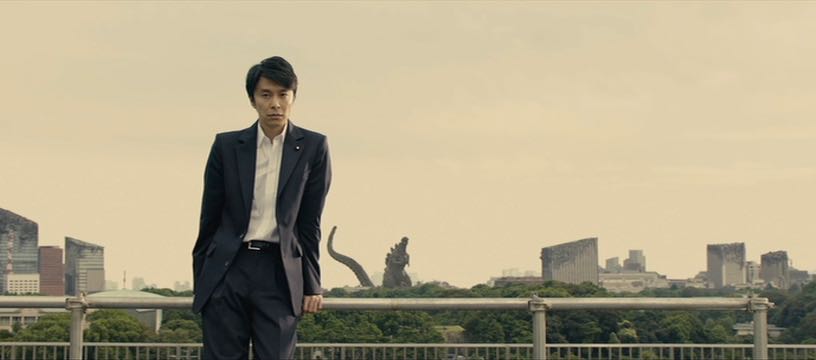
Shin Godzilla (2016, dir. Hideaki Anno & Shinji Higuchi)
One of the last shots from the film where Godzilla has now become part of the city skyline. If you haven’t seen this Godzilla movie, then I highly recommend you check it out.
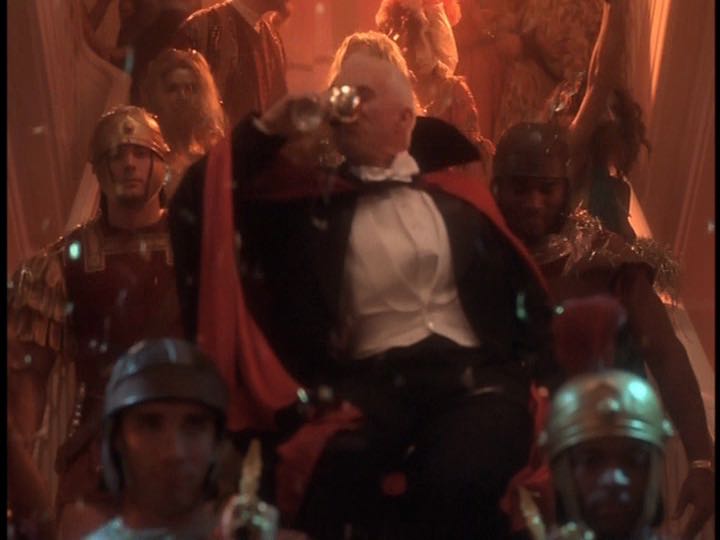
The First 9 1/2 Weeks (1998, dir. Alex Wright)
Malcolm McDowell remembering the time he played Caligula (1979) in a knockoff of The Game (1997) which bills itself as prequel to 9 1/2 Weeks (1986). The only connection it has to the first two films is that it tries something like the fridge scene from the original and the shampoo scene from Another 9 1/2 Weeks (1997). However, that’s like Witchcraft 8: Salem’s Ghost (1996) claiming it has a connection to 9 1/2 Weeks because it too features a fridge scene (a disgusting one).
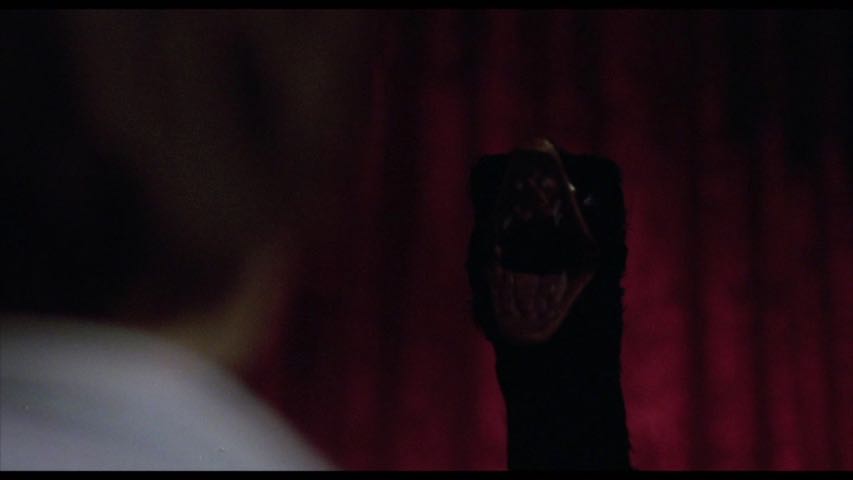
Etoile (1989, dir. Peter Del Monte)
Okay, I’m cheating on this one. I actually watched this film last year when I was finally able to get my hands on two of Jennifer Connelly’s early films–the other being Seven Minutes In Heaven (1985). This was during what I call her mystical period. Another example is Some Girls (1988).
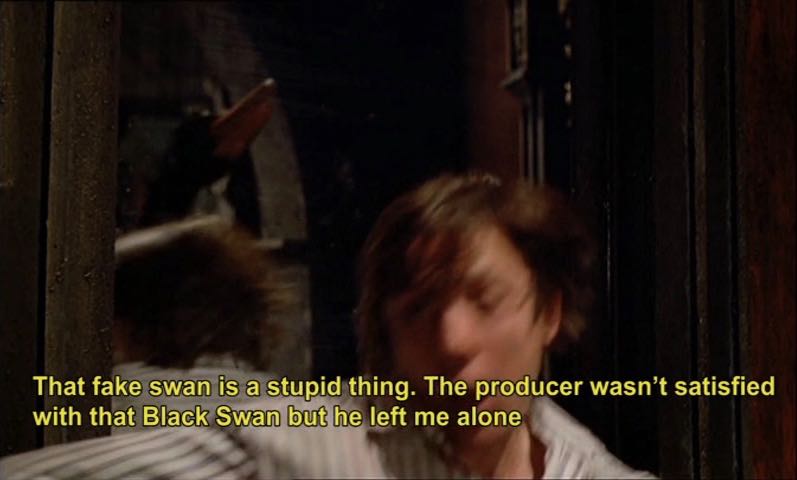
In Etoile (aka Ballet), Jennifer Connelly and some other guy get drawn into a bad movie where Connelly performs in a weird version of Swan Lake. So of course the movie needs to include somebody getting attacked by a giant black swan during a scene a little reminiscent of the time Jessica Harper referenced Dario Argento’s first film while fighting a witch. Yes, I’m well aware that Connelly was also in an Argento film.
As a bonus, here’s what the director thought of the giant black swan.
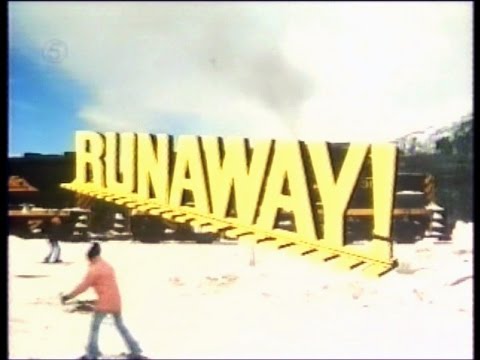
Runaway! begins with a train starting a slow descent down a snowy mountain. On board the train are collection of skiers, gigolos, conductors, and engineers. One couple discusses their upcoming divorce. An athletic father tries to bond with his less-athletic son. A slick con artist tries to convince a depressed young woman not to throw herself from the train. A group of skiers put on an impromptu concert, banging on their suitcases like bongo drums. They get so loud that the conductor doesn’t even hear the engineer desperately trying to contact him. What none of the passengers realize is that the train’s brake engines have frozen and the train is about to start hurtling down the mountain. Unless the chief engineer can figure out a way to stop the train, everyone’s going to die!
Made for television in the year between the release of The Poseidon Adventure and The Towering Inferno, Runaway! is a low-key but entertaining disaster movie. With a running time of only 70 minutes, Runaway! doesn’t waste any time getting down to business and, even if it is a low-budget movie, there’s no way that an out-of-control train racing down a mountain can’t be exciting.
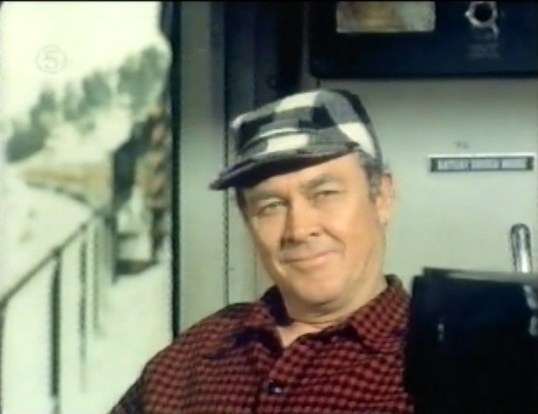
Compared to the other disaster movies of the era, Runaway! does not exactly have an all-star cast though there are some familiar faces. Vera Miles and Ed Nelson are the divorcing couple while Martin Milner is the father who puts too much pressure on his son. Ben Murphy is the gigolo who refuses to pay for a ticket on general principle while Darleen Carr is the woman who wants to jump to her death. Most of them are just there as placeholders. It’s obvious from the start that the real stars of the film are going to be the train and the mountain. However, the famously gruff character actor Ben Johnson manages to make an impression just by being Ben Johnson. Johnson plays the chief engineer and, as long as he’s manning the engine, you know that the train’s passengers are in good hands.
Runaway! has never been released on DVD or even VHS but it is currently available on YouTube.
Sometimes, you have to be careful which films you choose to watch over the course of the day.
Such as, last Friday night, I heard the news that Jill Clayburgh had died and I ended up watching An Unmarried Woman. This, along with the fact that I also watched the Black Swan trailer, led to me dancing around the house in my underwear, en pointe in bare feet, and doing a half-assed pirouette in the living room. And I felt pretty proud of myself until I woke up Saturday morning and my ankle (which I don’t think has ever properly healed from the day, seven years ago, that I fell down a flight of stairs and broke it in two places) literally felt like it was on fire. That was my body’s way of saying, “You ain’t living in a movie, bitch. Deal with it.”
So, come Sunday, I decided to play it safe by watching something that I was sure wouldn’t lead to any imitative behavior on my part. Since I had previously reviewed Earthquake on this site, I decided that I would devote some time to the movies that started the entire 1970s disaster movie genre — Airport. Watching Airport led to me watching Airport’s three sequels.
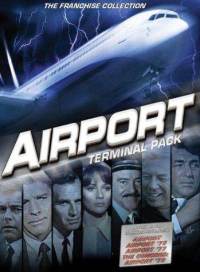
I was able to do this largely because I own the Airport Terminal Pack, a two-disk DVD collection that contains all four of the Airport films and nothing else. There’s no special features or commentary tracks. That’s probably a good thing because these films are so extremely mainstream that I doubt the commentary tracks would be all that interesting except to people who love “Me and Jennings Lang had the same lawyer…” style stories.
The movies are a mixed bag of ’70s sexism, mainstream greed, and casts that were described as being “all-star” despite the fact that they featured very few stars. They’re all worth watching as time capsules of a past time. Some of them are just more worthy than others.
Below are my thoughts on each individual film in the collection…
Airport (directed by George Seaton)
First released in 1970, Airport was nominated for 10 Academy Awards (including best picture), broke box office records, and started the whole 70s disaster movie trend. It also has to be one of the most boring, borderline unwatchable movies ever made. The fact that I managed to sit through the whole thing should be taken as proof that I’m either truly dedicated to watching movies or I’m just insane. Take your pick.
Anyway, the film is painstakingly detailed account of the every day operations of an airport. Yeah, sounds like a lot of fun, doesn’t it? Burt Lancaster runs the airport. His brother-in-law Dean Martin flies airplanes. Both of them have mistresses but we’re told that’s okay because Lancaster’s wife expects him to talk to her and Martin’s wife is cool with him fucking around as long as he comes home at night. I would be tempted to say that this is a result of the film having been made in 1969 and released in 1970 but actually, it’s just an introduction to the sexual politics of the typical disaster film. Men save the day while women get in the way. And if you think things have changed, I’d suggest you watch a little film calledf 2012…
The only interesting thing about the film is that Lancaster’s mistress is played by Jean Seberg who, ten years earlier, had helped change film history by co-starring in Jean-Luc Godard’s classic film Breathless. Nine years later, after years of being hounded by the American press and the FBI for her radical politics, Seberg committed suicide.
Airport 1975 (directed by Jack Smight)
As opposed to its predecessor, Airport 1975 is actually a lot of fun in its campy, silly way. This is the one where a small private plane (flown by Dana Andrews, the star of the wonderful film noir Laura) collides with a commercial airliner. The entire flight crew is taken out and head stewardess Karen Black has to pilot the plane despite the fact that she’s obviously cross-eyed. Luckily, since Black is a stewardess, she has a pilot boyfriend who is played by Charlton Heston. Heston talks her through the entire flight despite the fact that she was earlier seen trying to pressure him into not treating her like an idiot. Anyway, Heston does his usual clench-jaw thing and if you need a drinking game to go with your bad movie, just take a shot every time Heston calls Black “honey.” You’ll be drunk before the plane lands.
There’s some other stuff going on in this movie (for instance, Gloria Swanson appears as “herself” and doesn’t mention Sunset Boulevard or Joseph Kennedy once!) but really, all you need to know is that this is the film where Karen Black acts up a storm and random characters keep saying, “The stewardess is flying the plane!?”
Odd trivia fact: Airport 1975 was released in 1974.
Airport ’77 (directed by Jerry Jameson)
In Airport ’77, a group of art thieves attempt to hijack an airplane which, of course, leads to the airplane crashing into the ocean and somehow sinking down to the ocean’s floor without splitting apart. The crash survivors have to try to figure out how to get to the surface of the water before they run out of oxygen.
In this case, our resident sexist pilot is Jack Lemmon who has a really ugly mustache. He wants to marry head stewardess Brenda Vaccarro. Vaccarro doesn’t understand why they have to get married to which Lemmon responds, “Because I want a wife and kids!” The film also gives us Lee Grant as a woman who is married to Christopher Lee but who is having an affair with another man. She also drinks a lot and dares to get angry when she realizes that the airplane is underwater. While this sort of behavior is acceptable from Dean Martin, Charlton Heston, and Jack Lemmon, the film punishes Lee Grant by drowning her in the final minutes.
Technically, Airport ’77 is probably the best of the Airport films. The cast does a pretty good job with all the melodrama, the film doesn’t drag, and a few of the scenes manage to generate something resembling human emotion. (For instance, when the blind piano player died, I had a tear in one of my freaky, mismatched eyes.) Unfortunately, the movie’s almost too good. It’s not a lot of fun. Everyone plays their roles straight so the silly plot never quite descends into camp and the key to a good disaster film is always camp. This film also has the largest body count of the series, with most of the cast dead by the end of the movie. (And, incidentally, this film did nothing to help me with my fear of water…)
The Concorde: Airport ’79 (directed by David Lowell Rich)
The last Airport movie is also the strangest. Some people have claimed that this film was meant to be a satire of the previous Airport films. I can understand the argument because you look at film like Concorde and you say, “This must be a joke!” However, the problem with this theory is that there are moments of obvious “intentional” humor in this film (i.e., J.J. from Good Times smokes weed in the plane’s bathroom, another passenger has to go to the bathroom whenever she gets nervous) and none of them show any evidence of the type of wit and outlook necessary to come up with anything this silly on purpose. Add to that, the film’s story is credited to Jennings Lang, a studio executive. Studio execs do not take chances. (Plus, the actual script was written by Eric Roth, who went on to write the amazingly humorless The Curious Case of Benjamin Button).
No, this film is meant to be taken seriously and oh my God, where do I start?
Our pilots are George Kennedy and Alain Delon. The head stewardess (and naturally, Delon’s girlfiend) is played by Sylvia “Emanuelle” Kristel who, at one point, says, “You pilots are such men!” “Hey, they don’t call it a cockpit for nothing, honey,” Kennedy replies.
Meanwhile, Robert Wagner is trying to destroy the Concorde because one of the passengers is his girlfriend who has proof that Wagner has been selling weapons to America’s enemies. So, he attempts to blow the plane up with a guided missile and when that fails, he sends a couple of fighter planes after them. Kennedy responds by opening up the cockpit window — while breaking the sound barrier mind you — and firing a flare gun at their pursuers.
After this, there’s stop over in Paris where Delon arranges for Kennedy to sleep with a prostitute who assures Kennedy that he made love “just like a happy fish.”
The next day, everyone returns to the exact same Concorde — despite the fact that just a day earlier they’d nearly been blown up by a squadron of fighter planes — and take off on the second leg of the flight. Let me repeat that just to make sure that we all understand what this film is asking us to believe. After nearly getting blown up by a mysterious squad of fighter planes, everybody shows up the next morning to get on the exact same plane.
Oh, and it never occurs to Wagner’s ex-girlfriend that Wagner might have something to do with all of this.
Now sad to say, Concorde is the one of those films that’s a lot more fun to talk about than to actually watch. It should be a lot more fun in its badness than it actually is. Still, the movie has just enough camp appeal to make it fun in a “what the fuck…” sorta way.
And that’s how the Airport series comes to an end.
 Nick Denato (Lee Horsley) is a world-famous photographer. His wife, Ellie (Kirstie Alley!), is a renowned doctor. They have homes in San Francisco and Africa and they regularly fly from one continent to another. The Denatos used to be called “jet-setters,” back when flying back and forth was seen as a positive instead of as a crime against the environment.


 Through the Shattered Lens