Doctor Who — Destiny of the Daleks, City of Death, The Creature From The Pit, Nightmare of Eden, Horns of Nimon, Shada


Remember when I was writing about classic Doctor Who for Halloween?  Let’s get back to that with a look at the 17th season of the original series.  This season is a controversial one.  It featured some of the show’s worst serials but also one of its best.  Today, it’s remembered for introducing Lalla Ward as the second Romana and for featuring Douglas Adams as the script editor.

One frequent complaint about this season is that, under Adams’s influence, the season featured more comedy than before and it sometimes felt more like a version of Hitchhiker’s than Doctor Who.  There’s some truth to that but Adams’s influence also made Season 17 into a season unlike any other.  Many of Adams’s ideas didn’t work but he did give us City of Death.

Destiny of the Daleks (1979, directed by Kim Grieve)

Destiny of the Daleks will always have a place in my heart because it opens with Romana regenerating into Lalla Ward.  I will admit right now that, as a kid watching Doctor Who on PBS, I had a huge crush on Lalla Ward.  So did Tom Baker.  He ended up marrying Ward, though the marriage did not last for long.  The relationship between Baker and Ward often seemed to reflected in the relationship between The Doctor and Ward’s Romana.  Long before the Doctor Who reboot had people buzzing about the Doctor and Rose, fans of the original series knew that the Doctor and Romana were in love.

Destiny of the Daleks opens with Lalla Ward’s Romana cheerfully informing the Doctor that she’s decided to regenerate because she was bored and she’s decided to look like Princess Astra.  The Doctor points out that Princess Astra is a real person and Romana can’t just take on her appearance.  Romana then tries out several other appearances before The Doctor tells her to go with Astra.  This goes against everything that the show had established about Time Lords and regeneration but at least we end up with Lalla Ward as Romana.

It’s too bad that the rest of the serial itself isn’t that interesting, even if it does feature the first appearance by the Daleks since Genesis of the Daleks.  Davros returns as well, though he’s now more or less just another generic villain.  The Daleks have a new enemy, a group of robots called the Movellans.  The war between the Daleks and the Movellans are at a standstill because both are governed by logic.  That goes against everything we know about the Daleks.

This was Terry Nation’s final script for Doctor Who.  Reportedly, he was angered when Douglas Adams extensively rewrote the script.  Nation moved to America and later created the original MacGyver.

City of Death (1979, directed by Michael Hayes)

City of Death is a Doctor Who classic.  Romana and the Doctor visit modern-day Paris and the BBC found the money to allow the production to shoot on location.  The Doctor and Romana walk around Paris, hand-in-hand.  Count Scarlioni (Julian Glover) is actually an alien who wants to steal the Mona Lisa so that he can use it to fund his time travel experiments.  Countess Sacrlioni (Catherine Schell) is a classic femme fatale.  An American private investigator named Duggan (Tom Chabdon) wears a trench coat and solves problems by punching first and asking questions later.  John Cleese and Eleanor Bron appears as museum patrons who think the TARDIS is a work of modern art.  Douglas Adams later reworked bits of his script into Dirk Gentley’s Holistic Detective Agency.

Even people who cannot stand the rest of season 17 will agree that City of Death is one of the best of Tom Baker’s serials.  City of Death balances humor and drama and it features an excellent villain in the form of Julian Glover.  Tom Baker and Lalla Ward are at their best, the story is genuinely interesting, and — much like Jago and Lightfoot from The Talons of Weng-Chiang — Duggan deserved his own spin-off.

The Creature From The Pit (1979, directed by Christopher Barry)

This serial features the season’s first appearance by K-9, who is now voiced by David Brierley.  Though this serial was third to be aired, it was the first to be filmed.

It’s not much of a serial.  The TARDIS materializes on yet another feudal planet where Lady Adastra (Myra Frances) rules through fear.  Lady Adastra’s critics are thrown in the pit, which is said to be home to a great monster.  Instead, it’s home to a gentle blob that was sent to the planet as an ambassador.  The Doctor helps the blob gets its freedom while Romana and K-9 are briefly detained by a group of bandits.  Whatever potential the story had is short-circuited by the very unconvincing monster.

Nightmare of Eden (1979, directed by Alan Bromley and Graham Williams)

Two ships materialize in the same location and end up locked together.  Then the TARDIS materializes and the Doctor offers to find a way to unlock the two ships.  One of the ships is a luxury space liner and the passengers are soon being menaced by clawed monsters that look like stuntmen in rubber suits.  The other ship is a trade ship that the Doctor comes to suspect is involved in a drug-running operation.

Once again, the monsters were not at all convincing but the Doctor investigating the interstellar drug traffic was at least something different.  Much like City of Death, Nightmare of Eden, with its luxury spaceliner, had a few moments of satire that worked.  Unlike City of Death, the supporting characters were not that interesting and Tom Baker himself just seemed to be going through the motions.  Nightmare of Eden was better than a lot of Season 17 but it still ultimately comes across as being rather muddled.

The Horns of Nimon (1979 — 1980, directed by Kenny McBain)

The Horns of Nimon, is it terrible or is it great?  Some defend it because of its allusions to Greek mythology, its deliberate humor, and the over-the-top performance of Graham Crowden as Soldeed, the leader of the Skonnan Empire.  Others, like me, point out the turgid pacing, the bad creature effects, and the fact that the majority of the serial is just people walking around.  Based on the myth of the minotaur, The Horns of Nimon looks and feels cheap.  Crowden splits his pants at one point and I guess there was no time to stitch them back up.  The whole thing is just too slapdash.

Shada (2018, directed by Pennant Roberts and Charles Norton)

For decades, Shada was the Holy Grail of Doctor Who.  The final serial of the 17th century, Shada was in the process of filming when the BBC’s technicians went on strike.  With 50% of the serial filmed, production was suspended and eventually canceled.

Afterwards, Shada developed a legendary reputation.  It was often described as being a potential masterpiece, despite the fact that Season 17 was not one of Doctor Who‘s best.  Footage of the Doctor and Romana visiting Cambridge was widely released and even used in The Five Doctors.  The footage itself did look good but that was because it was mostly just Tom Baker and Lalla Ward relaxing and trading funny quips.  There was very little of the actual plot to be found in those scenes.

Finally, in 2017, Shada aired.  Animation was used for the unfilmed sequences and a white-haired Tom Baker even returned to shoot some new linking scenes.  Shada was finally broadcast in the U.S.  And, it wasn’t bad.  It may not have been the masterpiece that so many assumed it would be but it was certainly an improvement on The Creature From The Pit, Nightmare on Eden, and the Horns of Nimon.  

The Doctor and Romana travel to Cambridge to help out another timelord, Prof. Chronitis (Denis Carey).  After Chronitis is apparently killed, The Doctor and Romana discover that space criminal Skagra (Christopher Neame) is seeking a Time Lord named Salyavin who is somewhere on the prison planet, Shada.  Things get muddled once the Doctor actually travels to Shada but the Cambridge scenes are a definite highlight of the serial, a very British diversion for a very British show.  Much as with City of Death, the best moments are the ones where Tom Baker and Lalla Ward just get to play off of each other without having to deal with any sort of intergalactic menace.  Also, as with City of Death, Douglas Adams would borrows bits and pieces of Shada for Dirk Gentley’s Holistic Detective Agency.

Shada may not have been a masterpiece but it would have been a decent end for the seventeenth season.

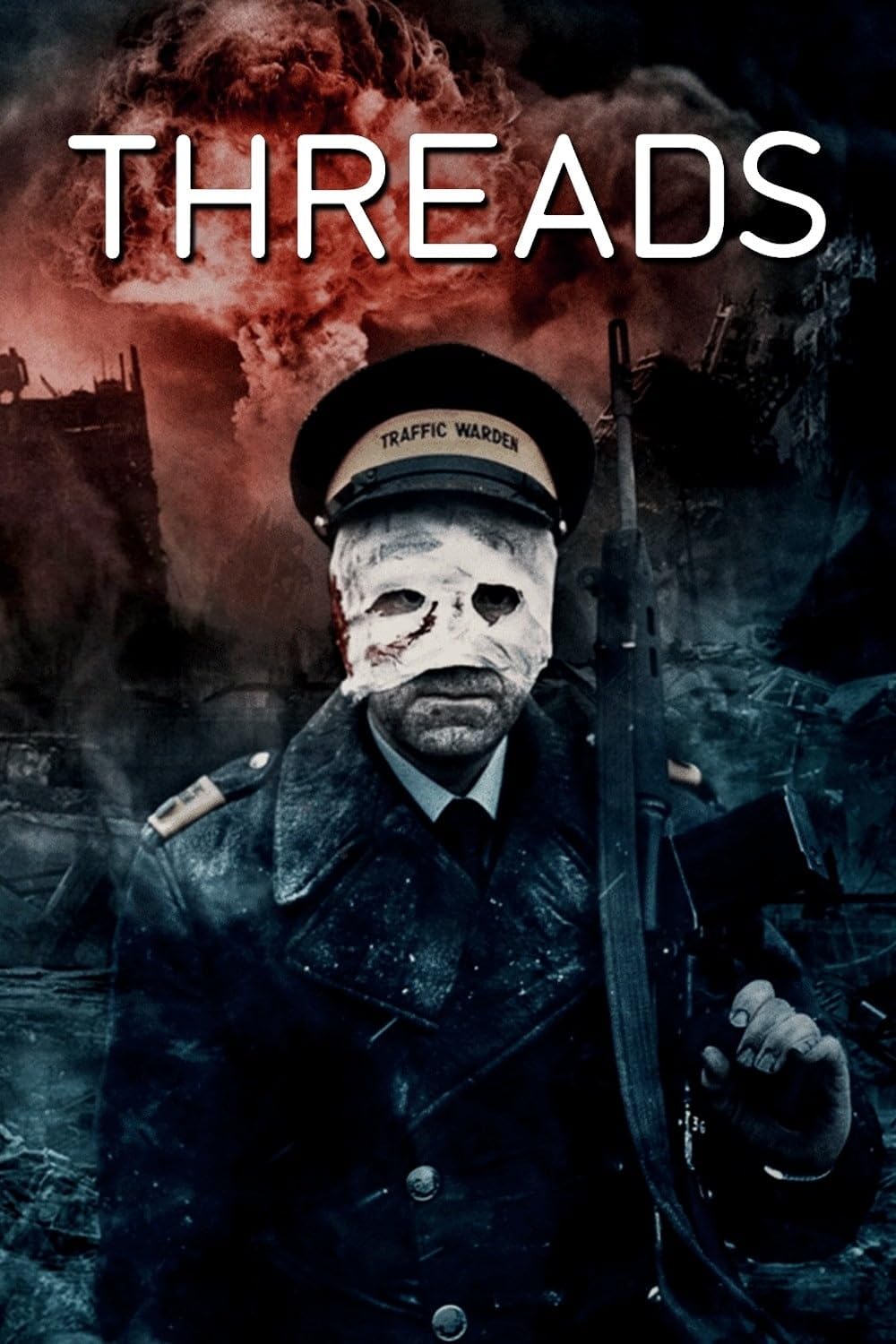


Horror Review: Threads (dir. by Mick Jackson)


“You cannot win a nuclear war! Now just suppose the Russians win this war… What exactly would they be winning? All major centres of population and industry would have been destroyed. The Russians would have conquered a corpse of a country.” — Peace Speaker

Mick Jackson’s Threads remains one of the most devastating and singular experiences in the history of horror cinema. Made for British television in 1984, it presents the end of the world without spectacle, sentiment, or escape. It is horror pared down to elemental truth—an autopsy of civilization staring directly into the void. What it reveals isn’t an invasion or a curse but something far more intimate and plausible. The apocalypse here is homemade.

The film’s dread begins in familiarity. Sheffield in the early 1980s looks ordinary, even dull. We meet young people planning families, moving furniture, going to work. Everyday life rolls forward in its small, reassuring cycles. But the news keeps playing in the background, and the background starts to change. Political tension builds quietly, buried inside the calm language of diplomacy and deterrence. The repetition of these news bulletins—so mundane at first—becomes unnerving because this is precisely how horror entered real life during the Cold War: through information, not imagination. The end of all things doesn’t announce itself with thunder or sirens. It arrives exactly the way it did in history—through headlines, warnings, updates, and comfortable denial.

What makes Threads so frightening is that it removes the supernatural shield that most horror films rely on. There are no vampires in the night, no zombies clawing at the door, no ancient curses waiting for foolish mortals to uncover. The threat here is invisible, mathematical, already built into the fabric of daily existence. The horror is bureaucratic and omnipresent: wires humming, missiles waiting, politicians rehearsing meaningless statements. Jackson’s approach traps viewers in the reality that haunted the Cold War decades—the understanding that extinction wasn’t a mythic event but a possibility hanging over breakfast tables and factory shifts alike. The monsters were human hands resting on launch buttons.

When the bombs finally fall, the destruction plays out without warning or beauty. The light is so intense it erases faces, streets, even color itself. There’s no music to prepare the viewer, nothing to stylize the moment. It looks less like cinema than an interference signal—white noise flooding the world. And when the noise fades, time stops. The air is grey and silent. This is where every cinematic idea of horror—jump scares, final girls, raging beasts—collapses. What’s left isn’t fiction but aftermath. Humanity’s extinction is not delivered by some otherworldly force. It’s the logical consequence of its own inventions.

In the post-blast silence, Sheffield turns into a landscape of wandering ghosts—ordinary people stripped of memory and meaning. The city becomes an enormous grave where speech and thought slowly decay. Threads spends the rest of its running time documenting how civilization erodes, not in minutes but in years. Crops fail, radiation poisons the newborn, and eventually language itself thins out until the survivors grunt out half-words. Watching it feels like witnessing evolution run backward. And all of it happens without villains or intent. The horror is simply that there’s no one left to blame, only ashes where institutions used to be.

That’s the heart of what makes Threads such a distinct kind of horror film. Its terror isn’t supernatural but logistical. The Cold War, for all its abstract politics, becomes the perfect horror setting because its apocalypse was designed, built, and maintained by bureaucrats and citizens who believed they were preserving peace. The film internalizes that historical anxiety and turns it against the viewer. Watching it now reveals how modern the fear remains—the quiet knowledge that our existence can still be undone by systems we built and barely understand.

This level of realism transforms ordinary images into nightmare language. The gray sky, the still streets, the cracked glass—all look completely real because they are. The production relied on weathered locations, handheld cameras, and non‑actors to erase any cinematic polish. That choice doesn’t just increase believability; it removes emotional distance. The audience isn’t safe behind the screen. It’s the same realism people felt in their bones during the Cold War years when the thought of nuclear annihilation hung above every ordinary activity—from going to school to buying groceries. Threads doesn’t invent horror; it recalls one that was already shared by millions, a psychological climate instead of a plot.

What follows after the detonation is not chaos in the traditional sense, but entropy. The world doesn’t explode; it unravels. Government collapses in slow motion, social order dissolves quietly, and hunger becomes the only law. By the time years have passed and humanity has regressed to primitive barter and suspicion, viewers understand that the true monster in Threads isn’t radiation or politics—it’s the continuity of existence stripped of meaning. The worst possible outcome is survival without civilization. Every journal entry and every voice-over that marks the passage of years feels like the universe keeping record of its own disappearance.

The film’s tone never changes. It stays cold, methodical, and precise, as if narrated by the last bureaucrat left alive. That neutrality becomes unbearable after a while, more suffocating than screaming terror. The dispassionate narration reporting the number of dead or the decline in literacy level is as unnerving as any demonic whisper. It’s the voice of civilization reduced to an algorithm, describing its own end with perfect grammar. That was perhaps the truest evocation of Cold War horror imaginable: the notion that when the world ended, it would sound exactly like a news broadcast.

For all its austerity, there’s also a strange poetry in Jackson’s imagery. The empty fields where ash falls like snow, the distant hum of wind through broken windows, the silhouettes trudging through a gray dusk—they linger like haunted photographs. It feels less like humanity has died than that it has become part of the landscape. The apocalypse in Threads isn’t theatrical fire but the slow bleaching of everything living. In a way, it makes the viewer complicit: this is what our collective imagination produced when fear became policy.

The final scene still carries the force of a psychological detonation. The young woman who has grown up in this ruin gives birth to a stillborn child, the last link of continuity severed. There’s no dialogue, no reaction—just a freeze-frame that seems to suspend time at its bleakest point. For a moment, the world stops existing altogether. Few films end so harshly, with no fade‑out or reflection, because Threads doesn’t need metaphor. It closes the loop on its own warning: the horror never came from outside, it came from within—from the quiet machinery of our collective choices and the weapons we built to enforce them.

Seen today, Threads remains deeply relevant because the foundation of its terror hasn’t disappeared. While new anxieties have replaced the Cold War, the sense of self-made extinction still lingers. Watching it feels like eavesdropping on a civilization rehearsing its own burial. Its power lies in showing that the apocalypse isn’t cinematic fantasy. It’s civic policy, historical precedent, and shared human guilt wrapped into the shape of a mushroom cloud. The film’s real horror is how close it remains.

Threads exposes the simplest and most terrifying truth of horror: that sometimes there is no invader, no contagion, no supernatural imbalance waiting for correction. There is only us. The apocalypse that consumed Sheffield was never distant or mythic. It was the reflection in the mirror, the sound on the news, the thing every citizen of that decade tried not to think about while going about ordinary life. That proximity—horror without distance—makes the film feel eternal. It tells us that the end of the world has always been near, not because of monsters waiting outside the window, but because of everything we’ve built inside it.