The TSL Grindhouse: Bummer (dir by William Alan Castleman)


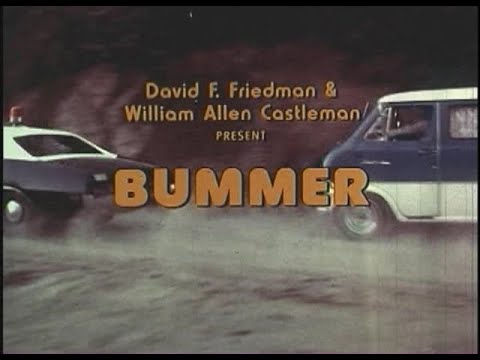
The 1973 film Bummer tells the story of a California rock band known as The Group.

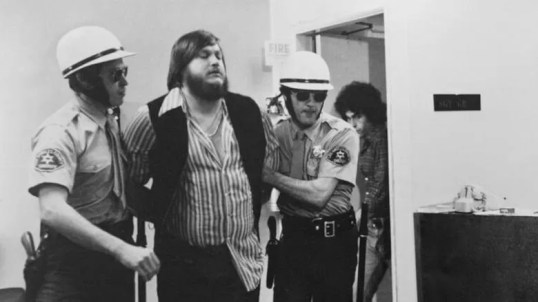
The Group plays groovy music with a mellow feel.  The music they play doesn’t sound so much like actual 70s California rock as much as it sounds like what someone from the big band era would have assumed mellow 70s California rock sounded like.  The Group is led by the charismatic Duke (Kipp Whitman).  The lead guitarist and the drummer look like groovy dudes as well.  But then there’s Butts (played by the great character actor, Dennis Burkley), the bass player.  Butts is a big fat slop with a beard, unwashed hair, and a genuine aura of grime.  Duke’s girlfriend tells Duke that he really should kick Butts out of the band.  The problem is that Duke owns the van that the Group travels around in.  It’s the type of 70s van that was probably nicknamed “The Second Base Mobile.”

Well, Duke really should have considered kicking Butts out of the band because it turns out that Butts is crazy.  He’s a sociopath with a mother fixation and, when he realizes that he’s the only member of the band who isn’t getting laid on a regular basis, he goes crazy and starts assaulting and murdering groupies.

It’s a bummer!

This film was produced by David Friedman, the genial sexploitation producer who is best-known for his collaborations with Herschell Gordon Lewis.  Lewis did not direct Bummer and I have to say that I was a little bit surprised to discover that because there’s a scene at a strip club that goes on for so long and which features so many pointless close-ups of pervy men staring up at the dancers that I immediately assumed that Lewis must have, at the very least, snuck onto the set and supervised it.  Instead, the film was directed by William Allen Castleman, who also did directed Johnny Firecloud and The Erotic Adventures of Zorro.  So be it.  I’m still convinced that Lewis has something to do with this movie.

Bummer is one of those films about how wasteful the younger generation is, with their mellow rock music and their bongs and their groupies.  The film’s main message seems to be that anyone under the age of 30 is intellectually vapid and spiritually empty but at least they look good without their clothes on.  It’s a mix of exploitation and nostalgia.  “You know who didn’t murder groupies?” the film seems to be saying, “Glenn Miller, that’s who.”

The film is pretty dull.  Scenes drag.  It takes forever for any sort of plot to develop.  Most of the cast is forgettable but Dennis Burkley makes an impression as the unhinged bass player and watching him in this, it’s easy to understand why be became such a busy character actor.  There’s an authentic edge to Burkley, one that comes through even in this film.  One of the groupies is played by Carol Speed, who would later appear in Disco Godfather and warn people about the dangers of “whack attack.”  Oddly enough, the film looks surprisingly good.  Cinematographer Gary Graver worked on films like this in between working on Orson Welles’s The Other Side Of The Wind.

In the end, Bummer lives up to its title.
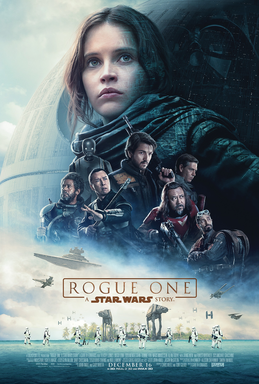
No Ewoks, No Jar Jar: Rogue One: A Star Wars Story (2016, directed by Gareth Edwards)


rogue_one_a_star_wars_story_posterA long time ago in a galaxy far, far away…
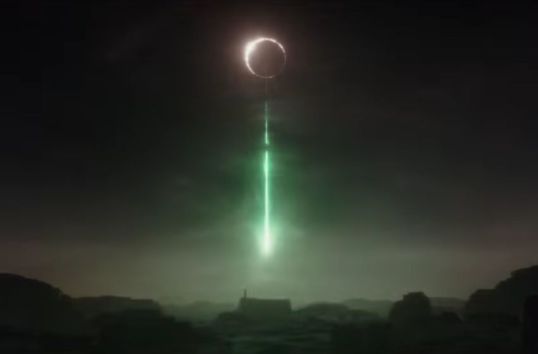
The evil Galactic Empire spent what had to be billions of Imperial credits to build the greatest weapon in the universe.  It was known as the Death Star and it housed a laser so powerful that it could blow up a planet with just one shot.  And yet, for all the effort and all the years that were spent building it, the Death Star had one glaring vulnerability, an exposed exhaust valve that the Rebel Alliance twice used to the destroy it.

For years, fanboys debated why the Empire would go to the trouble to build a super weapon with such an obvious design flaw.  I have to admit that I was often one of them.  No one else seemed to care but, to us, this was a huge deal.  If the Empire could figure out how to blow up a planet with one super laser, why couldn’t they figure out how to protect that one valve?

Now, thanks to Rogue One: A Star Wars Story, we have an answer.  We not only know why that valve was there but we also know what was meant in New Hope when the rebel general said that the plans to the Death Star had been stolen at great cost.

Rogue One is a fan’s dream, one that answers questions while expanding on the Star Wars mythology.  Unlike the previous prequels, it adds to the story without cheapening the original films.  In fact, of all the Star Wars films, Rogue One is the first to make the Death Star into a believable weapon of mass destruction.  When it appears over one planet, it blots out the sun.  When it blows up a rebel base, we see the destruction from inside the base instead of observing it from the safety of Death Star.  Director Gareth Evans does for the Death Star what he previously did for Godzilla.

death-star

Unfortunately, like Godzilla, the action and the special effects in Rogue One are usually more interesting than any of the film’s characters.  Felicity Jones, Diego Luna, Donnie Yen, Jiang Wen, Alan Tudyk, and Riz Ahmed are all good actors but they’re all playing underwritten parts.  No one steps up like Harrison Ford did in the original trilogy.  Commander Kennec, played by Ben Mendelsohn, has a little more depth than the typical Imperial villain but, for better or worse, the film’s most memorable performances come from a CGI Peter Cushing and James Earl Jones providing the voice of Darth Vader.

rogue-one

Despite the underwritten characters, Rogue One is still the best Star Wars film since Empire Strikes Back, a return to the grittiness, the thrilling action, and the awe of discovering new worlds that distinguished the first two movies.  For once, a Star Wars film seems to have more on its mind than just selling toys.  Though we already know what is ultimately going to happen to the Death Star at the end of New Hope, Rogue One is a frequently downbeat film.  There are no Ewoks and, to great relief and rejoicing, Jar Jar is never seen.  The closest that Rogue One gets to comic relief is Alan Tudyk providing the voice of a cynical robot.  The emphasis is on the horrors of war and even the rebels are troubled by some of the things that they have done.  For once, the Rebel Alliance actually feels like a rebellion and the evil of the Empire feels real instead of cartoonish.

Rogue One is projected to be the first of many “Star Wars stories,” stand-alone film that will expand the universe and hopefully clarify some of the points that were left unclear by the original trilogy.  I think it’s going to be very successful very Disney.  I’m just dreading the inevitable Jar Jar origin story.