Brad’s thoughts on KILL BILL: THE WHOLE BLOODY AFFAIR!


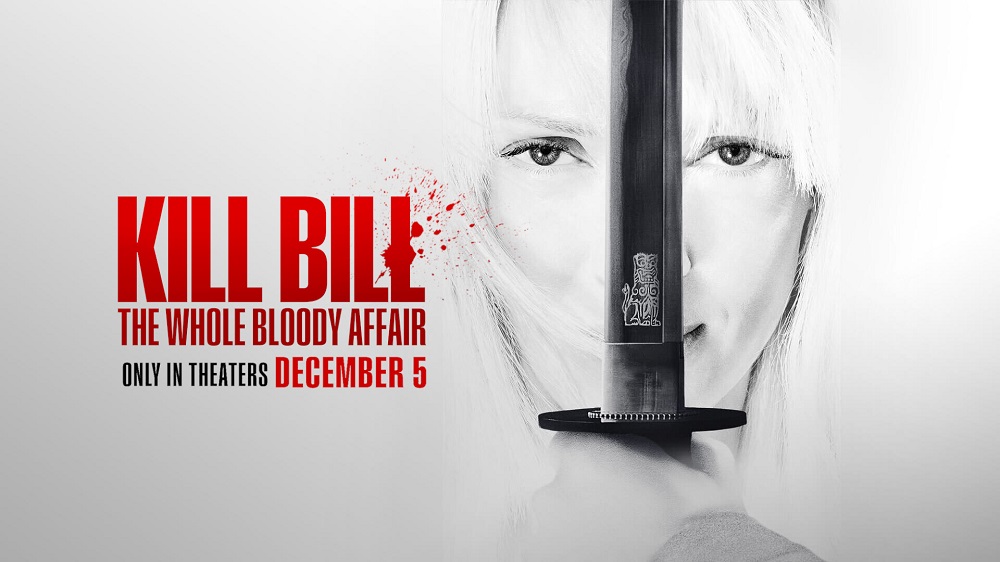
Anything new from Quentin Tarantino is a big deal at my house. When you consider that it’s been over six years since the auteur released his most recent film, ONCE UPON A TIME IN HOLLYWOOD (2019), I was understandably excited when I saw that the full “extended cut” version of the KILL BILL films, dubbed “The Whole Bloody Affair” was being released to theaters. Then, after seeing the trailer, I became really curious about the new scenes that were added, as well as the different presentations of the previous material. When I originally watched the separate volumes at the movie theater in 2003 and 2004, I enjoyed the first movie slightly more than the second based on the fact that it had more action. Now, I wanted to see how the two volumes flowed as one single film. My wife was working this weekend, so I had some time on my hands and decided to spend about four hours of that time watching KILL BILL: THE WHOLE BLOODY AFFAIR.

First, a quick summary of the film… on the eve of her wedding, a pregnant bride-to-be (Uma Thurman) and her entire wedding party is gunned down by the Deadly Viper Assassination Squad, commanded by her former lover, Bill (David Carradine). Somehow surviving the rehearsal massacre, the Bride, who was once a member of the same assassination squad, sets her sights for revenge on each of the members, beginning with O’Ren Ishii (Lucy Liu), and then moving on to Vernita Green (Vivica A. Fox), Budd (Michael Madsen), Elle Driver (Daryl Hannah), and finally Bill himself. It’s a simple premise, but Tarantino uses that premise as a springboard to share his love of kung fu movies, samurai cinema, spaghetti westerns and grind house fare and create something truly special. I loved the KILL BILL films when they were originally released, and the four hours seemed to go by very quickly today as I had a blast watching this definitive version with a relatively full theater of fans.

After watching KILL BILL: THE WHOLE BLOODY AFFAIR, my first thought is that it wouldn’t be that different if the theater just showed Volume One, had a 15-minute intermission, and then showed Volume Two. This isn’t putting down the new version in any way, but there are not a large number of changes that enhance the overall quality of the film itself, and screening the original volumes back-to-back would provide the context for the “big picture” of the story that was lacking when the movies were released in the separate years of 2003 and 2004. With that said, watching the film in this new version was a lot of fun for me, and it should become the norm moving forward as it is truly Tarantino’s vision. It does flow better, mainly by eliminating the unnecessary, late cliffhanger reveal of the daughter in Volume One, as well as the Bride’s “direct to the camera” update at the beginning of Volume Two.

For those who want to go see this new version, I did want to point out the significant differences I noticed while viewing KILL BILL: THE WHOLE BLOODY AFFAIR. The first sequence where I noticed obvious additions to the film occurred in the anime sequence that introduces the background of O’Ren Ishii. This extended version adds additional footage of the Yakuza assassin Pretty Riki to the sequence, and once O’Ren is a slightly older schoolgirl, we get to see her execute a plan of vengeance against him. I would guess somewhere between five and ten minutes of action was added to the sequence. I enjoyed it in Volume One, and I also enjoyed the extended anime sequence in this new version. Does the sequence really add to the overall quality of the film, though? Even though I enjoyed the new material and am glad it was added, I would say no. The next significant difference I noticed with this version concerns the addition of color to the fight sequence between the Bride and the crazy 88’s in the House of Blue Leaves, as compared to the sequence in Volume One that was shown largely in black and white. As a person who doesn’t enjoy a lot of gore in my movies, it never bothered me that the scene switched from color to black and white once the limbs and heads started getting lopped off. With that said, it was kind of fun watching all those limbs hacked off in glorious color this time around. Finally, there is a post-credits animated sequence called “The Lost Chapter: Yuki’s Revenge” where Gogo Yubari’s twin sister tries to get revenge on the Bride. It lasts about ten minutes or so, but honestly, it didn’t add much to the overall experience for me, and I doubt I’ll ever watch it again. As a completist though, I am glad that I stuck around and watched it. These are the only big changes I noticed while watching THE WHOLE BLOODY AFFAIR. I’m sure there had to be some more changes, but I don’t think they were significant. 

I did want to share some final thoughts I had while watching KILL BILL: THE WHOLE BLOODY AFFAIR this afternoon. I noticed on the opening title card that the movie is dedicated to the great Japanese director Kinji Fukasaku, and you can definitely see his influence all over this film. It also affected me more watching Michael Madsen’s excellent performance as Bill’s brother Budd. Tarantino just knows how to get the best out of Madsen, and considering that he passed away a few months ago, I just really appreciated his work while watching the film. I also enjoyed the multiple shoutouts to my movie hero Charles Bronson in the film. First, there’s a MR. MAJESTYK poster hanging on the wall in Budd’s trailer that is featured often throughout the various shenanigans and fights that take place in the trailer. Second, Charles Bronson passed away in 2003, the year that Volume One of KILL BILL was released. In the final credits of the film, Bronson receives an RIP credit. I’ve always loved the fact that Tarantino loves Charles Bronson, and that’s on full display in KILL BILL: THE WHOLE BLOODY AFFAIR. I would have given anything if Bronson had been in better health as Tarantino was coming into his own as a filmmaker. I have no doubt that he would have been offered a chance to appear in one of the director’s films.

At the end of the day, I had a great time watching KILL BILL: THE WHOLE BLOODY AFFAIR. The four hours flew by, and I truly appreciated seeing Tarantino’s full vision realized on screen. While I do think this should be the definitive version moving forward, I loved the KILL BILL films before today. THE WHOLE BLOODY AFFAIR improves the overall flow of the film and adds some fun new stuff, but my love for the film didn’t really change that much today… it just runs a tad bit deeper.

Who’s going to see KILL BILL: THE WHOLE BLOODY AFFAIR (2025) this weekend?


To answer my own question, “I am!” I was checking my local movie theater listings for this weekend and came across the showtimes for the release of KILL BILL: THE WHOLE BLOODY AFFAIR, and I must admit I’m pretty excited about it. My wife is working this weekend so I have all Sunday to myself, and watching this Quentin Tarantino classic in a whole new way sounds like a lot of fun.

Check out the trailer below, and if you’re in the Little Rock area, I just may see you there!

Memoirs of an Invisible Man (1992, directed by John Carpenter)


An accident at a laboratory renders stock analyst Nick Holloway (Chevy Chase) invisible.  CIA agent David Jenkins (Sam Neill) wants to recruit Nick to be an assassin but Nick doesn’t want to kill people.  He just wants to make his date with Alice (Daryl Hannah).  With Jenkins and his agents in pursuit, Nick flees to a beach house belonging to his friend George (Michael McKean) and tries to figure out what to do with his life now that no one can see him.  Fortunately, Alice is staying at the beach house too.  Nick and Alice fall in love but Jenkins is close behind.

Based on a science fiction novel by H.F. Saint, Memoirs of an Invisible Man started out as a vanity project for Chevy Chase, who felt that the film’s mix of comedy and drama would establish him as a serious actor.  The project went through a series of directors, including Ivan Reitman and Richard Donner, but in the end no one wanted to work with the special effects necessary to create the impression of invisibility and, even more importantly, no one wanted to work with Chase.  When the film was finally offered to John Carpenter, he was reluctant to do another studio film because of his bad experience with They Live.  He finally agreed because it had been four years since his last film.

The special effects in Memoirs of an Invisible Man are still impressive and the chase scenes show off Carpenter’s abilities as an action director.  The movie flopped with critics and audiences but that was not Carpenter’s fault.  Carpenter keeps the story moving and gets good performances out of Sam Neill and even Daryl Hannah.  The problem with the movie is that Chevy Chase is miscast as an action hero and he tries too hard to give a serious performance.  Carpenter later said he wanted to add more comedy to the film and to emphasize Chase’s talent for physical comedy but Chase refused to do so.  Chase also resented wearing the blue bodysuit that would be used to render him invisible onscreen and often removed the suit early, ruining whatever else Carpenter had planned to shoot during the day.  You can add John Carpenter to the long list of directors who have said they will never work with Chevy Chase again.

One good thing did come out of Memoirs of an Invisible Man.  Carpenter met and enjoyed working with Sam Neill.  (Memoirs of an Invisible Man probably would have worked better in Neill and Chase had switched roles.)  Neill would go on to star in Carpenter’s next film, In The Mouth of Madness.

Late Night Retro Television Reviews: Gun 1.4 “All The President’s Women”


Welcome to Late Night Retro Television Reviews, a feature where we review some of our favorite and least favorite shows of the past!  On Tuesdays, I will be reviewing Gun, an anthology series that ran on ABC for six week in 1997.  The entire show is currently streaming on Tubi!

This week, Robert Altman!  This will be good …. right?

Episode 1.4 “All The President’s Women”

(Dir by Robert Altman, originally aired on May 10th, 1997)

When it comes to the fourth episode of Gun, I have to admit that my expectation were high because this episode was the only one in the series to be directed by Gun’s producer, Robert Altman.  The story, about the womanizing president of a golf club, sound like it would be right up Altman’s alley and allow him to engage in the social satire for which he was best-known.

Unfortunately, the episode itself just isn’t that good.  In fact, it’s the worst episode of Gun that I’ve seen so far.  Watching the show, it’s easy to see that Altman directed it.  There’s several very Altman-like moments.  The show’s plot and its characters all tend to mirror Altman’s trademark obsessions.  That said, for all of Altman’s strengths as a filmmaker and a satirist, he was also a bit self-indulgent and this episode is basically 50 minutes of Altman patting himself on the back and bragging about how clever he is.

The film takes place at a golf club in Texas.  After the club’s president is bitten by a rattlesnake and then accidentally shoots himself in the foot while trying to kill the snake, Bill Johnson (Randy Quaid) is elected as his replacement.  Bill is friendly but shallow, a businessman who is all about prestige and showing off his wealth.  While his wife (Daryl Hannah) spends her time researching real-life presidents, Bill is having an affair with the former’s president’s widow (Jennifer Tilly) while also flirting with his new secretary (Dina Spybey).  Meanwhile, another former lover (Sean Young) is now his attorney while Sally Kellerman plays Jennifer Tilly’s mother and continually warns Bill to stay away from her daughter.

Bill is shocked to discover that someone is sending packages to the women in his life.  Jennifer Tilly receives the gun that was used to shoot the rattlesnake.  Darryl Hannah receives the magazine.  Sean Young receives the bullets.  If you can’t already guess that this is going to end up with Bill in his underwear on the 18th hole, being menaced by a woman carrying a gun, I don’t know what to tell you.

This episode just falls flat and it’s largely the fault of the cast.  Randy Quaid, at the very least, has a Texas accent but he’s not a convincing lothario.  The women all butcher their accents, with the majority of them sounding more like they’re from Georgia than Texas.  Most the cast goes overboard with their quirkiness while Altman directs in a meandering fashion that robs the episode of whatever satirical impact that it might have had.  It’s just a boring episode, regardless on the nails-on-a-chalkboard accents and all the overacting.  Watching this episode, I was reminded of why I usually can’t stand anthology shows.  They just seem to bring out the worst in everyone.

Next week, Kirsten Dunst guest stars.  Did Gun bring out the worst in her?  We’ll find out!

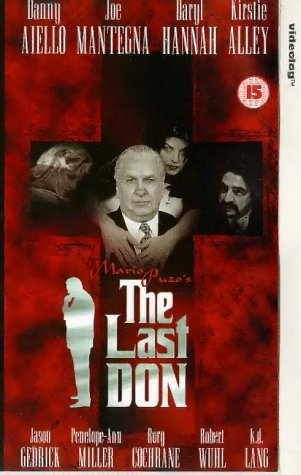
Miniseries Review: Mario Puzo’s The Last Don (dir by Graeme Clifford)


First broadcast over three nights in 1997, The Last Don tells the story of a powerful and respected Mafia family. They control politicians across the country and they own casinos in Vegas and their power even extends all the way to Hollywood. Despite having many enemies, the family has thrived due to the leadership of a wise but ruthless Don.  This Don remembers the old ways and imparts lessons about honor to the members of his own family.  Never let anyone know what you’re thinking.  Never side against the family.  If someone like you were to make enemies, they would become the Don’s enemies and then they would fear you …. you know, stuff like that.

However, times are changing and America is changing with it.  The underworld is no longer run by men of honor.  On top that, the Don is aging and in ill-health. Who will succeed him? One possible successor is respected by all but he’s stayed out of the dirtier aspects of the family’s business and, in fact, he seems to have no desire to be a feared man.  Another possible successor is ruthless and has a terrible temper.  He sometimes speaks out of turn, because the Don has a sentimental weakness for his children.  This possible successor’s anger is feared but perhaps fear is the future of the organized crime in America.  The old ways are changing but one thing remains the same.  The Don believes in America and he believes in family and….

Wait.

Okay, is it just me or does this all sound just a little bit familiar?

If it does, that’s probably because The Last Don is based on a novel by The Godfather‘s Mario Puzo.  Though the family may be called The Clerichuzios and the action may have been moved fro the 40s and the 50s to the 60s, 70s, and 80, the story is still the same basic one that was told in The Godfather.  Don Clerichuzio (Danny Aiello) is an honorable man whose time is coming to an end.  His grandnephew, Cross (Jason Gedrick), is the possible successor who isn’t crazy.  His grandson, Dante (Rory Cochrane), is the possible successor who is violent and doesn’t know how to negotiate.  Don Clerichuzio’s dream is for the family to become completely legitimate but good luck with that when the film business and the political world are just as corrupt as the Mafia.  I supposed one could argue that The Last Don is narrated by Don Clerichuzio while The Godfather has no narration at all but, seriously, once you have to add a voice-over to explain what’s going on, you have pretty much already last the war.

And yes, I did mention the film business.  When Francis Ford Coppola first read The Godfather, he famously hated the Hollywood sections of the book and, with the exception of Tom Hagen’s visit to Jack Woltz (and Woltz’s subsequent discovery of a horse’s head in his bed the next morning), Coppola refused to include them in the movie.  The second half of The Last Don, however, goes full Hollywood and, more or less, proves Coppola’s point.  Cross’s sister, Claudia (Michelle Burke, who also co-starred with Cochrane in Dazed and Confused), gets a job as an agent and one of her clients is the world’s most famous actress, the ludicrously named Athena Aquataine (Daryl Hannah).  When Athena has trouble with her crazy ex-husband (Chris Meloni, bringing a spark of genuine danger to the production), Cross helps her out, falls in love, and gets involved in the production of her next film.  This brings him into conflict with a studio exec named Bobby Bantz (Robert Wuhl).  Unfortunately, all of the Hollywood stuff is pretty dull.  One gets the feeling that Puzo was perhaps settling some old scores with the character of Bobby but Robert Wuhl is one of those goofy actors who belongs nowhere near a Mafia drama.  And don’t even get me started on country singer k.d. lang, who is bizarrely cast as a film director.

(Add to that, how can anyone take a character named Athena Aquataine seriously?  I never miss an Athena Aquataine movie!))

The Hollywood stuff distracts from the Mafia stuff, which is unfortunate because the Mafia stuff is at least occasionally interesting and it’s certainly better-acted than the Hollywood scenes.  Joe Mantegna plays Pippi, who is Cross’s father and who, years earlier, killed Dante’s father.  (Mantegna’s always good but it’s a struggle to take any character named Pippi seriously.)  Kirstie Alley plays Rose Marie, who is Dante’s mentally unstable mother and the Don’s only daughter.  Aiello, Mantegna, and Alley all give good performances, as do Burt Young and Seymour Cassel in the roles of family associates.  As for the “younger generation” of Clerichuzios, Gedrick is a bit dull but then again, Cross isn’t a very interesting character.  The slightly-built Cochrane is miscast as Dante but ultimately, that miscasting kind of works in that it reminds us that, due to his father being the scion of a rival family, Dante is destined to always be viewed as being an outsider.

As I said earlier, The Last Don was originally broadcast over three nights.  I watched the whole thing — all five hours of it — in one sitting and, yes, it was a bit of an endurance test.  It’s not just that it’s long but also that it keeps getting bogged down in all of the Hollywood stuff.  You don’t watch a film like this because you want to spend five hours watching Robert Wuhl mug for the camera.  You watch a film like this for the Mafia action and, for a film called The Last Don, there really wasn’t enough Mafia action.  It has its moments but it never feels as authentic as The Godfather, Casino, Goodfellas, The Irishman, The Sopranos or any of the other classic films and shows about the Mafia..  The Last Don needed to be extremely Italian but instead, it was only slightly Italian.  Robert Evans famously said that Coppola was selected to direct The Godfather because Coppola would make audiences “smell the pasta.”  There’s very little pasta in The Last Don.

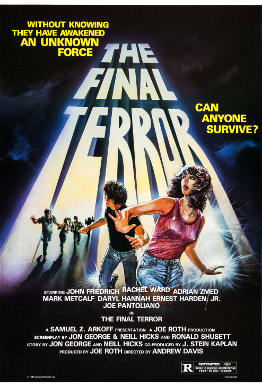
The TSL’s Grindhouse: The Final Terror (dir by Andrew Davis)


“Marco!?”

“Melanie!?”

“Margaret!?”

“Dennis!?”

“Eggar!?”

“Windy!?”

If you watch the 1983’s The Final Terror, be prepared to frequently hear the names of the film’s characters.  For a slasher film about a bunch of campers wandering through the forest, The Final Terror has a surprisingly large cast and they all spend a good deal of time walking around and yelling out each other’s names.  Somehow, people keep getting lost even though they know that there’s a killer out there and they all really should be sticking together.

Interestingly enough, for a slasher film, there aren’t that many deaths.  The majority of the cast survives.  Even the most obnoxious of the campers, the one who seems like an obvious victim, manages to make it through to the finale.  I guess we should be happy that most of them survived and this was apparently their final terror.  The majority of the campers were teenagers and if you’re having your surviving your final terror when you’re not even old enough to drink yet …. well, consider yourself lucky.

The Final Terror is set up like an entry in the Friday the 13th franchise but it’s never anywhere close to being as sleazy as those films.  Whether that’s a good or a bad thing depends on what you, as a viewer, want in terms of a wilderness slasher film.  If you want lots of sex, blood, and people making stupid decisions, The Final Terror will probably bore you to death, despite the fact that it includes all three.  If you want a relatively realistic film about being lost in the wilderness while being stalked by an unseen killer, you’ll probably appreciate The Final Terror.  This film was directed Andrew Davis, who went on to direct several big budget Hollywood action films.  Before he became an action director, though, he worked as an assistant to cinematographer Haskell Wexler on the semi-documentary Medium Cool.  Davis brings that realistic style to The Final Terror.  Even though the film does feature some familiar faces, it’s easy to believe that you’re just watching a bunch of campers trying to survive for the weekend.

As for the cast, Rachel Ward plays one of the leaders of the campers.  Joe Pantoliano makes an early appearance as the creepy Eggar.  Daryl Hannah plays Windy.  Mark Metcalf plays another camper named Mike.  The entire ensemble actually does a pretty good job.  As I said, you really do believe that the majority of the cast are delinquent teenagers who have been sent on a camping trip.  When they work together to keep someone from bleeding to death, it almost feels like an educational film.  “Because the campers worked together,” you can imagine a narrator saying, “they might survive The Final Terror.”

The Final Terror is not bad, though I have to admit that I like my 80s slashers to be a little bit more sordid.  But for what it is — an attempt to take a realistic approach to a genre that is regularly held in dismissive disdain — The Final Terror works surprisingly well.  As captured by Andrew Davis, the wilderness is both beautiful and terrifying.  You’ll never catch me camping!

The Tie That Binds (1995, directed by Wesley Strick)


John (Keith Carradine) and his wife, Leanne (Daryl Hannah) are two white trash murderers who are on the run with the police.  When the cops catch them in the act of burglarizing a house (and murdering the people who live there), John and Leanne manages to narrowly escape but they’re forced to leave behind their 6 year-old daughter, Janie (Julia Devlin).

Traumatized by her former life, Janie is adopted by an architect named Russell (Vincent Spano) and his wife, Dana (Moira Kelly).  Dana, who lost her previous baby, and Russell are convinced that they can give Janie a loving home and help her overcome her past traumas.  And it seems like they might be correct, even though Janie is still terrified of a mysterious monster that she calls “the tooth fairy.”

However, John and Leanne are determined to get their daughter back and they’ve just found out where Russell and Dana live.

The Tie That Binds is a stupid movie from 1995 that, like a lot of stupid movies from the 90s, was put into heavy rotation on HBO and Cinemax after a brief box office run.  The main problem with the film is that everyone consistently makes the dumbest decisions possible but then we’e expected to sympathize with them when everything goes wrong.  John and Leanne may be extremely evil but they’re also extremely stupid so it’s hard to really buy into the idea that they could somehow successfully evade being caught by the police long before the inevitable scene where they confront Russell and Dana in the unfinished house that Russell’s spent the entire movie working on.

The Tie That Binds does feature good performances, all from actors who deserved better.  Keith Carradine and Daryl Hannah are frightening and Moira Kelly and Vincent Spano are convincing as a normal couple who just want to do the right thing.  Both Kelly and Spano should have been bigger stars back in the day but instead, it seems like they usually just ended up in stuff like The Tie That Binds.