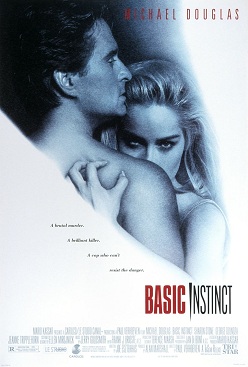
Basic Instinct (1992, directed by Paul Verhoeven)


Nick Curran (Michael Douglas) is a San Francisco police detective who, along with his jolly partner Gus (George Dzundza), finds himself investigating the ice pick-stabbing of a rock star.  The main suspect is glamorous writer Catherine Trammel (Sharon Stone), who is obviously guilty but manages to outsmart all of the men investigating her by not wearing panties during her interrogation.  Nick finds himself drawn to Catherine, despite his own relationship with with psychologist Elizabeth Garner (Jeanne Tripplehorn).  The more Nick digs into Catherine’s past, the more he becomes obsessed with her but also the more he suspects that she may be a serial killer.  This is mostly because Catherine obviously is a serial killer and anyone should have been able to figure that out.  Instead, Nick, an experienced homicide detective, just gets turned on.

It’s strange to remember how seriously people took Basic Instinct when it was released in 1992.  People debated whether it was a throwback to Hitchcock or just a dirty movie.  Feminists debated whether it was empowering or exploitive.  For several years afterwards, every show from The Simpsons to Seinfeld parodied the interrogation scene.  (In Seinfeld’s case, it helped that Wayne Knight appeared in the film as the district attorney who kept shifting in his seat to get a better view.)  Sharon Stone was described as being the new Grace Kelly and, for a period of years, was the subject of fawning profiles in which she was asked about the future of sex in movies.  For a while, she was inescapable.

Sharon Stone, to be fair, did make the role of Catherine her own.  It’s impossible to imagine some of the other actresses considered — Michelle Pfeiffer, Geena Davis, Mariel Hemingway, or Meg Ryan — in the role.  After a decade of not getting anywhere with her film career, Stone was hungry to be a star and was also willing to do things on camera that other name actresses would have refused.  Sharon Stone was not the next Grace Kelly and Catherine Trammel was ultimately more of a sexual fantasy than an actual character but Stone still deserves a lot of credit for her uninhibited performance in the role.  Though Stone later said that she didn’t realize what was actually being filmed during the interrogation scene, it’s her confidence and her unapologetic sensuality that makes the scene compelling.  Her performance has the energy that the sleepwalking Michael Douglas lacks.

Today, Basic Instinct is best-viewed as a satire.  Director Paul Verhoeven sends up both the cop film and the erotic thriller with a movie that turned everything to eleven.  The film’s sensibility is established by the fact that Michael Douglas’s “hero” is nicknamed Shooter because he killed two innocent people while high on cocaine.  The film’s main joke is an obvious one.  Everyone is too busy staring at Sharon Stone to notice that she’s about to stab them in the back with an icepick.  Joe Eszterhas’s script was vulgar to the point of parody and, fortunately, director Paul Verhoeven understood that even more than Eszterhas did.

Basic Instinct has been imitated countless times but it’s never been equaled.  To that, the credit is owed to Sharon Stone and Paul Verhoeven.
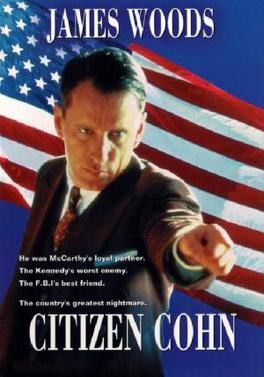
 

Citizen Cohn (1992, directed by Frank Pierson)


The year is 1986 and the powerful attorney Roy Cohn (James Woods) is dying.  The official story is that Cohn has liver cancer but the truth is that he’s dying of AIDS.  As he lies in his hospital bed, he thinks about his past and the events the led to him becoming one of the most feared and powerful men in America.  He is haunted by the ghosts of his many enemies, people like communist spy Ethel Rosenberg (Karen Ludwig) and his former colleague, Bobby Kennedy (David Marshall Grant).

Not surprisingly, a good deal of Cohn’s memories center around his association with Sen. Joseph McCarthy (Joe Don Baker), a charismatic alcoholic who, in the 50s, charged that he had a list with the names of communist spies deep within the government.  Cohn and Kennedy served as the counsels on McCarthy’s committees.  Cohn is with McCarthy from the beginning and he’s with him until the end of the senator’s career.  In fact, it’s Cohn’s own shadowy relationship with an army private that ultimately leads to McCarthy’s downfall.

Except for one aspect of the film, Citizen Cohn is one of the best films to ever be produced by HBO.  The film covers a lot of history in a little less than 2 hours and it does so in a way that is always interesting and easy to follow.  By including incidents from every phase of Cohn’s life, as opposed to just focusing on his time as McCarthy’, the film also shows how someone like Roy Cohn can become a behind-the-scenes power player despite the majority of the country having no idea who he is.  James Woods gives one of his best performances as the hyperactive and unapologetically corrupt Cohn while Joe Don Baker is perfect as the self-pitying Joseph McCarthy.

The problem with the film, and your mileage may vary on how big an issue this is, is that it almost presents Cohn’s final days — dying of AIDS in a lonely New York hospital room — as being some sort of deserved fate for everything that he did wrong in life.  For me, even in the case of someone like Roy Cohn, that’s a step too far and it comes very close to presenting AIDS as some sort of divine punishment (which, itself, comes dangerously close to mirroring the homophobic statements that were made — and still are being made — by anti-gay activists).  That may not have been the film’s intention but, with the flashback structure and all of his dead enemies materializing to taunt Cohn as he lies dying, it’s still a very valid interpretation.

Some of that is perhaps unavoidable.  Cohn, in both real life and the film, died largely unrepentant for anything he did during his life.  As the central character of a biopic, Cohn never has the type of big moment that you would hope for, where he would realize that it was wrong for him to destroy so many lives and show at least a hint of contrition for his past behaviors.  That Roy Cohn is even a compelling character is a testament to the talent of James Woods because it’s certainly not due to any sort of hidden goodness lurking underneath the surface of Cohn’s snarling personality.  The lack of apologies and regrets that made Cohn a powerhouse in real life also makes him an ultimately unsatisfying subject for a movie.

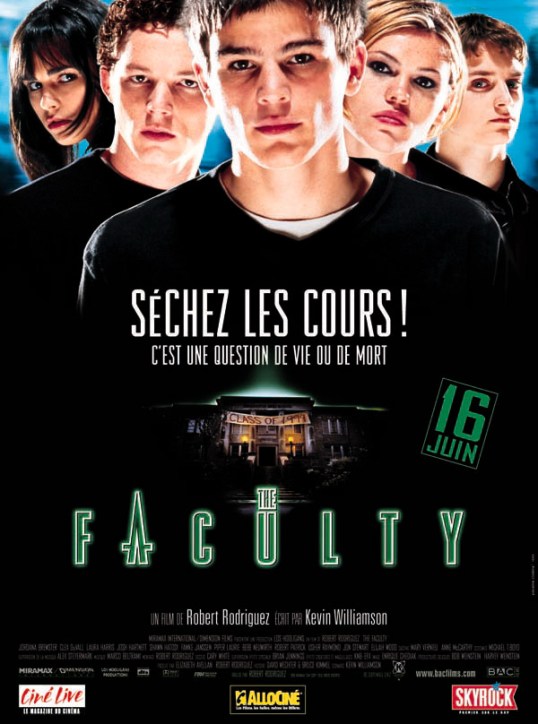
Back to School #52: The Faculty (dir by Robert Rodriguez)


3494-b-the-faculty

Have you ever wanted to see Jon Stewart get stabbed in the eye with a hypodermic needle?

If you answered yes, then 1998’s The Faculty might be the film for you!

The Faculty takes a look at what happens when a new alien species happens to turn up outside of a painfully normal high school in Ohio.  By painfully normal, I mean that Herrington High School is just as messed up as you would expect a suburban high school to be.  The teachers are all underpaid and resentful of their principal (Bebe Neuwrith).  Prof. Furlong (Jon Stewart) is the overqualified science teacher who will perhaps be a little too excited about the chance to examine a new alien species.  Coach Willis (Robert Patrick) is the emotionally shut off coach of the school’s losing football team.  Mrs. Olson (Piper Laurie) is the drama teacher who struggles to promote creativity in a school that’s more interested in blind conformity.  Miss Burke (Famke Janssen) is the teacher who cares too much.  And, finally, there’s Nurse Harper (Salma Hayek), who looks a lot like Salma Hayek.

And, as typical as the teachers may be, the students are even more so.  We get to know a few and they all neatly fit into the expected stereotypes.  Casey (Elijah Wood) is the nerdy outcast who is regularly picked on by … well, by everyone.  Deliliah (Jordana Brewster) is the status-obsessed head cheerleader who has just broken up with her boyfriend, Stan (Shawn Hatosy), because he quit the football team.  Zeke (Josh Hartnett) is the school rebel, the kid who is repeating his senior year and who sells synthetic drugs out of the trunk of his car.  Stokes (Clea DuVall) is an intentional outcast who pretends to be a lesbian and has a crush on Stan.  And finally, there’s Marybeth (Laura Harris), a new transfer student who speaks with a Southern accent.

These students would seem to have nothing in common but they’re going to have to work together because the entire faculty of Herrington High has been taken over by aliens!  Fortunately, the aliens are vulnerable to Zeke’s drugs, which is something that is learned after Jon Stewart takes a hypodermic to the eye…

When one looks over the top Texas filmmakers (director like Terrence Malick, Richard Linklater, Mike Judge, and David Gorden Green), Robert Rodriguez often comes across as being both the most likable and the least interesting.  Like his frequent collaborator Quentin Tarantino, Rodriguez fills his movies with references and homages to other films but, unlike Tarantino, there rarely seems to be much going on behind all of those references.  However, Rodriguez’s referential style works well in The Faculty because, along with acting as an homage to both Invasion of the Body Snatchers and John Carpenter’s The Thing, The Faculty also manages to tap into a universal truth.

Teachers are weird!

Or, at least, they seem weird when you’re a student.  Now that I’m out of high school, I can look back and see that my teachers were actually pretty normal.  They were people who did their jobs and, as much as I like to think that I was everyone’s all-time favorite, I’m sure that there have been other brilliant, asthmatic, redheaded, aspiring ballerinas who have sat in their class.  My teachers spent a lot of time talking about things that I may not have been interested in but that wasn’t because they were obsessed with talking to me about algebra or chemistry or anything like that.  They were just doing their job, just like everyone else does.

But, seriously, when you’re a student, it’s easy to believe that your teachers have been possessed by an alien life form.

Probably the best thing about The Faculty is the fact that the aliens cause the teachers to act in ways that are the exact opposite of their usual personalities.  For most of the teachers, this means that they turn into homicidal lunatics.  But, in the case of Coach Willis, this actually leads to him not only becoming a happy, well-adjusted human being but it also turns him into a good coach.  Suddenly, Willis is getting emotional about the games, his team loves him, and he even gets a win!

Go Coach Willis!

As for the film itself, it’s not bad at all.

Lisa’s rating: 7 out of 10.

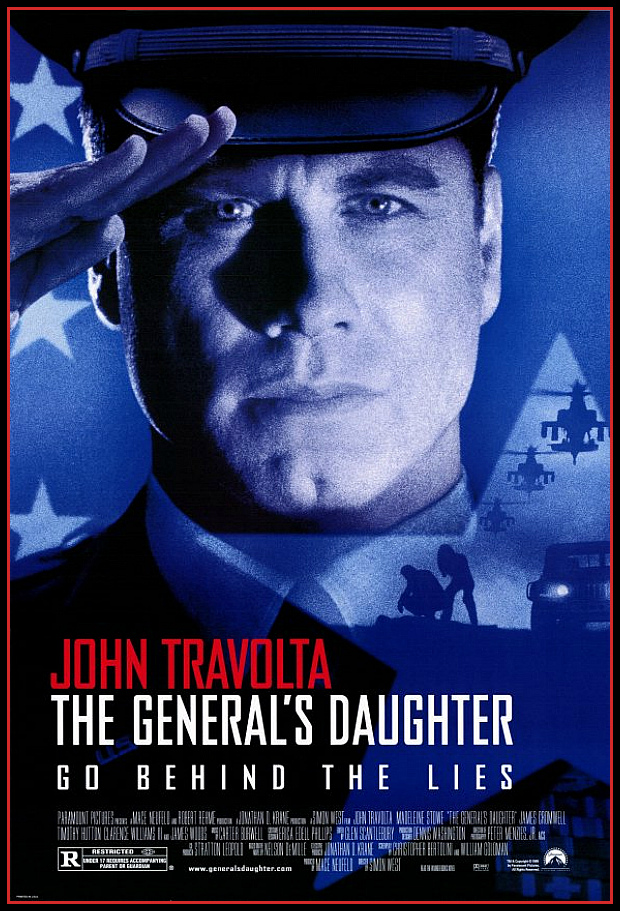
Quickie Review: The General’s Daughter (dir. by Simon West)


The time around the late 1990’s saw a slew of filmmakers who seemed to have been influenced by the filmmaking style of one Michael Bay. In 1998 one such film which had a certain Michael Bay look to it was the crime thriller The General’s Daughter by filmmaker Simon West (fresh off his success from the previous year’s Con-Air). This film adaptation of the Nelson DeMille novel of the same name starred John Travolta when he was still enjoying the second renaissance of his career brought on by his role in Pulp Fiction.

The General’s Daughter was pretty much a crime procedural wrapped around the secretive and insular world of military life. It has Chief Warrant Officer Paul Brenner (played by Travolta) of the Army’s CID investigating what seems to be the apparent rape and murder of a female officer who also happens to be the daughter of the base’s commandant and political-minded general. Brenner’s soon joined by another CID agent, Sara Sunhill (Madeleine Stowe), who must now navigate the insular world which makes up the officer ranks of the military. They find suspects cropping up faster than they could handle and the one prime suspect in base psychologist Col. Moore (James Wood in an over-the-top performance) has secrets about the victim that could jeopardize the lives and career of not just most of the officers on the base but the victim’s own father. This set-up and the basic understanding of the plot should make for a great thriller, but the by-the-numbers direction by Simon West and the over-the-top performances by too many of the characters in the film sinks The General’s Daughter before it could soar.

The story in of itself really has nothing to drag down the film. From the beginning the screenplay does a great job in tossing red herrings to keep the true murderer secret until the very end. It’s these red herrings which manages to bring out the ultimate reason as to the death of Capt. Elisabeth Campbell (Leslie Stefanson) and how a traumatic event in her past became the one major link which would lead to her death early in the film. It’s how these events were acted out which brings down the script. It’s been said that great performances could raise a mediocre script, but the same could be said for the opposite. Very average to bad performances could drag down a great script.

Travolta’s performance was good enough most of the time. He’s especially good when pouring on the Southern charm to try and gain an advantage over those he’s interacting with, but when he suddenly switches over to tough Army investigator that he goes from just beyond campy to over the line into full-blown camp. The same could be said for pretty much everyone in the film from Stowe’s character who manages to just stand around doing nothing but act as a sort of “gal Friday” for Travolta’s character until the very end when she suddenly becomes a crack investigator to help move the plot along. Clarence Williams III really hams it up as the base general’s right-hand man and one would wonder if he realized he wasn’t actually in a grindhouse or exploitation film when it was time to act.

Despite the performances dragging the film down I must admit that The General’s Daughter was quite watchable and entertaining to a certain level. It’s the film’s inadequacies which also makes it quite a disposable fare that should’ve been more. One wonders how the film would be done today with a different set of actors and a filmmaker who knew the nuances of how to navigate around a thriller. Until the inevitable remake from Hollywood gets greenlit (the way things get remade now it’s bound to happen) it’s this version of The General’s Daughter that’d be on record and it’s a film that has too many bad performances for a great screenplay to overcome. A film that ultimately remains mildly entertaining but forgettable in the end.