Late Night Retro Television Review: CHiPs 3.23 “Nightengale”


Welcome to Late Night Retro Television Reviews, a feature where we review some of our favorite and least favorite shows of the past!  On Mondays, I will be reviewing CHiPs, which ran on NBC from 1977 to 1983.  The entire show is currently streaming on Prime!
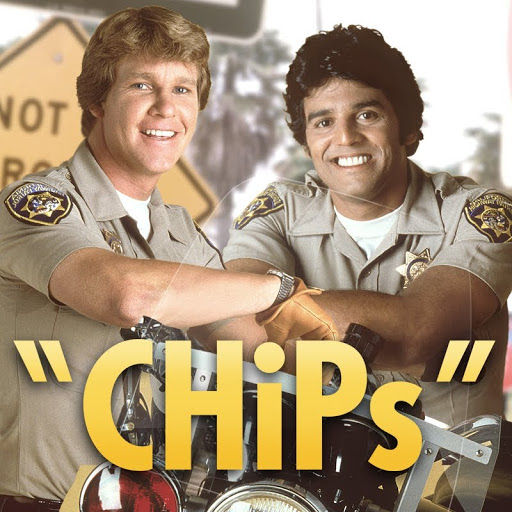
This week, someone is performing emergency surgery on the street!

Episode 3.23 “Nightengale”

(Dir by Don Weis, originally aired on March 23rd, 1980)

Something strange is happening in Los Angeles.  Every time there’s a serious accident, a middle-aged woman (Louise Latham) appears and provides medical help to the injured.  At the start of the episode, she even performs an emergency tracheotomy on the side of the freeway.  Whenever the highway patrol officer on the scene asks her for her name, she avoids the question.  And, whenever an ambulance shows up, she always manages to slip away.  As Jon and Ponch discover, the woman is named Lucy Kenton and, even though she’s a medical expert, she’s not a doctor.  With the help of the always-understanding Sgt. Getraer, Jon and Ponch help her to get her medical license so that she can legally perform surgery on the street.  Good for them!

This was a bit of an odd episode.  It seemed strange that the woman somehow always seemed to be around whenever there was an accident.  A car would crash and suddenly, Lucy would come running up, almost as if she had been patiently waiting.  The show acted as if it was just a coincidence but what are the chances that the same woman would be present at the sites of multiple accidents over the course of just a few days?  And what are the chances that Ponch would just happen to be the responding officer at two of those accidents?

To be honest, that’s one of the things that always struck me as being strange about CHiPs.  Somehow, the same people keep running into Ponch and Jon over and over again.  I mean, Los Angeles is a big city and it’s home to a lot of people.  But if you run into Ponch and Jon once, it seems you’re destined to keep seeing them for at least a week.  Once they get that first speeding ticket or stern warning, people literally can’t step outside of their house without Ponch and Jon just happening to be somewhere nearby.  That’s the sort of thing that would make me paranoid.

The B-plot of this episode featured a teenage couple whose van kept breaking down whenever they tried to run away from home.  There wasn’t much to this story but it did feature “special guest star” Dana Plato as the younger sister of the female half of the couple.  Plato delivered all her lines as if she was auditioning for a school play.  Oddly enough, Dana Plato appeared at the start of this season as herself.  She was one of the many celebrities to show up for the roller disco episode.

There really wasn’t much to this episode.  It wasn’t terrible but it did feel somewhat insubstantial.  We’re coming up on the end of the season and, from the last few episodes, I get the feeling the show’s writers just wanted to wrap things up and start their vacations.  I don’t blame them!

Next week, the third season concludes!
Late Night Retro Television Review: CHiPs 3.1 and 3.2 “Roller Disco”


Welcome to Late Night Retro Television Reviews, a feature where we review some of our favorite and least favorite shows of the past!  On Mondays, I will be reviewing CHiPs, which ran on NBC from 1977 to 1983.  The entire show is currently streaming on Prime!

This week, season three begins with a classic episode!

Episode 3.1 and 3.2 “Roller Disco”

(Dir by Don Weis, originally aired on September 22nd, 1979)

It’s the roller disco episode!

From the moment that I first announced that I would be watching and reviewing CHiPs for this feature, people have been telling me about the legendary roller disco episode.  Having finally reached it, I can say that it lived up to the hype.  You’re not likely to see anything more 70s than the third season premiere of CHiPs.

Now, this was a two-hour episode so there were actually quite a few subplot going on, all of which were typical CHiPs storylines.  In no particular order:

  1. A kid named Mark (Bobby Rolofson) is roller skating around the beach and idolizing three criminals.  Can Baker show him that the good guys always win?
  2. The three criminals are Lita (Helena Kallianiotes), Ty (Fred Williamson), and Romo (Jim Brown).  Lita sets up the targets.  Ty and Romo steal their purses and their wallets and then escape on roller skates.  Ty and Romo are tired of breaking the law.  Lita demands that they continue to steal.  Eventually, it falls to Baker and Ponch to arrest them.
  3. Carlin (Larry Linville) and Franco (Larry Storch) continually cause accidents on the highway.
  4. Rock star Jimmy Tyler (Leif Garrett) is so tired that he sleeps through one of those accidents.  Looking to break free from his well-meaning but overbearing manager (Bill Daily), Jimmy decides to manage his own affairs while staying at Jon Baker’s apartment.

There’s a lot going on but the main plotline is Ponch trying to find celebrities to take part in the annual highway patrol fund raiser.  Even with his big smile, Ponch struggles to charm the celebs.  He pulls over Ed McMahon at one point but fails to recognize him until McMahon drives off.  Gatraer tells Ponch that police work comes first but also tells him that he has to find celebrities.  Gatraer’s been giving Ponch a hard time ever since the first season.  Some things never change.

Fortunately, Jimmy feels guilty for overstaying his welcome at Baker’s apartment and he makes it up to Baker and Ponch by asking his celebrity friends to take part in the fund raiser.  It’s time for a roller disco with the stars!

It all leads to this classic scene:

I recognized a few of the stars, though certainly not all of them.  I recognized Victor French because I’ve been reviewing Highway to Heaven.  I’ve also seen enough old sitcoms that I immediately recognized Robert Mandan, who was apparently the best roller skater in Hollywood.  Melissa Sue Anderson, I knew from Happy Birthday To Me.  Cindy Williams, who got two shout-outs, I knew from American Graffiti.  Is it just me or did Nancy Kulp look kind of lost?  Neither Melissa Sue Anderson nor Cindy Williams seemed to want to talk to her.

The roller disco actually goes on for fifteen minutes, which I appreciated.  The show promised a roller disco and it delivered.  It was like stepping into a time machine and traveling to the 70s.  It was a great way to start season three!

Because of the holidays, this is going to be my final CHiPs review of 2024.  My reviews of this show will return on January 6th!

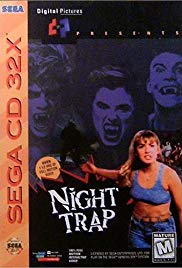
Game Review: Night Trap (1992, Sega)


Moral panics about video games are nothing new.

Long before people were worrying about the violence in Grand Theft Auto or the nudity in Heavy Rain, they were holding Congressional hearings about a game called Night Trap. 

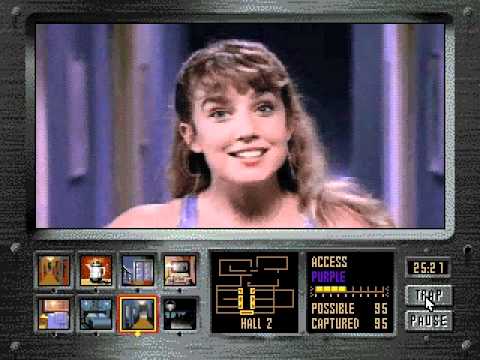
Night Trap was an interactive movie video game, one that was presented through full motion video at a time when that was still a big deal.  The player was a member of S.C.A.T., the Special Control Attack Team.  For 25 minutes, your job was to watch as blood-sucking creatures known as Augers attempted to launch a sneak attack on five girls at a slumber party.  Whenever an Auger approached a trap, the player had to click a button to capture the Auger.

It sounds pretty simple and it was.

It also sounds pretty stupid and again, it was.

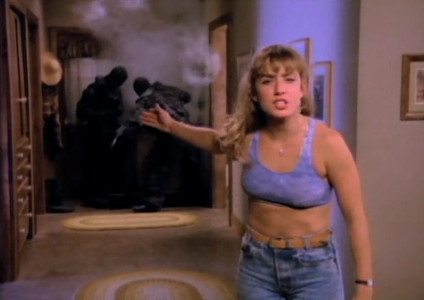
Night Trap initially received some attention because it featured former Diff’rent Strokes star Dana Plato as one of the girls.  Plato played Kelly, who was actually an undercover member of S.C.A.T. and who searched for clues while you were busy trapping Augers.  Plato gave such an annoying performance that many gamers probably purposefully let a few Augers escape just so they could get the “bad” ending, with Kelly plunging into Hell.


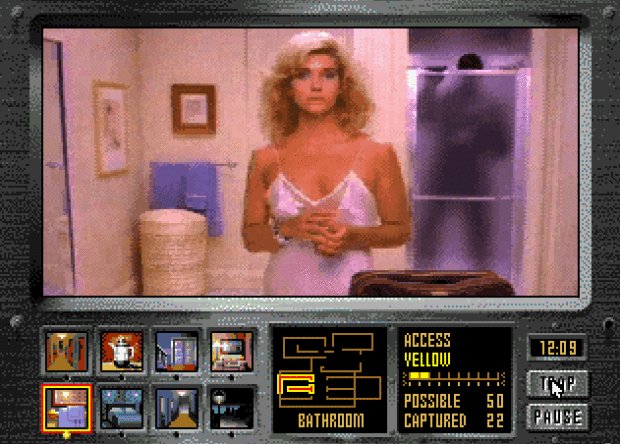
However, even more than Dana Plato running around in a sports bra, it was a scene of one of the girls being stalked while wearing a nightgown that truly worried the moral guardians of 1993.  At the Congressional hearings, Senators Joseph Lieberman and Herb Kohl spent hours reviewing this scene and demanding to know whether it had any socially redeeming qualities.  The hearings also focused on Mortal Kombat and the senators seemed to be far more offended by an actress in a nightgown than they were about Kano ripping his opponent’s still-beating heart out of his chest.

Night Trap seems tame today but, of course, it was also tame back in 1993.  One reason why the “nightgown scene” got so much attention at the hearings is because it was the only scene in the entire game that could be considered the least bit racy.  There’s no sex or nudity in Night Trap.  For the most part, there’s also not any violence.  Whatever actual blood sucking that happens in Night Trap happens off-camera.  Probably the most intense scenes in the game involved Dana Plato scolding you if you let too many of the girls get captured.  Since the only thing the player could do during the game was activate a trap by pushing a button at a certain moment, this game required not so much skill as just being able to keep track of time.  Now, If you enjoyed just pushing a button over and over again, Night Trap might have some appeal but otherwise, this is a dull and poorly acted game.  Not even as formidable a thespian as Dana Plato could liven things up.

Ironically, those Congressional hearings made Night Trap.  If people still remember the game today, it’s because of those hearings.  If you want to know how a boring game like Night Trap could get a special 25th anniversary edition, it was because of those hearings.  There’s nothing like a moral panic to boot sales.


Horror Film Review: Exorcist II: The Heretic (dir by John Boorman)


Exorcist2poster

The Exorcist is one of the greatest horror films of all time and a personal favorite of mine.  But what about Exorcist II: The Heretic?  Well, it would be a bit of an understatement to say that The Heretic has not quite received the amount of critical acclaim as the first film.  Since it was first released in 1977, The Heretic has been widely considered to be one of the worst sequels of all time.  It’s a film that is often cited as evidence as to why not all successful films need a follow-up.

Myself, I have sat through The Heretic twice.  And yes, it is a pretty bad film but I have to admit that I enjoyed it each time that I saw it.  It’s not a scary film at all.  It’s not a successful horror film.  But, as an unintentional comedy, it’s hilarious.

The Heretic opens four years after the end of The Exorcist.  Father Merrin (Max von Sydow) is dead, having had a heart attack during the first film while performing an exorcism on Regan MacNeil (Linda Blair).  In the years since, some in the Vatican have cast doubt on whether or not Merrin actually performed exorcisms.  It turns out that, contrary to everything that we saw in the first film, Father Merrin was actually something of a rebel.  His teachings are controversial.  For instance, he was convinced that everyone has latent psychic powers and that the demon Pazuzu possesses those who have the potential to be the strongest psychics.  Why?  Because those people have the ability to lead humanity into a shared global consciousness and…

Well, it gets a little bit complicated.  That’s one of the big differences between The Exorcist and Heretic.  The Exorcist kept things relatively simple.  The Heretic drags in a lot of metaphysical argle bargle.

The deceased Father Merrin has been brought up on charges of heresy.  The Cardinal (Paul Henreid, many, many years after Casablanca), assigns Father Lamont (Richard Burton) to investigate the circumstances surrounding Father Merrin’s final exorcism.

The presence of Richard Burton is what elevates Heretic from merely being bad to being so bad that it’s good.  As written, Father Lamont is supposed to be something of a naive idealist, someone who never met Father Merrin but who has been intrigued by his writings.  Reportedly, several youthful actors turned down the role and eventually, production decided to make Lamont an older man and they ended up casting Richard Burton.  Speaking in a shaky rasp and staring at the camera with bloodshot eyes, Burton appears to be at the height of his famous self-loathing in this film.  Burton is so miscast as an idealistic priest that the film becomes fascinating to watch.  Occasionally, the film tries to make us suspect that Lamont himself may be possessed but with Burton snarling his way through the role, how could anyone tell the difference?

Lamont tracks Regan down in New York.  Regan doesn’t remember a thing about the exorcism and appears to be an overly happy teenage actress.  (A good deal of the movie is devoted to her rehearsing a big dance number.)  She is under the care of psychiatrist Gene Tuskin (Louise Fletcher).  Tuskin has a device called the Synchronizer.  When two people are hooked up to it, they can literally see into each other’s minds.  They can share the same memories.  They can … wait a minute.  What the Hell?  The Synchronizer essentially appears to be little more than a blinking light but it can actually allow you to enter into someone else’s mind?  Doesn’t that seem like that should be a big deal?

Well, it’s not.  Everyone pretty much just shrugs and accepts it…

Through the use of the Synchronizer, Reagan, Lamont, and Tuskin get to watch a lot of scenes from the first Exoricst.  It also allows Father Lamont to have visions of Africa and another exorcism, this one involving a young boy named Kokumo.

This leads to one of my favorite parts of the film; Richard Burton wandering around a dusty African market and randomly telling people, “I am looking for Kokumo.”  It turns out that Kukomo has grown up to be a doctor and he’s now played by James Earl Jones, who appears to be amused by his dialogue.  Also showing up in the film’s Africa scenes is Ned Beatty.  Beatty plays a pilot who flies Lamont to Kokumo’s village.  “Have you come here before?” Beatty asks.  “Once … on the wings of a demon,” Lamont replies.

Well, okay then…

The first Exorcist worked largely because William Friedkin directed it as if he was making a documentary.  John Boorman takes the exact opposite approach here, trying to turn a cheap sequel into a metaphysical meditation on good, evil, and nature.  It’s amazingly pretentious and it would actually be rather annoying if not for the fact that Burton doesn’t make the slightest bit of effort to come across as being in any way emotionally or intellectually invested in his over-the-top dialogue.  When you combine Burton’s overwhelming cynicism with Linda Blair’s nearly insane perkiness, Louise Fletcher’s genial confusion, and James Earl Jones’s cheerful humor, the end result is something that simply has to be seen to be believed.

So, yes, The Heretic is as bad as you’ve heard.  But that doesn’t mean you shouldn’t watch it.