In 1989’s Dance of the Damned, Cyril O’Reilly plays a vampire with a sensitive side.
The Vampire is out on his nightly prowl. He goes to a strip club where he finds himself drawn to a dancer named Jodi (Starr Andreef). The Vampire is drawn to Jodi because Jodi is thinking of committing suicide. It’s her son’s birthday and the boy’s father refuses to even let her see him. The Vampire approached Jodi and says the wants to talk to her because he hasn’t talked to anyone in a long time. He offers to pay Jodi one thousand dollars if she’ll come back to his house and have a conversation with him.
Because the Vampire doesn’t drive, they take a city bus back to his place. While sitting on the bus, they are harassed by two wannabe punks. The Vampire pierces one of their eyes with the stem of a rose. Oddly, Jodi barely notices.
At the house, the Vampire reveals his fangs and explains that he rarely feasts but tonight is one of those nights when he does. He says that he picked Jodi because he could sense her loneliness and could tell that she wanted to die. He also explains that, contrary to the vampire mythology, Jodi will not turn into a vampire after he drinks her blood. Instead, she’ll just die. Jodi’s response is to shoot the Vampire several times. The bullets fall off of his body.
Jodi and the Vampire end up talking. In fact, Dance of the Damned often feels more like a one-act play than a traditional vampire film. Both Jodi and the Vampire are lonely and they discuss what its like to feel like they have nothing in the world. The Vampire cannot exist in the daylight and, as a stripper, Jodi’s life is centered around the night as well. When Jodi learns that the Vampire has never been to the beach because he never felt like there was much point in going during the night, Jodi insists that they go immediately. The Vampire discovers what sand feels like. He struggles to walk on it which was kind of weird but whatever. At least the movie was trying to do something different!
The main theme of the film is that both the Vampire and Jodi are outsiders. The Vampire was born a vampire and has no idea what it’s like to be a mortal being that can safely walk around in the daylight. Because he has scars from a childhood incident with the humans, even the Vampire’s own people have rejected him. Jodi, meanwhile, has been rejected by conventional society because she’s a stripper and now, she can’t even see her own child. They are two outsiders who are linked together by their feelings of being lost. Over the course of the night, they fall in love but it’s obvious that only one will still be around the next night and it’s also fairly obvious which one it will be.
I liked Dance of the Damned, though I imagine that it might be too talky for a lot of fans of the horror genre. It’s more of a dual character study than a traditional vampire film. Just as she did with films like Poison Ivyand The Rage: Carrie 2, director Katt Shea uses the horror genre as a way to explore the pressure that society puts on women to act, look, and dress a certain way. Shea’s direction is moody and atmospheric and she gets an excellent performance from Starr Andreef. Dance of the Damned is not a film for everyone but for those who are looking for a little emotional honesty to go along with their horror, it’s an intriguing film.
I can still remember the first time that I saw the 1973 film, Messiah of Evil.
It was on a Monday night, many years ago. I had recently picked up a 10-movie DVD box set called Tales of Terror and I was using the movies inside to try to deal with a bout of insomnia. I had already watched The Hatchet Murders (a.k,a. Deep Red) and The House At The Edge of the Park and, at two in the morning, I was faced with a decision. Should I try to sleep or should I watch one more movie?
Naturally, I chose to watch one more movie and the movie I picked was Messiah of Evil. So, there I was at two in the morning, sitting at the edge of my bed in my underwear and watching an obscure horror movie while rain fell outside.
And, seriously — this movie totally FREAKED me out!
Messiah of Evil opens with a man (played by future director Walter Hill) stumbling through the night, obviously trying to escape from something. A mysterious woman appears and kills him. We’re left to wonder who the man was supposed to be as the film doesn’t ever really return to his murder. In most films this would be a weakness but it feels appropriate for Messiah of Evil, a film that plays out with the visual style and fragmented logic of a particularly intense nightmare.
The rest of the story tells the story of Arletty (Marianna Hill), a neurotic woman who drives to an isolated California town in order to visit her father. Her father is an artist who specializes in painting eerie pictures of large groups of black-clad people. However, once she arrives at his home, Arletty discovers that her father has vanished and left behind a diary where he claims that a darkness has overtaken the town. Meanwhile, it sometimes appear as if the people in the paintings are moving or threatening to come out of the walls.
Meanwhile, one crazed man (Elisha Cook, Jr.) explains that “the dark stranger” is returning. An albino (Bennie Robinson) drives a truck up and down the street and talks about how he likes to listen to “Wagner.” The back of the truck is full of blank-faced people staring at the sky and the Albino eats a rat. Finally, a mysterious man named Thom (Michael Greer) is wandering about town with two groupies (played by Anitaa Ford and Joy Bang) and interviewing random townspeople. After meeting Arletty, they all end up moving into her father’s house.
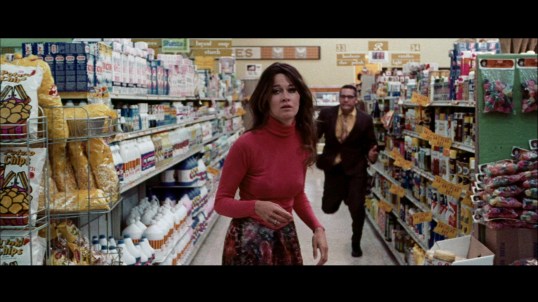
Messiah of Evil is literally one of the strangest films that I’ve ever seen. It’s shot in a dream-like fashion and the much of the film is left open to the viewer’s interpretation. Joy Bang goes to see a Sammy Davis, Jr. western and doesn’t notice as the theater slowly fills up with pale, red-eyed townspeople. Anitra Ford goes to a grocery store late at night and discovers the townspeople indulging in their appetites. If the film was only distinguished by those two scenes, it would still be worth saying. However, Messiah of Evil is a total and complete experience, a film where every scene matters and the audience is tasked with putting the puzzle together.
This film was directed by Gloria Katz and Willard Huyck, two longtime associates of George Lucas. (They wrote the screenplay for American Graffiti and Huyck directed Howard The Duck.) There’s absolutely nothing else in their filmography that is as surreal as Messiah of Evil, leading me to suspect that the film itself might be a very fortunate accident. Apparently, the production ran out of money before Katz and Huyck finished principal photography, which is what led to the film’s disjointed nature. Accident or not, Messiah of Evil is a masterpiece of surreal horror.
Messiah of Evil (1973, directed by Willard Huyck and Gloria Katz)
You have 30 seconds to decide who is the werewolf. Is it the professor? Is it the wife of the big game hunter? Is it the long-haired hippie who has a history of cannibalism? Is it the concert pianist? Is it the diplomat? Make your guess and then….
This is the challenge that is presented to the viewers of the 1974 film, The Beast Must Die. The Beast Must Die is a werewolf film. Calvin Lockhart stars as millionaire big game hunter Tom Newcliffe. Tom has invited a group of people to his English mansion because, according to him, one of them is a werewolf and he plans to hunt down whoever it is. It’s not a terrible premise and I imagine that, in 1974, it was probably quite revolutionary to cast a black actor as a millionaire with a large British estate. (In America, the film was marketed as being a blaxploitation film under the title BlackWerewolf.)
That said, The Beast Must Die is still best-known for its “Werewolf Breaks.” At certain points in the film, a stopwatch appears on the screen and a narrator asks us if we’ve figured out who the werewolf is yet. The viewer is given 30 seconds to make a guess before the film continues. The “Werewolf Breaks” were apparently added to the film after production was completed and director Paul Annett was not happy about them. TheBeastMustDie is, in many ways, a pretty grim film or, at least, it would be if not for the campy narrator telling us that it’s up to us to solve the mystery.
But you know what? I like the Werewolf Breaks. They’re fun and, without them, TheBeastMustDie would come across as being a film that takes itself way too seriously. Calvin Lockhart, who was so good in Melinda, overacts to a tremendous degree as Tom Newcliffe and, as the film progresses, he goes from being merely eccentric to actually coming across as being rather unhinged in his attempts to discover who is the werewolf. It’s never really clear how he settled on his suspects. (All of them are described as being in the area of several unexplained deaths but it seems like the same could be said of probably hundreds of other people as well.) But once he has them at the mansion, he’s determined to keep them there until he figures out which is infected with lycanthropy. (In this film, the werewolf curse is described as basically being a virus.)
Fortunately, the suspects are played by an interesting gallery of British and American character actors. Charles Gray plays the shady diplomat. Malene Clark is Tom’s wife. Michael Gambon is the pianist while Ciaran Madden plays his wife. Tom Chadbon plays the hippie cannibal while Anton Diffring shows up as the head of security for the mansion. Best of all, Peter Cushing plays the professor who is an expert on werewolves. It’s always a joy to see Peter Cushing in any film. He’s particularly good here, handling his often overwritten dialogue like the pro that he was.
TheBeastMustDie is an uneven film. The opening sequence, which features Tom testing the mansion’s security systems, seems to go on forever and the plot is full of twists that fall apart if you give them too much thought, But the Werewolf Breaks made me smile and the supporting cast is a delight. It’s a fun film to watch during the Halloween season.
In 1975’s Mary, Mary, Bloody Mary, Cristina Ferrare plays Mary, an American painter who lives and works in Mexico.
Mary seems to be living her ideal life. She paints. She travels. Her work is popular. She has glamorous and wealthy friends. She has her independence. Even when she starts a relationship with a young American diplomat named Ben (David Young), he seems like a genuinely nice guy who respects her need to have a space of her own.
However, Mary has a secret.
Mary is a vampire. She doesn’t have fangs, she doesn’t sleep in a coffin, and she can go out in the daylight. But she has an obsessive need to drink blood. Whenever she can get away from Ben, she’ll pull out a knife and slit the nearest throat. On the beach, a pushy, middle-aged man falls victim to her. Back in the city, she kills her former lover (Helena Rojo), who is not happy that Mary is now dating a man. Mary does her best to hide her murderous inclinations from Ben, even as she finds herself tempted to taste his blood.
However, someone else has recently arrived in Mexico and he appears to be looking for Mary. The Man (John Carradine) dresses in black and wears a mask over his face. The Man also carries a blade and, like Mary, he drinks the blood of his victims. When Mary reads a newspaper story about a murder that she didn’t commit, she realizes that she’s not the only vampire in Mexico. At the film progresses, we learn that Mary and the Man share a very close connection and Mary is forced to confront whether or not she can be both in love and a vampire.
One thing that I appreciated about Mary, Mary Bloody Mary is that it didn’t leave much ambiguity as to whether or not Mary was actually a vampire. At first, it seemed like the movie was going to play the “Is-she-or-isn’t-she” game and maybe suggest that Mary was just mentally disturbed, But instead, the film makes it clear that Mary is dependent upon drinking the blood of others. It’s suggested that vampirism is something that was passed down to her, much like how I inherited my red hair from my father’s side of the family. But, in the end, there’s no doubt that Mary actually is a vampire. Cristina Ferrare occasionally seems miscast as a ruthless killer but, ultimately, she brings the right amount of sophistication to the role and John Carradine is, as always, a nice addition to the cast.
Unfortunately, the majority of Mary, Mary, Bloody Mary is very slowly paced. I can appreciate a film that takes it time but the first 45 minutes of Mary, Mary, Bloody Mary really does sometimes feel like an endurance test. Once The Man shows up, the film’s pace starts to pick up and Mary is very quickly forced to confront the truth of her cursed existence. At times, I got the feeling that the director was trying too hard to convince me that there was more to Mary, Mary, Bloody Mary than there actually was. The film is littered with scenes that suggest the story was meant to be a statement on the human condition but …. nah. Ultimately, it’s just a film about a woman who drinks blood.
In 1988’s The Undertaker, a small college town is rocked by a serious of viscous, sexually-charged murders. While the professors and the students deal with their own dramas on campus, the bodies are piling up at the local funeral home. Who could the murderer be?
Well, Joe Spinell’s in the film. That really should be the only clue you need.
Spinell plays Roscoe, the town undertaker who has issues with his mother, cries at random, talks to dead bodies, watches movies featuring sacrifices, and occasionally performs what appears to be some sort of a ritual with his victims. This film was Spinell’s final film and he gives a performance that alternates between being perfunctory and being fully committed. On the one hand, there are plenty of scenes where Spinell appears to be making up his lines as he goes along, In the scenes in which he appears in his office, it’s appears that Spinell is literally reading his lines off of the papers on top of his desk. Then there are other scenes where Spinell suddenly seems to wake up and he flashes the unhinged intensity that made him such a fascinating character actor. In the 70s and 80s, there were many actors who frequently played dangerous people. Spinell was the only one who really came across like he might have actually killed someone on the way to the set. Spinell was in poor health for most of his life and he also struggled with drug addiction. In The Undertaker, he doesn’t always look particularly healthy. Even by Joe Spinell standards, he sweats a lot. And yet, in those scenes were actually commits himself to the character, we see the genius that made him so unforgettable.
As for the film itself, it’s basically Maniacbut without the New York grit that made that film memorable. Instead, it takes place in a small town and Spinell, with his rough accent and his button man mustache, seems so out-of-place that the film at times starts to feel like an accidental satire. Roscoe is obviously guilty from the first moment that we see him and yet no one else can seem to figure that out. Only his nephew suspect Roscoe but that problem is quickly taken care of. Whenever anyone dies, their body is brought to Rosco’s funeral home. Roscoe puts on his black suit, plasters down his hair, and tries to look somber. Roscoe spends a good deal of the film talking to himself. When a victim runs away from Roscoe, Spinell looks at a nearby dead body and shrugs as if saying, “What can you do, huh?”
If you’re into gore, this film has a lot of it and, for the most part, it’s pretty effective. In the 80s, even the cheapest of productions still found money to splurge on blood and flayed skin effects. If you’re looking for suspense or a coherent story, this film doesn’t really have that to offer. It does, however, offer up Joe Spinell in his final performance, sometimes bored and yet sometimes brilliant.
In 1979’s The Toolbox Murders, someone is murdering the female tenants of a building in Los Angeles. The killer, who wears a mask and a leather jacket, uses tools. One woman is killed by a hammer to the head. Another is skewered by a power drill. One is stabbed with a screwdriver. Another is shot with a nail gun. The identity of the killer would be a total mystery if not for the fact that we’ve already seen Cameron Mitchell’s name in the cast list.
Indeed, it’s a bit pointless to cast Cameron Mitchell in any sort of whodunit-type of film. Nine times out of ten, Mitchell being in a movie means that that Mitchell (who, in the early days of his career, originated the role of Death of a Salesman‘s Happy Loman on Broadway) is going to be revealed as the murderer. In this case, Mitchell plays Vance Kingsley, the owner of the building. Vance has never recovered from the death of his daughter so he’s punishing women who he considered to be sinful.
The actual toolbox murders are pretty much finished after the first twenty minutes of the film. The rest of the movie deals with Laurie (Pamelyn Ferdin), a 15 year-old girl who is kidnapped by Vance and his nephew, Kent (Wesley Eure). Joey (Nicholas Beauvy), who is Laurie’s brother, attempts to find and then rescue his sister and turns out to very much not up to the task. The film itself ends on a rather sick note, one that is followed by a title card that informs us that the film is based on a true story. Yeah, sure, it was.
The Toolbox Murders has somehow earned a reputation for being a gory and shocking grindhouse film. It was among the films that was banned in the UK for several years. It’s actually not that gory and the use of tools to commit the murders is not quite as clever as the film seems to think it is. Even the nail gun murder (which is the film’s best known moment) feels rather awkward as the victim (Kelly Nichols) never really makes a run for it despite the fact that Vance has to stop to reload after every nail that he fires.
The scenes with Laurie being held hostage are far more disturbing and weird, largely due to Mitchell’s characteristically over-the-top portrayal of Vance’s psychosis. When you watch a movie called The Toolbox Murders, you’re probably not expecting a lengthy scene where Laurie — pretending to be Vance’s dead daughter — tells a long story about what it’s like in the afterlife. In the role of Vance’s nephew, Wesley Eure is even more disturbing than Mitchell. As opposed to the sinister-looking Mitchell, Eure actually has the look of a nice, young community college student and that makes his actions at the end of the film all the more icky to watch.
The Toolbox Murders doesn’t quite live up to its bloody reputation but it’s still a disturbing film nonetheless. Did you know that Heaven smells like lollipops? After this film, you’ll never forget.
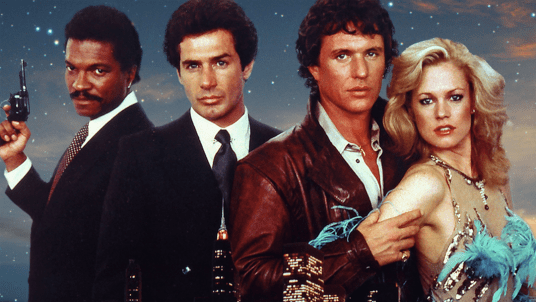
While self-righteous vice cop Al Wheeler (Billy Dee Williams) patrols the streets with the fury of an Old Testament prophet, men flock to seedy bars to watch women like Loretta (Melanie Griffith) dance and strip. Mobsters like Carmine (Rossano Brazzi) control the streets while club owners like Mike (Michael V. Gazzo) and Frank (Joe Santos) try to do business and make enough money to keep things open. Bookers like Nicky Parzeno (Jack Scalia) and Lou Goldstein (Jan Murray) compete to see who can place their girls in the most clubs. Nicky’s best friend and business partner, Matt Rossi (Tom Berenger), is haunted by his violent past as a boxer and his failed relationship with the drug-addicted Loretta.
Meanwhile, a nameless man (John Foster) practices nude tai chai in his warehouse apartment and writes feverishly in his journals. At night, he stalks the streets with a blade in his hand. He targets strippers, attacking them as they try to get home from the club. Honey (Ola Ray) is attacked on a subway platform. Loretta’s girlfriend, Leila (Rae Dawn Chong), is attacked on the streets. Obsessed with Loretta’s safety, Matt struggles with his own inner demons as he prepares for a final confrontation with the killer….
1985’s Fear City is another one of director Abel Ferrara’s heavily stylized fever dreams. In typical Ferrara fashion, the plot is so sordid that one might be tempted to think that the film is meant to be a self-parody and the dialogue mixes profane insults with bizarrely philosophical asides. As played by Billy Dee Williams, Al Wheeler is not just a cop who wants to clean up New York and Times Square. Instead, he’s a seething soldier to traditional morality and one who is so intense that it’s something of a shock that he doesn’t just walk around New York shooting people for jaywalking. Meanwhile, Tom Berenger’s Matt is a hulking brute who is haunted by the time he killed a man in the ring. He knows what he’s capable of and it scares him but, in order to save Loretta and his business, he’s going to have to become that deadly boxer once again. “I hate Matt Rossi because he’s arrogant,” Al Wheeler says through gritted teeth. Meanwhile, Matt deals with his own issues by trashing his office and then leaving the mess for someone else to clean up. I’m not sure what that was supposed to accomplish but it’s apparently something that Matt just has to do.
Abel Ferrara directed this film five years before King of New York and, in some ways, Fear City feels like a dry run for King of New York. Both films are highly stylized and both present New York as being a neon-lit Hell where the rich and the poor come together in mutual self-loathing and where the criminals often have more of a code of honor than the cops who are trying to stop them. Of course, King of New York had Christopher Walken’s magnetic performance as Frank White holding the film and its many storylines together. Fear City doesn’t really have that. Billy Dee Williams, Tom Berenger, Jack Scalia, and Melanie Griffith all give strong performance but none of their characters are really quite compelling or grounded enough to keep the film from spinning off into delirious excess.
In other words, Fear City is a mess but it’s one of those over-the-top, shamelessly sordid messes that you really can’t look away from. There’s enough philosophical dialogue to confirm that, as with King of New York, Ferrara was shooting at something more than just a typical exploitation film. Unlike King of New York, Ferrara doesn’t quite succeed in saying anything particularly deep about the human condition in Fear City. But that’s okay. It’s an entertainingly sordid film.
First released in 1980, Maniac stars Joe Spinell as Frank Zito.
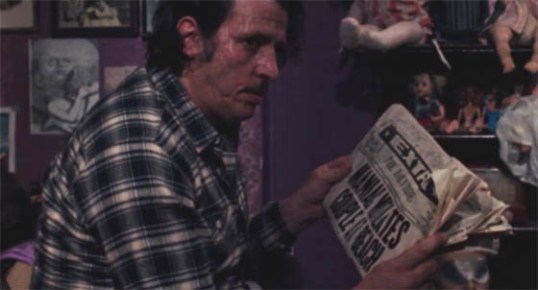
Frank lives in a run-down New York apartment. The grimy walls are covered with pictures that appear to have been cut out of magazines. The sheets on the bed look like they haven’t been washed in over a year and, for that matter, the sweaty and greasy Frank Zito looks like he could definitely use a shower as well. Frank lives alone but he has several blood-stained mannequins. He talks to the mannequins, cooing about how he just wants them to be nice to him and to stop abusing him. Just looking at the apartment, one can imagine the nauseating odor of sweet, blood, and who knows what else that seeps out whenever Frank Zito opens his door.
Frank Zito is also a murderer. The majority of the film is taken up with scenes of him stalking his victims. One extended sequences features him stalking a nurse through a subway station. Another scene features a rather nightmarish moment in which Frank, in slow motion, jumps on the hood of a car and shoots a man point blank with a shotgun. (The man is played by Tom Savini, who was also responsible for the film’s gore effects.) An innocent model is killed after Frank breaks into her apartment. “I just want to talk to you,” he says and maybe he actually believes that at first.
Frank has a chance meeting with a glamorous and beautiful photographer named Anna (Caroline Munro, playing a role that was rejected by Daria Nicolodi). Somewhat improbably, Anna is charmed by the socially awkward Frank and even agrees to go out with him. She’s touched when Frank shows up at the funeral of the model that he killed. “She didn’t have many friends,” Anna tells Frank.
Meanwhile, at the cemetery, Frank’s fate awaits….
Maniac is one of the most infamous and controversial grindhouse films ever made. The film’s atmosphere and the bleak visuals are the equivalent of being forced to look at New York while wearing glasses that somebody found floating in the sewer. The deaths are drawn out and Savini’s gore effects are disturbingly convincing. It’s a nearly plotless film about a man who hates women and what makes it scary as opposed to just exploitive is the fact that there are men like Frank Zito out there. Joe Spinell, who was one of the great character actors of the 70s, appeared in everything from The Godfather to Taxi Driver to Rocky but, in the end, it’s his performance as Frank Zito that he seems to be destined to be most-remembered for. Spinell is frightening, convincing, and disturbing as Frank Zito. Spinell was planning on doing a sequel before his untimely death, at the age of 52, in 1989.
(Spinell was a hemophiliac who bled to death after slipping in the shower. According to Maniac director William Lustig, when the police entered Spinell’s apartment, the first thing they saw was a huge amount of blood. The second thing they saw was a life-like replica of Spinell’s head sitting on top of the television. The head was a prop from Maniac and so convincing that the police originally assumed someone had broken into the apartment and decapitated him. Spinell’s death not only prevented him from playing Frank Zito for a second time but also kept him from reprising his role as Willie Cicci in The Godfather Part III.)
Maniac is not an easy film to defend but, if I had to, I would point out that Frank Zito is portrayed as being an unsympathetic loser throughout the entire film. He’s not some evil genius like Hannibal Lecter. He’s not a nonstop quip machine like Freddy Krueger. He’s not even enigmatic or superhuman like Michael Myers or Jason Voorhees. Instead, he’s a pathetic loser who can’t even win an argument with the voices in his head. Horror films all too often glorify or make excuses for serial killers. (Just look at all of the Ted Bundy films.) Maniac does not present Frank Zito as being anything other than a pathetic and twisted man and, as such, it’s probably one of the most realistic portrayals of a serial killer to be found on film. Frank Zito is not meant to be glorified, though I’m sure that went over the heads of more than a few people who saw this film when it first opened. It’s an ugly film but it’s about an ugly subject. It’s exploitive but ultimately it’s on the side of Zito’s victims.
The film was an early directorial credit of William Lustig, who worked as a production assistant on Dario Argento’s Inferno in order to see how Argento deal with shooting on location in New York. It was while working on Inferno that Lustig met Daria Nicolodi and offered her the part of Anna in Maniac. (Anna’s last name is D’Antoni, a clear nod to Nicolodi’s Italian roots.) Nicolodi was disgusted by the script and turned it down. (Caroline Munro accepted the role and was reunited with her Starcrashco-star, Joe Spinnell. Interestingly enough, even after all of the controversy created by Maniac, Munro and Spinell went on to co-star in The Last Horror Movie.) Lustig based his serial killer on David “Son of Sam” Berkowitz and named him after director Joe Zito, who would go on to direct Friday the 13th — The Final Chapter.
For all the controversy that has dogged Maniac over the years, it’s easy to forget that the film itself is surprisingly well-directed and acted. Caroline Munro bring some much needed class to the proceedings, even if the script requires her character to make some truly dumb decisions. And Joe Spinell was simply horrifying as Frank Zito. It’s not a pleasant film and if you ever find yourself in a home where the owner has a Maniac poster on the wall, I would suggest leaving immediately. It is, however, a landmark of grindhouse filmmaking.
The year is 1972 and the news is grim. The fighting continues in Vietnam. The protests continue at home. Crime is rising. The economy is struggling. Groups like the Weathermen and the SLA are talking about taking the revolution to the streets. In New York, the notorious murderers Krug Stillo (David Hess) and Fred “Weasel” Podowksi (Fred Lincoln) have broken out of prison and are one the run. They are believed to be traveling with Krug’s drug-addicted son, Junior (Marc Sheffler), and a woman named Sadie (Jeramie Rain), who is said to be feral and bloodthirsty.
However, Mari Collingwood (Sandra Cassel) doesn’t care about any of that. She’s just turned seventeen and she can’t wait to go to her first concert with her best friend, Phyllis (Lucy Grantham). Mari is naive, optimistic, and comes from from a comfortably middle-class family. Phyllis is a bit more worldly and tougher. As she explains it, her family works in “iron and steel.” “My mother irons, my father steals.”
While Mari’s parents (Richard Towers and Eleanor Shaw, though they were credited as Gaylord St. James and Cynthia Carr) bake a cake and prepare for Mari’s birthday party, Mari heads into the city with Phyllis. Before they go to the concert, they want to buy some weed. When they see Junior Stillo hanging out on a street corner, they assume he must be a dealer and they approach him. Junior takes them to an apartment, where they are grabbed by Weasel and Krug.
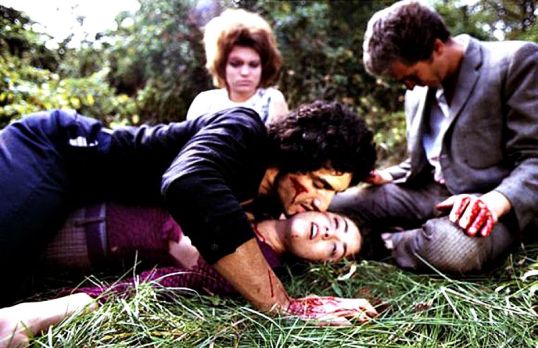
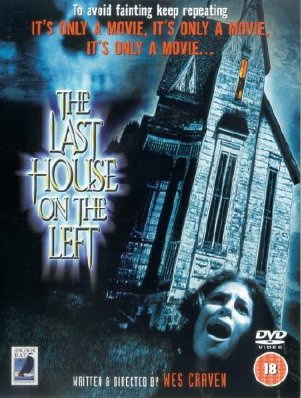
1972’s The Last House On The Left was advertised with the classic (and much-repeated line), “To avoid fainting, keep repeating, ‘It’s only a movie …. it’s only a movie…. it’s only a movie….” That advice is easy to remember during the first part of the film because, up until Mari and Phyllis approach Junior, the movie is fairly cartoonish, with Richard Towers giving an incredibly bad performance as Mari’s father. This film was Wes Craven’s debut as both a director and a writer. By his own admission, Craven had no idea what teenage girls would talk about and, as such, he just wrote a lot of dialogue in which Mari talked about her breasts and Mari’s mother complaining that young women no longer wore bras. (On the commentary that he recorded for the film’s DVD release, Craven succinctly explained, “I guess I was obsessed with breasts.”) This part of the film plays out like a weird counter-culture comedy. Even when we first meet Krug, he’s using his cigar to pop a little kid’s balloon.
The Last House On The Left (1972, dir by Wes Craven, DP: Victor Hurwitz)
The tone of the film jarringly shifts the minute that Mari and Phyllis step into that apartment. That’s largely due to the performances of David Hess and Fred Lincoln, who are both so convincing in their roles that it can be difficult to watch them. In real life, Fred Lincoln was a stuntman (he’s in The French Connection) and an adult film actor. David Hess, meanwhile, was a songwriter who was looking to break into acting. (Hess’s songs — some of which are beautifully sad and some of which are disturbingly jaunty — are heard throughout the movie.) Hess, in particular, is so frightening as Krug that he spent the rest of his career typecast as sociopathic murderers. The middle part of the film alternates between disturbingly realistic scenes of Mari and Phyllis being tortured and humiliated and cartoonish scenes involving two incompetent cops (one whom is played by Martin Kove) and Mari’s parents. Phyllis is murdered and dismembered in a graveyard and the gore effects remains disturbingly realistic even when seen today. Mari, after being raped by Krug, recites a prayer, and then wades into a nearby lake. Krug shoots her three times. Afterwards, Krug, Weasel, and Sadie try to wash the blood off of themselves, the expression on their faces indicating that even they understand that they’ve gone too far.
Eventually, Krug, Weasel, Sadie, and Junior stop off at a nearby house, claiming to be salespeople who just had a little car trouble. What they don’t realize is that the people who are generously welcoming them to spend the night are also the parents of Mari Collingwood….
Basing his script on Ingmar Bergman’s The Virgin Spring, Wes Craven has often said that The Last House On The Left was meant to be a commentary on the Vietnam War and the way that other films had glamourized violence. That may or may not be true. (Craven has also said that, at the time, he was so desperate to direct a movie that he would have filmed almost anything.) What is true is that the violence in Last House On The Left is not easy to watch. Once it starts, it’s relentless and, at no point, is the audience given an escape. David Hess is so committed to playing a sadist that he never takes a moment to wink at the audience and say, “Hey, we’re just playacting here!” Craven shot the film in a guerilla style and the shaky camera, the natural light, and the grainy images leave you feeling as if you’re watching some sicko’s home movies. At the end of the movie, when Mari’s parents take the same joy in attacking her killers as Krug took in attacking their daughter, it’s hard not to feel that Mari has been forgotten. Everyone has been consumed by the violence that has erupted around them. Even though Richard Towers’s nearly blows the ending with a few hammy line readings, the film still leaves you exhausted.
The Last House on the Left (1972, dir. by Wes Craven, DP: Victor Hurwitz)
Not surprisingly, The Last House On The Left was attacked by most reviewers when it was originally released. The movie played the drive-in and grindhouse circuit for three years, with producer Sean Cunningham often taking out advertisements in local newspapers that read: “You will hate the people who perpetrate these outrages—and you should! But if a movie—and it is only a movie—can arouse you to such extreme emotion then the film director has succeeded … The movie makes a plea for an end to all the senseless violence and inhuman cruelty that has become so much a part of the times in which we live.” The film’s advertisements also contained a warning that no one under 30 should see the movie. Needless to say, The Last House On The Left was a huge hit, especially with viewers under 30.
(One of the great ironies of film criticism is that one of the few critics to defend Last House On The Left was Roger Ebert. Ebert, who would later be one of the slasher genre’s biggest attackers, gave Last House On The Left a very complimentary review and praised it for its political subtext.)
Seen today, The Last House On The Left still packs a punch. It’s a shocking and shamelessly sordid film, one that shows hints of the talent that would make Wes Craven one of the most important directors to work in the horror genre. It’s flawed, it’s exploitive, it’s thoroughly unpleasant, and yet it’s also a film that sticks with you. It’s powerful almost despite itself. It’s not a movie that I would necessarily chose to watch on a regular basis but, at the same time, I can recognize it as being a historically important film. For better or worse, much of modern American horror owes a debt to Wes Craven’s Last House On The Left. Even today, when one is regularly bombarded with horrific images, Last House On The Left still has the power to shock.


 Through the Shattered Lens