Retro Television Reviews: The Secret Life of John Chapman (dir by David Lowell Rich)


Welcome to Retro Television Reviews, a feature where we review some of our favorite and least favorite shows of the past!  On Sundays, I will be reviewing the made-for-television movies that used to be a primetime mainstay.  Today’s film is 1976’s The Secret Life of John Chapman!  It  can be viewed on Tubi.
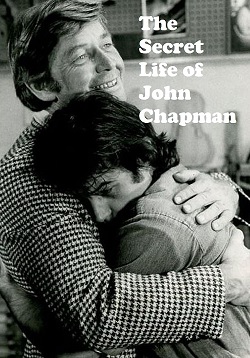
John Chapman (Ralph Waite) is a mild-mannered college president and a recent widower.  Everyone tends to assume that John grew up wealthy but John is actually the son of a bricklayer.  As he puts it, his father literally helped to build the college of which John is now president.  John has felt lost and directionless ever since the passing of his wife.  When his rebellious son (Brad Davis) announces that he’s going to drop out of college and pursue a career as a laborer, John is at first outraged but soon, he’s wondering if perhaps his son has a point.  Has John spent so much time cocooned in his college that he’s lost touch with the rest of the world?

John takes a sabbatical and pursues a career as a blue collar worker.  He discovers that it’s not as easy as he assumed.  Because John doesn’t want to reveal that he’s an academic, John doesn’t really have any references to offer up to potential employers.  Because he’s nearly 50, John is continually told that he’s too old for most of the jobs that he applies for.  When he goes into a bar and attempts to order a dry martini, he quickly realizes that he has no idea what it’s like to be blue collar.

John eventually does get a job, helping to lay water pipes.  His boss is the gruff Gus Reed (Pat Hingle), who John eventually discovers is not quite as fearsome a figure as he originally appears.  Once the pipe job is done, John gets a job in a diner and even pursues a tentative romance with a waitress (Susan Anspach) who, as she points out,  comes from a totally different world than him.  And yet, despite John’s efforts, his son remains unimpressed.  According to his son, John is just slumming.  He has the freedom to quit and return to the college whenever he wants.

Yikes!  John’s son is a bit judgmental and it doesn’t help that he’s played by Brad Davis, who was never a particularly likable actor.  (Davis later starred in Midnight Express, in which director Alan Parker used his lack of likability to good effect.)  Yet, watching the film, you can’t help but feel that John’s son has a point.  At times, it seems like John wants a lot of credit for spending a week working in the type of job that most people take because they don’t have any other option.  Indeed, you could argue that John’s project is basically keeping someone who really needs the money from finding a job.  It’s not like John gives up any of his money when he goes to work.  It doesn’t help that John Chapman narrates his story and his voice-over often feels like a parody of liberal noblesse oblige.

Fortunately, Ralph Waite was a likable actor and he plays John Chapman as being well-intentioned if occasionally a bit condescending.  The made-for-TV movie plays like a pilot and it’s easy to imagine a series in which John Chapman would have worked a different job every week.  It’s a slight but pleasant-enough made-for-TV movie.  Seen today, it works best as a time capsule, a portrait of a society still trying to find its identity in the wake of the turbulence of the 60s.
Film Review: Den of Thieves (dir by Christian Gudegast)


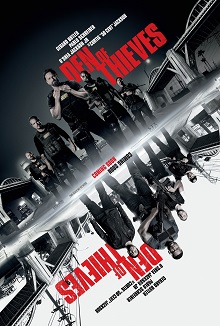
Den of Thieves is quite simply one of the most exhausting films that I’ve ever sat through.

It’s not just that the film itself is overly long, though that’s definitely an issue.  (Den of Thieves last 2 hours and 20 minutes.  For the sake of comparison, that’s 17 minutes longer than last year’s best picture winner, The Shape of Water.)  Instead, the real problem is that there’s really not a single unexpected moment to be found in Den of Thieves.  Every cliché imaginable shows up in Den of Thieves and, after a while, the film’s predictability becomes a bit much to take.

It’s a bank heist film.  We know that because it opens with a strangely portentous title card that informs us that more banks are robbed in Los Angeles than anywhere else in the country.  This is one of those heist films where a self-destructive police detective goes head-to-head with a ruthless yet sympathetic criminal mastermind.  If you’re thinking that this sounds a lot like Heat, you’re right.  In fact, imagine if they remade Heat without any of the stuff that made Heat more than just another crime film and you have a pretty good idea what you’re going to get with Den of Thieves.

The detective is named Big Nick O’Brien (Gerard Butler) and we know he’s a badass because he’s got a lot of tattoos and a beard and when he’s not busting criminals, he’s either getting drunk or getting served with divorce papers.  Nick’s an asshole but that’s okay because Nick … NICK GETS RESULTS, GODDAMMIT!  Nick has a crew that’s devoted to him.  Of course, a lot of them will be dead by the end of the movie.  That’s just the way things go when you’re living in a clichéd crime film.

Big Nick wants to take down Merrimen (Pablo Schreiber), who is a former marine turned bank robber.  We know that Merrimen is a badass because he’s got a beard and he’s got even more tattoos than Nick!  In fact, his entire crew is covered with tattoos!  You have to wonder how smart these criminals are, all getting body art that will make it very easy for the police to identify them.  But they’re a good crew.  In fact … THEY’RE THE BEST!  THEY GET RESULTS!  And only Nick can take them down because … ONLY THE MOTHERFUCKING BEST CAN TAKE DOWN THE MOTHERFUCKING BEST, GODDAMMIT!

Sorry, am I yelling a lot?  This is one of those films where everyone yells a lot.  Basically, this entire movie is drenched in testosterone.  This is one of those films where no one gets interrogated with getting knocked around beforehand and where every meeting is some sort of confrontation.  When the end credits rolled, I was shocked to learn that some of these people actually had names.  Just from listening to the dialogue, I assumed everyone in the film was named “Motherfucker.”

And again, it just all gets exhausting after a while.  Maybe if Den of Thieves had been a 90 minute action flick or had featured any of the self-aware humor of Baby Driver, it would have been entertainingly dumb.  But 140 minutes is a long time to spend with a bunch of thinly drawn stereotypes.

Now, there are two positive things that can be said about Den of Thieves.

First off, one of the thieves is played by O’Shea Jackson, Jr. and he’s got enough screen presence that he can overcome some clunky scenes.  (A scene where he’s interrogated by the police literally seems to go on forever.)

Secondly, the film itself looks great.  The film’s opening scenes do a good job of capturing Los Angeles’s unique mix of grit and glitz.  The opening shootout is pretty well-done and briefly suggests some promise on which the film ultimately doesn’t deliver.

Anyway, Den of Thieves came out this January and despite middling reviews, it did well enough at the box office to earn itself a sequel.  So, in 2020, look forward to more scenes of Gerard Butler … GETTING RESULTS!

Film Review: Southpaw (dir by Antoine Fuqua)


Southpaw_poster

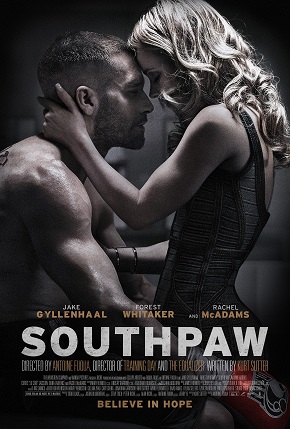
Southpaw features Jake Gyllenhaal as a boxer who loses his wife, his daughter, his career, his self-respect, his car, his house, his manager, his friends, and nearly his life.  But then, about 70 minutes into the film, he gets a chance to get it all back.  Well, almost all of it.  His wife is dead so he can’t get her back but there are hints that he might get together with a helpful social worker after the end credits role.

There was really only one reason why I was interested in seeing Southpaw and that’s because it starred Jake Gyllenhaal.  Last year, Gyllenhaal gave the performance of his career in Nighcrawler.  Gyllenhaal was so brilliant that you just knew the Academy was going to prove itself clueless by not nominating him.  And that’s exactly what happened.  Gyllenhaal was snubbed and, as a result, the Academy now owes him a nomination.  When the trailer for Southpaw first appeared and we saw Gyllenhaal as muscular and bloody, a lot of us assumed that Southpaw would be the film that would get him that nomination.

And Jake Gyllenhaal does do a pretty good job in Southpaw.  He’s one of the main reasons for seeing the film.  It’s interesting to compare Gyllenhaal’s hyperactive performance and sickly appearance in Nightcrawler with his work as boxer Billy Hope in Southpaw.  Billy is a professional brawler and you believe it when you look at him.  Not only is he huge and muscular but he’s got a face that has obviously been punched more than a few times.  When he speaks, he isn’t the hyper articulate con man of Nightcrawler and Love and Other Drugs.  Instead, he stares at the ground as he mumbles and struggles to put together the simplest of thoughts.  It’s a good performance but, at the same time, it lacks the element of surprise that Gyllenhaal has brought to his best roles in the past.  You watched both Donnie Darko and Nightcrawler and you knew that only Gyllenhaal could have brought those roles to life.  Billy Hope, however, is a far less interesting character and you could imagine any number of actors playing the role.  (Reportedly, Southpaw was actually written with Eminem in mind and you really can see him playing the role.)

And really, the entire film is a lot like Billy Hope.  It does its job but there’s nothing all that interesting about it.  Southpaw‘s biggest surprise comes about 20 minutes into the film when Billy’s loving wife, Maureen (Rachel McAdams), is shot and killed and you already knew that was going to happen from the film’s trailer.  After Maureen’s death, Billy starts using alcohol and drugs and, as a result, he loses custody of his daughter, Leila (12 year-old Oona Laurence, giving a great performance).  Because this is a sports film, Billy has to hit rock bottom before, with the help of a grizzled and haunted trainer (Forest Whitaker), he can get a chance to win back both the championship and his daughter.  Director Antoine Fuqua obviously know how to tell these type of testosterone-drenched stories but there’s not a single moment in Southpaw that you won’t see coming from miles away.

And don’t get me wrong.  Unlike some other films that I was less than overwhelmed by, I can actually understand why some people in the theater applauded at the end of Southpaw.  It’s an effective film, even if it does run on for a little bit too long.  It tells a heartfelt story.  It’s a crowd pleaser and I’m sure that a lot of people will enjoy it.  But, for me, it was just too predictable.  I like it when movies catch me off guard and that’s something that Southpaw never came close to doing.

A quick sidenote: Southpaw features the final score composed by the late James Horner and the film is dedicated to his memory.  If you see the movie, be sure to stick around for the dedication so that you can put your hands together for a cinematic and musical legend.