Lisa Marie Reviews An Oscar Nominee: In The Name Of The Father (dir by Jim Sheridan)


One thing that I’ve come to realize is that Irish-Americans (like myself) have been guilty of idealizing the Irish Republican Army in the past.

We tend to view the IRA as being freedom fighters, battling against the occupation and standing up against religious bigotry.  The truth of the matter is that the IRA was a violent organization whose actions often made things even worse for the Catholics in Northern Ireland.  While the IRA’s American supporters always tended to present the IRA as plotting actions against the British army, the truth of the matter is that many of the IRA’s victims were Irish citizens who were judged to either be collaborators or to not be properly enthused about the IRA in general.  The popular excuse for the IRA’s terrorism is to say that the IRA usually called and gave advanced warning before a bomb went off but really, that’s kind of a weak excuse when you think about it.  Really, the only thing that the IRA had going for it was that the British were often just as bad and even more heavy-handed when it came to dealing with the Irish.

In 1993’s In The Name of the Father, Daniel Day-Lewis plays Gerry Conlon, who is sent to London by his father, Giuseppe (Pete Postlethwaite), specifically to keep him from falling victim to the IRA.  Of course, once Gerry arrives in London, he supports himself through burglaries and spends most of his time in a state of stoned bliss with his friends.  It’s while Gerry is in London that an IRA bomb blows up a pub in Guildford.  When Gerry later returns to Belfast, he is promptly arrested and accused of being one of the four people responsible for the bombing.

Gerry protests that he’s innocent and we know that he’s innocent.  We know that, when the bomb was placed, Gerry was busy getting high with Paul Hill (John Lynch).  Paul has also been arrested and the British police are determined to get a confessions out of both him and Gerry.  The interrogation stretches for hours.  Though exhausted, Gerry refuses to confess.  Suddenly, Inspector Robert Dixon (Corin Redgrave) enters the room.  He walks up to Gerry and whispers in his ear that if Gerry doesn’t confess, “I will kill your Da.”

It’s a shocking moment because the threat is delivered without a moment of hesitation on the part of Dixon.  Dixon’s voice is so cold and so direct that, when I watched this film, I actually gasped at the line.  An exhausted and terrified Gerry confesses.  Soon, Gerry is thrown in prison.  He’s joined by his sickly father, who has been accused of being a co-conspirator.  At first, Gerry resigns himself to never being free again.  He meets Joe (Don Baker), who says that he’s the one who set the bomb and that he confessed after Gerry, Giuseppe, Paul Hill, and the other members of the so-called Guildford Four had been given their life sentences.  With Giuseppe’s health faltering, Gerry finally steps up and, with the help of an attorney (Emma Thompson), fights for his freedom.

In The Name of the Father is a powerful film, one that was based on a true story.  Gerry and his father come to represent every victim of a biased justice system and an authoritarian-minded police force.  Gerry starts the movie trapped between the two sides of the Troubles.  The IRA doesn’t trust him because he’s not a bomb-thrower.  The British distrust him because he’s Irish.  Despite his innocence being obvious, Gerry finds himself sent to prison because letting him go would be viewed as a sign of weakness.  Daniel Day-Lewis gives a passionate and charismatic performance as the impulsive and somewhat immature Gerry but the film’s heart really belongs to the late Pete Postlethwaite, playing a father who refuses to give up on either his freedom or his son.

In The Name of the Father received seven Oscar nominations, including Best Picture, Director, Actor, Supporting Actor, and Supporting Actress (for Emma Thompson).  That was also the year of Schindler’s List, which took the Oscars for both Picture and Director.  Daniel Day-Lewis lost to Philadelphia’s Tom Hanks while Postlethwaite lost to Tommy Lee Jones for The Fugitive and Thompson lost to Anna Paquin for The Piano.  1993 was a good year for movies and the Oscars, though I would have voted for Day-Lewis over Hanks.
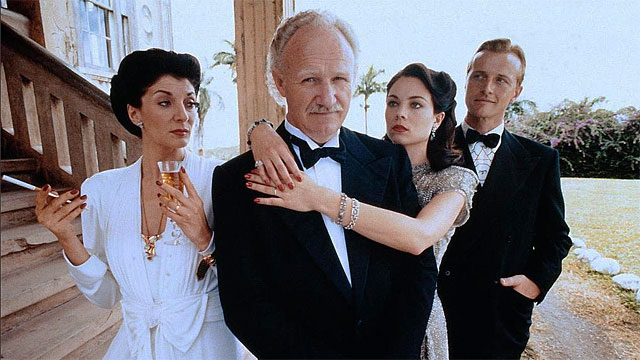
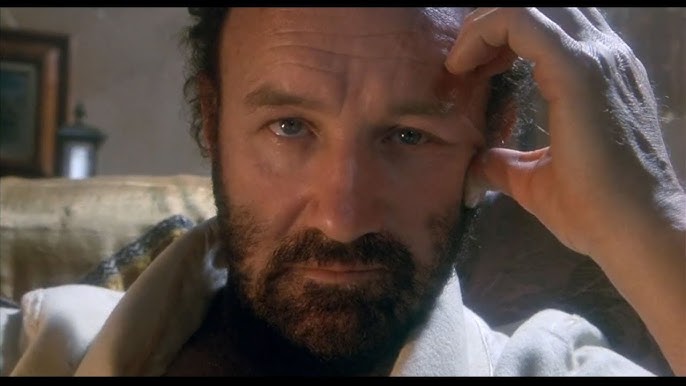
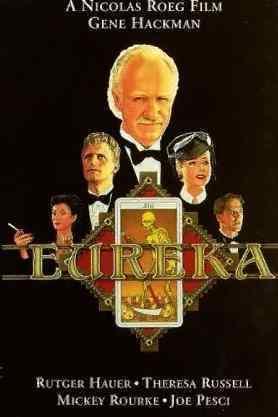
EUREKA (1983) – Gene Hackman strikes gold and tries to strike Rutger Hauer with a meat cleaver in the same move!


I’ve been thinking a lot about Gene Hackman as he recently celebrated his 95th birthday. He’s an incredible actor who has been a part of my life since I first really discovered my love of movies beginning in the mid-80’s. I’ve also been writing about Rutger Hauer every Sunday here on the Shattered Lens. Hackman and Hauer made a movie together back in 1983 called EUREKA, and to be honest, I almost forgot about it. It’s a movie I watched a long time ago and hadn’t watched again until today. It seemed like the perfect time for a revisit.

EUREKA opens with a stunning aerial shot that descends upon obsessed gold prospector Jack McCann (Gene Hackman) who’s fighting with a man on a snow-covered mountain in the Yukon territory. The man has asked Jack to partner with him in their search for gold, and Jack makes it clear that he will never “make a nickel on another man’s sweat.” Next, we see Jack as he’s walking through a nearly deserted town. In another unforgettable shot, Jack watches a man, who’s clearly gone mad, commit suicide just outside of the local “Claims office.” Before watching again today, that was the only scene that I could remember from my initial viewings of the film so many years ago. Next, we see Jack lying down below a tree at night, in windy, frigid temperatures, just about to freeze to death. Three hungry wolves have even approached ready for dinner. And this is where things get strange. Out of the blue, this clairvoyant madam (Helena Kallianiotes) from a local brothel sees him in her crystal ball, as a mysterious stone falls right next to him, starting a fire that warms him and drives away the wolves. He goes to see the madam at the brothel where she tells him that he will strike gold, but he “will be alone now.” Jack leaves the next morning and finds gold, rivers of gold. It’s another stunning sequence showing the obsessed man, who’s been searching for gold for 15 long and hard years, finally finding the object of his obsession. 

Cut to 20 years in the future, where Jack is now the richest man on earth, living on his own Caribbean island. It also appears he may also be the unhappiest man on earth. He has all the money in the world, but there is no peace in his heart or soul. His wife Helen (Jane Lapotaire), who he was once deeply in love with, is now detached and addicted to alcohol. His daughter Tracy (Theresa Russell) has fallen in love and married Claude Maillot Van Horn (Rutger Hauer). Jack cannot stand Claude as he suspects that he seduced and married Tracy so he could get to his money. His best friend Charles (Ed Lauter) has somehow gotten mixed in with Miami mobsters, led by a guy named Mayakofsky (Joe Pesci) and his lawyer Aurelio D’Amato (Mickey Rourke), who want to force Jack to sell them land on his island so they can build a casino. Jack feels like everybody just wants a piece of him and his money. He has lost the joy in his life. The rest of the film plays out against this backdrop as Jack tries to separate Tracy from Claude, and as the mobsters try to force Jack to sell to them by any means necessary.

EUREKA is not a film that everyone will love, but I enjoyed watching it again after so many years. Director Nicolas Roeg, who also directed PERFORMANCE (1970), DON’T LOOK NOW (1973) and FULL BODY MASSAGE (1995), creates some truly amazing and brutal images that once seen are not easily forgotten. The scene where Jack McCann finds his huge vein of gold is so beautiful, but there are alternatively horrific scenes of brutal violence that play out almost to the point of overkill. The movie also takes some surprising twists and turns in the third act that you may not see coming. I always like it when a movie surprises me. It’s a melodramatic film that doesn’t have a lot of likable characters, but with a cast this good, I’m willing to go along with the filmmakers. In addition to the excellent work of Gene Hackman and Rutger Hauer, Theresa Russell has the important role as the daughter stuck between the man she loves and the dad who adores her. Her acting style exemplifies the melodrama of Roeg’s vision, so it works well in the context of this film. Jane Lapotaire has a couple of strong moments as Hackman’s alcoholic wife who yearns for days long gone when they were so in love. We were quite spoiled in the early 80’s when a movie could round out its already impressive cast with actors like Joe Pesci, Mickey Rourke, Ed Lauter, Corin Redgrave and Joe Spinell.

Nicolas Roeg appears to be trying to make deep statements about the meaning of life in EUREKA. I’m not a person who generally consumes films for deep meaning, but I thought it might be fun to at least take a surface-level view of some of the items I noticed while watching the movie. Jack spouts a lot of profound things throughout the movie, things that he feels describe him as a person. I mentioned one earlier when Jack tells the competing prospector prior to finding gold that, “I’ll never make a nickel off of another man’s sweat.” He will continue to use this saying throughout the film, even after he’s a rich, jaded, older man. The truth is that he would not have found the gold without the help of the clairvoyant madam, with her even passing away right after he hits the jackpot. In another scene at an extremely awkward dinner party, Jack tells his guests that the only rule that matters is the Golden Rule, “Do unto others as you would have them do unto you.” While I agree with the importance of this rule, Jack does not seem to follow the Golden Rule in any way that helps others or gives him any sense of peace or connection. Jack does not seem to understand the contradictions in his use of these phrases as played out in his own life, but I also think that his lack of understanding helps to illustrate a truth that plays out at times in many of our own lives. So often we’ll claim certain beliefs and values, but our lives as lived will be much more complex and often hypocritical. We can see them in Jack, but can we always see them in ourselves?

EUREKA also seems to be a movie that’s open to different interpretations based on who’s viewing the movie and where they are in life at that specific time. In a moment of clarity with his wife, Jack seems to recognize the hypocrisy in his life when he tells her “I once had it all… now I just have everything.” Jack is finally reflecting on the important things in his life, rather than dwelling on his current distrust of everyone around him. This final quote got me to thinking about my own life and just how different I am as a man in my early 50’s compared that naïve 20-year-old who first watched this film. I didn’t know what it was like to chase my dreams, catch them, and then try to figure out how to keep striving with a purpose. I didn’t know what it was like to be married with the responsibility of loving my wife and genuinely caring about her needs, through both the good times and the bad times. I didn’t know what it was like to be a dad who wanted nothing but true happiness for his children. Jack has lived through these specific opportunities in life, and we can see how he’s dealt with them. Each of these things have now played out in my own life. There have been times that I’ve failed, and there have been times that I’ve succeeded. I just keep reminding myself to try to focus on the things that matter and not get distracted by the things that don’t. Even now, it’s not always easy to do.    

I’ve included the trailer for EUREKA below:

Excalibur (1981, directed by John Boorman)


During the Dark Ages, Britain is at war.  King Uther Pendragon (Gabriel Byrne) leads his men against The Duke of Cornwall (Corin Redgrave).  Uther and his men swear their allegiance to God and St. George but they trust in the magic of the mysterious Merlin (Nicol Williamson).

Merlin negotiates peace between Uther and Cornwall but Uther throws that peace away when he becomes obsessed with Cornwall’s beautiful wife, Igrayne (Katrine Boorman).  Merlin uses his magic to disguise Uther as Cornwall so that Uther can spend one night with Igrayne.  When Cornwall is killed in battle, Uther marries Igrayne and realizes it was never necesarry to use Merlin’s magic and that Merlin, who has the power to see the future, knew that.  Merlin takes Uther and Igrayne’s infant son from them and then disappears.  Later, Uther is killed by by three of Cornwall’s men.  Before dying, Uther drives his magic sword, Excalibur, into a stone.  On the true king of England will be able to remove it.

Uther’s son, Arthur (Nigel Terry), grows up with no knowledge about his parentage.  When he accidentally draws Excalibur out of the rock, Merlin returns to counsel the new king.  And the new king has much to learn, as not all of the nobleman are willing to accept him as their ruler.  Arthur proves himself worthy to be king while his half-sister, Morgan (Helen Mirren), waits for her chance to get revenge.

Excalibur is one of the most ambitious films made about King Arthur.  John Boorman fits the entire legend of Arthur, Lancelot (Nicholas Clay), Percevel (Paul Geoffrey), Guinevere (Cherie Lunghi), and the search for the Holy Grail into one movie and, as a result, there’s not a dull moment.  Boorman presents the reign of King Arthur as a conflict between England’s pagan past and the new era of man.  Merlin and Morgan’s magic is powerful but, in the end, power is determined by bloody battles fought by men encased in clunky armor.  Arthur, Lancelot, and the other knights claim to live by the honorable, chivalric code but only one of them is able to live up to the ideal.  The others become consumed by lust, jealousy, and a thirst for power.

In my opinion, Excalibur is the best movie made about King Arthur, mostly because John Boorman takes the story seriously and makes us feel like we are watching people who truly are living in different world and a different time.  The chivalric code is necessary to keep the peace in a time when there are multiple pretenders-to-throne.  Mordred (Robert Addie) is not just a villain because he seeks to overthrow his father but also because he is the one person to have no respect for the code or the mystic power of the Holy Grail.

Excalibur has a large cast with many familiar faces.  Keep an eye out for Patrick Stewart as one of Arthur’s earliest supporters and also Liam Neeson as a surly Sir Gawain.  Of all the Lancelots who have appeared in the movies, Nicolas Clay is the best and Helen Mirren is the perfect Morgan.  Nicol Williamson steals the movie as the mysterious Merlin.  And while Nigel Terry was too old for the scenes where Arthur is supposed to be a callow teenager, he grows into the role just as Arthur grew into being king of the Britons.

Monty Python and The Holy Grail will always make me laugh but John Boorman’s big, beautiful, and bloody Excalibur is the best film about Camelot.

Spring Breakdown: Eureka (dir by Nicolas Roeg)


In this 1983 film, Gene Hackman plays Jack McCann, a prospector who is determined to either get rich or freeze to death as he wanders around Alaska in the 1920s.  When he’s not having sex and philosophical discussions with the local witch, Freida (Helena Kallianiotes), Jack desperately searches for gold.  Jack is convinced that gold is all that he needs to be happy, though Freida counsels him that it’s also important to pursue more Earthly delights.  Everywhere Jack looks, he sees people dying in the snow.  In fact, Jack nearly dies himself until he stumbles across a mountain full of gold.  As gold dust pours down on him, he celebrates while having flashbacks to Freida writhing in ecstasy.  It’s just that type of film.  When Jack tells Freida about his claim, he asks what’s going to happen next.  Freida tells him that it’s both the end and the beginning.  Once again, it’s just that type of film.

At this point, Eureka jumps ahead 20 years.  The year is 1945.  World War II is coming to an end.  Jack is no longer freezing and starving to death in Alaska.  Now, he is one of the world’s richest men.  He even owns his own island in the Caribbean.  Jack has a huge house, a beautiful view of the ocean, and all the money in the world.  One could even say that his life has become an exclusive beach vacation, an eternal Spring Break, if you will.  And yet, even with all of his money, Jack has fallen victim to ennui.  He was happier when he was poor and starving and seeking warmth from Freida.  Now, he’s got an alcoholic wife (Jane LaPotaire) and his daughter, Tracy (Theresa Russell), is in love with a dissolute aristocrat named Claude (Rutger Hauer), to whom Jack takes an instant dislike.  Claude claims that Jack has stolen his wealth from the Earth.  Claude is the type who eats gold and then promises to return it to Jack as soon as he can.  That’s something that actually happens.  It’s kind of silly but Rutger Hauer is such a charmer that he nearly pulls it off.

Claude and Tracy aren’t the only thing that Jack has to worry about.  An American gangster named Mayakofsky (Joe Pesci) wants to take over Jack’s island so that he can build a casino on it.  However, despite the best efforts of Mayakofsky’s attorney (Mickey Rourke), Jack is still not willing to sell.  When hitman Joe Spinell shows up outside the estate, are Jack’s days of ennui numbered?

Of course, they are!  That’s not really a spoiler.  Eureka is (loosely) based on the real-life murder of Sir Harry Oakes, an American-born prospector who was thought to be one of the world’s richest men when he was brutally murdered in the 40s.  Jack is, of course, a stand-in for Oakes while Mayakofsky is based on Meyer Lansky, the mobster who many people suspect ordered Oakes’s murder.  Lansky was never charged with the crime.  Instead, Oakes’s son-in-law, Count Alfred de Marigny, was arrested and charged with the crime.  After a trial that made international news and was described as being “the trial of the century,” de Marigny was acquitted and the murder of Harry Oakes remains officially unsolved.

It’s an interesting story and it seems like one that should perfectly translate to film.  Surprisingly though, Eureka doesn’t really do it justice.  The film was directed by one of the masters of cinematic surrealism, Nicolas Roeg.  Roeg, of course, is probably best remembered for films like Performance, Don’t Look Now, Walkabout, and The Man Who Fell To Earth.  As one might expect from a Roeg film, Eureka is visually stunning but, as a director, Roeg can’t seem to decide whether he’s more interested in Jack’s ennui or in all the soapy melodrama surrounding Jack’s murder.  As such, neither element of the film gets explored with any particular depth and the resulting film, while always watchable, still feels rather shallow and disjointed.  (After taking forever to reach the end of Jack’s story, Eureka then turns into a rather conventional courtroom drama.  Theresa Russell does get to utter the immortal line, “Did you cut off my father’s head?” but otherwise, it’s kind of dry.)  The film is at its strongest when Jack is just a prospector in Alaska.  The harsh landscape and the crazed dialogue is perfect for Roeg’s dream-like style.  Once the film moves to the Caribbean, it suffers the same fate that befell Jack when he become rich.  It loses its spark.

That said, Eureka has its moments.  Any film that features Gene Hackman, Mickey Rourke, Joe Pesci, Rutger Hauer, and Joe Spinell all acting opposite of each other is going to have at least a few scenes worth watching.  I particularly liked Pesci’s surprisingly subdued performance as Mayakofsky.  With everyone else in the film chewing every piece of scenery on the island, Pesci wisely underplays and is all the more menacing for it.  While Eureka ultimately doesn’t add up too much, it’s worth watching at least once for the cast.

Finally, my personal theory is that Harry Oakes’s murder had more to do with the Duke and Duchess of Windsor (formerly King Edward VIII and Wallis Simpson) than it did with Meyer Lansky.  (The Duke was the governor of the Bahamas at the time of Oakes’s murder.)  But that’s just my opinion.

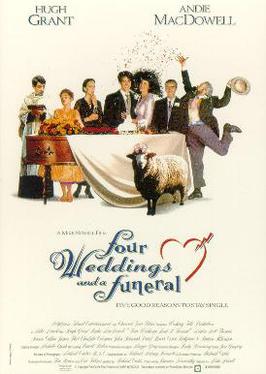
Lisa Reviews An Oscar Nominee: Four Weddings and a Funeral (dir by Mike Newell)


(With the Oscars scheduled to be awarded on March 4th, I have decided to review at least one Oscar-nominated film a day.  These films could be nominees or they could be winners.  They could be from this year’s Oscars or they could be a previous year’s nominee!  We’ll see how things play out.  Today, I take a look at the 1994 best picture nominee, Four Weddings and a Funeral!)

(SPOILERS)

Four Weddings and a Funeral is truly an oddity.  It’s a romantic comedy that works wonderfully well, despite the fact that there’s next to no chemistry between the two leads.

Hugh Grant plays Charles, a neurotic bachelor who lives in London and who, despite having been in several relationships, has yet to marry.  As he’s explains it, he’s spent his life expecting love to hit him like a thunderbolt and it hasn’t happened yet.  Andie MacDowell plays Carrie, an American who has one of those vaguely defined magazine jobs that are so popular in romantic comedies.  Carrie and Charles meet over the course of … well, four weddings and a funeral.  From the minute they first meet, they are attracted to one another but the path of true love is never an easy one.  After spending the night with him, Carrie leaves for America.  When Charles meet her for a second time, she’s now engaged to Sir Hamish Banks (Corin Redgrave), a rather boring politician.

Hugh Grant is perfectly cast as Charles.  It can be easy to make fun of an actor like Grant, what with all the stammering and the carefully calculated charm.  But it works perfectly in Four Weddings and a Funeral, in which Grant manages to believable as both a hopeless romantic and a committed cynic.  Within moments of his first scene (in which Charles wakes up and realizes he’s late for a friend’s wedding), you forget that you’re watching Hugh Grant.  He is Charles.

On the other hand, Andie MacDowell never convinces us that she’s Carrie.  That’s not totally MacDowell’s fault, of course.  Carrie is an underwritten character, one who serves more as a plot device than anything else.  We’re never quite sure how she feels about Charles.  For that matter, we never understand why she’s marrying Hamish.  When she shows up at the film’s funeral, we’re left wondering if she’s really mourning or if she’s just showing up to be polite.  Carrie never comes to life and MacDowell never feels comfortable in the role.  When she gives a warmly received speech at her own wedding reception, the scene feels false because you never feel as if the words are coming from Carrie.

The film ends with Charles and Carrie finally getting together.  Charles both swears his love for her and asks if she’ll agree to never marry him.  We later see them in a snapshot, with a child.  But, despite all of that, you never believe that Charles and Carrie are going to stay together.  There’s just not enough chemistry between Grant and MacDowell to convince you that Carrie isn’t going to get bored and run off with whoever it is she meets at the next wedding she attends.

So, why does this film work so well?  It works because it’s a love story.  However, it’s not about the love between Charles and Carrie.  Not really.  Instead, it’s about the love between Charles and his friends.  Because of the way the film is structured, we only get to see how these people behave at weddings and a funeral.  We never really get to see what these people do for a living or what they’re like during the week.  In fact, we don’t even find out how they all became friends in the first place.

But it doesn’t matter.  The friendships feels real.  The friendships feels authentic.  You might not know how they all became friends but that doesn’t matter.  By the end of the movie, you feel as if you could go to London and possibly run into any of these people going about their daily lives.  They become real in a way that Carrie never does.

There’s Scarlett (Charlotte Coleman), who is Charles’s roommate and who gets flirty when she has too much to drink.

And then there’s David (David Bower), who is Charles’s younger brother.  Both the actor and the character are deaf.  One of the sweetest scenes in the film is when a woman who has been crushing on David attempts to show off her sign language skills.  Everything she signs is wrong but David’s sweet smile tells us all we need to know about how he feels towards her.

Fiona (Kristin Scott Thomas) and Tom (James Fleet) are siblings.  Fiona, who dresses in black, presents a hard exterior but, in one of the film’s more poignant scenes, she admits that the reason she’s never gotten married is because she’s been in love with Charles for ten years.  Tom is a goofy optimist, the type who never doubts that he’s going to find happiness no matter what.

Gareth (Simon Callow) and Matthew (John Hannah) are as close to being married as anyone within Charles’s clique of friends.  (Four Weddings and a Funeral was released twenty years before the legalization of same-sex marriage in the UK.  If someone views the film 50 years from now, they’ll probably wonder why, exactly, Matthew is always described, by those outside of his central group of friends, as merely being a “close friend” of Garth’s.)  Sadly, the funeral of the title is for the fun-loving Gareth.

It’s during the funeral, when Matthew reads a poem from Auden, that it becomes apparent that the heart of this film belongs not to Charles and Carrie but to their friends.  Ultimately, Four Weddings and a Funeral is a celebration of the bonds of friendship.  At the end of the movie, you’re happy, not because Charles and Carrie are finally together but because this unique and wonderful group of friends have all found each other.  Everyone should be so lucky.

Four Weddings and a Funeral was nominated for best picture but lost to Forrest Gump.