4 Or More Shots From 4 Or More Films is just what it says it is, 4 shots from 4 of our favorite films. As opposed to the reviews and recaps that we usually post, 4 Shots From 4 Films lets the visuals do the talking!
Today is the start of a new year and it’s also a day to start thinking about which film you’re going to discover over the course of the next 12 months! Below are my suggestions for 8 films that, if you haven’t already watched them, you should definitely make time to watch before 2023 rolls around!
8 Shots From 8 Film For 2022
It (1927, dir by Clarence Badger, DP: H. Kinley Martin)
The Rules of Game (1939, dir by Jean Renoir, DP: Jean Bachelet)
Portrait of Jennie (1948, dir by William Dieterle, DP; Joseph H. August)
Chappaqua (1966, dir by Conrad Rooks, DP: Etienne Becker, Robert Frank, and Eugene Schufftan)
An American Hippie in Israel (1972, dir by Amos Sefer, DP: Ya’ackov Kallach)
Strange Behavior (1981, dir by Micahel Laughlin, DP: Louis Horvath)
The Two Orphan Vampires (1997, dir by Jean Rollin, DP: Norbert Marfaing-Sintes)
A Field in England (2013, dir by Ben Wheatley, DP: Laurie Rose)
At the risk of sounding like every other girl who has ever sat in a corner of Starbucks and spent a few hours writing emo poetry in her Hello Kitty notebook, I love the Beat Generation. I’ve read all of Jack Kerouac’s novels, Allen Ginsberg’s poems, and William S. Burroughs’ cut-ups. I’ve even tried to listen to the music of the Fugs and I just recently finished reading the very first Beat novel, John Clellon Holmes’ Go. It was my interest in the Beats that led to me discovering Chappaqua.
Originally filmed in 1966 and released a year later, Chappaqua was produced, written, and directed by Conrad Rooks. The son of the president of Avon, Rooks had a lot of money and a lot of addictions. In 1962, Rooks checked into a European clinic where he detoxed and claimed to have been cured of his drug dependency through something called “sleep therapy.” Chappaqua is based on his experiences both as a drug addict and a patient and, since Rooks was something of a hanger-on in the American underground art scene, the final film featured cameos from such counterculture figures as Allen Ginsberg and William S. Burroughs.
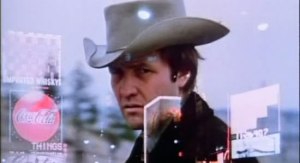
In the film, Rooks plays himself, a young man who is usually seen wandering aimlessly from one location to another. The film is edited in such a way that you’re never quite sure where Rooks is going to be from one scene to another. Most famously, the film’s opening features Rooks wandering across the countryside of Nebraska while images (and sounds) of New York’s 42nd Street are superimposed over his face. Later on in the film, Rooks will just as abruptly turn up walking through the streets of India and meditating with a random guru. Rooks, it quickly becomes apparent, is a man with no true home, a wanderer who seems to randomly alternate between being lost and being on a mission.
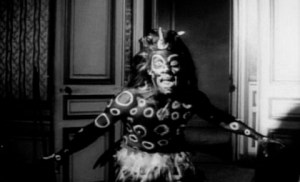
For most of the film, however, Rooks is in a small clinic outside of France. Along with telling his doctor (played by Jean-Louis Barrault) about how he came to be addicted to drugs and alcohol, Rooks goes through withdrawal and has the surreal hallucinations that dominate the majority of the film. During one hallucination, Rooks sees himself as a gangster gunning down a midget in a parking garage. Then, suddenly, Rooks is no longer a gangster and instead, he’s a vampire speaking in an over-pronounced Transylvanian accent. A druid appears and does a jig in the middle of the Stonehenge and a witch doctor shows up and starts to dance through the halls of the clinic. Throughout it all, Rooks is haunted by the image of a stunningly beautiful woman (Paula Pritchett) in a white dress, kneeling by a placid lake. Observing all of this is the menacing figure of Opium Jones (played by William S. Burroughs), who continually encourages Rooks to stay on drugs and who may, or may not, be a figment of Rooks’ imagination.
How to explain the odd (and occasionally frustrating) charm of Chappaqua. This is truly a pretentious mess of a movie, full of symbolism that is both obvious and willfully obscure. However, there’s a strange charm to the film’s pretension. The film may not make much sense but it’s never incoherent. Largely thanks to cinematographer Robert Frank, the visuals of the film are so strong and striking that they often provide the narrative drive that the film would otherwise lack. Chappaqua is, ultimately, just a fascinating film to watch.
My main reason for enjoying and recommending Chappaqua, is that the film truly is a time capsule. Both the film’s strengths and its flaws can be linked back to the fact that it was made in 1966. It’s a true cultural artifact and, therefore, it is a must-see for anyone who is interested in either the Beats or the counter-culture that was indirectly descended from them.
Well, here’s your chance to, once again, tell me what to do. I’ve randomly selected 12 films from my film collection. Whichever film gets the most votes will be watched and reviewed by me next Tuesday, March 20th.
Here are the films up for consideration:
1) Black Jesus (1968) — This Italian film stars Woody Strode as an African rebel leader who is captured by his country’s right-wing, American-backed dictatorship.
2) Capote (2005) — Philip Seymour Hoffman was an Oscar for best actor for playing writer Truman Capote in this film that details how Capote came to write his true crime classic, In Cold Blood. This film was also nominated for best picture.
3) Chappaqua (1966) — In this underground cult classic, drug addict Conrad Rooks seeks treatment in Switzerland while being haunted by a scornful William S. Burroughs. This film features cameo from Allen Ginsberg, The Fugs, and just about every other cult figure from 1966.
4) Crazy/Beautiful (2001) — Jay Fernandez and Kirsten Dunst have lots and lots of sex. This was like one of my favorite movies to catch on cable back when I was in high school. 🙂
5) An Education (2008) — In my favorite movie from 2008, Carey Mulligan is a schoolgirl in 1960s England who has a secret affair with an older man (played by Peter Sarsgaard), who has plenty of secrets of his own. Co-starring Rosamund Pike, Emma Thompson, Alfred Molina, and Dominic Cooper (who is to die for, seriously).
6) Female Vampire (1973) — In this atmospheric and ennui-filled film from the infamous Jesus Franco, a female vampire spends the whole movie wandering around naked and dealing with the lost souls who want to join the ranks of the undead.
7) Nightmare City (1980) — In this gory and fast-paced film from Umberto Lenzi, an accident at a nuclear plant leads to a bunch of blood-thirsty zombies rampaging through both the city and the countryside. Hugo Stiglitz plays Dean Miller, zombie exterminator! Nightmare City is probably most remembered for introducing the concept of the fast zombie and for serving as an obvious inspiration for Danny Boyle’s 28 Days Later.
8) The Other Side of Midnight (1977) — Based on a best-selling novel, The Other Side of Midnight tells the story of a poor French girl who becomes a world-famous actress and who ends up sleeping with apparently every wealthy man in the world. Meanwhile, the man she loves ends up marrying Susan Sarandon. Eventually, it all ends with both a hurricane and a murder. Apparently, this film cost a lot of money to make and it was a notorious box office bomb. It looks kinda fun to me.
9) Peyton Place (1957) — Also based on a best-selling novel, Peyton Place is about love, sex, and scandal in a small town. Lana Turner is a repressed woman with a past who struggles to keep her daughter from making the same mistakes. At the time it was made, it was considered to be quite racy and it was even nominated for best picture. This film is a personal favorite of mine and it’s pretty much set the template for every single film ever shown on Lifetime.
10) Rosebud (1975) — From director Otto Preminger comes this film about what happens when a bunch of rich girls on a yacht are taken hostage by Islamic extremists. The film’s diverse cast includes Peter O’Toole, Richard Attenborough, Cliff Gorman, former New York Mayor John Lindsay, former Kennedy in-law Peter Lawford, Raf Vallone, Adrienne Corri, Lalla Ward, Isabelle Huppert, and Kim Cattrall.
11) Valley of the Dolls (1967) — Oh my God, I love this movie so much! Three aspiring actresses move to the big city and soon become hooked on pills and bad relationship decisions. Every time I watch this movie, I spend hours yelling, “I’m Neely O’Hara, bitch!” at the top of my lungs.
12) Zombie Lake (1981) — From my favorite French director, Jean Rollin, comes this extremely low budget film about a bunch of Nazi zombies who keep coming out of the lake and attacking the nearby village. Some people claim that this is the worst zombie films ever made. I disagree.
Please vote below for as many or as few of these films as you want to. The poll will remain open until March 20th and whichever film gets the most votes will be watched and reviewed by me.
No, the Valley of the Dolls is not one of the trailers included in the latest installment of Lisa Marie’s Grindhouse and Exploitation Trailers. It just happens to be the movie that I’m watching as I edit this post. Anyway, Valley of the Dolls was an exploitation film mostly because of human error. The trailers below are for films that came by their exploitation label honestly.
1) An American Hippie In Israel
There’s some debate as to whether or not this movie actually exists. I originally saw this trailer as an extra on the I Drink Your Blood DVD about three years ago. At that time, Grindhouse Releasing claimed that it would be releasing this film on DVD “soon.” Three years later, the DVD has yet to be released. Perhaps it’s for the best. I doubt that actual film could live up to lunacy and silliness of the trailer.
This is a good example of a movie that, if it was released today, would probably be marketed as an indie art film. However, since it came out in the 70s, it played in grindhouses and drive-in movie theaters. It’s actually a surprisingly well-made and well-acted film.
Much like Best Friends, Chappaqua is proof that art and exploitation often go hand-in-hand. The film was produced and directed by Conrad Rooks and features William S. Burroughs at his cynical best.
This movie, I suppose, could also have been called The Hellcat. Adam Roarke, the star of this one, appeared in every biker film released in 1970.
6) Savage Sisters
This is another one of those films that, frustratingly enough, is not yet available on DVD. That’s a shame. The world needs more movies about women kicking ass.


 Through the Shattered Lens