Stripes (1981, directed by Ivan Reitman)


Bill Murray and Harold Ramis join the army.

Wait, that can’t be right, can it?  Bill Murray and Harold Ramis were cinematic anarchists.  Early in his career, Bill Murray was the ultimate smart aleck slacker who did not have any respect for authority.  Harold Ramis was hardly a slacker but he came across as someone more likely to be marching on the Pentagon than guarding it.  Stripes is one of the ultimate examples of a comedy where the laughs come from things  that don’t seem to go together suddenly going together.

John Winger (Murray) at least has a reason to join the army.  He has a dead end job.  He has just broken up with his girlfriend.  The country appears to be at peace so why not spend four years in the Army?  It’s harder to understand why John’s friend, Russell (Ramis), also decides to enlist, other than to hang out with John.  Along with Ox (John Candy), Cruiser (John Diehl), Psycho (Conrad Dunn), and Elm0 (Judge Reinhold), they enlist and go through basic training under the watchful eye of Sgt. Hulka (Warren Oates).  John and Russell go from treating everything like a joke to invading East Germany in a tank that’s disguised as an RV.  They also meet the two sexiest and friendliest MPs in the service, Stella (P.J. Soles) and Louise (Sean Young).  Russell goes from being an proto-hippie who teaches ESL to asking John if he thinks he would make a good officer.  John goes from not taking anything seriously to picking up a machine gun and rescuing his fellow soldiers.

It’s a comedy that shouldn’t work but it does.  It’s actually one of my favorite comedies, full of memorable lines (“Lighten up, Frances.”), and stupidly funny situations.  The cast is full of future comedy legends and P.J. Soles shows that she deserved to be a bigger star.  This was early in Bill Murray’s film career and he was still largely getting by on his SNL persona but, in his confrontations with Hulka, Murray got a chance to show that he could handle drama.  With all the comedic talent in the film, it’s Warren Oates who gets the biggest laughs because he largely plays his role straight.  Sgt. Hulka is a drill sergeant who cares about his men and who knows how to inspire and teach  but that doesn’t mean he’s happy about having to deal with a collection of misfits.  (Watch his face when Cruiser says he enlisted so he wouldn’t get drafted.)

The movie does get strange when the action goes from the U.S. to Germany.  What starts out as Animal-House-In-The-Army instead becomes an almost straight action movie and the movie itself sometimes feels like a recruiting video.  Join the Army and maybe you’ll get to steal an RV with PJ Soles.  That would have been enough to get me to enlist back in the day.  But the combination of Murray, Ramis, and Oates makes Stripes a comedy that can be watched over and over again.

Death Warrant (1990, directed by Deran Sarafian)


A series of murders have occurred at Harrison State Prison in California.  What better way to investigate the crimes and catch the guilty than to send in an undercover cop?  Who can enter a California prison and investigate the crime without drawing too much attention to himself?  It would have to be someone who could blend in with the population without seeming out of place.

How about Jean-Claude Van Damme?

Van Damme, in one of his early films, stars as Louis Burke, a Canadian with a Belgian accent who comes to Los Angeles to track down a serial killer known as the Sandman (Patrick Kilpatrick, who was last seen running for governor of California in 2021) and then just sticks around.  Burke enters the prison and somehow, he is not immediately tagged as being a B-movie star who is working for the police.  I guess California prisons are full of Belgian kickboxers.

A realistic portrait of prison and police work, this is not.  But it is Van Damme at his most berserk, flexing his muscles and shouting at his enemies and getting hit in the head by a flying wrench at one point.  To the surprise of no one, the Sandman eventually ends up in the prison with Burke and it leads to an epic showdown that takes place in the middle of a prison riot.  The fight is exciting because Van Damme and Kilpatrick were two tough actors who, at that point in their careers, had nothing to lose by going all out on screen.

(Of the three major B-action stars of the 90s, Dolph Lundgren was the one you watched because he could actually act.  Steven Seagal was the one you watched because you hoped someone would beat him up.  Jean-Claude Van Damme was the one you watched because he could actually do everything he did in the movies in real life as well.)

There are many good actors to be found in Death Warrant, playing paper-thin characters.  Robert Guillaume is the one-eyed clerk who takes Burke under his wing.  Larry Hankin is the biggest weasel in the prison.  Art LaFleuer is the prison guard from Hell.  George Dickerson is the obviously corrupt official.  Abdul Salaam El-Razzac is the voodoo priest who watches over the prison.  Cynthia Gibb is the attorney who pays Burke a conjugal visit.  It’s good to see them all.

Death Warrant is a dumb and entertaining B-movie that doesn’t take itself too seriously.  It’s not Van Damme’s best but it’s not his worst either.  It’s Damme fun.

Embracing the Melodrama Part II #102: Chicago (dir by Rob Marshall)


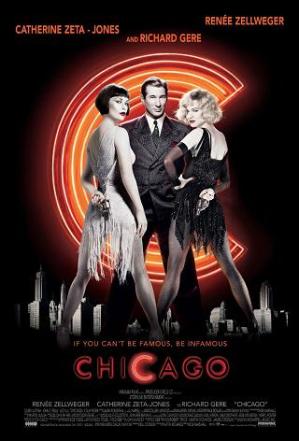
ChicagopostercastIt’s strange to refer to a best picture winner as being underrated but that’s exactly the perfect description for the 2002 film Chicago.

When Chicago was named the best picture of 2002, it was the first musical to take the top prize since The Sound of Music won in 1965.  Until the box office success and Oscar triumph of Chicago, it was assumed by many that a musical had to be animated in order to be successful.  After Chicago won, the conventional wisdom was changed.  Dreamgirls, Nine, Rock of Ages, Hairspray, Jersey Boys,  Into the Woods, Les Miserables, none of these films would have been produced if not for the success of Chicago.  It’s also due to Chicago that television networks are willing to take chances on shows like Glee and Smash.  And while I think a very valid argument could be made that we would all be better off without Glee, Smash, and Rock of Ages, you still can not deny that Chicago both challenged and changed the conventional wisdom.

https://twitter.com/Delanynder/status/606251356136042496

And yet, despite its success and its continuing influence, Chicago is one of those best picture winners that often seems to get dismissed online.  Some of that’s because, by winning best picture, Chicago defeated not only The Two Towers (which is arguably the best installment in Peter Jackson’s Lord of the Rings trilogy) but also Roman Polanski’s searing masterpiece, The Pianist.  Critics often point out that The Pianist won for best adapted screenplay, best actor, and best director but Chicago somehow managed to win best picture.  They suggest that the Academy was either worried about the implications of giving best picture to a film directed by Roman Polanski or else they were blinded by Chicago‘s razzle dazzle.  They argue that Chicago was merely an adaptation of an iconic stage production, whereas The Pianist and The Two Towers were both the result of visionary directors.

Well, to be honest, I think those critics do have a point.  The Pianist is one of the most emotionally devastating films that I have ever seen.  The Two Towers is the perfect mix of spectacle and emotion.  And yet, with all that in mind, I still love Chicago.

And it’s not just because of scenes like this:

Or this:

Or even this scene of Richard Gere tap dancing:

If you’ve been reading this site for a while then you know my bias.  You know that I grew up dancing.  You know that I love to dance.  And you know that I automatically love any film that features a dance number.  And, since you know my bias, you may be thinking to yourself, “Well, of course Lisa likes this….”  And you’re right.

But you know what?  Even if nobody danced a step in this film, I would still enjoy it.  (Though it would be odd to see a musical with absolutely no dancing.)  Chicago is not just about spectacle.  Instead, it tells a very interesting story, one that is probably even more relevant today than when the film was first released.

Set in 1924, Chicago tells the story of Roxie Hart (Renee Zellweger).  Married to the decent but boring Amos (John C. Reilly), Roxie wants to be a star.  She has an affair with slrazy Fred Casely (Dominic West), believing that he has showbiz connections.  When Fred finally admits to her that he lied in order to sleep with her, Roxie reacts by murdering him.  Because Roxie is pretty and blonde and claims to have been corrupted by the big, bad, decadent city, she becomes a celebrity even while she sits in jail and awaits trial.

Also in the jail is Velma Kelly (Catherine Zeta-Jones), a nightclub singer who killed her husband and sister.  Roxie idolizes Velma but, after Velma snubs her, a rivalry forms between the two.  Roxie hires Velma’s lawyer, the slick Billy Flynn (Richard Gere).  During the trial, Roxie becomes even more popular, Velma grows jealous, and the only innocent women on death row — a Hungarian who can’t speak English — is ignored and executed because she doesn’t make for a good news story.

Chicago is a cynical and acerbic look at both the mad pursuit of celebrity and the pitfalls of the American justice system.  In its way, it’s the film that predicted the Kardashians.  (If Roxie had been born several decades later, it’s not difficult to imagine that she’d build her career off of a sex tape as opposed to murder.)  Renee Zellweger and Catherine Zeta-Jones are both sociopathic marvels in their respective roles.  Even Richard Gere, who, in other films, can come across as being oddly empty, is perfectly cast and surprisingly witty in the role of Billy.

Director Rob Marshall does a great job of making this stage adaptation feel truly cinematic.  At no point does Chicago feel stagey.  Perhaps Marshall’s smartest decision was to tell the entire film through Roxie’s eyes.  Every musical lives and dies based on whether it can convince the audience that it would perfectly natural for everyone onscreen to suddenly break out into song.  Chicago is convincing because, of course, Roxie would view her life as being a musical.

And did I mention that the film features a lot of great dancing?

Because it so seriously does….

So, yes, it can be argued that Chicago beat out some worthier films for the title of best picture of the year.  But, regardless, it’s still a good and memorable film.