Film Review: Wonder Woman (dir by Patty Jenkins)


Wonder Woman is awesome!

I spent a while trying to think of the best way to begin this review.  There’s a lot to be said about Wonder Woman, as both a film and as a character.  Over the next few weeks, we’re going to be flooded with think pieces.  Is Wonder Woman too feminist or not feminist enough?  Does Wonder Woman herald a new direction for the DC Expanded Universe or is it destined to just be an anomaly among the ruins of crap like Man of Steel and Suicide Squad?  Does it announce the arrival of new star?  Is Wonder Woman pro-war or a plea for peace?  Does Wonder Woman live up to the rapturous early reviews or is it destined to suffer the same fate as the initially acclaimed, later-reviled Ghostbusters reboot?

Those are all legitimate questions.  They’re all worthy of debate and discussion.  And I look forward to reading everyone’s thoughts on blah blah blah blah….

Yes, Wonder Woman is empowering, both as a film and as a character.  It’s amazing to think that, with all the super hero adaptations that have come out over the past ten years, Wonder Woman is the first one to center around a female super hero.

Yes, Wonder Woman does finally prove that DC Expanded Universe can produce a good film, though I do have to say that two of the best things about Wonder Woman is that it had very little to do with any of the other DCEU films and it felt more like an MCU film.  With the period setting (the film takes place during World War I) and it’s weary view of the wars that men fight, Wonder Woman has far more in common with the first Captain America film than it does with Man of Steel.

Yes, Gal Gadot is going to be a huge star and her performance here suggests that she has range beyond action films and comic book melodramas.

Yes, Wonder Woman is a plea for peace but it’s a sincere and honest plea and one that does not ignore the realities of human nature.

And, finally, yes, Wonder Woman deserves those good reviews and I believe it will stand the test of time.
When all is said and done, what really matters is that Wonder Woman is freaking awesome!  The teaming of director Patty Jenkins and star Gal Gadot has resulted in one of the most entertaining and exciting comic book movies of recent times.  Usually, I resent it when an audience breaks into applause at the end of a movie, largely because it makes me feel as if I’m being pressured to make a snap judgment about a movie’s worth before I’ve had time to give it proper thought.  However, this time, when the applause broke out at the Alamo Drafthouse, I happily joined in.

I could be wrong about this but I don’t think Wonder Woman is ever actually called “Wonder Woman” at any point during the film.  If she was, I missed it and I’m sure someone will correct me in the comments.  Instead, she is referred to by her proper name, Diana.  When the film opens (after the obligatory modern-day prologue), Diana is a child living on the island of Themyscira, the home of the legendary Amazons.  Diana is the only child among the Amazons.  The daughter of Queen Hippolyta (Connie Nielsen), Diana dreams of becoming a warrior but her mother refuses to allow it.  When Diana is trained, it’s in secret by her aunt, General Antiope (Robin Wright).  At one point, Antiope tells Diana that if she’s going to be warrior, she’s going to have to be prepared to fight for everything.  No victory, Antiope tells her, will ever come easily.  I nodded at that line and I’m sure every other woman in the audience did so as well.  We understood what Antiope was saying.

In 1918, for the first time in centuries, a man reaches the island.  His name is Steve Trevor (Chris Pine) and he’s an American spy.  No sooner does Steve’s plane crash on the beach then a boat full of Germans arrive.  After a genuinely exciting battle (perhaps the first exciting action scene to appear in any of the DCEU films), Steve reveals that the world is at war.  Suspecting that it is the influence of Ares, the god of war, that is causing people to kill one another, Diana defies her mother’s orders and leaves the island with Steve.  Steve’s goal is to keep the Germans from developing and deploying a lethal gas.  Diana, meanwhile, plans to track down and kill Ares.

While Steve is convinced that, as a result of human nature, wars are inevitable, Diana is resolute in her belief that all the evil in the world can be linked to Ares.  Their conflicting world views give Wonder Woman far more emotional depth and intellectual resonance than any of the other films that have, so far, been a part of the DC Expanded Universe.  By refusing to indulge in portentous hypermasculinity, it avoids becoming a pretentious slog like Man of Steel or Batman v Superman.  By refusing to treat war, death, and violence as a joke, it avoids falling into the soulless trap that imprisoned Suicide Squad.  When Diana runs and leaps into battle, she’s not just fighting for good against evil.  She’s fighting for the soul of humanity.

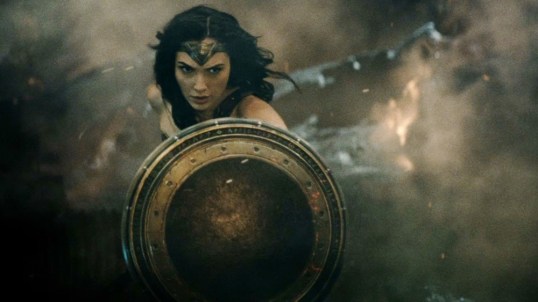
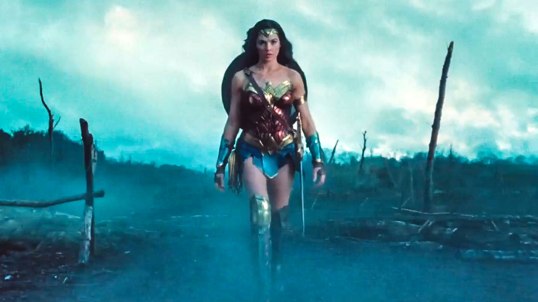
Some of the action scenes in Wonder Woman are nothing less than amazing.  The scene where Diana crosses the aptly named “No-Man’s Land” is destined to be remembered as a classic moment in comic book cinema.  I don’t want to spoil too much of the film but I will say that you’ll also never forget the way that Diana takes out a German sniper.  It’s an amazing moment, one that is matched by the film’s final battle.  Again, I don’t want to spoil anything so I’ll just say that the film’s finale brought tears to my eyes.
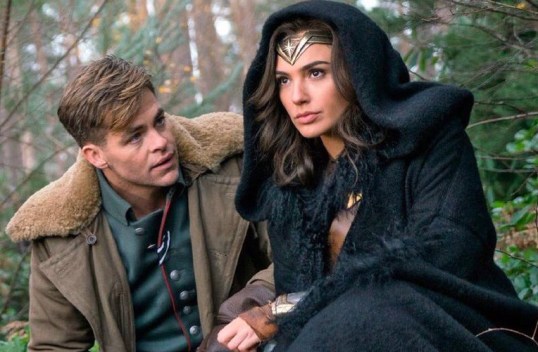
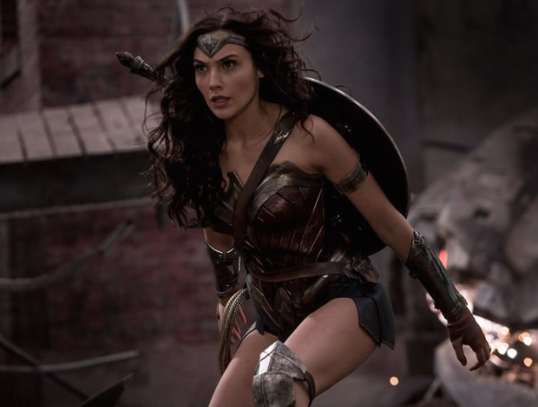
After providing Batman v Superman with its only good moments, Gal Gadot finally gets the film that she deserves and she gives an amazing performance.  As played by Gadot, Diana is confident but never arrogant, occasionally naive but never foolish.  She’s a fighter, one who refuses to surrender even when the rest of the world tells her to go home.  (There’s a rather interesting throw-away line, in which Steven’s secretary says that she’s looking forward to getting to vote in her first election.  Wonder Woman is saving a world that wouldn’t even allow her a voice in selecting the man who are constantly putting it in danger.)  Gal Gadot gives a charismatic and star-making performance.

Also giving a good performance — perhaps a career best if you take Hell or High Water out of the equation — is Chris Pine.  When Pine first appears, he seems to be doing a riff on his too-perfect Prince Charming performance in Into the Woods.  But, as the film progresses, Pine brings unexpected depth to this role.  Special mention should also be made of David Thewlis, who may not have a huge role but who makes the most of his limited screen time.

But, with all that in mind, the most important thing that I can tell you about Wonder Woman is that the film is an absolute blast, a fast-paced and exciting action film that is complimented by strong performances and an unexpectedly poignant subtext.

It’s empowering.

It’s entertaining.

It’s worthy of the applause that filled the Alamo Drafthouse.

In short, it’s absolutely awesome.

See it this weekend.
(Now, Marvel, where’s that Black Widow movie that y’all better be developing?)
Film Review: Permanent Midnight (dir by David Veloz)


Meh.  Who cares?

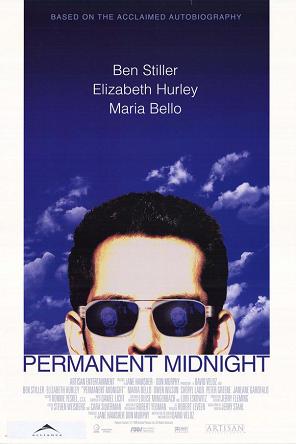
That was largely my reaction to watching the 1998 film, Permanent Midnight.  In this film, Ben Stiller plays Jerry Stahl, a real-life screenwriter who had a fairly successful career going in the 80s and early 90s.  He came out to Los Angeles looking to be a serious writer but, instead, he ended up writing for silly puppet show and getting addicted to heroin.  He also married a British television executive named Sandra (Elizabeth Hurley), so that Sandra could get her green card.  When the star of a show that he writes for tells him to kick his habit or lose his job, Jerry ends up smoking crack cocaine with a new dealer (Peter Greene).  When Sandra tells him that she’s pregnant, Jerry responds by shooting up in the bedroom.  When he’s trusted to spend the day taking care of his baby daughter, he drives her around the seediest sections of Los Angeles while he searches for his drug dealer.  As the baby cries beside him, Jerry shoots heroin into his jugular.  Jerry ends up unemployable and abandoned by every friend that he had.  He works at a fast food restaurant, or at least he does until he meets another recovering addict (Maria Bello).  She’s the one to whom he tells his story, in between sex and bouts of impotence.  In the end, what’s left for Jerry Stahl to do but write a book and then a movie about his life as a junkie?

It’s a harrowing story and I guess Stahl deserves some credit for writing the screenplay for a movie that doesn’t exactly make him look good.  However, Permanent Midnight runs into the same problem that afflicts most movies about drug addiction.  With very few exceptions, drug addicts are just not that interesting.  The only thing more boring than watching someone shoot up is then having to listen to that person explain why he shoots up.  (Trainspotting is the obvious exception but Trainspotting benefits from Danny Boyle’s frenetic direction, Ewan McGregor’s explosively charismatic lead performance, a witty script, and a killer soundtrack.  These are things that Permanent Midnight lacks.)  The film attempts to build up some sympathy for Stahl by telling us about his difficult childhood, his father’s suicide, and his mother’s instability but, in the end, Jerry is a junkie who shoots up in front of his baby.  Regardless of how crappy his childhood was, it’s hard to care about whether or not he ever gets his shit together.  Mostly, you just want someone to step in and make sure he never gets near that baby again.

Permanent Midnight makes another mistake, one that is all too common when it comes to films about troubled artists.  It continually tells us that Jerry is a talented and important writer without ever showing us any evidence of that fact.  We’re supposed to feel bad that Jerry is stuck working on a sitcom called Mr. Chompers but, at no point, does the film really convince us that he deserves anything better.  Everyone says that Jerry is talented but we don’t really get to see any evidence of that fact.  It’s hard not to feel that maybe Jerry should just be happy that, unlike the majority of writers in Los Angeles, he actually has a steady job.

(Jerry does get one good line, when he appears on The Maury Povich Show to promote his book and says, “People always ask, ‘What’s the worst thing heroin drove you to do?’  I always answer, ‘showing up on Maury.'”)

Of course, for most people, the main appeal of seeing Permanent Midnight will be the chance to see Ben Stiller shooting up heroin while soaked in withdrawal sweat.  Stiller gives a serious performance, good enough that you regret that his acting career now seems to mostly consist of starring in bad movies and making cameos in even worse ones.  There’s actually a lot of familiar faces in Permanent Midnight: Elizabeth Hurley, Maria Bello, Fred Willard, Owen Wilson, Sandra Oh, Janeane Garofalo, Andy Dick, and others.  They all give good enough performance but ultimately, this is aimless and ultimately rather frustrating movie.

Wonder Woman Trailer Emerges At Comic-Con To Thunderous Applause


Wonder Woman

“What I do is not up to you.” — Wonder Woman

With that single line in the newly released San Diego Comic-Con trailer for next summer’s Wonder Woman a gauntlet has been dropped on manbros everywhere.

With Batman v. Superman: Dawn of Justice having been received with underwhelmingly at best to outright vehemence with some, DC was now setting it’s sights on the third of the DC Triumvirate to help right the DC Extended Universe film franchise. With Patty Jenkins doing directing duties and Gal Gadot in the title role, Wonder Woman will actually beat Marvel Studios in having the first female-led superhero film by at least a year.

From the reaction written about at SDCC’s Hall H where Warner Bros. had it’s presentation the trailer was received with thunderous applause and hope that DC has learned from their past mistakes and now ready to truly show the world it’s own diverse and wondrous universe of Gods, monsters, heroes and men.

Wonder Woman is set for a June 2, 2017 release date.

Back to School #54: Rushmore (dir by Wes Anderson)


rushmore-play

It’s an understatement to say that Wes Anderson’s films tend to divide viewers.  It seems like critics either love his excessively stylized and quirky vision or else they dismiss him as being a pretentious, overrated, and overly concerned with the problems of the rich and the suburban.  Even among the writers here at the Shattered Lens, there are conflicting opinions.  Leon the Duke gave Moonrise Kingdom a rave review.  On the other hand, I know that Ryan The Trashfilm Guru is not particularly a fan of Anderson’s films.

Myself, I always find it usually takes me a while to warm up to an Anderson film.  With the exception of The Fantastic Mr. Fox, I always seem to find myself somehow both impressed and slightly disappointed after seeing an Anderson film for the first time.  Perhaps it’s because Anderson is such a highly praised director with such a recognizable style that I always tend to go into his film with my expectations set way too high.  And so, I often times end up watching the latest Anderson film and thinking about how much I loved the film’s production design and some of the performances but often times feeling that, narratively, there was something missing.  On first viewing, Anderson’s trademark quirkiness can be overwhelming.  Usually it’s not until a second or third viewing that I really start to appreciate an Anderson film for something more than just the way it looks.  Eventually, I came to love Moonrise Kingdom and The Grand Budapest Hotel but it took me a while.

However, there is an exception to every rule.  And, as far as my reaction to Wes Anderson’s films are concerned, 1998’s Rushmore is that exception.  Rushmore is a film that I have unquestionably loved since the very first time I saw it.  Maybe it’s because, while Rushmore is undeniably quirky, that quirkiness doesn’t overwhelm the human aspect of the film’s story.  Maybe it’s because Rushmore — along with Bottle Rocket — is the most identifiably Texan of all of Anderson’s films.  Or maybe it’s just because Bill Murray gives such a great performance.

Seriously, Bill Murray makes any movie better.

02-rushmore-max-and-mr-blume

Rushmore is named after Rushmore Academy, a private school in Houston.  (Rushmore is quite obviously based on St. Mark’s, which is perhaps the most exclusive private school down here in Dallas.  Owen Wilson, who collaborated on Rushmore‘s script with Anderson, was expelled from St. Mark’s in the 10th Grade.)  15 year-old Max Fischer (Jason Schwartzman, who gives a sympathetic performance as a potentially off-putting character) loves attending Rushmore.  He’s involved in a countless number of extracurricular activities and has written and directed several plays, the majority of which are based on films from the 70s.  (We see his stage version of Serpico and it’s hilarious.)

tumblr_mcasy9Qj4S1r5l2jyo1_400

Unfortunately, Max has a few problems.  For one thing, unlike most of his peers, he’s not rich.  He tells everyone that his father (Seymour Cassel) is a neurosurgeon but actually, he’s a barber.  Even more seriously, Max spends so much of his time starting clubs and writing plays that he doesn’t ever bother to study.  Max is on the verge of flunking out and, despite numerous warnings from Dr. Guggenheim (Brian Cox), he refuses to do anything to improve his grades.

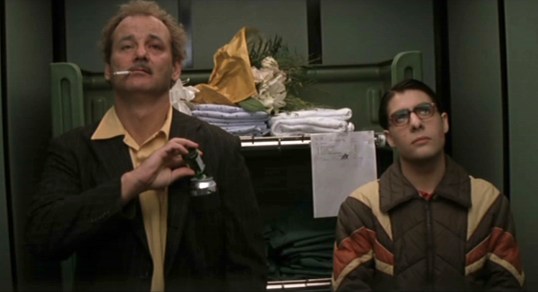
Instead, Max is more interested in pursuing a crush he has on an older teacher, the widowed Rosemary Cross (Olivia Williams).  What Max doesn’t realize is that his mentor, industrialist Herman Blume (Bill Murray), also has a crush on Ms. Cross.

rushmore02

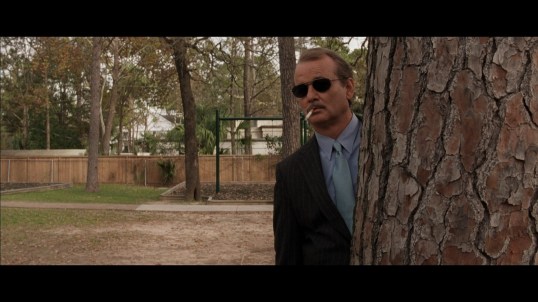
While Max may be the film’s main character, Herman Blume is, without a doubt, the film’s heart.  Blume is a Viet Nam vet (“You were in the shit?” Max asks.  “Yes, I was in the shit,” Blume replies) who has literally gone from rags to riches.  And now that he is rich, he finds himself living an empty life with a wife who doesn’t respect him and two sons who are total idiots.  When Blume starts to mentor Max and pursue Ms. Cross, he starts to care about living once again.

rm61

Meanwhile, Max attempts to impress Ms. Cross by building an aquarium on the school’s baseball field.  This leads to Max getting expelled and having to enroll in a public school.  (Max continues to wear a suit and tie, even after being expelled.)  However, Max then discovers that Blume has been seeing Ms. Cross and soon, the mentor and the student become rivals…

And a lot of other stuff happens but you know what?  I’m not going to tell you what because if you haven’t seen Rushmore, you need to see it and discover all of this for yourself.  You won’t be sorry!

It may be named after the school but Rushmore is ultimately about how love and our dreams make life worth living.  For Max, Rushmore is his fantasy ideal, a world that he loves because it provides him a sanctuary from the harshness of the real world.  When Mr. Blume says, about Ms. Cross, “She’s my Rushmore,” we understand exactly what he means.  But, and this is what distinguishes Rushmore from so many other films about quirky love triangles, is that Ms. Cross is just as independent and important a character as Max and Mr. Blume.  Blessed with excellent performances from Seymour Cassel, Brian Cox, Jason Schwartzman, Olivia Williams, and especially Bill Murray, Rushmore is one of Wes Anderson’s best films.

rushmore-1999-movie-poster1