Just been watching The Social Network on Starz and I couldn’t help but think back to this important scene from one of my favorite films of all-time. It was the film which propelled Arnold Schwarzenegger from just being a bodybuilding icon but into superstar film icon. The scene occurs during the part of the film where Conan has just gone through years of becoming the best pit-fighter in all the lands and now repaing the accolades from other warriors, warlords and women. One of the warlords (looking like a Mongol horselord) asks the important question that everyone should be asking: “What is best in life?”
The scene finishes with Conan answering this important life question. An answer which actually has it’s roots from a much more detailed quote from the greatest conqueror in history: Genghis Khan. A quote that goes like so…
“The greatest pleasure is to vanquish your enemies and chase them before you, to rob them of their wealth and see those dear to them bathed in tears, to ride their horses and clasp to your bosom their wives and daughters.” – Genghis Khan
Conan’s answer is quite similar but has been simplified for the film, but still retains it’s impact. This is a life lesson everyone should live by. Mark Zuckerberg definitely lives by them.
Last month, we did a poll asking which film you were most looking forward to seeing in June and July. The results can be viewed here.
Below, you’ll find the poll for August. Once again, you can vote for up to four films and write-ins are accepted. This poll will remain open until August 1st. Happy voting!
Conan:“To crush your enemies, see them driven before you, and to hear the lamentations of their women!”
1982 premiered what has to be one of my favorite films ever. It was a film that was year’s in the making and had as one of it’s producers the eccentric and powerful Hollywood icon, Dino De Laurentiis. It also starred who was then a very much unknown Austrian bodybuilder-turned-actor in Arnold Schwarzenneger. To round out this unusual cast of characters producing this film would be the maverick screenwriter-director John Milius not to mention a young writer still fresh from Vietnam, Oliver Stone. During it’s production there were conflicts between producer and director as to the tone of the film right up to who should actually play the lead character. It’s a good thing that Milius was the ringmaster of this group of characters as his personality was able to steer things to what finally ended up as the film legions of fans have known and seen throughout the decades since it’s release. Conan the Barbarian was, and still is, a fantasy film of quality which still remains as action-packed and full of flights of fancy in the beginning of 2011 as it did when it premiered in 11982.
Milius and Stone adapted the stories of Robert E. Howard while adding their own flourishes to the iconic Cimmerian character. While many Howard purists were aghast at how these two writers had turned a character who was muscular but also athletic and lean into the hulking muscle-bound one Schwarzenneger inhabited the final result would silence most of these critics. The film kept the more outlandish backstory of Howard’s writing, but left enough to allow the film’s story and background to remain something out of Earth’s past prehistory. It was a film which was part origin tale for the title character, part coming of age film and part revenge story.
The film begins with a sequence narrated by iconic Asian-actor Mako as he tells of the beginnings of his liege and master Conan and the high adventures which would soon follow. Conan the Barbarian actually has little dialogue in the very beginning outside of that narration and a brief interlude between a young Conan and his father about the meaning of the “riddle of steel”. Most of the film’s beginning is quite silent in terms of dialogue. This didn’t matter as film composer Basil Poledouris’ symphonic score lent an air of the operatic to the first ten to fifteen minutes of the film. It’s here we’re introduced to James Earl Jones’ Atlantean-survivor and warlord in Thulsa Doom whose barband scours the land trying to find the meaning to the “riddle of steel”. The destruction of Conan’s village and people is the impetus which would drive the young Conan to stay alive through years of slavery, pit-fighting and banditry. He would have his revenge on Thulsa Doom and along the way he meets up and befriends two other thieves in Subotai (Gerry Lopez) and Valeria (Sandahl Bergman whose presence almost matches Schwarzenneger’s in intensity and confidence).
The rest of the film sees these three having the very tales of high adventures mentioned of in the film’s beginning narration and how an unfortunate, albeit succcesful robbery of a cult temple, leads Conan to the very thing he desires most and that’s to find Thulsa Doom. It’s here we get veteran actor Max Von Sydow as King Osric in a great scene as he tasks Conan and his companions to find and rescue his bewitched daughter from the clutches of Doom. In King Osric we see a character who may or may not be a glimpse into Conan’s future, but as Conan’s chronicler says later in the film that would be a tale told at another time.
Conan the Barbarian is a film that was able to balance both storytelling and action setpieces quite well that one never really gets distracted by the dialogue that at times came off clunky. Plus, what action setpieces they were to behold. From the initial raid by Doom and his men on Conan’s village right up to the final and climactic “Battle of the Mounds” where Doom and his men square off against Conan and his outnumbered friends in an ancient battlefield full of graveyard mounds. The film is quite bloody, but never truly in a gratuitous manner. Blood almost flows like what one would see in comic books. Conan is shown as an almost primal force of nature in his violence. In the end it’s what made the film such a success when it first premiered and decades since. It was Howard’s character (though changed somewhat in the adaptation) through and through and audiences young and old, male and female, would end up loving the film upon watching it.
This film would generate a sequel that had even more action and piled one even more of the fantastical elements of the Howard creation, but fans of the first film consider it of lesser quality though still somewhat entertaining. The film would become the breakout role for Arnold Schwarzenneger and catapult him into action-hero status that would make him one of the best-known and highest paid actor’s in Hollywood for two decades. It would also catapult him to such popularity that some would say it was one of the stepping stones which would earn him seven years as California’s governor at the turn of the new millenium.
In the end, Conan the Barbarian succeeds in giving it’s audience the very tales of myths and high adventures spoken of by Conan’s chronicler. It’s a testament to the work by Milius and Schwarzenneger couple with one of the most beloved and iconic film scores in film history by Basil Poledouris that Conan the Barbarian continues and remains one of the best films of it’s genre and one which helped spawn off not just a sequel but countless of grindhouse and exploitation copies and imitation both good and bad. The film also is a great in that it helped bring audiences to want to learn more about the character of Conan and as a lover of the written word the impact this film had on Howard’s legacy is the best compliment I can give about this film.
1982 saw the release of one of the most iconic fantasy films ever with the John Milius and Arnold Schwarzenneger collaboration, Conan the Barbarian. There was a follow-up sequel that wasn’t as great as the first, but still did well enough that down the year there was talk of a third film to finish off the Schwarzenneger Conan trilogy. It never happened as the project continued to be shelved year after year until even Arnold himself backed out and thought a third film was never in the cards.
This trailer suggests otherwise though it’s more of a reboot to the Conan film franchise and sticks much closer to the character and world created by it’s creator Robert E. Howard. This film is directed by German filmmaker Marcus Nispel whose body of work tends to be in the genre arena like the remake of Texas Chainsaw Massacre to the Viking-Indians mashup story, Pathfinder. There’s also to be a new Conan in the form of Jason Momoa (who played the character of Ronan in the long-running scifi tv series, Stargate Atlantis) who is currently gaining some fans outside of his Stargate work due to his casting as the mighty Khal Drogo in HBO’s critically-acclaimed and very popular fantasy series, Game of Thrones.
This Conan the Barbarian remake looks to return the character to it’s Age of Hyboria roots. The trailer gives ample evidence of the film using much of the fantasy world Robert E. Howard created with long-lost civilizations, evil warlords, sorcery and, of course, fantastic monsters. While the trailer doesn’t show just how well Jason Momoa acts as the character Conan it does show that he fits the role the way Howard originally wrote him. While still having a muscled physique this Conan also is more agile and lithe than the Schwarzenneger iteration.
Conan the Barbarian is set for an August 19, 2011 release on both 2D and 3D screens.
For the latest song of the day I couldn’t make up my mind on which of the two I had picked I should post so I decided to just treat the two as a pair thus the latest “song of the day” is, for today, “songs of the day”. Once you hear what I had chosen you will realize why they had to be together.
The latest song of the day is from film score composer Basil Poledouris and comes from his best work and what many consider as one of the best film scores ever put up on the big-screen. They are “Anvil of Crom” and “Riddle of Steel/Riders of Doom” from Poledouris’ score for Conan the Barbarian. These two pieces, especially from the Varese Sarabande release of the soundtrack, form the very powerful introduction to the Hyperborean world that Conan inhabits.
“Anvil of Crom” starts off the film and does it with such a bombastic combination of timpani drums setting the rhythm with French horns (a massive 24 in total) keeping up to speed with some very strong brass work. This intro to the film has become synonymous with the film and has become famous for being used by other filmmakers to score trailer for their own films. While the piece is just under 3 minutes in length the power of the sound Poledouris creates helps set the tone for the rest of the film and what audiences should expect.
Following up “Anvil of Crom” is what will turn out to be the motifs for the two main characters in the film. “Riddle of Steel/Riders of Doom” comes in in a peaceful manner which builds up to become Conan’s theme. This is the riddle of steel of the tracks title. But this doesn’t last long as “Riddle of Steel” is suddenly joined by the more orchestral and doom-laden sound of “Riders of Doom” which will forever become the theme for Conan’s nemesis, Thulsa Doom. This second track bears a significant resemblance to Carl Orff’s own orchestral masterpieces, “Carmina Burana”. While there’s still a few people out there who thinks that Poledouris cheated somewhat in using Orff’s work as too much of a guide I would have to disagree. Poledouris might have used “Carmani Burana” as a template but the overall execution and final product stands on its own and have become one of the most iconic piece of film music ever heard.
When listened to back-to-back it would come to no suprise why the two had to be picked together. “Anvil of Crom” and “Riddle of Steel/Riders of Doom” belong together and should be listened together. Everytime I listen to it I instantly imagine times of high adventure and lands long-forgotten by the march of time.
It’s been awhile since I picked a film for the Grindhouse of the Day feature. For this go-round I will go into the little-known grindhouse fantasy subgenre.
Grindhouse flicks seem to always deal with horror, blaxploitation, Italian murder mysteries and scifi, but the fantasy subgenre has always been kept from the conversation. This is a shame since there’s been some very good (in grindhouse terms) flicks in the fantasy genre that could qualify as grindhouse. I would especially point out the ones made after the release of the very popular Conan the Barbarian. The one I chose is from that grindhouse master of the 1980’s: Albert Pyun. I speak of his 1982 sword and fantasy flick, The Sword and the Sorcerer.
The film definitely riffs-off of the Schwarzenegger-Milius fantasy epic. We have a kingdom conquered and destroyed by an evil tyrant who uses black-armored soldiers in addition to getting the help of an undead sorcerer. This time around the Conan-archetype is played by 80’s TV star Lee Horsley who does a valaint effort to affect a Shakespearean speech pattern (for some reason when people think fantasy they instantly try to speak like they were in a Shakespearean production). Baddie icon Richard Lynch plays the evil tyrant and he definitely looked like he was having the time of his life in the film despite the corny dialogue. There’s an abundance of graphic violence, nudity and magic spells (done in early 80’s heavy metal effects).
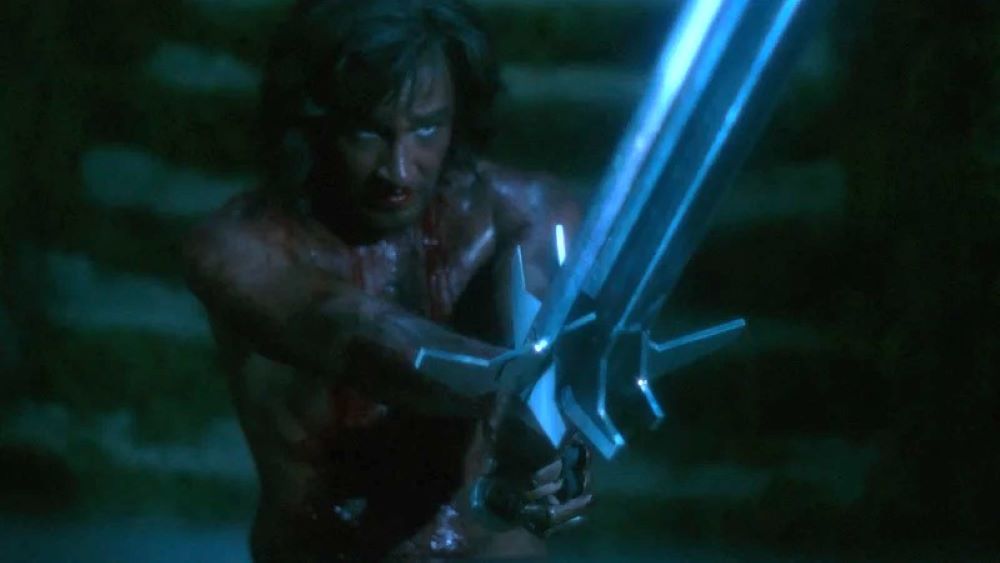
One thing this flick does have which made it a cult classic for fans of the fantasy genre is the sword in the title. The main character of Talon wielded a three-bladed sword. Let me repeat that: A THREE-BLADED SWORD. The sword wasn’t just sporting three blade but the wielder has the ability to shoot two of the blades at someone. Definitely puts to shame those sissy Spetnaz ballistic knives. Arnold may have had an Atlantean-forged blade in Conan the Barbarian, but Lee Horsley definitely outsworded him in his flick.
Another thing about this flick which makes it a favorite of mine is the poster art created for it. The producers of the film did one other thing right outside of populating the film with a kick-ass sword, much nudity and violence. I talk of the Frank Frazetta painted posters done up for the flick. More than one version were done depending on the region. The one above which was the original was the best and the film definitely lives up to what Frazetta painted.